The Tesla Model 3 remains the default entry point into the Tesla ecosystem and one of the best-selling electric sedans in the United States. For 2026, it carries over the significant "Highland" refresh architecture introduced in late 2023—refined suspension, quieter cabin, ventilated seats, and ambient lighting—while continuing to offer two distinct battery chemistries that directly affect range, charging behavior, and long-term ownership costs. This review breaks down exactly what you get for the money, including the often-overlooked basic vehicle limited warranty Tesla provides, real-world range expectations, and whether the Model 3 still holds up against a growing field of rivals like the Hyundai Ioniq 6, BMW i4, and Polestar 2.
2026 Tesla Model 3: Quick Specs at a Glance
| Spec | RWD (Standard Range) | Long Range AWD | Performance AWD |
|---|---|---|---|
| EPA Range | 272 mi | 363 mi | 315 mi |
| Battery (usable) | ~57.5 kWh (LFP) | ~75 kWh (NMC) | ~75 kWh (NMC) |
| Drivetrain | Rear-Wheel Drive | Dual-Motor AWD | Dual-Motor AWD |
| Horsepower | 271 hp | 346 hp | 510 hp |
| 0-60 mph | 5.8 sec | 4.2 sec | 2.9 sec |
| Peak DC Fast Charge | 170 kW | 250 kW | 250 kW |
| 10-80% DCFC Time | ~25 min | ~27 min | ~27 min |
| Level 2 Home Charge | 11.5 kW (~37 mi/hr) | 11.5 kW (~44 mi/hr) | 11.5 kW (~44 mi/hr) |
| MPGe (combined) | 132 MPGe | 132 MPGe | 119 MPGe |
| kWh/100 mi | 25 | 25 | 28 |
| Base MSRP | $38,990 | $47,740 | $54,990 |
| Federal Tax Credit (§30D) | Potential up to $7,500 | Potential up to $7,500 | Potential up to $7,500 |
Source: fueleconomy.gov and Tesla.com specifications. Prices before destination fees. Tax credit eligibility subject to IRS §30D rules—see pricing section below.
Real-World Range: What the EPA Sticker Doesn't Tell You
EPA 272 mi (RWD) / 363 mi (Long Range) — On paper, the Long Range AWD's 363 miles is class-leading for a sedan in this price bracket. In real-world highway driving at 70-75 mph with climate control on, expect approximately 290-310 miles from the Long Range and 220-240 miles from the RWD. In cold weather (below 32°F), LFP-equipped RWD models can lose 25-35% of range due to chemistry limitations in low temperatures, bringing usable highway range down to roughly 170-190 miles. The NMC Long Range handles cold better (15-25% loss) and benefits from a more robust heat pump system. If your commute is mostly city driving with regenerative braking, you'll land closer to—or even slightly above—the EPA sticker.
The split between LFP (lithium iron phosphate) and NMC (nickel manganese cobalt) battery chemistries is one of the most consequential decisions Tesla makes across its lineup. The RWD Model 3 uses an LFP pack, which is heavier and less energy-dense but offers superior cycle life and can be charged to 100% daily without accelerating degradation. Tesla explicitly recommends periodic 100% charges on LFP vehicles for battery calibration. The Long Range and Performance trims use NMC chemistry, which delivers more range per kilogram but should be kept between 20-80% for daily use to maximize longevity—charging to 100% only before long road trips.
Efficiency remains a Tesla strong point. At 25 kWh per 100 miles (combined), the Model 3 RWD and Long Range match the best sedans in the segment. For context, the Hyundai Ioniq 6 SE Long Range achieves 24 kWh/100mi, while the BMW i4 eDrive40 sits at 27 kWh/100mi. This efficiency advantage translates directly to lower charging costs and more miles per charging session.
Charging Speed and Network Access
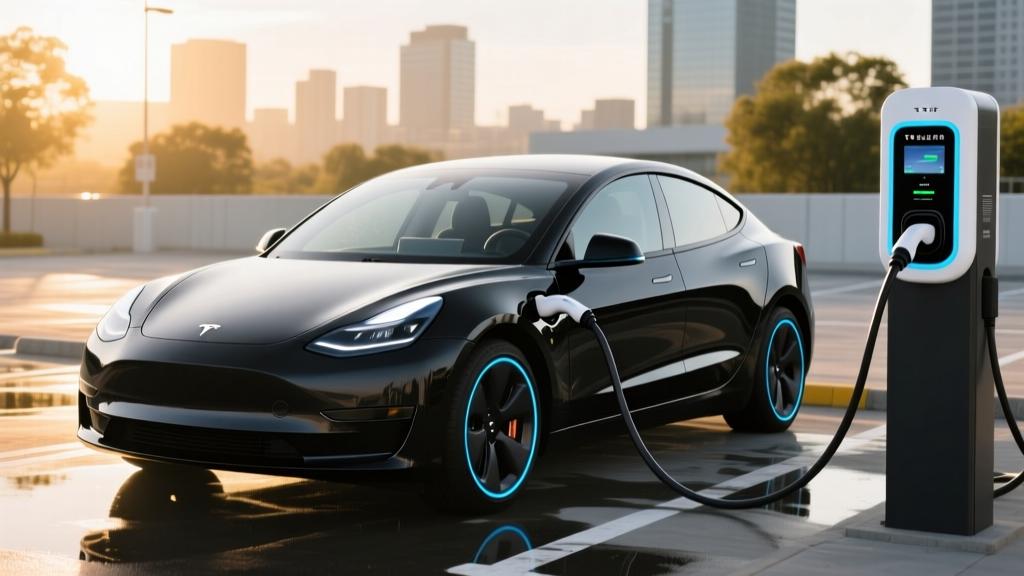
Charging is where the Model 3's ecosystem advantage becomes tangible. Tesla's NACS connector is now the industry standard—Ford, GM, Rivian, Hyundai, and others have adopted it for 2025-2026 models—but Tesla owners still benefit from native Supercharger integration: no adapter required, automatic billing, and preconditioning that ramps up battery temperature en route to a stall for optimal charge rates.
| Charging Level | Power | RWD (mi/hr) | Long Range (mi/hr) | Notes |
|---|---|---|---|---|
| Level 1 (120V) | ~1.4 kW | ~4 mi/hr | ~5 mi/hr | Emergency/trickle only |
| Level 2 (240V, 48A) | 11.5 kW | ~37 mi/hr | ~44 mi/hr | Home Wall Connector or public L2 |
| DC Fast Charge | 170 kW (RWD) / 250 kW (LR/Perf) | 10-80% in ~25 min | 10-80% in ~27 min | Peak rate; tapers above 60% SoC |
A critical detail many buyers miss: peak kW is not sustained kW. The Long Range Model 3 hits 250 kW only briefly at low state of charge (roughly 10-30% SoC), then progressively tapers. From 50-80%, you'll see rates closer to 80-120 kW. This is why the 10-80% time (~27 minutes) is a more honest metric than the headline peak number. The LFP RWD model peaks at 170 kW and has a flatter, more consistent charge curve, meaning the gap between RWD and Long Range charging times is narrower than the peak kW numbers suggest.
For home charging, Tesla's Wall Connector ($420) delivers up to 11.5 kW on a 60-amp circuit (48 amps continuous). A typical overnight session from 30% to 80% takes roughly 3.5 hours on the Long Range—easily handled while you sleep. Installation costs for a dedicated 240V/60A circuit range from $500 to $2,000 depending on panel proximity and local permit requirements. If your home's electrical panel is maxed out at 100 amps, a panel upgrade to 200 amps can add $1,500-$3,000. Always get a quote from a licensed electrician before purchasing.
Performance, Ride Quality, and Daily Driving
The 2026 Model 3 carries the Highland generation's chassis improvements: revised dampers, front and rear subframe bushings, and additional acoustic glass. The result is a meaningfully quieter and more compliant ride than the pre-2024 Model 3, which drew consistent criticism for harshness over broken pavement. It's still firm by luxury-sedan standards—this is a sporty car—but the gap to competitors like the BMW i4 has narrowed considerably.
Acceleration remains thrilling across the lineup. The RWD's 5.8-second 0-60 time is quick for a base trim; the Long Range's 4.2 seconds puts it in sports-car territory; and the Performance model's 2.9 seconds is supercar-rapid. All trims feature Tesla's single-speed reduction gear—no shifting, just seamless torque delivery from a stop.
Interior space is adequate for four adults but tight for five. Rear legroom measures 35.2 inches, which is competitive with the BMW i4 (34.7 in) but trails the Hyundai Ioniq 6 (39.0 in). Cargo volume is 23 cubic feet combined (trunk + frunk), enough for a week's groceries or two carry-on bags plus a stroller. The frunk adds 3.1 cubic feet of secure, weatherproof storage—a genuine advantage over rear-motor-only competitors that omit front trunks.
The 15.4-inch center touchscreen handles virtually all vehicle functions, including climate, mirrors, and glovebox release. There are no physical stalks for turn signals or wipers—these live on the steering wheel and screen, respectively. This minimalist approach polarizes buyers. Some find it clean and intuitive after a day's adjustment; others find it distracting, particularly for turn signals in roundabouts. Test-drive before committing.
Warranty Coverage: Basic Vehicle Limited Warranty and Beyond
Understanding Tesla's warranty structure is essential before purchase, because it differs meaningfully from legacy automakers. Here's the breakdown:
| Warranty Type | Duration | Mileage Limit | What It Covers |
|---|---|---|---|
| Basic Vehicle Limited Warranty | 4 years | 50,000 miles | Bumper-to-bumper: body, interior, electronics, suspension, HVAC, infotainment, glass, 12V battery |
| Battery & Drive Unit (RWD) | 8 years | 100,000 miles | Traction battery, motor(s), power electronics; min 70% capacity retention |
| Battery & Drive Unit (LR/Perf) | 8 years | 120,000 miles | Traction battery, motor(s), power electronics; min 70% capacity retention |
The basic vehicle limited warranty Tesla provides—4 years/50,000 miles—covers everything not explicitly part of the high-voltage battery or drive unit. This includes the touchscreen, power windows, seat motors, heat pump, cameras, and the 12V lithium auxiliary battery. It is comparable in duration to BMW's 4-year/50,000-mile new-vehicle warranty but shorter than Hyundai's 5-year/60,000-mile bumper-to-bumper coverage on the Ioniq 6.
The battery and drive unit warranty is where Tesla provides real confidence. Eight years with a 70% minimum capacity retention guarantee is competitive with the industry standard. In practice, Tesla's fleet data and independent analyses from sources like Tesla's Impact Report show average degradation of approximately 10-12% at 100,000 miles for NMC packs, with LFP packs showing even less degradation due to the chemistry's inherent stability. Full battery replacements under warranty are rare but do happen—typically triggered by cell imbalance or manufacturing defects rather than gradual capacity loss.
One important caveat: Tesla's warranty excludes damage from flooding, fire not caused by the vehicle, racing, and modifications to the powertrain. It also does not cover cosmetic corrosion, paint defects reported after delivery, or tires. Tesla does not offer a complimentary maintenance program—there are no scheduled service intervals for the powertrain, but cabin air filters, wiper blades, brake fluid checks, and tire rotations remain owner responsibilities.
Pricing, Trims, and Federal Tax Credit Eligibility
| Trim | Base MSRP | Est. with Destination | Max §30D Credit | Est. Effective Price |
|---|---|---|---|---|
| RWD (Standard Range) | $38,990 | $40,280 | Up to $7,500 | ~$32,780 |
| Long Range AWD | $47,740 | $49,030 | Up to $7,500 | ~$41,530 |
| Performance AWD | $54,990 | $56,280 | Up to $7,500 | ~$48,780 |
Federal tax credit eligibility under IRS §30D is not automatic. For 2026, the following requirements apply:
- MSRP cap: Sedans must be priced at or below $55,000. The RWD and Long Range trims qualify; the Performance trim at $54,990 base also clears the cap, but adding options (Ultra Red paint, 19" wheels) can push it above $55,000 and disqualify it.
- Buyer income cap: Modified adjusted gross income must not exceed $150,000 (single), $225,000 (head of household), or $300,000 (married filing jointly).
- Battery sourcing: The full $7,500 credit requires meeting both critical-mineral and battery-component sourcing thresholds, which increase annually. Tesla's US-built battery packs have historically qualified for the full credit, but sourcing rules tighten each year. Verify current-year eligibility on the IRS website or with your tax professional before relying on the credit in your budget.
- Point-of-sale transfer: As of 2024, buyers can transfer the credit to the dealer at purchase, reducing the upfront cost rather than waiting for a tax refund. Tesla supports this at delivery.
Always confirm eligibility at the time of purchase. Rules change, and your specific tax situation may affect the benefit. Consult a tax professional for personalized guidance.
Autopilot, FSD, and Driver Assistance
Tesla Autopilot and Full Self-Driving (Supervised) are Level 2 driver-assistance systems per SAE International classification. This means the driver must remain fully engaged, hands on or near the steering wheel, eyes on the road, and prepared to take over at any moment. These systems do not make the vehicle self-driving. Only Level 4 services like Waymo operate without a human driver in geofenced areas.
Every 2026 Model 3 includes Tesla's Basic Autopilot: adaptive cruise control and lane-centering assist on highways. It works well in clear lane markings and moderate traffic. The optional Full Self-Driving (Supervised) package ($8,000 or $99/month subscription as of early 2026) adds automatic lane changes, traffic-light and stop-sign recognition, and city-street navigation. FSD has improved substantially since 2024, but it still makes errors—late braking for merging vehicles, hesitation at unprotected left turns, and occasional phantom braking on highways. Treat it as an advanced convenience feature, not a replacement for attention.
Tesla's vision-only approach (no lidar, no radar on current Model 3 builds) means performance degrades more than sensor-fusion competitors in heavy rain, fog, or direct sun glare. If you live in an area with frequent adverse weather, this is worth testing on your own roads.
How the Model 3 Compares to Key Rivals
| Attribute | Tesla Model 3 LR | Hyundai Ioniq 6 SEL | BMW i4 eDrive40 | Polestar 2 LR DM |
|---|---|---|---|---|
| EPA Range | 363 mi | 361 mi | 307 mi | 276 mi |
| Base MSRP | $47,740 | $42,600 | $52,200 | $49,900 |
| Peak DCFC | 250 kW | 240 kW | 205 kW | 200 kW |
| 10-80% Time | ~27 min | ~18 min | ~31 min | ~30 min |
| Rear Legroom | 35.2 in | 39.0 in | 34.7 in | 35.6 in |
| Basic Warranty | 4 yr / 50k mi | 5 yr / 60k mi | 4 yr / 50k mi | 4 yr / 50k mi |
| Battery Warranty | 8 yr / 120k mi | 10 yr / 100k mi | 8 yr / 100k mi | 8 yr / 100k mi |
| Charging Network | Native Supercharger | NACS adapter + Supercharger | NACS adapter + Supercharger | CCS → NACS adapter req. |
The Ioniq 6 is the Model 3's closest rival on range and price, and it charges faster (18-minute 10-80% on an 800V architecture). The BMW i4 offers a more traditional luxury interior and superior rear-seat comfort at a higher price. The Polestar 2 provides a distinctive Scandinavian design and Google-based infotainment but trails on range and charging speed. The Model 3's advantages remain efficiency, Supercharger network seamlessness, and over-the-air software updates that genuinely add features over time.
- You value Supercharger network reliability and seamless plug-and-charge billing
- You want class-leading efficiency (25 kWh/100mi) and strong real-world range
- You prefer over-the-air updates and a tech-forward, minimalist cabin
- You plan to charge primarily at home with LFP's 100%-daily capability (RWD)
- You need generous rear-seat space for adults on long trips (Ioniq 6 is roomier)
- You prefer physical controls, stalks, and a traditional instrument cluster
- You want the fastest possible DC charging (Ioniq 6's 800V architecture wins)
- You want the longest basic bumper-to-bumper warranty (Hyundai's 5yr/60k mi)
Frequently Asked Questions
What is the real-world range of the 2026 Tesla Model 3?
The EPA rates the RWD at 272 miles and the Long Range AWD at 363 miles. In real-world highway driving at 70-75 mph, expect 220-240 miles (RWD) and 290-310 miles (Long Range). Cold weather below freezing reduces these figures by 15-35%, with LFP packs hit harder than NMC.
How fast does the Model 3 charge at home and on the road?
On a home Level 2 Wall Connector (11.5 kW), the Long Range adds roughly 44 miles of range per hour—a full overnight session covers most daily needs. On DC fast chargers, the Long Range peaks at 250 kW and charges 10-80% in approximately 27 minutes. The RWD peaks at 170 kW with a 10-80% time of roughly 25 minutes.
Does the 2026 Tesla Model 3 qualify for the $7,500 federal tax credit?
All three trims are priced below the $55,000 MSRP cap for sedans. However, eligibility also depends on your income (≤$150k single / ≤$300k joint), and the battery must meet annual critical-mineral and component sourcing thresholds. Tesla's US-built packs have historically qualified for the full credit, but verify current-year rules at irs.gov before budgeting.
What does Tesla's basic vehicle limited warranty actually cover?
The basic vehicle limited warranty covers 4 years or 50,000 miles (whichever comes first) on virtually everything except the high-voltage battery and drive unit. This includes the touchscreen, cameras, HVAC, suspension, power seats, glass, and the 12V auxiliary battery. The battery and drive unit carry a separate 8-year warranty (100,000 miles for RWD, 120,000 miles for Long Range/Performance) with a 70% minimum capacity retention guarantee.
Is the Tesla Model 3 worth buying over the Hyundai Ioniq 6 or BMW i4?
It depends on your priorities. The Model 3 wins on efficiency, Supercharger network integration, and software. The Ioniq 6 offers faster DC charging, more rear-seat space, and a longer basic warranty at a lower price. The BMW i4 provides a more refined, traditional luxury experience. For most buyers who can charge at home and value ecosystem simplicity, the Model 3 Long Range remains the strongest all-around package in this segment.
How long will the Tesla Model 3 battery last?
Tesla's fleet data indicates average NMC battery degradation of roughly 10-12% at 100,000 miles, with LFP packs showing even less. With proper care—avoiding prolonged storage at 100% SoC on NMC, keeping LFP periodically calibrated to 100%—most packs should retain 80%+ capacity well past the 8-year warranty period. Out-of-warranty battery replacement currently costs between $12,000 and $16,000 depending on the pack, though prices continue to decline.