2026 Tesla Model 3: The Benchmark Compact EV Keeps Getting Better
The Tesla Model 3 Highland refresh brought meaningful improvements to ride quality, cabin noise, and interior materials — and for 2026, Tesla continues to refine the platform through over-the-air software updates rather than annual hardware overhauls. If you're researching the Model 3 as a potential purchase, or you already own one and want to understand how to update Tesla vehicles to get the latest features, this review covers everything from real-world range and charging speed to the software ecosystem that sets Tesla apart.
The 2026 Model 3 lineup carries forward with three primary trims: the Long Range RWD, the Long Range AWD, and the Performance AWD. The base RWD trim with the LFP battery was discontinued in the U.S. market for 2026, simplifying the lineup around the larger NMC battery pack. Here's what you need to know before you buy — or before you tap 'Update' on your touchscreen.
Full Specifications at a Glance
| Spec | Long Range RWD | Long Range AWD | Performance AWD |
|---|---|---|---|
| EPA Range | 363 mi | 346 mi | 315 mi |
| Battery (usable) | ~79 kWh (NMC) | ~79 kWh (NMC) | ~79 kWh (NMC) |
| Drivetrain | RWD (single motor) | AWD (dual motor) | AWD (dual motor) |
| Horsepower | ~271 hp | ~346 hp | ~510 hp |
| 0-60 mph | 5.8 sec | 4.2 sec | 2.9 sec |
| Peak DC Charge Rate | 250 kW | 250 kW | 250 kW |
| 10-80% DC Fast Charge | ~25 min | ~25 min | ~25 min |
| Level 2 Charge Rate | 11.5 kW (~44 mi/hr) | 11.5 kW (~44 mi/hr) | 11.5 kW (~44 mi/hr) |
| MPGe (combined) | 132 MPGe | 125 MPGe | 118 MPGe |
| Efficiency | 25 kWh/100 mi | 27 kWh/100 mi | 29 kWh/100 mi |
| Cargo Volume | 23 cu ft (trunk + frunk combined) | ||
| Rear Legroom | 35.2 in | ||
| Base MSRP | $42,490 | $47,490 | $52,990 |
| Battery Warranty | 8 yr / 120,000 mi (Long Range) | ||
Source: EPA fueleconomy.gov, Tesla spec sheets. Specs reflect 2026 model year. Prices exclude destination fee ($1,390).
Real-World Range: What to Actually Expect
EPA Estimated: 363 miles (Long Range RWD) / 346 miles (Long Range AWD)
Real-World Highway (70 mph, mild weather): ~300-320 miles
Real-World Highway (cold weather, 30°F): ~250-280 miles
City / Commuter Driving: ~340-360 miles (regen braking recovers energy)
Tesla's EPA range figures for the Model 3 Long Range are among the best in the compact EV segment, but EPA tests include significant low-speed and city driving where regenerative braking boosts efficiency. On a sustained 70-mph highway run in 65-75°F conditions, expect to use roughly 27-29 kWh per 100 miles in the AWD model, translating to about 300-320 real miles before you need to stop.
Cold weather hits all EVs hard, and the Model 3 is no exception. Tesla's heat pump (standard since the Highland refresh) mitigates cabin heating draw, but battery chemistry slows in freezing temps. At 30°F on highway drives, plan for 25-30% range reduction. Preconditioning the battery while plugged in at home recovers some of this loss — a critical habit for cold-climate owners.
The Model 3's ~79 kWh usable NMC (nickel manganese cobalt) battery pack offers strong energy density for its weight. Tesla does not publish exact chemistry breakdowns, but teardowns confirm NMC cells supplied primarily by Panasonic and CATL. NMC delivers higher energy density than LFP, which is why it powers the Long Range variants, though it degrades slightly faster over thousands of cycles. For daily use, Tesla recommends charging to 80-90% and reserving 100% charges for road trips.
Charging Speed: DC Fast, Level 2, and Home Setup
| Charging Level | Power | Speed (Miles Added/Hour) | Notes |
|---|---|---|---|
| Level 1 (120V outlet) | ~1.4 kW | ~4-5 mi/hr | Emergency/trickle only |
| Level 2 (240V, 48A) | 11.5 kW | ~44 mi/hr | Full charge in ~7-8 hours |
| Level 2 (240V, 32A) | 7.7 kW | ~30 mi/hr | Common with Mobile Connector |
| DC Fast Charge (V3 Supercharger) | Peak 250 kW | ~175 mi in 15 min | 10-80% in ~25 min |
| DC Fast Charge (V4 Supercharger) | Peak 250 kW* | Similar to V3 | *Model 3 limited by vehicle architecture |
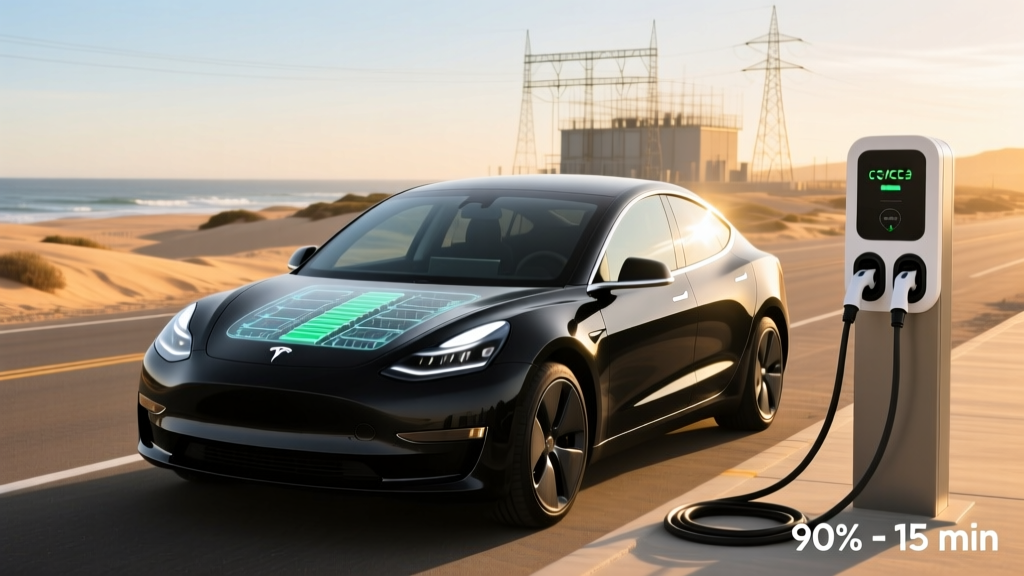
The Model 3 peaks at 250 kW on DC fast chargers, but that peak is sustained only briefly — typically between 10% and 30% state of charge. The charging curve tapers significantly above 50%, and drops sharply past 80%. This is normal lithium-ion behavior: the battery management system reduces current to protect cell longevity. A realistic 10-80% session at a V3 or V4 Supercharger takes about 25 minutes. Plan road-trip stops accordingly — you're not charging at 250 kW for the full session.
At home, a Tesla Wall Connector on a 60-amp circuit delivers 48 amps (11.5 kW), adding roughly 44 miles of range per hour of charging. An overnight charge from 20% to 80% takes about 4-5 hours — more than sufficient for daily needs. Installation typically costs $800-$2,000 depending on panel capacity and conduit run. If your home has a 200-amp electrical panel with spare capacity, expect the lower end of that range. Homes needing a panel upgrade to 200A should budget $2,000-$4,000 additional.
Tesla's NACS (North American Charging Standard) connector is now the industry standard, with Ford, GM, Rivian, Hyundai, and others adopting it. Model 3 owners benefit from the largest fast-charging network in North America — over 6,000 Supercharger stations and growing. The reliability gap between Tesla's Supercharger network and third-party CCS networks remains a meaningful ownership advantage, though Electrify America and others have improved.
Performance, Ride Quality, and Daily Driving
The 2026 Model 3 Long Range AWD delivers 346 horsepower and a 4.2-second 0-60 mph time — genuinely quick for a daily driver. The Performance trim drops that to 2.9 seconds with 510 hp, rivaling sports cars at a fraction of the price. But straight-line speed is only part of the story.
The Highland redesign brought substantially improved suspension tuning, new bushings, and acoustic glass that transformed the Model 3 from a firm-riding tech sedan into something genuinely comfortable on broken pavement. Road noise dropped noticeably. The steering remains direct and well-weighted, though some enthusiasts miss the feedback of a traditional hydraulic system.
Regenerative braking in the Model 3 is aggressive by default, enabling one-pedal driving in most situations. Tesla removed the user-adjustable regen setting in recent software updates — it's now always strong. Most owners adapt within a week, but if you're coming from a gas car, expect a brief adjustment period.
Cargo space totals 23 cubic feet between the rear trunk (including a powered liftgate) and the front trunk (frunk). The frunk holds about 3.1 cu ft — enough for a charging cable bag or a small grocery run. Rear legroom measures 35.2 inches, adequate for adults on shorter trips but tight for anyone over 6 feet on long drives. The Model 3 is a compact sedan, and it feels that way in the back seat compared to the Model Y crossover.
Pricing, Trims, and Federal Tax Credit Eligibility
| Trim | Base MSRP | + Destination | Est. After §30D Credit |
|---|---|---|---|
| Long Range RWD | $42,490 | $43,880 | ~$36,380* |
| Long Range AWD | $47,490 | $48,880 | ~$41,380* |
| Performance AWD | $52,990 | $54,380 | ~$46,880* |
*Estimated after maximum $7,500 federal tax credit. Actual eligibility depends on buyer income, battery sourcing, and point-of-sale transfer rules. See IRS §30D guidelines.
All 2026 Model 3 trims fall under the $55,000 MSRP cap for sedans under the IRS §30D federal clean vehicle credit. However, qualifying for the full $7,500 is not automatic. Here's what determines eligibility:
- Buyer income caps: Modified adjusted gross income must not exceed $150,000 (single), $225,000 (head of household), or $300,000 (joint filing).
- Battery sourcing requirements: A percentage of critical minerals and battery components must be sourced from the U.S. or free-trade-agreement countries. These thresholds tighten annually, and Tesla's supply chain has shifted to meet them — but verify current-year compliance on the IRS qualified vehicles list before purchasing.
- Point-of-sale transfer: As of 2024, buyers can transfer the credit to the dealer (Tesla) at purchase, reducing the upfront price rather than waiting for a tax refund. This applies to 2026 purchases as well.
- MSRP verification: The base MSRP must be under $55,000 for sedans. All Model 3 trims qualify at base, but adding options that push the vehicle price above the cap does not change eligibility — the cap applies to MSRP by vehicle class, not your final transaction price.
Always confirm eligibility with a tax professional and check the latest IRS clean vehicle credit page before finalizing your order. State incentives vary and may stack on top of the federal credit — check your state's energy office or DSIRE database for local rebates.
How to Update Tesla Software: OTA Updates Explained
One of Tesla's defining ownership features is over-the-air (OTA) software updates. Unlike traditional automakers that require dealer visits for firmware updates, Tesla pushes improvements directly to your vehicle via Wi-Fi or cellular connection. Here's how the process works in 2026:
How Updates Arrive
Tesla rolls out updates in waves — not every vehicle receives an update simultaneously. Your Model 3 will display a notification on the touchscreen and in the Tesla mobile app when a new version is available. Updates are categorized as:
- Minor updates (e.g., 2025.44.25.1 to 2025.44.25.2): Bug fixes, small feature tweaks. Download and install quickly.
- Major updates (e.g., 2025.44 to 2026.2): New features, UI changes, Autopilot/FSD improvements. Larger downloads, longer install times.
- Recall-related updates: NHTSA-mandated fixes delivered OTA — no service center visit required for software-only recalls.
How to Install a Tesla Software Update
- Connect to Wi-Fi: Updates download much faster over home Wi-Fi than cellular. Park within range of your network.
- Check for updates manually: Go to Controls > Software on the touchscreen, or tap Software > Check for Updates. You can also set your update preference to "Advanced" to receive updates sooner.
- Schedule the install: Once downloaded, you can install immediately or schedule for a specific time. The vehicle cannot be driven during installation (typically 25-45 minutes for major updates).
- Don't interrupt the process: Once installation begins, do not attempt to start the vehicle, open the frunk, or disconnect power. The touchscreen will go dark and the car may make clicking sounds from relay resets — this is normal.
- Review release notes: After installation, the touchscreen displays a summary of new features and changes. You can also view these in the Tesla app.
Tips for Reliable Updates
- Keep your Model 3 connected to home Wi-Fi whenever parked in your garage. Tesla prioritizes Wi-Fi-connected vehicles for early update waves.
- Set your update preference to "Standard" if you prefer stability, or "Advanced" if you want new features immediately.
- Ensure your battery is above 20% state of charge before starting an installation — the car will block the update if charge is too low.
- Full Self-Driving (FSD Supervised) updates arrive separately from base vehicle software and require an active FSD subscription or purchase.
Tesla's Autopilot and Full Self-Driving (Supervised) are SAE Level 2 driver-assistance systems. The driver must remain fully engaged, hands on or near the wheel, eyes on the road at all times. These systems do not make the vehicle autonomous. Tesla's naming convention ("Full Self-Driving") is widely considered misleading by safety advocates. Never disengage from driving responsibilities while using these features.
Standout Tech, Drawbacks, and Ownership Experience
The Model 3's 15.4-inch central touchscreen handles virtually every vehicle function — climate, mirrors, glovebox, navigation, media, and vehicle settings. There are no physical buttons for HVAC or volume (a steering wheel scroll wheel handles volume and media). This minimalist approach is polarizing: some owners love the clean aesthetic, while others find it distracting to adjust climate settings through a touchscreen while driving.
The 2026 Model 3 includes ventilated front seats, ambient lighting, a rear 8-inch touchscreen for passengers, and power-folding side mirrors — all features added with the Highland refresh. The glass roof provides an airy cabin but offers no shade mechanism; in hot climates, aftermarket tinting or a sunshade is practically mandatory.
Notable drawbacks persist. The lack of a traditional instrument cluster means speed and navigation info are projected on the left portion of the central screen — a glance to the right rather than straight ahead. Turn signal stalks were eliminated in the Highland redesign, replaced by steering-wheel-mounted buttons that require an adjustment period. Rear visibility is limited by the sloping rear window and thick C-pillars, making the backup camera essential.
Insurance costs for the Model 3 tend to run 15-25% higher than comparable gas sedans, reflecting Tesla's repair costs and parts pricing. Tesla Insurance is available in many states and uses real-time driving data to set premiums — safe drivers may find competitive rates, but those with incidents may see steep increases.
Who Should Buy the 2026 Tesla Model 3?
✅ Choose the Model 3 If:
- You want the longest range per dollar in a compact EV sedan
- Supercharger network access matters for road trips
- You value OTA software updates that add features over time
- Your daily commute is under 60 miles round-trip (home charging covers it easily)
- You want strong performance without a performance-car price tag
❌ Look Elsewhere If:
- You regularly carry rear-seat passengers (Model Y is roomier)
- You want physical buttons and a traditional gauge cluster
- You need towing capacity (Model 3 is not rated for towing)
- You prefer a dealership service experience over mobile service
- You want to buy a car today without ordering and waiting
The Model 3 is best suited for tech-forward commuters, couples, and small households who prioritize range, charging infrastructure, and software-driven features over cargo versatility. If you need more space, the Model Y shares the same platform with crossover practicality. If you want a more traditional interior layout, the Hyundai Ioniq 6 and BMW i4 are worthy competitors, though neither matches Tesla's charging network or software update cadence.
Frequently Asked Questions
What is the real-world range of the 2026 Tesla Model 3?
The EPA rates the Long Range RWD at 363 miles and the Long Range AWD at 346 miles. In real-world highway driving at 70 mph in mild weather, expect 300-320 miles. In cold weather (below freezing), plan for 250-280 miles. City driving with regenerative braking can match or approach the EPA number.
How fast does the Model 3 charge at home and on the road?
At home on a 240V/48A Level 2 charger (Tesla Wall Connector), the Model 3 adds about 44 miles of range per hour, fully charging overnight. On a V3 or V4 Supercharger, DC fast charging peaks at 250 kW, reaching 10-80% in approximately 25 minutes. The charge rate tapers significantly above 80% — don't plan to charge past 80% on road trips unless necessary.
How much does the 2026 Model 3 cost after tax credits?
The Long Range RWD starts at $42,490 (plus $1,390 destination). If you qualify for the full $7,500 federal §30D credit, the effective price drops to approximately $36,380. Eligibility depends on your income (under $150K single / $300K joint), battery sourcing compliance, and MSRP caps. The credit can be transferred at point of sale to reduce your upfront cost.
Is the Tesla Model 3 worth buying vs. competitors in 2026?
The Model 3 remains the range and efficiency leader in its class. The Hyundai Ioniq 6 offers a more conventional interior but less range and no Supercharger access. The BMW i4 is more refined but significantly more expensive. The Polestar 2 is stylish but trails on range and charging speed. If the Supercharger network and software ecosystem matter to you, the Model 3 is still the default choice.
Does the 2026 Model 3 qualify for the federal EV tax credit?
All Model 3 trims fall under the $55,000 sedan MSRP cap. Full $7,500 credit eligibility depends on current-year battery critical-mineral and component sourcing requirements, plus buyer income limits. Tesla's U.S.-assembled vehicles have generally qualified, but thresholds tighten annually. Check the IRS qualified vehicles list at the time of purchase for confirmation.
How do I update my Tesla's software?
Connect your Model 3 to home Wi-Fi, go to Controls > Software on the touchscreen, and check for available updates. Downloads happen in the background; installation takes 25-45 minutes and the car cannot be driven during the process. Set your update preference to "Advanced" to receive updates earlier, or "Standard" for a more gradual rollout.