The 2026 Tesla Model 3 remains the benchmark compact electric sedan, blending strong range, rapid DC charging, and a tech-heavy cabin at a price point that undercuts most rivals. With the Long Range AWD variant delivering an EPA-estimated 341 miles and the Performance trim hitting 0-60 in 2.9 seconds, the Model 3 covers commuter and enthusiast use cases alike. But the headline feature drawing search interest — Tesla's Auto Park and broader Autopilot suite — deserves a clear-eyed look at what it actually does, what it costs, and how it compares to rival driver-assist systems.
This review covers the full 2026 Model 3 lineup: range and efficiency, charging speeds, performance, interior practicality, pricing after federal tax credits, and whether Tesla's parking automation justifies the FSD subscription. All figures reflect the latest 2026 model-year specifications.
2026 Tesla Model 3 Spec Sheet at a Glance
| Spec | RWD (Standard Range) | Long Range AWD | Performance |
|---|---|---|---|
| EPA Range | 272 mi | 341 mi | 315 mi |
| Battery (usable) | ~57.5 kWh (LFP) | ~75 kWh (NMC) | ~75 kWh (NMC) |
| Drivetrain | Rear-Wheel Drive | Dual-Motor AWD | Dual-Motor AWD |
| Horsepower | 271 hp | 346 hp | 510 hp |
| 0-60 mph | 5.8 sec | 4.2 sec | 2.9 sec |
| MPGe (combined) | 132 MPGe | 130 MPGe | 119 MPGe |
| Efficiency | 25 kWh/100mi | 26 kWh/100mi | 28 kWh/100mi |
| Peak DC Charge | 170 kW | 250 kW | 250 kW |
| 10-80% DC Time | ~30 min | ~25 min | ~25 min |
| Level 2 Rate | 11.5 kW (~44 mi/hr) | 11.5 kW (~44 mi/hr) | 11.5 kW (~44 mi/hr) |
| Cargo (trunk + frunk) | 23 cu ft + 3.1 cu ft | 23 cu ft + 3.1 cu ft | 23 cu ft + 3.1 cu ft |
| Base MSRP | $38,990 | $42,990 | $52,990 |
Source: fueleconomy.gov and Tesla manufacturer specifications. Figures subject to mid-year updates.
Range and Efficiency: EPA vs Real-World
EPA Sticker: 341 miles (Long Range AWD)
Real-world highway (70-80 mph, mild weather): ~280-300 miles
Real-world mixed city/highway (65°F): ~310-325 miles
Cold weather (below 32°F, highway): ~220-260 miles (30-35% reduction)
Cold weather with heat pump preconditioning: ~250-275 miles
The Model 3 Long Range's 341-mile EPA figure is among the highest in its class, but sustained highway speeds above 75 mph and winter temperatures are the two biggest range killers. Tesla's heat pump — standard since the 2021 refresh — mitigates cold-weather loss better than resistive heating, but physics still applies: expect 25-35% range reduction in sub-freezing conditions.
The RWD trim's LFP (lithium iron phosphate) battery trades some energy density for longevity and cost savings. LFP cells tolerate regular 100% charging without the degradation concerns of NMC chemistry, meaning RWD owners can safely charge to full daily — effectively giving you the entire 272-mile EPA range as usable capacity. The Long Range and Performance trims use NMC (nickel manganese cobalt) packs, which Tesla recommends charging to 80% for daily use, reserving 100% for road trips.
Efficiency-wise, the Model 3 remains one of the most efficient EVs on the road. At 25-28 kWh per 100 miles depending on trim, it converts electricity to distance better than heavier crossovers like the Model Y (27-29 kWh/100mi) and significantly better than electric trucks.
Charging Speed: DC Fast, Level 2, and Level 1
| Charging Level | Power / Rate | Miles Added per Hour | Best Use Case |
|---|---|---|---|
| Level 1 (120V household) | ~1.4 kW | ~4-5 mi/hr | Emergency / overnight trickle |
| Level 2 (240V home, 48A) | 11.5 kW | ~44 mi/hr | Daily home charging |
| DC Fast (Supercharger V3) | Up to 250 kW | Up to ~175 mi in 15 min | Road trips |
| DC Fast (Supercharger V4) | Up to 250 kW (cable-limited) | Similar to V3 | Newer stations |
Tesla's Supercharger network remains the gold standard for public DC fast charging, with over 50,000 connectors globally. On a V3 Supercharger, the Long Range and Performance Model 3 peak at 250 kW — but that peak only holds briefly at low state of charge. The charging curve tapers significantly above 50% SoC, and especially above 80%. A realistic 10-80% session takes approximately 25 minutes in optimal battery temperature conditions.
Preconditioning is critical here. If you navigate to a Supercharger using the car's built-in navigation, the Model 3 will automatically warm the battery en route, enabling peak charge rates on arrival. Without preconditioning — for example, plugging into a third-party CCS charger (via adapter) on a cold morning — you may see peak rates of only 80-120 kW until the battery warms up.
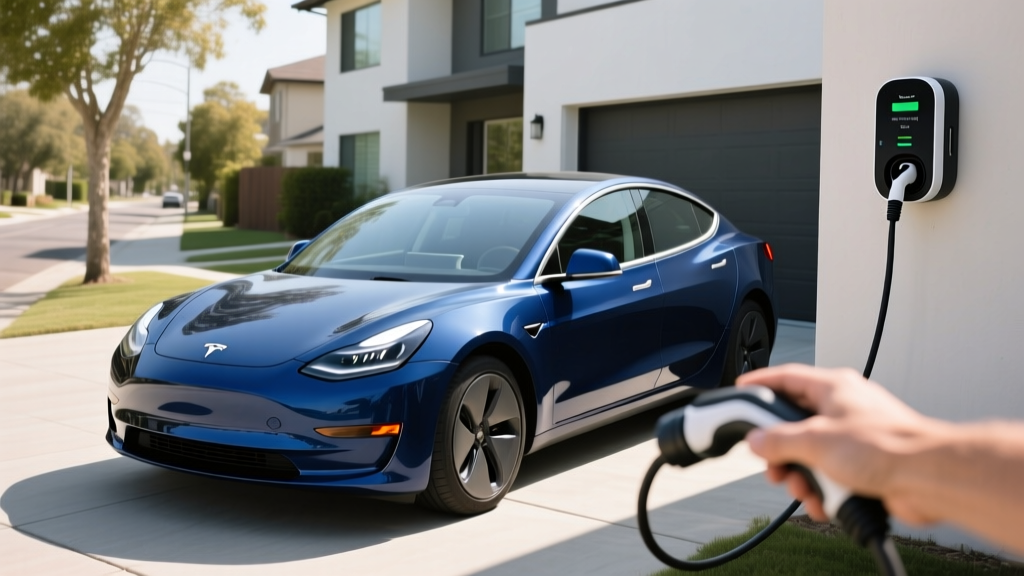
Home Level 2 charging at 11.5 kW (48 amps on a 60-amp circuit) adds roughly 44 miles per hour, meaning a full overnight charge from 20% to 80% takes about 4-5 hours. Most owners with a Tesla Wall Connector or equivalent 240V setup wake up to a full battery every morning, making public charging a road-trip-only affair.
Tesla Auto Park, Autopilot, and FSD: What You Actually Get
Tesla Autopilot, Enhanced Autopilot, and Full Self-Driving (Supervised) are all SAE Level 2 driver-assistance systems. The driver must remain fully engaged, hands on or near the wheel, eyes on the road, and ready to take over instantly. These are NOT self-driving systems. Only Level 4 services like Waymo operate without a human driver.
The keyword drawing attention — Tesla Auto Park — refers to the automated parking feature bundled within Tesla's driver-assist packages. Here's how the feature tiers break down in the 2026 model year:
- Basic Autopilot (included): Traffic-Aware Cruise Control and Autosteer (lane-centering on highways). No Auto Park.
- Enhanced Autopilot ($6,000 add-on): Adds Auto Park (parallel and perpendicular), Summon (move car forward/backward in tight spaces), Smart Summon (car navigates a parking lot to you), Auto Lane Change, and Navigate on Autopilot.
- Full Self-Driving Supervised ($8,000 or $99/month): Everything in Enhanced, plus traffic light and stop sign recognition, and FSD's city-street driving capability (still Level 2, still requires supervision).
Auto Park in practice: The system detects suitable parallel or perpendicular spots at low speed, then takes over steering, acceleration, and braking to slot the car in. It works reliably in well-marked, spacious lots and on residential streets. However, it struggles with tight urban spots, poorly painted lines, and obstructed sensor views (heavy rain, dirty cameras). Expect a success rate around 85-90% in favorable conditions — useful, but not flawless.
Smart Summon has improved since its rough 2020 debut, but it remains a novelty more than a daily tool. The car navigates parking lots at low speed but can be indecisive around pedestrians, shopping carts, and complex intersections. It's a party trick, not a replacement for walking to your car.
- Auto Park does not work at speeds above ~15 mph during spot detection.
- FSD does not make the car autonomous — you are legally and practically the driver at all times.
- Neither system handles construction zones, unmapped roads, or extreme weather reliably.
- Tesla's camera-only vision system (no ultrasonic sensors since late 2022) can misjudge distances to curbs, poles, and low obstacles.
- NHTSA continues to investigate Tesla's Autopilot/FSD safety record. Check nhtsa.gov for active investigations before purchasing FSD.
Performance and Driving Dynamics
The 2026 Model 3 Performance is a genuine sports sedan that embarrasses cars costing twice as much. Its 510 horsepower and 2.9-second 0-60 time are supercar-adjacent, and the dual-motor AWD system delivers relentless grip off the line. Track mode allows adjustable torque distribution and aggressive regen settings for closed-course driving.
The Long Range AWD, at 4.2 seconds to 60 mph, is the sweet spot for most buyers — quick enough to merge with authority, efficient enough to maximize range. The RWD model's 5.8-second sprint is perfectly adequate for daily driving, though single-motor rear-drive means less traction in snow and rain compared to the dual-motor trims.
Ride quality improved substantially with the 2024 "Highland" refresh, and the 2026 model carries over the revised suspension tuning: firmer than a Toyota Camry but well-damped, with minimal harshness over rough pavement. Cabin noise is dramatically reduced from pre-2024 models thanks to acoustic glass and improved seals.
Interior, Cargo, and Practicality
The Model 3's minimalist interior is polarizing but functional. A single 15.4-inch touchscreen handles infotainment, climate, navigation, and vehicle settings — no physical buttons, no instrument cluster. The 2024+ refresh added ventilated front seats, ambient lighting, rear-seat ventilation controls via an 8-inch rear screen, and improved material quality (soft-touch surfaces replacing the older hard plastics).
Practicality dimensions:
- Front legroom: 42.7 inches
- Rear legroom: 35.2 inches (tight for tall passengers)
- Trunk volume: 23 cu ft (competitive with midsize sedans)
- Frunk (front trunk): 3.1 cu ft (charging cables, small bag)
- Total cargo: 26.1 cu ft with seats up; ~52 cu ft with 60/40 rear seats folded
The rear seat is the Model 3's weakest practicality point. At 35.2 inches of legroom, it's snug for adults on long trips — a Model Y or Hyundai Ioniq 5 offers notably more rear space. The low roofline also cuts into headroom for passengers over 6 feet. If rear-seat comfort is a priority, cross-shop the Model Y or Ioniq 5.
Pricing, Trims, and Federal Tax Credit Eligibility
| Trim | Base MSRP | Destination | Est. §30D Credit | Effective Price |
|---|---|---|---|---|
| RWD (Standard Range) | $38,990 | $1,390 | Up to $7,500* | ~$32,880 |
| Long Range AWD | $42,990 | $1,390 | Up to $7,500* | ~$36,880 |
| Performance | $52,990 | $1,390 | Up to $7,500* | ~$46,880 |
*Federal §30D credit eligibility depends on buyer income, battery sourcing, and MSRP caps. See details below.
- MSRP cap: Sedans must be ≤ $55,000 (all Model 3 trims qualify).
- Buyer income cap (MAGI): $150,000 single / $225,000 head of household / $300,000 joint.
- Battery sourcing: Critical minerals and battery components must meet phased-in percentage thresholds from US/FTA countries. Tesla's US-built batteries generally qualify, but specific mineral sourcing can shift — verify at purchase.
- Point-of-sale transfer: As of 2024+, the credit can be transferred to the dealer at purchase for an immediate price reduction, rather than claimed on your tax return.
- Full details: Consult IRS.gov §30D guidance and a tax professional before relying on credit eligibility.
All three Model 3 trims fall under the $55,000 sedan MSRP cap, making them potentially eligible for the full $7,500 credit — provided the buyer meets income limits and the specific vehicle's battery satisfies critical-mineral and component-sourcing requirements. Tesla's US battery production and supply-chain localization have generally kept the Model 3 in qualifying territory, but the IRS updates eligible VIN lists periodically. Confirm eligibility on the fueleconomy.gov credit lookup tool before finalizing your order.
Warranty and Long-Term Battery Outlook
Tesla's warranty coverage for the 2026 Model 3:
- Basic vehicle: 4 years / 50,000 miles
- Battery and drive unit (RWD): 8 years / 100,000 miles
- Battery and drive unit (Long Range & Performance): 8 years / 120,000 miles
- Battery capacity retention threshold: 70% of original capacity during warranty period
The 70% retention threshold is industry-standard but worth noting — if your battery degrades to 69% within 8 years, Tesla replaces or refurbishes it. In practice, Tesla fleet data and third-party analyses (including IIHS reliability studies) show most Model 3 packs retain 85-90% capacity at 100,000 miles. The LFP pack in the RWD trim shows particularly strong longevity data, with slower degradation curves than NMC chemistry under equivalent usage.
Out-of-warranty battery replacement for the Model 3 currently runs approximately $12,000-$16,000 including labor — a significant cost, but one that most owners will never face given the pack's demonstrated durability.
Pros, Cons, and Verdict
- Class-leading efficiency (25-28 kWh/100mi) and up to 341 mi EPA range
- 250 kW peak DC charging; Supercharger network is the most reliable in the US
- Strong performance across all trims; Performance trim is a legitimate sports sedan
- Over-the-air updates continuously add features
- LFP battery option (RWD) offers excellent long-term durability
- Eligible for up to $7,500 federal tax credit (subject to sourcing/income rules)
- Rear seat legroom (35.2 in) is tight for adults
- No physical controls — everything through the touchscreen
- Camera-only vision system lacks ultrasonic sensors; Auto Park can misjudge obstacles
- FSD subscription ($99/mo) is expensive for a Level 2 system
- Insurance premiums tend to be higher than segment average
- Build quality has improved but still lags legacy luxury brands in panel consistency
Who Should Buy the 2026 Tesla Model 3?
Choose the Model 3 Long Range AWD if: You take regular road trips, need AWD for snow/rain climates, want the longest range (341 mi EPA), and value dual-motor traction.
Choose the Model 3 Performance if: You want sports-car acceleration (2.9 sec 0-60), track capability, and don't mind sacrificing ~26 miles of range vs. Long Range.
Look elsewhere if: You need generous rear-seat space (consider Model Y or Ioniq 5), prefer physical buttons and a traditional instrument cluster, or want a Level 4 autonomous experience (no consumer vehicle offers this).
Frequently Asked Questions
What is the real-world range of the 2026 Tesla Model 3?
The Long Range AWD is EPA-rated at 341 miles. In real-world mixed driving at moderate temperatures, expect 310-325 miles. Sustained highway driving at 75-80 mph reduces that to ~280-300 miles. In freezing weather, plan for 220-260 miles depending on use of the heat pump and preconditioning.
How fast does the Tesla Model 3 charge at home and on the road?
On a 240V Level 2 home charger at 11.5 kW, the Model 3 adds about 44 miles of range per hour — a full overnight session easily replenishes daily driving. On a Tesla V3 Supercharger, the Long Range and Performance trims peak at 250 kW, achieving a 10-80% charge in approximately 25 minutes under optimal conditions. The RWD trim peaks at 170 kW DC, taking about 30 minutes for the same 10-80% session.
How much does the 2026 Tesla Model 3 cost after the federal tax credit?
The RWD starts at $38,990 + $1,390 destination, potentially dropping to ~$32,880 with the full $7,500 §30D credit. The Long Range AWD starts at $42,990, potentially ~$36,880 after credit. The Performance starts at $52,990, potentially ~$46,880 after credit. All trims fall under the $55,000 sedan MSRP cap. Eligibility depends on buyer income (≤$150K single / ≤$300K joint) and battery-sourcing compliance. Verify at purchase.
Does the Tesla Model 3 qualify for the $7,500 federal EV tax credit?
Yes, all 2026 Model 3 trims are MSRP-eligible (under the $55,000 sedan cap). However, the full $7,500 credit requires meeting both critical-mineral and battery-component sourcing thresholds set by the IRS, plus buyer income limits. Tesla's US-built battery supply chain has generally qualified, but always verify the specific VIN on fueleconomy.gov and consult a tax professional before relying on the credit.
Is Tesla Auto Park worth it, and how does it compare to competitors?
Auto Park is bundled into Enhanced Autopilot ($6,000) or FSD ($8,000 / $99/mo). It handles parallel and perpendicular parking in well-marked spaces reliably but struggles in tight urban environments and poor weather due to the camera-only system (no ultrasonic sensors). Compared to Hyundai's Remote Smart Parking Assist or BMW's Parking Assistant Plus, Tesla's Auto Park is comparable in capability but requires a more expensive package to access. If Auto Park is your primary motivation, consider whether the $6,000 Enhanced Autopilot add-on justifies the cost versus simply parking manually.
Is the 2026 Tesla Model 3 worth buying vs. key competitors?
The Model 3 Long Range AWD at ~$36,880 (after credit) offers 341 miles of range, 250 kW charging, and a mature Supercharger network — a combination the Hyundai Ioniq 6 (361 mi EPA, slower charging network access), BMW i4 eDrive40 (301 mi, higher price), and Polestar 2 (276 mi) struggle to match holistically. If you prioritize rear-seat space, the Ioniq 5 or Model Y are better fits. If you want the best efficiency, range-per-dollar, and charging infrastructure, the Model 3 remains the default answer in the compact electric sedan segment.