Quick Verdict: Is the Grey Tesla Model 3 Still the EV to Beat?
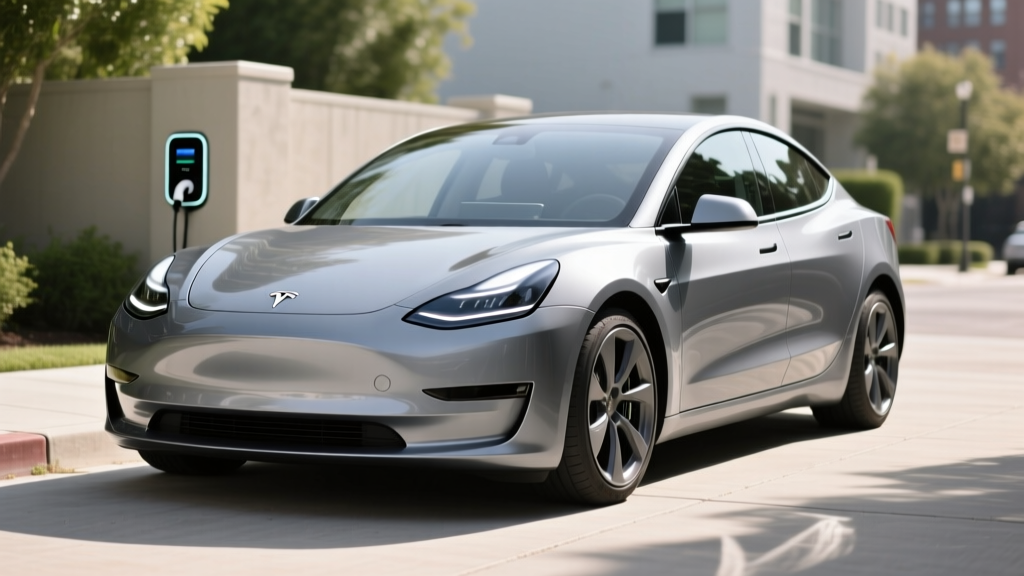
The Tesla Model 3 remains one of the most recognizable electric sedans on the road, and the grey exterior (officially "Quicksilver" or "Stealth Grey" depending on the model year) is among the most popular color choices for buyers who want understated elegance without the upcharge of premium paints. For 2026, the refreshed Model 3 (internally known as the "Highland" and subsequent updates) continues to offer a compelling blend of efficiency, charging speed, and tech-forward design — but it faces stiffer competition than ever from the Hyundai Ioniq 6, BMW i4, and updated Polestar 2.
This review covers the 2026 Tesla Model 3 across all trims — Rear-Wheel Drive, Long Range AWD, and Performance — with a focus on the real-world ownership experience: actual range on the highway, charging curve behavior at DC fast chargers, federal tax credit eligibility under current IRS §30D rules, and the practical trade-offs that spec sheets don't always reveal.
Range, Efficiency, and Battery: What the EPA Number Doesn't Tell You
| Trim | EPA Range | Battery (Usable) | Chemistry | MPGe (Combined) | kWh/100 mi |
|---|---|---|---|---|---|
| RWD (Standard Range) | 272 mi | ~57.5 kWh | LFP | 132 MPGe | 25 |
| Long Range AWD | 363 mi | ~75 kWh | NMC | 134 MPGe | 25 |
| Performance AWD | 315 mi | ~75 kWh | NMC | 119 MPGe | 28 |
The EPA sticker is a laboratory estimate. In real-world highway driving at 70-75 mph, expect the Long Range AWD to deliver approximately 300-320 miles before needing a charge. In cold weather (below 30°F), range can drop 20-30%, bringing the Long Range down to roughly 250-270 miles and the RWD to around 195-215 miles. City driving with frequent regenerative braking opportunities will get you closer to — or even slightly above — the EPA number. The LFP battery in the RWD model is more resilient to cold-weather degradation at the chemistry level, but the smaller pack size still means fewer absolute miles.
The RWD Model 3 uses a lithium iron phosphate (LFP) battery, which trades energy density for longevity and thermal stability. Tesla recommends charging LFP packs to 100% regularly — unlike NMC chemistries, where daily charging to 80% is preferred to minimize degradation. The Long Range and Performance trims use nickel-manganese-cobalt (NMC) cells, which offer higher energy density (hence the 363-mile rating) but require more careful state-of-charge management for long-term health.
According to fueleconomy.gov, the Model 3 Long Range AWD achieves 134 MPGe combined, making it one of the most efficient all-wheel-drive electric sedans available. The RWD model's 132 MPGe is nearly identical, though its smaller battery limits total range.
Charging Speed: DC Fast Charging, Home Level 2, and the Charge Curve
| Charging Method | Max Power | 10-80% Time | Miles Added per Hour |
|---|---|---|---|
| DC Fast Charge (Supercharger V4 / CCS adapter) | 250 kW (peak) | ~25-28 min (Long Range) | N/A (DC session) |
| DC Fast Charge — RWD (LFP) | 170 kW (peak) | ~30-35 min | N/A (DC session) |
| Level 2 Home (Tesla Wall Connector, 48A) | 11.5 kW | ~7-8 hr (full charge) | ~44 mi/hr |
| Level 2 Home (32A mobile connector, 240V) | 7.7 kW | ~10-11 hr (full charge) | ~30 mi/hr |
| Level 1 (120V standard outlet) | 1.4 kW | Multi-day | ~3-5 mi/hr |
The Long Range and Performance Model 3 can accept up to 250 kW at a Tesla Supercharger or any CCS-compatible DC fast charger (with the included NACS-to-CCS adapter, as Tesla's North American Charging Standard has become the dominant connector). However, peak kW is not sustained kW. The charge curve is aggressive: you'll see 250 kW only between roughly 10-30% state of charge, after which the rate tapers progressively. By 60% SoC, you're typically at 100-120 kW, and above 80% the rate drops sharply to protect the battery. This is why the 10-80% metric matters more than peak kW alone.
The RWD model's LFP battery charges at a lower peak rate (~170 kW) and exhibits a flatter charge curve, meaning it sustains a moderate rate longer but never hits the same peak. For road trippers who charge from 10-80% at each stop, the Long Range still finishes faster despite the NMC taper.
For home charging, Tesla's Wall Connector at 48 amps (requiring a 60-amp circuit) delivers 11.5 kW — enough to add roughly 44 miles of range per hour of charging, or fully replenish a Long Range battery overnight in about 7-8 hours. Installation costs vary widely depending on your electrical panel's capacity and the run distance from panel to charger. Budget $500-$1,500 for a straightforward install, or $2,000-$4,000+ if a panel upgrade (from 100A to 200A service) is needed.
Performance, Drivetrain, and Driving Dynamics
| Trim | Drivetrain | Horsepower | 0-60 mph | Top Speed |
|---|---|---|---|---|
| RWD | Rear-Wheel Drive | 271 hp | 5.8 sec | 125 mph |
| Long Range AWD | Dual-Motor AWD | 346 hp | 4.2 sec | 125 mph |
| Performance AWD | Dual-Motor AWD | 510 hp | 2.9 sec | 163 mph |
Even the base RWD Model 3 delivers instant torque and a 5.8-second 0-60 time — quicker than most gas-powered sport sedans in its price range. The single rear motor provides confident acceleration, though traction can be a concern in wet or snowy conditions without all-wheel drive.
The Long Range AWD adds a front induction motor for all-weather capability and a 4.2-second sprint. The Performance trim unlocks 510 hp, a track-tuned suspension, larger brakes, and a 2.9-second 0-60 that rivals supercars. All trims feature one-pedal driving with adjustable regenerative braking — though Tesla removed the user-selectable regen strength setting in recent updates, defaulting to a strong regen profile that most owners adapt to within a week.
Ride quality in the refreshed Model 3 improved significantly over the pre-2024 generation, with new frequency-selective dampers, additional acoustic glass, and improved sound deadening. Highway noise is noticeably lower, and the suspension handles expansion joints with composure that earlier models lacked.
Interior, Tech, and Cargo Space
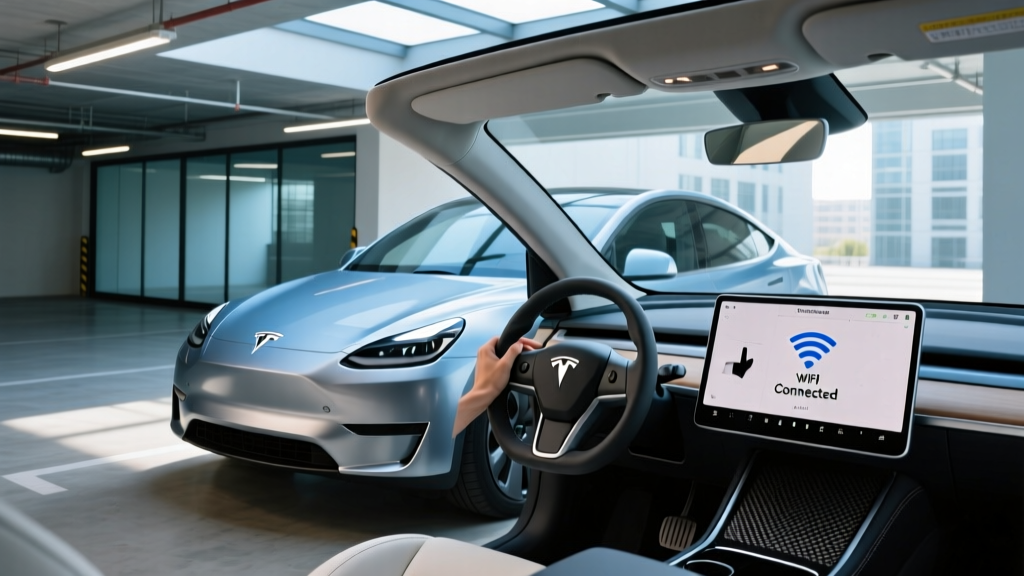
The Model 3's minimalist interior centers on a 15.4-inch touchscreen that handles virtually all vehicle functions — climate, mirrors, glovebox, and driving visualization. There is no instrument cluster; speed and navigation appear in the upper-left corner of the main display. The 2026 refresh added ventilated front seats, ambient lighting, a rear-seat touchscreen (8.0 inches for climate and media control), and power-folding side mirrors.
| Dimension | Measurement |
|---|---|
| Front Headroom | 40.3 in |
| Front Legroom | 42.7 in |
| Rear Headroom | 37.8 in |
| Rear Legroom | 35.2 in |
| Trunk (rear cargo) | 21.0 cu ft |
| Frunk (front trunk) | 3.1 cu ft |
| Total Cargo Volume | 24.1 cu ft |
Cargo capacity is competitive for the compact luxury sedan segment, though the sloping roofline limits the vertical space available for taller items. The 21.0 cu ft trunk is supplemented by the 3.1 cu ft frunk, useful for charging cables or a small bag. Rear legroom at 35.2 inches is adequate for average-height adults but tight for taller passengers on long trips — a notable weakness versus the Hyundai Ioniq 6 or BMW i4.
The infotainment system remains Tesla's proprietary software, which offers seamless navigation with integrated Supercharger routing, over-the-air updates, streaming apps (Netflix, YouTube while parked), and a strong voice assistant. However, Apple CarPlay and Android Auto are not supported — a dealbreaker for some buyers who prefer phone-mirroring interfaces.
Autopilot, FSD (Supervised), and Driver Assistance
Tesla's Autopilot and Full Self-Driving (Supervised) are SAE Level 2 driver-assistance systems. The driver must remain fully engaged, hands on the wheel (or providing torque input), and eyes on the road at all times. These systems are not autonomous and cannot drive without human supervision. For more on automation levels, see the SAE J3016 standard.
Standard Autopilot includes Traffic-Aware Cruise Control and Autosteer (lane-centering on divided highways). The optional FSD (Supervised) package ($8,000 one-time or $99/month as of 2026) adds automated lane changes, Navigate on Autopilot (highway on/off-ramp handling), Autopark, Summon, and traffic light/stop sign recognition. While FSD has improved substantially, it still requires active driver supervision and can behave unpredictably in construction zones, complex intersections, or poor weather.
All Model 3 trims include Tesla's active safety suite: automatic emergency braking, blind-spot monitoring, lane departure warning, and rear cross-traffic alert. The Model 3 continues to earn top marks from the NHTSA (5-star overall) and the IIHS (Top Safety Pick+ when equipped with acceptable headlights).
Pricing, Trims, and Federal Tax Credit Eligibility
| Trim | Base MSRP | Est. Federal Credit (§30D) | Effective Price (est.) |
|---|---|---|---|
| RWD | $38,990 | Up to $7,500* | ~$31,490* |
| Long Range AWD | $45,490 | Up to $7,500* | ~$37,990* |
| Performance AWD | $52,990 | Up to $7,500* | ~$45,490* |
*Federal tax credit eligibility under IRS §30D is subject to multiple requirements that change frequently. Key 2026 rules include:
- MSRP cap: Sedans must have an MSRP at or below $55,000 (the Performance trim at $52,990 qualifies; adding options that push MSRP above $55,000 may disqualify it).
- Buyer income cap: Modified adjusted gross income must not exceed $150,000 (single), $225,000 (head of household), or $300,000 (joint filers).
- Battery sourcing: A percentage of critical minerals and battery components must be sourced from the U.S. or free-trade-agreement countries. These percentages increase annually. The $7,500 credit is split into two halves ($3,750 for minerals, $3,750 for components) — vehicles that meet only one requirement receive $3,750.
- FEOC restriction: Vehicles with battery components from a "foreign entity of concern" (primarily Chinese suppliers) may be disqualified entirely, regardless of other criteria.
- Point-of-sale transfer: As of 2024, eligible buyers can transfer the credit to the dealer at purchase, receiving it as an immediate price reduction rather than waiting to claim it on their tax return.
Battery sourcing rules tighten each year. A Model 3 configuration that qualifies for the full $7,500 credit in early 2026 may qualify for only $3,750 — or none — later in the year as supply chains shift. Always verify current eligibility on fueleconomy.gov and consult a tax professional before relying on the credit in your purchase decision. The figures above assume full eligibility for illustration purposes.
Paint color affects price: Solid Black and Ultra White are no-cost options, while Stealth Grey (the "grey Model 3" many shoppers search for) typically carries no upcharge. Quicksilver, Deep Blue, and Red Multi-Coat add $1,000-$2,500 depending on the selection. The grey Model 3 in Stealth Grey is one of the most popular combinations because it hides road grime well and photographs cleanly for resale listings.
Warranty, Ownership Costs, and Long-Term Battery Health
| Coverage | Term |
|---|---|
| Basic Vehicle Limited Warranty | 4 years / 50,000 miles |
| Battery & Drive Unit (RWD) | 8 years / 100,000 miles |
| Battery & Drive Unit (Long Range / Performance) | 8 years / 120,000 miles |
| Battery Capacity Retention Threshold | 70% of original capacity during warranty period |
Tesla's battery warranty guarantees that the pack will retain at least 70% of its original capacity for the stated term. In practice, Tesla's own fleet data and third-party analyses (including reports from Recurrent Auto) show that Model 3 batteries typically degrade only 5-8% over the first 100,000 miles, with the NMC packs exhibiting slightly more initial degradation that stabilizes, while LFP packs degrade more linearly but at a slower overall rate.
Out-of-warranty battery replacement costs remain a concern for long-term owners: a Model 3 pack replacement currently runs approximately $12,000-$16,000 including labor. However, the failure rate within the first 200,000 miles is low based on available fleet data.
Insurance premiums for the Model 3 tend to be higher than comparable gas sedans, averaging $1,800-$2,800 annually depending on trim, location, and driver profile. Tesla's own insurance product (available in most states) uses real-time driving data and can be competitive for safe drivers.
Pros, Cons, and Who the Grey Model 3 Suits Best
Pros
- Class-leading efficiency (25 kWh/100 mi on Long Range)
- Access to the Tesla Supercharger network — the most reliable and extensive DC fast-charging network in North America
- Over-the-air updates continuously add features
- Strong resale value relative to other EVs
- LFP battery in RWD allows daily 100% charging without degradation concerns
- 250 kW peak DC charging (Long Range/Performance) enables quick road-trip stops
- Minimalist interior with premium materials in the refresh
Cons
- No Apple CarPlay or Android Auto
- Rear legroom is tight for taller passengers (35.2 in)
- All controls routed through touchscreen — no physical buttons for climate or volume
- FSD (Supervised) remains a Level 2 system despite its name and price
- Higher insurance costs than segment average
- Turn-signal stalks removed in refresh — signals now on steering wheel buttons (polarizing)
- RWD model's 170 kW peak DC charge rate is slower than competitors
Who Should Buy the Grey Model 3?
Choose the RWD ($38,990) if: You commute under 40 miles round-trip, have reliable home Level 2 charging, live in a mild climate, and want the lowest entry price with an LFP battery you can charge to 100% daily without worry.
Choose the Long Range AWD ($45,490) if: You take regular road trips (300+ mile real-world range minimizes charging stops), need all-wheel drive for snow/rain, or want the fastest DC charging speeds the lineup offers.
Choose the Performance ($52,990) if: You prioritize acceleration and handling above all else, want a track-capable sedan, and don't mind sacrificing ~50 miles of range for the performance hardware.
Look elsewhere if: You need spacious rear seating for adults (consider the Hyundai Ioniq 6 or BMW i4), require Apple CarPlay, or want physical buttons and knobs for climate/audio controls.
Frequently Asked Questions
What is the real-world range of the grey Tesla Model 3?
The EPA rates the Long Range AWD at 363 miles, but real-world highway driving at 70-75 mph typically yields 300-320 miles. In cold weather (below 30°F), expect 250-270 miles. The RWD model's 272-mile EPA rating translates to roughly 220-240 miles highway and 195-215 miles in cold conditions.
How fast does the Model 3 charge at home and on the road?
At a Tesla Supercharger or CCS DC fast charger, the Long Range peaks at 250 kW and charges 10-80% in about 25-28 minutes. The RWD peaks at 170 kW, taking 30-35 minutes. At home on a 48-amp Level 2 Tesla Wall Connector, you'll add about 44 miles of range per hour — a full overnight charge from empty takes 7-8 hours for the Long Range.
How much does the grey Model 3 cost after tax credits?
The RWD starts at $38,990 MSRP, the Long Range AWD at $45,490, and the Performance at $52,990. If you meet all IRS §30D requirements (income caps, MSRP below $55,000 for sedans, battery sourcing rules), you may qualify for up to $7,500 in federal tax credits, potentially bringing the RWD to ~$31,490. Eligibility varies — verify on fueleconomy.gov and consult a tax professional.
Does the grey Tesla Model 3 qualify for the federal EV tax credit?
As of early 2026, the Model 3 RWD and Long Range AWD appear on the eligible vehicle list at fueleconomy.gov, but the credit amount ($3,750 or $7,500) depends on current battery-sourcing compliance, which changes periodically. The Performance trim qualifies on MSRP ($52,990 is under the $55,000 sedan cap), but adding options that push MSRP above $55,000 could disqualify it. Buyer income must also fall under IRS thresholds.
Is the Model 3 worth buying vs. the Hyundai Ioniq 6 or BMW i4?
The Model 3 wins on Supercharger network access, over-the-air updates, and efficiency. The Ioniq 6 offers more rear-seat space, 800V architecture for faster charging at compatible stations (up to 350 kW), and Apple CarPlay. The BMW i4 provides a more traditional luxury interior with physical controls and CarPlay but at a higher starting price and with lower efficiency. Your decision should hinge on charging access (home vs. public), rear-seat needs, and interface preference.
Is Stealth Grey the same as Quicksilver on the Model 3?
No. Stealth Grey is a darker, more subdued grey that has been a no-cost option on the Model 3. Quicksilver is a lighter, more metallic grey that carries a premium upcharge (typically $1,500-$2,500). Both are popular, but Stealth Grey is far more common on used-market listings due to its zero-cost availability.
How long will the Model 3 battery last?
Tesla warranties the battery for 8 years / 100,000 miles (RWD) or 8 years / 120,000 miles (Long Range/Performance), guaranteeing at least 70% capacity retention. Real-world data from fleet analyses suggest most Model 3 packs retain 88-95% capacity at 100,000 miles. With proper charging habits (80% daily limit for NMC, regular 100% for LFP), the battery should outlast 200,000 miles before approaching the 70% threshold.