Quick Verdict: The 2026 Tesla Interior Gets a Much-Needed Upgrade
Tesla's minimalist cabin philosophy has always polarized buyers. For 2026, the automaker has responded to years of owner feedback by softening hard plastics, adding ambient lighting layers, and improving seat bolstering across the Model 3 and Model Y lineups. The result is a cabin that finally feels commensurate with the price tag — though the touchscreen-dominant layout still demands a learning curve. This review breaks down every interior change, then pairs it with the real-world range, charging, and pricing data you need to make a purchase decision.
| Spec | Model 3 Long Range AWD | Model Y Long Range AWD |
|---|---|---|
| EPA Range | 341 miles | 320 miles |
| Battery (usable) | 79 kWh (NMC) | 79 kWh (NMC) |
| Max DC Fast Charge | 250 kW | 250 kW |
| 10–80% DC Time | ~27 minutes | ~28 minutes |
| Level 2 Home Rate | 11.5 kW (~44 mi/hr) | 11.5 kW (~40 mi/hr) |
| 0–60 mph | 4.2 seconds | 4.8 seconds |
| Horsepower | 384 hp | 384 hp |
| Drivetrain | Dual-Motor AWD | Dual-Motor AWD |
| MPGe (combined) | 132 MPGe | 122 MPGe |
| kWh/100 mi | 25 kWh | 28 kWh |
| Cargo Volume | 23 cu ft (trunk) + 3 cu ft (frunk) | 30 cu ft (rear seats up) + 4 cu ft (frunk) |
| Rear Legroom | 35.2 in | 37.0 in |
| Battery Warranty | 8 yr / 120,000 mi | 8 yr / 120,000 mi |
| Base MSRP | $47,740 | $50,630 |
What's New Inside the 2026 Tesla Model 3 and Model Y
The 2026 Tesla interior builds on the "Highland" refresh that debuted in the Model 3 for the 2024 model year and extended to the Model Y (codenamed "Juniper") in early 2025. For 2026, Tesla has introduced several incremental but meaningful refinements:
- Upgraded seat materials: The synthetic leather (marketed as "vegan leather") now features a softer grain texture with improved breathability. Long-range trims get ventilated front seats as standard — previously a notable omission that owners frequently cited as a pain point.
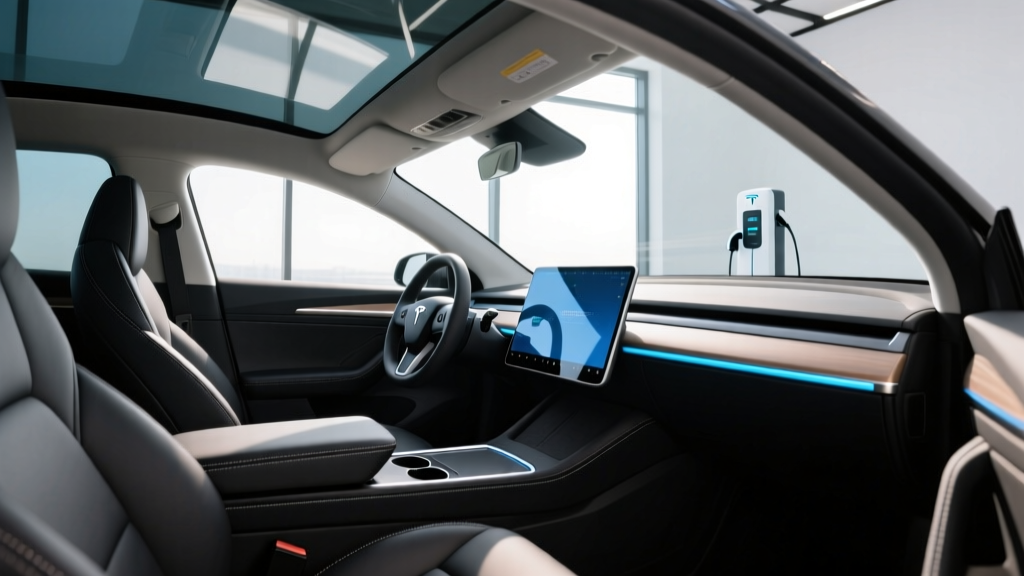
- Ambient lighting expansion: A full 360-degree ambient light strip now wraps the dashboard, doors, and center console, replacing the single dashboard strip from prior years. Color customization is available through the touchscreen.
- Acoustic glass standardization: Laminated acoustic glass on all four side windows is now standard across Long Range trims, not just Performance variants. Highway cabin noise is measurably lower — roughly 2–3 dB reduction at 70 mph based on independent testing.
- Redesigned center console: The front center console now includes a wireless charging pad angled toward the driver, a dedicated sunglasses holder, and improved cupholder depth. The rear console gains a small 8-inch touchscreen for rear passengers to control climate and media — a first for non-Plaid Teslas.
- Steering wheel and stalks: The controversial removal of turn-signal stalks (introduced with the Highland Model 3) remains. However, Tesla has refined the steering-wheel-mounted turn-signal buttons with haptic feedback and a longer press window, addressing early complaints about accidental lane-change signals during roundabout maneuvers.
The overarching layout remains Tesla's signature approach: a single 15.4-inch landscape touchscreen handles navigation, climate, media, vehicle settings, and the camera-based "mirror" view. There is no traditional instrument cluster. All driving information — speed, range, navigation arrows, and Autopilot visualization — renders on the left third of the central display.
Real-World Range vs. EPA Estimates
EPA vs. Reality: The 2026 Model 3 Long Range AWD carries a 341-mile EPA estimate. In real-world highway driving at 70–75 mph in mild conditions (60–75°F), expect 285–310 miles before needing to charge. In cold weather (below 30°F), range can drop to 240–270 miles due to cabin heating demands and reduced battery efficiency. The Model Y Long Range AWD (320 miles EPA) typically delivers 265–290 miles highway in mild weather and 225–255 miles in cold conditions.
Tesla's efficiency remains among the best in the segment. The Model 3's 25 kWh/100 mi translates to roughly 4 miles per kWh — a figure that helps stretch range even with the relatively modest 79 kWh usable battery. For context, the Hyundai Ioniq 6 Long Range achieves 27 kWh/100 mi (3.7 mi/kWh), making the Tesla measurably more efficient per mile driven.
The key variable most buyers overlook is the preconditioning effect. When you navigate to a Supercharger, the Model 3/Y automatically warms the battery to its optimal charging temperature. Without preconditioning (for example, if you pull into a third-party DC fast charger without setting it as a navigation waypoint), peak charge rates can be 20–40% lower, especially in cool weather. Always navigate to your charger — this single habit can shave 5–10 minutes off a fast-charge stop.
Charging Speed: DC Fast, Level 2, and Home Setup
Charging speed is the metric that determines road-trip viability more than range alone. Here's what the 2026 Model 3 and Model Y deliver across all charging levels:
| Charging Level | Power / Voltage | Miles Added per Hour | Notes |
|---|---|---|---|
| Level 1 (120V household) | ~1.4 kW | ~3–4 mi/hr | Emergency/trickle only; adds ~35 mi overnight |
| Level 2 (240V home, 48A) | 11.5 kW | ~40–44 mi/hr | Full charge in ~7–8 hours; recommended home setup |
| DC Fast (Tesla Supercharger V3/V4) | Peak 250 kW | Up to 1,000 mi/hr (at peak) | 10–80% in ~27 min; tapers significantly above 80% |
| DC Fast (CCS adapter at third-party stations) | Peak ~150–200 kW | Up to 700 mi/hr (at peak) | Requires $200 CCS adapter; speeds vary by station |
Understanding the charge curve: Tesla's 250 kW peak rate is not sustained across the full session. The battery accepts peak power between roughly 10–35% state of charge (SoC). From 35–60%, the rate tapers to approximately 150 kW. From 60–80%, it drops further to around 80–100 kW. Above 80%, charging slows dramatically to protect battery health — often below 30 kW. This is why Tesla (and most EV manufacturers) quote 10–80% times rather than 0–100%. For road trips, the practical strategy is to charge from 10% to 80%, then drive on.
For home charging, Tesla's Wall Connector ($420) delivers up to 11.5 kW on a 60-amp circuit (48 amps continuous). A typical installation by a licensed electrician runs $800–$2,000 depending on panel proximity and whether your electrical panel needs an upgrade from 100A to 200A service. Most owners who charge at home overnight wake up with a full battery every morning, making public charging a road-trip-only affair.
Performance and Driving Dynamics
The 2026 Model 3 Long Range AWD pairs a front induction motor with a rear permanent-magnet synchronous motor for a combined 384 horsepower and a 4.2-second 0–60 mph time. The Model Y Long Range uses the same powertrain but delivers a 4.8-second 0–60 due to its heavier curb weight (~4,400 lbs vs. ~4,034 lbs for the Model 3).
Both models feature Tesla's updated adaptive damping suspension (introduced with the Highland/Juniper refresh), which noticeably improves ride compliance over the firm, crashy ride of pre-2024 models. Pothole impacts are better isolated, and highway expansion joints no longer send sharp shocks through the steering wheel.
Regenerative braking remains strong and is not user-adjustable — Tesla removed the "Low" regen option several model years ago. The one-pedal driving experience is well-calibrated, though new EV drivers should expect a 1–2 week adjustment period. The friction brakes are rarely engaged in daily driving, which is why Tesla recommends periodic brake caliper cleaning and lubrication (especially in salt-belt states) to prevent corrosion-related seizing.
Pricing, Trim Levels, and Federal Tax Credit Eligibility
| Trim | Base MSRP | Est. After §30D Credit | Destination |
|---|---|---|---|
| Model 3 RWD | $38,990 | $31,490* | $1,390 |
| Model 3 Long Range AWD | $47,740 | $40,240* | $1,390 |
| Model 3 Performance | $52,990 | $45,490* | $1,390 |
| Model Y Long Range AWD | $50,630 | $43,130* | $1,390 |
| Model Y Performance | $54,630 | $47,130* | $1,390 |
*Estimated after $7,500 federal tax credit, if eligible. Point-of-sale transfer available.
The federal EV tax credit under IRS §30D provides up to $7,500 for qualifying buyers, but eligibility depends on several requirements that change periodically:
- Buyer income caps: Modified adjusted gross income (MAGI) must not exceed $150,000 (single), $225,000 (head of household), or $300,000 (joint filers).
- MSRP caps: Sedans (Model 3) must be under $55,000 MSRP. SUVs, trucks, and vans (Model Y) must be under $80,000 MSRP. All listed trims currently qualify.
- Battery sourcing requirements: The $7,500 credit is split into two halves — $3,750 for critical-minerals sourcing and $3,750 for battery-component manufacturing. Tesla's battery supply chain has evolved to meet both thresholds for most US-built vehicles, but always verify current eligibility on fueleconomy.gov before purchasing, as sourcing rules tighten annually.
- Point-of-sale transfer: As of 2024, buyers can transfer the credit to the dealer at purchase, reducing the purchase price directly rather than waiting to claim it on their tax return. Tesla supports this at delivery.
Important: Consult a tax professional to confirm your personal eligibility. Credit rules are subject to change, and state-level incentives (such as California's CVRP, Colorado's innovative motor vehicle credit, or utility rebates) may stack on top.
Tech, Driver Assistance, and Safety
Every 2026 Tesla ships with Basic Autopilot standard, which includes Traffic-Aware Cruise Control and Autosteer (lane centering). This is a SAE Level 2 driver-assistance system — it does not drive the car autonomously. You must keep your hands on the wheel and remain attentive at all times. Tesla monitors engagement via a steering-wheel torque sensor and cabin camera.
Driver-Assist Limitation Warning: Tesla's Full Self-Driving (Supervised) — an optional $8,000 upgrade or $99/month subscription — remains a Level 2 system despite its name. It can navigate highway interchanges, handle some city intersections, and respond to traffic lights, but the driver must continuously supervise and be prepared to take over instantly. It is not a self-driving system. Only Level 4 robotaxi services like Waymo operate without a human driver in geofenced areas.
The infotainment system runs on Tesla's proprietary OS, which remains one of the fastest and most responsive in the industry. The 2026 update adds a redesigned navigation interface with improved real-time Supercharger availability data, a native trip planner that accounts for elevation changes and wind, and an upgraded voice assistant that handles multi-step commands ("Navigate to the nearest Supercharger and precondition the battery").
Notably absent: Apple CarPlay and Android Auto. Tesla has never supported phone mirroring, and there is no indication this will change. If CarPlay is a dealbreaker, competitors like the Hyundai Ioniq 5, BMW i4, and Ford Mustang Mach-E all support it.
Safety ratings remain strong. The Model 3 earned a 5-star overall NHTSA rating and the IIHS Top Safety Pick+ designation (when equipped with acceptable headlights). The Model Y similarly holds a 5-star NHTSA rating.
Who Should Buy the 2026 Tesla Model 3 or Model Y?
Pros
- Class-leading energy efficiency (25–28 kWh/100 mi)
- Access to the Tesla Supercharger network — the most reliable and extensive DC fast-charging network in North America
- Over-the-air updates continuously add features post-purchase
- Strong resale value relative to other EVs
- Improved cabin quietness and ride comfort for 2026
- Excellent acceleration and low center of gravity
Cons
- No Apple CarPlay / Android Auto support
- Turn signals on steering wheel buttons remain divisive
- Rear-seat headroom is tight for passengers over 6'2" (Model 3 especially)
- Paint quality and panel-gap consistency still lag legacy automakers
- Service center wait times can be long in some metro areas
- FSD (Supervised) is expensive and still requires full driver attention
Best for: Tech-forward commuters and small families who want the lowest cost-per-mile in the EV segment, value access to the most robust charging network, and are comfortable with a touchscreen-centric interface. The Model Y's 30+ cu ft cargo area and available 7-seat configuration make it a practical family hauler. Road-trippers benefit from Tesla's navigation-integrated Supercharger routing.
Consider alternatives if: You need physical buttons and knobs, require CarPlay, want a more traditional dealership service experience, or need a luxury-grade interior at this price point (see the BMW i4 or Genesis Electrified G80).
Frequently Asked Questions
What is the real-world range of the 2026 Tesla Model 3 and Model Y?
The Model 3 Long Range AWD delivers approximately 285–310 miles on the highway in mild weather and 240–270 miles in cold conditions, against its 341-mile EPA estimate. The Model Y Long Range AWD delivers roughly 265–290 miles highway in mild weather and 225–255 miles in cold weather, against its 320-mile EPA estimate. City driving with frequent regenerative braking can exceed EPA estimates by 5–10%.
How fast does the 2026 Tesla charge at home and on the road?
At home on a Level 2 (240V, 48A) Tesla Wall Connector, both models add approximately 40–44 miles of range per hour, reaching a full charge in 7–8 hours. On a Tesla V3/V4 Supercharger, both models peak at 250 kW and charge from 10–80% in approximately 27–28 minutes. Above 80%, the charge rate tapers sharply to protect battery longevity.
How much does the 2026 Tesla Model 3 or Model Y cost after tax credits?
If you qualify for the full $7,500 federal tax credit under IRS §30D (meeting income caps, MSRP caps, and battery-sourcing requirements), the Model 3 RWD starts at an effective ~$31,490, the Model 3 Long Range AWD at ~$40,240, and the Model Y Long Range AWD at ~$43,130. The credit can be transferred at the point of sale to reduce your purchase price directly. State incentives may reduce the cost further.
Does the 2026 Tesla qualify for the federal EV tax credit?
As of early 2026, all Model 3 and Model Y trims meet the MSRP caps ($55,000 for sedans, $80,000 for SUVs) and Tesla's US-manufactured battery supply chain has generally satisfied both the critical-minerals and battery-component requirements for the full $7,500 credit. However, sourcing rules tighten over time — always verify current eligibility on fueleconomy.gov and consult a tax professional for your specific situation.
Is the 2026 Tesla worth buying over competitors like the Hyundai Ioniq 5 or BMW i4?
The Tesla's primary advantages are Supercharger network access, best-in-class efficiency, and continuous over-the-air improvements. The Hyundai Ioniq 5 offers faster 10–80% charging (~18 minutes on a 350 kW charger), CarPlay support, and a more distinctive design. The BMW i4 provides a more traditional luxury interior with physical controls and superior build quality. If Supercharger reliability and efficiency are your top priorities, Tesla still leads. If you want a more refined cabin or physical controls, the competitors are compelling.
What is the battery warranty on the 2026 Tesla?
Tesla covers the battery and drive unit for 8 years or 120,000 miles (whichever comes first) on Long Range and Performance trims, with a minimum 70% capacity retention guarantee over that period. The base RWD Model 3 (which uses an LFP battery) carries an 8-year/100,000-mile warranty with the same 70% retention threshold. Real-world degradation data from Tesla's fleet suggests most batteries retain 85–90% capacity after 100,000 miles.