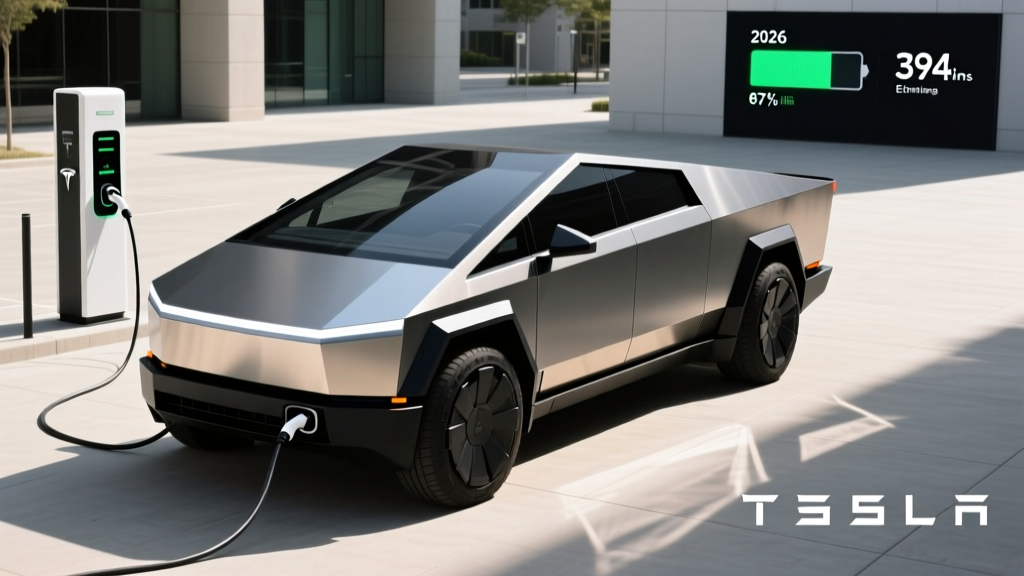
The Tesla Cybertruck enters the 2026 model year with revised pricing, expanded trim availability, and the kind of polarizing design that still turns heads at every charging station. But beneath the stainless-steel exoskeleton and steer-by-wire steering lies a serious question for truck buyers: does the math work? Below, we break down every 2026 Tesla Cybertruck MSRP tier, pair it against real-world range and charging data, and explain exactly where the federal tax credit does—and doesn't—apply.
2026 Cybertruck Pricing by Trim
Tesla restructured the Cybertruck lineup for 2026, moving away from the early "Foundation Series" pricing that drew criticism at launch. Here is the current MSRP landscape before any incentives or destination fees:
| Trim | Drivetrain | 0–60 mph | EPA Range | MSRP |
|---|---|---|---|---|
| Rear-Wheel Drive (RWD) | Single-motor RWD | ~6.5 sec | 250 mi (est.) | $60,990 |
| All-Wheel Drive (AWD) | Dual-motor AWD | 4.1 sec | 340 mi | $79,990 |
| Cyberbeast | Tri-motor AWD | 2.6 sec | 320 mi | $99,990 |
Destination fee: $1,995 (added at checkout). All prices reflect Tesla's US configurator as of early 2026. The RWD trim, originally announced for a later release window, is now in active delivery.
Estimated Out-of-Pocket After Federal Tax Credit
| Trim | MSRP + Destination | §30D Credit (max) | Effective Price* |
|---|---|---|---|
| RWD | $62,985 | $7,500 | ~$55,485 |
| AWD | $81,985 | $7,500 | ~$74,485 |
| Cyberbeast | $101,985 | $0 (over MSRP cap) | ~$101,985 |
*Assumes buyer meets all IRS §30D requirements. The Cyberbeast exceeds the $80,000 MSRP cap for trucks and is ineligible. See the tax credit section below for full eligibility rules. Source: IRS §30D.
EPA Range vs. Real-World Expectations
The Cybertruck's angular, stainless-steel body is visually striking but aerodynamically challenged compared to sleeker EVs. That directly impacts range, especially at highway speeds.
Real-World Range Reality Check
EPA estimate (AWD): 340 miles
Real-world highway (70–80 mph): Expect ~270–290 miles in mild weather
Cold weather (below 30°F): Expect ~230–260 miles, depending on cabin heat and preconditioning habits
City / mixed driving: Closer to EPA sticker, ~310–330 miles thanks to regenerative braking
The Cybertruck's large frontal area means highway range drops more sharply than in smaller EVs. If your commute is mostly interstate at 75+ mph, budget for ~15–20% below the EPA number.
For context, the EPA's fueleconomy.gov listing rates the dual-motor AWD Cybertruck at 340 miles combined. The tri-motor Cyberbeast dips to 320 miles due to the additional motor's weight and higher performance tuning. The RWD model, with a smaller battery pack, targets 250 miles — adequate for urban commuters but tight for road-trip duty.
Battery, Chemistry, and Efficiency
Tesla has not published the Cybertruck's exact usable battery capacity in owner documentation, but teardown analysis and EPA test data point to approximately 123 kWh usable in the AWD and Cyberbeast trims, with the RWD variant using a smaller pack estimated at ~100 kWh. The chemistry is Tesla's 4680-format NMC (nickel manganese cobalt) cells, manufactured at Giga Texas.
Why NMC, not LFP? The Cybertruck demands high energy density to offset its ~6,600–6,800 lb curb weight and to support the tri-motor Cyberbeast's power output. LFP (lithium iron phosphate) chemistry, which Tesla uses in some Model 3/Y RWD variants, is heavier per kWh and would compromise range and payload in a truck this size.
| Trim | MPGe (combined) | kWh/100 mi | Est. Battery (usable) |
|---|---|---|---|
| RWD | ~68 MPGe | ~49 | ~100 kWh |
| AWD | ~67 MPGe | ~50 | ~123 kWh |
| Cyberbeast | ~63 MPGe | ~54 | ~123 kWh |
Efficiency of 50–54 kWh/100 mi means the Cybertruck consumes roughly 2–2.5× the energy per mile of a Model Y. That matters for charging cost and road-trip planning — every stop takes longer because you're pushing more kWh back into a bigger pack.
Charging Speed: DC Fast Charge and Home Level 2
The Cybertruck uses the NACS (North American Charging Standard) connector natively — no adapter needed at Tesla Superchargers. It supports the 48-volt electrical architecture that Tesla introduced with this platform.
| Charging Level | Max Power | Speed / Time | Connector |
|---|---|---|---|
| Level 1 (120V household) | ~1.4 kW | ~3 mi/hr | NACS (mobile connector) |
| Level 2 (240V home/public) | 11.5 kW (48A) | ~25–28 mi/hr | NACS / J1772 w/ adapter |
| DC Fast Charge | Peak 350 kW | 10–80% in ~20 min (AWD) | NACS (Supercharger V4 / CCS w/ adapter) |
The charging-curve reality: The 350 kW peak only sustains briefly at low state-of-charge (roughly 5–15% SoC). Between 20–60% SoC, expect ~200–250 kW sustained. Above 80%, the curve tapers sharply to protect the 4680 cells — going from 80–100% can add another 25+ minutes. For road trips, plan 10–80% stops and skip the top-off unless you need the final miles to reach your destination.
At home on a 48-amp Level 2 circuit (requiring a 60-amp breaker), the Cybertruck recovers roughly 25–28 miles of range per hour. A full 10–80% home charge takes approximately 9–10 hours — manageable for overnight charging but worth knowing if you arrive home nearly empty and need a full pack by morning.
Performance and Drivetrain
The Cybertruck's performance specs read like a sports sedan wearing work boots:
- Cyberbeast (tri-motor AWD): 845 hp, 2.6-second 0–60 mph, electronically limited top speed of 130 mph
- AWD (dual-motor): 600 hp, 4.1-second 0–60 mph
- RWD (single-motor): ~315 hp, ~6.5-second 0–60 mph
All trims use Tesla's steer-by-wire system with a yoke-style steering wheel as standard (a conventional round wheel is available as a no-cost option on 2026 models). The 48-volt architecture powers the steering, brakes, and accessories, reducing wiring harness weight.
Towing: The AWD and Cyberbeast are rated for 11,000 lbs maximum towing capacity. The RWD is rated lower at approximately 7,500 lbs. Note that towing at max capacity cuts range roughly in half — expect 150–170 miles from the AWD when pulling a heavy trailer.
Cargo, Passenger Space, and Utility
The Cybertruck is a crew-cab pickup with a 6-foot composite bed (called the "vault") and a power-operated tonneau cover.
| Measurement | Spec |
|---|---|
| Bed length | 72 in (6 ft) |
| Bed volume (tonneau closed) | ~67 cu ft |
| Front trunk (frunk) | ~7 cu ft |
| Front legroom | 41.3 in |
| Rear legroom | 34.8 in |
| Seating capacity | 5 (bench front) or 5 (bucket front, depending on config) |
| Payload capacity | ~2,500 lbs |
Rear legroom at 34.8 inches is tighter than a Ford F-150 Lightning or Rivian R1T. Tall passengers on long drives will notice. The frunk is modest — useful for charging cables and a small bag, but not a major cargo area.
Warranty Coverage
| Component | Coverage |
|---|---|
| Basic vehicle | 4 years / 50,000 miles |
| Battery & drive unit | 8 years / 120,000 miles (min 70% capacity retention) |
| Restraint system | 5 years / 60,000 miles |
| Corrosion perforation | 12 years / unlimited miles |
The 8-year/120,000-mile battery warranty with a 70% capacity retention threshold is consistent with Tesla's other premium vehicles. Given the 4680 cells' structural role in the chassis, a full pack replacement outside warranty would be expensive — industry estimates place it above $20,000, though Tesla has not published official out-of-warranty pricing.
Tech, Driver Assistance, and Notable Drawbacks
Infotainment: An 18.5-inch center touchscreen runs Tesla's proprietary OS. Rear passengers get a 9.4-inch touchscreen for climate and media. There is no Apple CarPlay or Android Auto — a dealbreaker for some, a non-issue for Tesla loyalists. The UI is responsive, and the navigation-integrated trip planner with Supercharger routing remains best-in-class.
Driver assistance: Basic Autopilot (adaptive cruise + lane centering) is standard. Full Self-Driving (Supervised) remains a $8,000 add-on or $99/month subscription.
FSD (Supervised) is a driver-assist system, not a self-driving system. The driver must remain fully engaged, hands on or near the yoke, and eyes on the road at all times. Tesla's cabin camera monitors attention. This is the same SAE Level 2 classification as GM's Super Cruise and Ford's BlueCruise. No consumer vehicle sold in the US is Level 4 autonomous.
Notable drawbacks to weigh honestly:
- Ride quality: The stainless-steel body and air suspension deliver a firm ride. Expansion joints and rough pavement transmit more impact than an F-150 Lightning.
- Visibility: The angular greenhouse and thick A-pillars create blind spots. The camera-based mirror system (optional) helps but requires adaptation.
- Panel gaps and build quality: Improved since early 2024 deliveries but still inconsistent. Inspect carefully at delivery.
- Insurance costs: Cybertruck premiums run 30–50% above comparable trucks, driven by repair costs for the stainless-steel body and steer-by-wire system.
- No Apple CarPlay/Android Auto: A genuine pain point for buyers switching from other brands.
Federal Tax Credit Eligibility (§30D)
- MSRP cap for trucks: $80,000 — the RWD ($60,990) and AWD ($79,990) qualify; the Cyberbeast ($99,990) does not.
- Buyer income caps (MAGI): $300,000 joint / $225,000 head of household / $150,000 individual. Exceed these and you're ineligible regardless of the vehicle.
- Battery sourcing: The §30D credit requires increasing percentages of critical minerals and battery components sourced from the US or FTA partners. Tesla's 4680 cells are manufactured at Giga Texas, but critical-mineral sourcing compliance varies by production batch. Confirm eligibility on the vehicle's window sticker or via the IRS portal before purchasing.
- Point-of-sale transfer: As of 2024, you can transfer the credit to the dealer at purchase, reducing your out-of-pocket cost immediately rather than waiting for tax filing. This applies to the Cybertruck RWD and AWD trims.
- One vehicle per four years: You can only claim the new-vehicle credit once every four years per the IRS §30D rules.
Bottom line on the credit: The AWD trim at $79,990 squeaks under the $80,000 cap. If you add options that push the MSRP above $80,000, you lose the credit entirely. Configure carefully.
Who Should Buy the 2026 Cybertruck?
Choose the Cybertruck RWD if: You want a distinctive daily-driver commuter truck, mostly drive in urban or suburban settings, and 250 miles of range covers your needs. It's the most affordable entry and qualifies for the full $7,500 credit.
Choose the Cybertruck AWD if: You need genuine truck utility (towing, bed cargo, AWD traction) and want the best balance of range and value. This is the sweet-spot trim for most buyers.
Choose the Cyberbeast if: Performance is the priority, you want tri-motor capability, and the $100K price without a tax credit doesn't deter you. It's a halo vehicle, not a value play.
Look elsewhere (Rivian R1T, F-150 Lightning) if: You prioritize rear-seat comfort, traditional build quality, Apple CarPlay, or need a truck that doesn't draw a crowd at every stop.
Pros
- Class-leading DC fast-charge speed (350 kW peak)
- 11,000-lb towing capacity (AWD/Cyberbeast)
- Stainless-steel body resists dents and corrosion
- Best-in-class Supercharger network access
- Cyberbeast's 2.6-sec 0–60 defies physics for a truck
- 48-volt architecture is genuinely innovative
Cons
- Cyberbeast ineligible for federal tax credit (over MSRP cap)
- Highway range drops significantly vs. EPA sticker
- Rear legroom is tight for a crew cab (34.8 in)
- Insurance premiums well above segment average
- No Apple CarPlay or Android Auto
- Steer-by-wire and yoke require an adjustment period
Frequently Asked Questions
What is the real-world range of the 2026 Cybertruck?
The AWD trim carries a 340-mile EPA rating, but expect 270–290 miles on the highway at 70–80 mph in mild conditions, and 230–260 miles in sub-freezing weather. City and mixed driving gets closer to the EPA number thanks to regenerative braking.
How fast does the Cybertruck charge at home and on the road?
On a 48-amp Level 2 home charger (240V), it adds roughly 25–28 miles of range per hour, taking about 9–10 hours for a 10–80% charge. At a V4 Supercharger, the AWD peaks at 350 kW and charges 10–80% in approximately 20 minutes, though the curve tapers significantly above 80%.
How much does the Cybertruck cost after the federal tax credit?
The RWD at ~$62,985 (with destination) drops to roughly $55,485 with the full $7,500 credit. The AWD at ~$81,985 drops to ~$74,485. The Cyberbeast at $101,985 is ineligible for the credit because it exceeds the $80,000 MSRP cap for trucks. All figures assume the buyer meets income and sourcing requirements per IRS §30D.
Is the Cybertruck worth buying vs. the Rivian R1T or F-150 Lightning?
The Cybertruck wins on DC fast-charge speed and raw performance (Cyberbeast). The Rivian R1T offers superior rear-seat space, a more refined interior, and quad-motor capability. The F-150 Lightning provides a familiar truck experience with Apple CarPlay and a more traditional ride. If you value charging speed and Tesla's Supercharger network, the Cybertruck has the edge. If comfort and practicality rank higher, test-drive all three.
Does the 2026 Cybertruck qualify for the $7,500 federal EV tax credit?
The RWD and AWD trims qualify, provided the buyer's modified adjusted gross income is within IRS limits ($300K joint / $150K individual) and the vehicle's battery meets critical-mineral and component sourcing thresholds. The Cyberbeast does not qualify due to the $80,000 MSRP cap for trucks. Always verify eligibility on the specific VIN before purchase, as sourcing compliance can vary.
What is the Cybertruck's towing range impact?
Towing near the 11,000-lb maximum roughly halves range. Expect 150–170 miles from the AWD when pulling a heavy trailer. Use Tesla's integrated trip planner, which accounts for trailer load when routing through Superchargers.