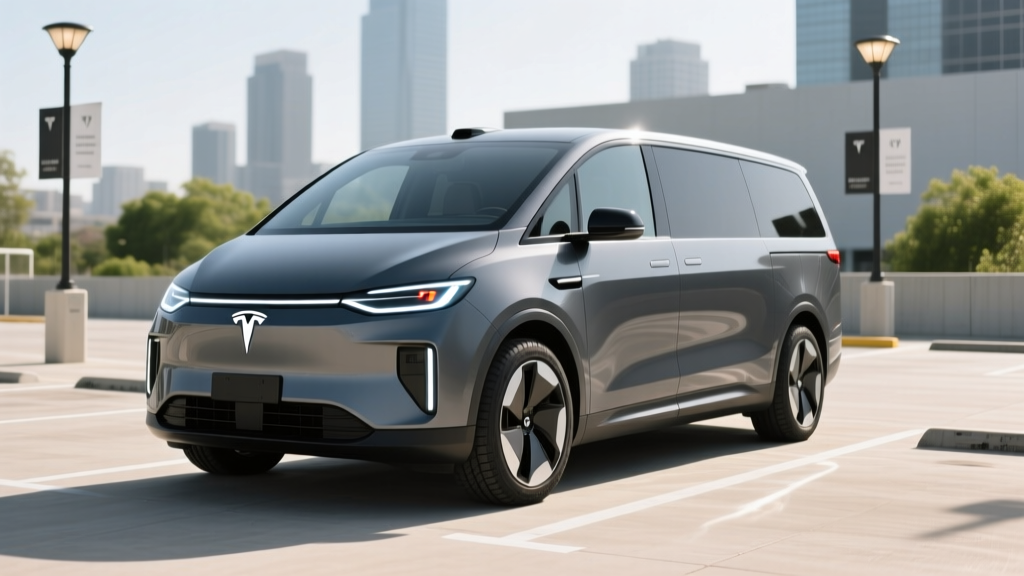
Quick Verdict: A Promising Electric Van, But Not Yet on Sale
The 2026 Tesla Cyber Van remains an announced and unreleased vehicle as of early 2026. Tesla has confirmed development of a passenger-oriented electric van built on a derivative of the Cybertruck/next-gen platform, but the company has not published final EPA certification data, pricing, or a firm on-sale date. What follows is a comprehensive preview based on Tesla's official statements, supply-chain reporting, patent filings, and reasonable engineering extrapolation from the current Tesla lineup. No specifications below should be treated as final until Tesla publishes them and the EPA certifies range figures.
If Tesla delivers on its stated goals — a sub-$50,000 starting price, 300+ miles of range, and a high-utilization interior — the Cyber Van could reshape the electric family-hauler and commercial-fleet segments. But buyers should hold deposits and expectations until real metal rolls off the Austin production line.
Estimated Range, Battery, and Efficiency
Tesla has targeted an EPA-estimated 320–350 miles of range for the Long Range AWD variant. In real-world highway driving at 70 mph, expect approximately 260–290 miles based on typical Tesla efficiency deltas. In cold weather (below 32°F), plan for 220–260 miles of usable range before needing to charge — consistent with observed LFP and NMC pack behavior across the Tesla fleet. These figures are estimates until EPA certification is published.
Tesla's next-generation platform, which the Cyber Van is expected to share, uses a structural battery pack design first introduced on the Cybertruck. Industry reporting and supply-chain data point to two likely battery configurations:
- Standard Range (RWD): ~75 kWh usable, likely LFP (lithium iron phosphate) chemistry — lower energy density but superior cycle life, no cobalt, and tolerant of regular 100% charging.
- Long Range (AWD): ~95–100 kWh usable, NMC (nickel manganese cobalt) chemistry — higher energy density for maximum range, with Tesla recommending daily charge limits of 80%.
The LFP/NMC split mirrors Tesla's current strategy with the Model 3 and Model Y. LFP packs sacrifice roughly 10–15% range compared to NMC but gain longevity and lower replacement cost — a practical trade-off for fleet operators and daily commuters who charge nightly at home.
Projected efficiency sits around 105–115 MPGe combined (roughly 29–32 kWh/100 mi), which would place the Cyber Van slightly behind the Model Y Long Range (122 MPGe) but ahead of most three-row electric SUVs, thanks to the van's aerodynamic packaging advantage over taller crossovers.
| Spec | Standard Range RWD | Long Range AWD |
|---|---|---|
| Battery (usable) | ~75 kWh | ~95–100 kWh |
| Chemistry | LFP | NMC |
| EPA Range (est.) | ~260–280 mi | ~320–350 mi |
| Real-World Highway (est.) | ~210–240 mi | ~260–290 mi |
| Efficiency (est.) | ~31–34 kWh/100 mi | ~29–32 kWh/100 mi |
Charging Speed: DC Fast Charging and Home Level 2
Charging speed is where Tesla's next-gen 800-volt architecture (debuted on the Cybertruck) should pay significant dividends. Based on Cybertruck charging behavior and Tesla's stated goals for the next-gen platform, here is the projected charging profile:
| Charging Level | Power / Rate | Speed / Time |
|---|---|---|
| Level 1 (120V household) | ~1.4 kW | ~3–4 mi/hr |
| Level 2 (240V, 48A Wall Connector) | ~11.5 kW | ~33–38 mi/hr |
| DC Fast Charge (peak) | ~250–350 kW | 10–80% in ~15–20 min (est.) |
| DC Fast Charge (sustained avg) | ~180–220 kW | Adds ~150–200 mi in 15 min |
Important kW vs kWh distinction: kW (kilowatts) measures charging power — how fast energy flows into the battery. kWh (kilowatt-hours) measures battery capacity — how much energy the battery stores. A 350 kW peak charge rate does not mean the battery charges at that speed for the entire session. The charge curve tapers significantly above 80% State of Charge (SoC) to protect battery health. Tesla's preconditioning feature warms the battery en route to a Supercharger, which is essential for achieving peak charge rates — without it, expect 30–50% slower initial charging speeds.
The Cyber Van is expected to ship with the NACS (North American Charging Standard) connector natively, giving it full access to Tesla's Supercharger network — currently the most reliable DC fast-charging network in the U.S., with over 25,000 stalls nationwide. For non-Tesla networks (Electrify America, EVgo), no adapter is needed since NACS has become the industry standard for 2025+ model-year vehicles.
Performance, Drivetrain, and Platform
Tesla's next-generation platform emphasizes manufacturing efficiency (gigacasting, simplified wiring harness) over raw performance. The Cyber Van is expected to offer:
- Standard Range RWD: Single rear motor, ~280 hp, 0–60 mph in ~6.5 seconds.
- Long Range AWD: Dual motor (front induction + rear permanent magnet), ~420 hp, 0–60 mph in ~4.8 seconds.
- Performance AWD (if offered): Dual motor, ~500+ hp, 0–60 mph in ~3.8 seconds.
These figures are extrapolated from the Cybertruck and Model Y powertrains. For a passenger van, the RWD single-motor variant is the most likely volume seller, prioritizing efficiency and cost over acceleration. The AWD dual-motor variant serves buyers in snow-belt states and those who need the traction for light towing.
Tesla's regenerative braking system with one-pedal driving will carry over, and a heat pump for cabin and battery thermal management should be standard — a critical efficiency feature in cold climates that reduces winter range loss by approximately 10–15% compared to resistive heating.
Interior, Cargo, and Passenger Space
The Cyber Van's core value proposition is interior volume. Based on patent filings, concept images, and Tesla's stated intent to compete with vehicles like the VW ID. Buzz and Mercedes-Benz Sprinter, here are the projected dimensions:
- Seating: Configurable 5-, 6-, or 7-passenger layouts. Expect a two-row (5-seat) standard configuration with an optional third row.
- Cargo volume (behind 2nd row): ~55–65 cu ft (estimated), expanding to ~100–120 cu ft with second-row seats folded or removed.
- Cargo volume (behind 1st row, 2-seat commercial config): ~140–160 cu ft (estimated).
- Second-row legroom: ~40–42 inches (est.), competitive with minivan benchmarks.
- Sliding side doors: Expected on both sides, power-operated on higher trims.
- Flat load floor: The skateboard platform enables a completely flat floor from the rear hatch to the front seats — a major advantage for cargo and wheelchair accessibility.
Tesla's minimalist interior approach will likely carry over: a single 15.4-inch center touchscreen, no physical instrument cluster, and a yoke or round steering wheel (buyer's choice, as currently offered on Model S/X). Rear-seat passengers should get dedicated USB-C ports and likely a small rear entertainment screen on higher trims.
Pricing, Trims, and Federal Tax Credit Outlook
Tesla CEO Elon Musk has publicly stated a target starting price below $50,000 for the next-generation platform vehicles. If the Cyber Van follows this pricing structure, here is a projected trim breakdown:
| Trim | Est. Base MSRP | Drivetrain | Est. Range |
|---|---|---|---|
| Standard Range RWD | ~$45,000–$48,000 | RWD | ~260–280 mi |
| Long Range AWD | ~$52,000–$56,000 | AWD | ~320–350 mi |
| Performance AWD | ~$58,000–$62,000 | AWD | ~290–310 mi |
Under current IRS §30D rules, the Cyber Van's tax-credit eligibility will depend on several factors at launch:
- MSRP cap: Vans and SUVs qualify up to $80,000 MSRP — all projected Cyber Van trims fall under this cap.
- Buyer income cap: Modified AGI must not exceed $150,000 (single) / $300,000 (joint) / $225,000 (head of household).
- Battery sourcing: Critical minerals and battery components must meet phased-in domestic/free-trade-partner sourcing thresholds for 2026. Tesla's shift toward LFP (often China-sourced) may complicate eligibility for the Standard Range trim.
- Point-of-sale transfer: Eligible buyers can apply the credit as an upfront discount at purchase rather than waiting for tax filing.
- FEOC restriction: Vehicles with battery components from a "foreign entity of concern" (primarily Chinese companies) are disqualified. This is the most uncertain variable for the LFP-equipped Standard Range variant.
Warranty, Technology, and Driver Assistance
Tesla's current warranty structure is expected to carry over to the Cyber Van:
- Basic vehicle warranty: 4 years / 50,000 miles
- Battery and drive unit warranty: 8 years / 120,000 miles (Long Range AWD), with a guaranteed minimum 70% capacity retention over the warranty period
- LFP battery warranty: Likely 8 years / 100,000 miles with similar retention guarantees
On the technology front, expect the Cyber Van to ship with:
- Autopilot (standard): Traffic-aware cruise control and autosteer — this is an SAE Level 2 driver-assistance system requiring continuous driver attention and hands on the steering wheel. It is not self-driving.
- FSD (Supervised) — $8,000 option or $99/mo subscription: Enhanced lane changes, navigation-guided driving, traffic light/stop sign recognition, and parking assist. Still SAE Level 2 — the driver must remain fully engaged and is legally responsible for the vehicle at all times.
- Infotainment: 15.4-inch touchscreen, streaming media, Tesla app integration, over-the-air updates, dashcam, and Sentry Mode.
- Unique features: Likely includes a front trunk (frunk), V2L (vehicle-to-load) power capability for tools or camping equipment, and Tesla's camp mode for overnight climate control.
Tesla's Autopilot and FSD (Supervised) are SAE Level 2 driver-assistance systems. They do not make the vehicle autonomous. The driver must remain alert, keep hands on the wheel, and be prepared to take over instantly. Misuse of these systems — including looking away from the road or removing hands from the wheel — has contributed to NHTSA-investigated crashes. Treat these features as enhanced cruise control, not a replacement for attentive driving.
Who Should Wait for the Cyber Van — and Who Should Look Elsewhere
- Families needing 6–7 seats with maximum cargo flexibility
- Fleet operators and small businesses seeking a low-cost electric work van
- Tesla ecosystem loyalists who want Supercharger access and OTA updates
- Daily commuters with home Level 2 charging who want 250+ real-world miles
- Buyers prioritizing total cost of ownership over luxury finishes
- You need a van now — the Cyber Van is not yet available for purchase
- You require proven reliability data and long-term ownership reviews
- You prefer traditional dealer service networks over Tesla's mobile-ranger model
- You need heavy towing (5,000+ lbs) — a body-on-frame SUV or truck may serve better
- Interior luxury and material quality are top priorities (Tesla's minimalist approach isn't for everyone)
Key Competitors: How the Cyber Van Stacks Up
The electric van and three-row EV space is growing. Here is how the Cyber Van is projected to compare against current and upcoming rivals:
- VW ID. Buzz: Already on sale in the U.S. (2025+), starting ~$59,995, EPA 234 mi range, 170 kW DC fast charging. The ID. Buzz is more expensive, shorter-ranged, and slower-charging than the Cyber Van's projected specs, but it's available now with retro styling appeal.
- Kia EV9: Three-row electric SUV, starting ~$54,900, EPA 304 mi range (LR RWD), 236 kW DC fast charging. A strong alternative if you don't need van-level cargo space.
- Hyundai Ioniq 9 (upcoming): Expected to compete directly on price and range; not yet on sale.
- Mercedes-Benz eSprinter: Commercial-focused, ~$70,000+, 200 mi range. More expensive and less efficient, but proven in fleet applications.
The Cyber Van's projected advantage is a combination of price, range, charging speed, and Supercharger network access. Its risk is timeline — Tesla has a history of delayed production launches, and competitors like VW and Kia are selling vehicles today.
Frequently Asked Questions
What is the real-world range of the 2026 Tesla Cyber Van?
Based on projected specs and typical Tesla real-world performance, expect approximately 260–290 miles of highway range for the Long Range AWD variant (EPA est. 320–350 mi) and 210–240 miles for the Standard Range RWD. Cold weather (below freezing) will reduce these figures by an additional 15–25%. These are estimates until EPA certification is published.
How fast does the Cyber Van charge?
Projected DC fast-charging peaks at 250–350 kW on a V4 Supercharger, with 10–80% charging in approximately 15–20 minutes. Sustained average charge rates are expected around 180–220 kW. Home Level 2 charging via a Tesla Wall Connector (48A, 240V) should add roughly 33–38 miles of range per hour.
How much does the Cyber Van cost after tax credits?
If the Standard Range RWD starts around $45,000–$48,000 and qualifies for the full $7,500 federal credit (pending battery-sourcing rules), the effective price could be as low as ~$37,500–$40,500. The Long Range AWD at ~$52,000–$56,000 has a clearer path to credit eligibility, potentially bringing it to ~$44,500–$48,500. State incentives (which vary widely) could reduce costs further. Always confirm eligibility via IRS §30D guidelines and fueleconomy.gov.
Does the 2026 Tesla Cyber Van qualify for the federal EV tax credit?
Potentially, but it depends on final battery sourcing. The Long Range NMC variant is more likely to qualify for the full $7,500 credit under current §30D rules. The Standard Range LFP variant faces uncertainty due to FEOC (foreign entity of concern) restrictions on China-sourced battery components. MSRP caps ($80,000 for vans/SUVs) and buyer income limits ($150K single / $300K joint) are expected to be met by most Cyber Van configurations.
Is the Cyber Van worth waiting for vs. buying a VW ID. Buzz or Kia EV9 now?
If you need a vehicle within 6 months, buy now — the Cyber Van has no confirmed delivery timeline. If you can wait 12–18+ months and Tesla's projected price/range/charging specs materialize, the Cyber Van could offer meaningfully better value than the ID. Buzz (~$60K, 234 mi range) and undercut the EV9 on price while matching or exceeding its range. The key risk is Tesla's history of production delays.
What are the biggest pros and cons of the Cyber Van?
Projected pros: Sub-$50K starting price, 300+ mi range (LR), fast 800V charging, Supercharger network access, spacious configurable interior, OTA updates, strong efficiency for its class, potential $7,500 tax credit.
Projected cons: Not yet available, unproven reliability, Tesla's minimalist interior polarizes, service center wait times in some markets, LFP trim's tax-credit eligibility uncertain, no physical controls for HVAC/media (screen-only), towing capacity likely limited to ~3,500 lbs.
When will the 2026 Tesla Cyber Van be available to order?
Tesla has not announced a firm order-date or delivery timeline for the Cyber Van. Industry estimates place initial deliveries in late 2026 at the earliest, with volume production ramping in 2027. Tesla's production timelines have historically slipped by 6–18 months from initial announcements. Monitor Tesla's official investor updates and earnings calls for confirmed dates.