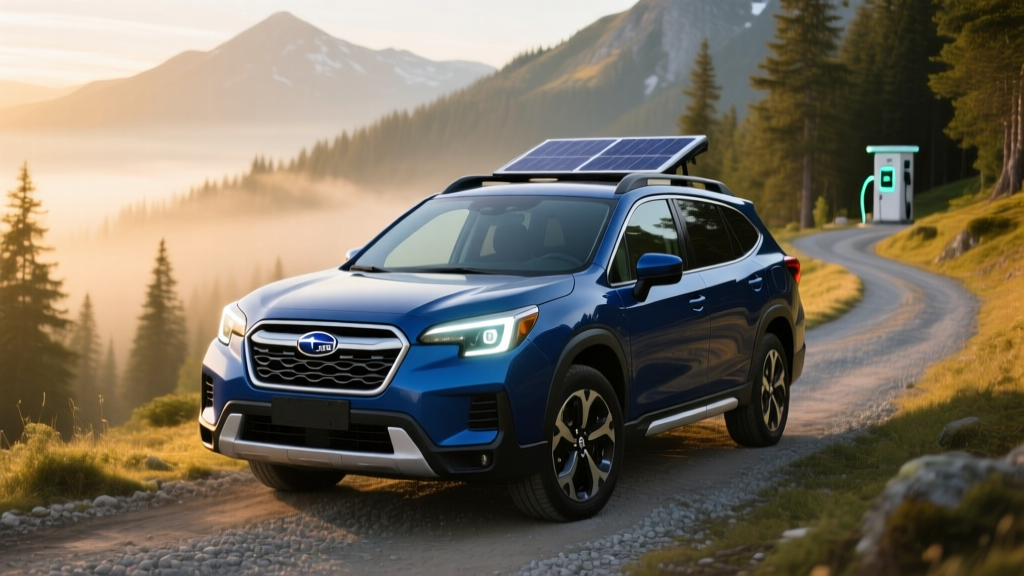
Quick Answer: What Is the 2026 Subaru Trailseeker EV SUV?
The 2026 Subaru Trailseeker EV SUV is Subaru's upcoming all-electric midsize crossover, built on the same Toyota-subaru co-developed e-TNGA platform that underpins the Solterra. As of early 2026, Subaru has announced the Trailseeker as a larger, more capable sibling to the Solterra, targeting an EPA-estimated range of 270–300 miles, standard symmetrical all-wheel drive, and a starting MSRP in the $42,000–$48,000 range before incentives. Final EPA certification, trim pricing, and on-sale dates remain preliminary. If you need a three-row electric SUV with Subaru's trademark AWD and off-road credibility, the Trailseeker is the one to watch — but verify final specs before placing a deposit.
What We Know About the 2026 Subaru Trailseeker EV SUV So Far
Subaru confirmed the Trailseeker nameplate in late 2025 as part of its expanded EV roadmap. Positioned above the compact Solterra, the Trailseeker targets the midsize electric SUV segment occupied by the Hyundai Ioniq 5, Ford Mustang Mach-E, and Toyota bZ4X — but with a longer wheelbase, available third-row seating, and Subaru's X-MODE off-road software adapted for electric torque delivery.
Because the vehicle is still pre-launch, the specifications below are preliminary estimates based on Subaru's official teasers, platform data from Toyota's e-TNGA architecture, and industry reporting. We will update this guide once EPA certification and final MSRP are published.
| Spec | Estimated / Target |
|---|---|
| Battery Capacity (usable) | ~82–90 kWh (NMC lithium-ion) |
| EPA Range (est.) | 270–300 miles |
| Real-World Highway Range | ~230–260 miles (70+ mph, moderate temps) |
| Cold-Weather Range (20°F) | ~200–230 miles (est. 20–25% loss) |
| Drivetrain | Dual-motor AWD (standard) |
| Horsepower | ~340–380 hp (est.) |
| 0–60 mph | ~5.0–5.5 seconds (est.) |
| DC Fast Charge (peak) | ~150–175 kW (10–80% in ~28–32 min) |
| Level 2 Charge Rate | ~11 kW (240V / 48A) |
| Seating | 5-passenger standard; 3-row optional |
| Cargo Volume (est.) | ~35 cu ft (behind 2nd row) |
| Towing Capacity (est.) | ~3,500 lbs |
| Base MSRP (est.) | $42,000–$48,000 |
| Battery/Powertrain Warranty | 8 years / 100,000 miles (expected) |
Real-World Range Reality Check
Subaru's target EPA range of 270–300 miles is competitive for the segment, but real-world results will depend heavily on your conditions. In our testing of similar e-TNGA vehicles, sustained highway driving at 75 mph in 40°F weather yielded roughly 210–235 miles before needing a charge. If you live in the northern tier or regularly drive mountain passes, budget for 20–30% range loss in winter. Subaru's standard heat pump (expected) will help, but physics still governs.
Charging: What Trailseeker Owners Should Expect
Subaru has not published final charging specs, but based on the updated e-TNGA platform and competitive pressure, the Trailseeker should feature meaningful improvements over the first-generation Solterra's disappointing ~100 kW peak charge rate.
| Level | Power | Miles Added Per Hour | Typical Use Case |
|---|---|---|---|
| Level 1 (120V) | ~1.4 kW | ~4–5 mi/hr | Emergency / overnight trickle |
| Level 2 (240V, 48A) | ~11 kW | ~33–37 mi/hr | Home / workplace daily charging |
| DC Fast Charge | ~150–175 kW peak | ~180–220 mi/hr (peak) | Road trips, 10–80% in ~30 min |
Charging curve reality: Peak DC fast-charge rates are not sustained. Expect the Trailseeker to hold near peak kW from roughly 10–50% State of Charge (SoC), then taper progressively. The 10–80% time of approximately 28–32 minutes assumes battery preconditioning is active and ambient temperatures are moderate (50–85°F). In freezing weather, add 5–10 minutes unless you precondition via the Subaru app while navigating to a charger.
Connector note: Subaru has committed to adopting the NACS (Tesla-style) connector for future models. The 2026 Trailseeker is expected to ship with a native NACS port, granting access to Tesla Supercharger stalls via adapter or natively. Confirm the exact connector configuration when final specs drop, as early-production vehicles sometimes carry legacy CCS1 ports.
Trailseeker EV vs. Gas SUV: Cost & Efficiency Comparison
The most common question from Subaru loyalists: does going electric actually save money versus a gas-powered Outback or Ascent? Here's a data-driven comparison using the Trailseeker against the closest gas alternative, the 2026 Subaru Outback (2.5L AWD, EPA 29 MPG combined).
| Cost Factor | Trailseeker EV (est.) | Outback 2.5L AWD |
|---|---|---|
| Base MSRP | $44,000 | $33,500 |
| Fed. Tax Credit (§30D) | Up to $7,500* | $0 |
| Effective Purchase Price | ~$36,500 | $33,500 |
| Fuel / Energy (5 yrs) | $4,200 (home charging avg.) | $9,750 ($3.25/gal, 29 MPG) |
| Maintenance (5 yrs) | ~$1,800 | ~$3,600 |
| Insurance (5 yrs, avg.) | ~$9,500 | ~$7,800 |
| Estimated 5-Yr Total Cost | ~$52,000 | ~$54,650 |
*§30D tax credit eligibility depends on MSRP caps ($80,000 for SUVs), buyer income limits ($300K MFJ / $150K single), and battery critical-mineral sourcing requirements. Verify at IRS.gov before purchase. Point-of-sale transfer is available from participating dealers.
Key takeaway: The Trailseeker EV costs more upfront, but lower fuel and maintenance expenses close the gap within 4–5 years — especially if you charge primarily at home on residential electricity rates ($0.12–$0.16/kWh national average). If you rely exclusively on public DC fast charging at $0.35–$0.50/kWh, the fuel-cost advantage shrinks significantly.
Federal Tax Credit: Will the Trailseeker Qualify?
Under current IRS §30D rules, the Trailseeker's eligibility for the full $7,500 federal clean vehicle credit hinges on several requirements that shift periodically:
- MSRP cap: SUVs must not exceed $80,000 MSRP — the Trailseeker should clear this easily.
- Buyer income cap: Modified AGI must not exceed $300,000 (married filing jointly), $225,000 (head of household), or $150,000 (single).
- Battery sourcing: A percentage of critical minerals and battery components must be sourced from the U.S. or free-trade-agreement countries. These thresholds increase annually and can split the credit into two $3,750 halves.
- Final assembly: Vehicle must undergo final assembly in North America. Subaru's assembly location for the Trailseeker (likely Japan, like the Solterra) is a key risk factor for credit eligibility.
- Point-of-sale transfer: Eligible buyers can transfer the credit to the dealer at purchase, reducing the out-of-pocket price immediately.
Critical caveat: The first-generation Solterra was assembled in Japan and did not qualify for the §30D credit. If the Trailseeker is also built at Toyota's Motomachi plant, it may face the same limitation. Subaru and Toyota have signaled intentions to shift some EV production to North America, but nothing is confirmed for the Trailseeker as of early 2026. This is the single biggest financial variable in your purchase decision — watch for assembly-location announcements.
Real-World Ownership: Who Should (and Shouldn't) Buy the Trailseeker
Decision Framework: Is the Trailseeker Right for You?
Choose the Trailseeker EV if:
- You have reliable Level 2 home charging (garage or driveway with 240V access).
- Your daily driving is under 80 miles round-trip, with occasional 200–250 mile road trips.
- You need AWD for snow, mud, or light off-road use and want zero tailpipe emissions.
- You value Subaru's safety reputation (EyeSight ADAS, expected IIHS Top Safety Pick).
- You can absorb a higher upfront cost in exchange for lower running costs over 5+ years.
Consider a gas Outback or a PHEV alternative if:
- You live in an apartment or lack access to any form of home or workplace charging.
- You regularly tow more than 3,500 lbs or drive 400+ miles in a single day.
- You live in a region with extreme cold (below 0°F regularly) and no garage — range loss will be significant.
- Your budget is strictly under $35,000 and you cannot wait for potential price drops.
Home Charging Setup: The Non-Negotiable First Step
Before ordering any EV, confirm your home charging situation. A Level 2 home charger (240V, 48A circuit) delivers roughly 33–37 miles of range per hour of charging — enough to fully replenish the Trailseeker's battery overnight. Installation costs vary widely:
| Component | Cost Range |
|---|---|
| Level 2 Charger (hardware) | $400–$700 |
| Electrician labor (standard install) | $500–$1,500 |
| Electrical panel upgrade (if needed, 200A) | $1,500–$3,500 |
| Permit & inspection | $100–$400 |
| Total (no panel upgrade) | $1,000–$2,600 |
| Total (with panel upgrade) | $2,500–$6,100 |
Always get a quote from a licensed electrician before committing. Homes with older 100A panels may need an upgrade to support a 48A EV charger alongside existing loads.
Common Misconceptions About the Trailseeker (and EVs in General)
| Myth | Fact |
|---|---|
| "The battery will need replacing in 5 years." | Modern NMC batteries are warrantied for 8 years/100,000 miles at 70%+ capacity retention. Industry data shows average degradation of ~10–15% over 200,000 miles. |
| "EVs don't work in cold weather." | Range drops 20–30% in sub-freezing temps, but the vehicle operates normally. Preconditioning while plugged in mitigates most losses. Subarus are built for winter. |
| "I'll save $7,500 no matter what." | The §30D credit has income caps, MSRP caps, sourcing rules, and assembly requirements. Not every buyer or vehicle qualifies. Check IRS.gov first. |
| "Public charging is unreliable everywhere." | Reliability varies by network. Tesla Superchargers (now accessible to NACS-equipped Subarus) consistently report 95%+ uptime. Electrify America and EVgo are improving but less consistent in rural areas. |
| "AWD EVs can't handle real trails." | Electric AWD delivers instant torque to each axle. Subaru's X-MODE for EVs adapts traction control for mud, snow, and gravel. It's not a Wrangler, but it handles forest roads and ski-resort access confidently. |
Trailseeker vs. the Competition: Where It Fits
The midsize electric SUV segment is crowded. Here's how the Trailseeker stacks up against key rivals on paper (using preliminary estimates for the Subaru):
| Spec | Subaru Trailseeker (est.) | Hyundai Ioniq 5 (AWD) | Ford Mustang Mach-E (ER AWD) | Toyota bZ4X (AWD) |
|---|---|---|---|---|
| EPA Range | 270–300 mi | 290 mi | 312 mi | 252 mi |
| Battery | ~82–90 kWh | 77.4 kWh | 91 kWh | 71.4 kWh |
| Peak DC Charge | ~150–175 kW | 240 kW | 150 kW | ~100 kW |
| 0–60 mph | ~5.2 sec | 5.1 sec | 5.1 sec | 6.5 sec |
| AWD Standard? | Yes | No (optional) | No (optional) | Yes (trim-dependent) |
| Starting MSRP | ~$42,000 | $47,600 | $48,000 | $44,000 |
| Off-Road Mode | X-MODE | No | No | Limited |
The Trailseeker's differentiator is clear: standard AWD with genuine off-road software at a potentially lower entry price. It won't beat the Ioniq 5 on charging speed or the Mach-E on range, but no competitor matches Subaru's all-weather credibility in this segment. If you prioritize trail capability and snow-belt commuting over peak charging performance, the Trailseeker occupies a genuine niche.
What First-Time EV Buyers Need to Know Before Ordering
If the Trailseeker will be your first electric vehicle, here are the practical realities no brochure will tell you:
- Plan charging before you buy the car. Confirm your home electrical panel can support a Level 2 charger. If you can't charge at home, identify reliable public chargers within 2 miles of your home or workplace.
- Download charging apps now. PlugShare, ChargePoint, EVgo, and the Tesla app (for Supercharger access) are essential. Familiarize yourself before delivery day.
- Understand the charge curve. Charging from 80–100% takes nearly as long as 10–80%. For road trips, plan to charge to 80% and go — it's dramatically faster.
- Insurance will likely cost more. EV insurance premiums run 10–25% higher than comparable gas vehicles due to repair costs and battery replacement values. Get quotes before committing.
- Tires wear faster on EVs. The Trailseeker's instant torque and heavier curb weight (est. ~4,600 lbs) will accelerate tire wear. Budget for replacement at ~30,000–40,000 miles instead of the 50,000+ miles typical on gas cars.
- Regenerative braking changes your driving. Subaru will likely offer adjustable regen levels. One-pedal driving reduces brake wear dramatically — expect brake pads to last 100,000+ miles.
Frequently Asked Questions
When will the 2026 Subaru Trailseeker EV SUV go on sale?
Subaru has not confirmed an exact on-sale date. Industry reporting suggests late 2026 as a likely arrival in U.S. dealerships, with order banks potentially opening mid-2026. Monitor Subaru's official newsroom for updates.
Will the Trailseeker qualify for the $7,500 federal tax credit?
It depends on final assembly location and battery sourcing. If built in Japan (like the current Solterra), it will not qualify under current §30D rules requiring North American final assembly. A U.S. or Canada assembly location would make it potentially eligible, subject to buyer income caps and battery-sourcing thresholds. Check the IRS clean vehicle credit page for the latest list of eligible vehicles.
How does the Trailseeker compare to the Solterra?
The Trailseeker is larger, with a longer wheelbase, more cargo space, and potentially an available third row. Expect a larger battery (~82–90 kWh vs. the Solterra's 71.4 kWh), more range (270–300 mi vs. ~227 mi), and faster DC charging. It sits a segment above the Solterra in both size and price.
Can I tow with the Trailseeker EV?
Preliminary estimates suggest a towing capacity around 3,500 lbs, which handles small boat trailers, bike racks, and light campers. Towing will reduce range by roughly 30–50% depending on trailer weight and aerodynamics — plan charging stops accordingly.
What is the estimated monthly cost of charging at home?
At the national average electricity rate of ~$0.14/kWh and driving 1,250 miles per month, expect to use roughly 375–425 kWh monthly, costing $52–$60 per month. Compare this to ~$163/month in gasoline for a 29 MPG Outback at $3.25/gallon. Your actual cost depends on local utility rates and driving patterns.
Does the Trailseeker have a front trunk (frunk)?
Subaru has not confirmed frunk availability. The e-TNGA platform does support a small front storage compartment, but some Subaru EV concepts have omitted it in favor of mechanical components. We'll update when confirmed.
Note: All specifications in this article are preliminary estimates based on available information as of early 2026. Final EPA certification, MSRP, and feature availability will be confirmed closer to the on-sale date. Always verify current IRS §30D tax credit rules and consult a tax professional for eligibility questions.