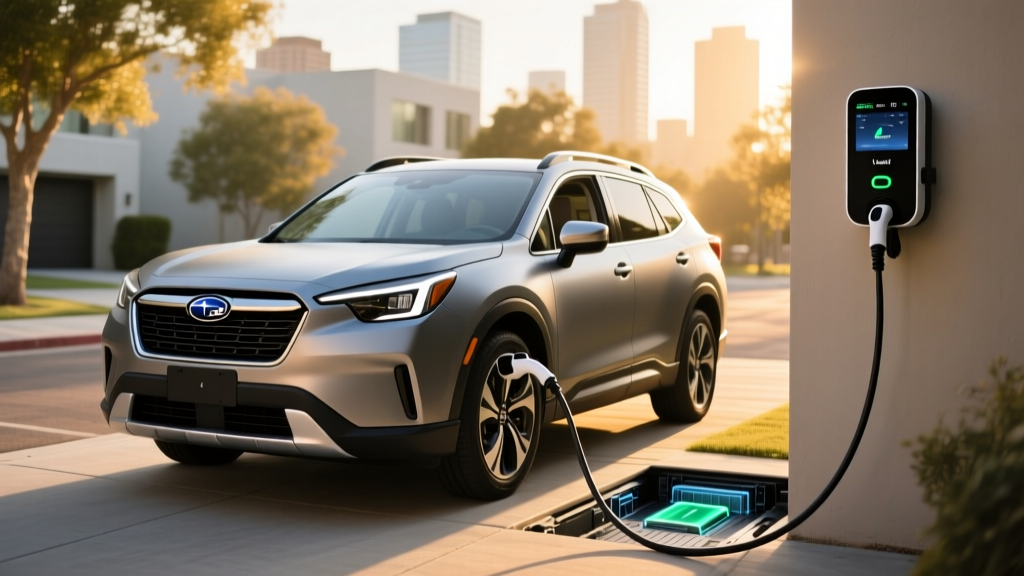
The 2026 Subaru Solterra Premium occupies a specific niche in the electric crossover market: it's the EV for buyers who want standard all-wheel drive, genuine ground clearance, and the Subaru brand's outdoorsy ethos — without paying luxury-EV prices. Built on the shared Toyota-Subaru e-TNGA platform alongside the Toyota bZ4X, the Solterra differentiates itself with Subaru's X-MODE traction system, 8.3 inches of ground clearance, and a more rugged design language. But with EPA range figures that trail competitors like the Hyundai Ioniq 5 and Tesla Model Y, the Solterra demands a clear-eyed look at what it does well and where it falls short.
This review covers the mid-tier Premium trim, which sits between the base model and the Touring, adding features like a panoramic glass roof, heated rear seats, and a 360-degree camera system. Here's everything you need to know about real-world range, charging behavior, ownership costs, and whether the 2026 Subaru Solterra Premium fits your driving life.
2026 Subaru Solterra Premium: Core Specifications
| Specification | 2026 Solterra Premium |
|---|---|
| EPA Range | 222 miles |
| Battery Capacity | 72.8 kWh (usable), lithium-ion (NMC chemistry) |
| Drivetrain | Dual-motor AWD (standard) |
| Horsepower | 215 hp (combined) |
| Torque | 248 lb-ft |
| 0–60 mph | 6.5 seconds |
| Max DC Fast Charge | 150 kW (peak) |
| 10–80% DC Charge Time | ~35 minutes |
| Level 2 Home Charging | 6.6 kW onboard charger (~25 mi/hr) |
| Efficiency | 104 MPGe combined / 32 kWh/100 mi |
| Ground Clearance | 8.3 inches |
| Cargo Volume (rear seats up) | 23.8 cu ft |
| Cargo Volume (rear seats folded) | 56.9 cu ft |
| Rear Legroom | 35.7 inches |
| Battery/Powertrain Warranty | 8 years / 100,000 miles |
| Base MSRP (Premium trim) | $41,995 (before destination) |
Real-World Range: What the EPA Number Doesn't Tell You
The 2026 Subaru Solterra Premium carries an EPA-estimated range of 222 miles on a full charge, according to fueleconomy.gov. That figure places it behind key competitors: the Hyundai Ioniq 5 AWD achieves 290 miles, and the Tesla Model Y Long Range AWD reaches 310 miles. The Solterra's efficiency of 104 MPGe combined (32 kWh per 100 miles) reflects the drag of its boxy SUV shape, all-terrain tires, and standard dual-motor AWD system.
EPA estimate: 222 miles
Highway driving (70–75 mph, moderate temps): expect ~180–195 miles before needing a charge stop.
Cold weather (below 32°F, mixed driving): plan for ~155–175 miles of usable range. The Solterra uses a resistive heater as a backup to its heat pump system, and cold temperatures reduce battery output while increasing cabin heating demands.
City/regenerative driving (mild temps): you may see 210–230 miles thanks to frequent regen braking opportunities.
The 72.8 kWh usable battery uses NMC (nickel manganese cobalt) chemistry, which prioritizes energy density over the longer cycle life of LFP (lithium iron phosphate) packs found in some competitors like the base Tesla Model 3. For most owners driving 30–40 miles daily, the Solterra's range means charging every 4–5 days at home. Road-trippers will need to plan DC fast-charging stops every 150–170 miles to maintain a comfort buffer — a meaningful limitation compared to 300+ mile rivals.
One practical note: the Solterra does not include a front trunk (frunk). The e-TNGA platform's motor and electronics packaging leaves no room under the hood, so all cargo goes in the rear. Subaru does offer a roof rail system rated for 165 pounds of dynamic load, which helps for gear-heavy outdoor trips.
Charging Speed: DC Fast Charging and Home Setup
Charging speed remains one of the Solterra's most debated specifications. The 2026 model peaks at 150 kW on a DC fast charger — a figure that improved from the original 2023 model's 100 kW cap through software and thermal management updates. However, 150 kW is still a moderate peak rate compared to the 240 kW available on the Ioniq 5 or the 250 kW on Tesla's V3 Superchargers.
| Charging Level | Power (kW) | Speed | Use Case |
|---|---|---|---|
| Level 1 (120V household) | ~1.2 kW | ~4 miles per hour | Emergency / overnight trickle |
| Level 2 (240V home charger) | 6.6 kW | ~25 miles per hour | Daily home charging; full charge in ~11 hours |
| DC Fast Charge (public) | 150 kW peak | 10–80% in ~35 min | Road trips; adds ~130 miles in 30 min |
Understanding the charge curve: Peak charge rate (kW) is not sustained across the entire session. The Solterra reaches its 150 kW peak only between roughly 10% and 30% state of charge (SoC) when the battery is properly preconditioned. Above 50% SoC, the rate tapers to approximately 80–90 kW, and above 80% it drops further to protect battery longevity. This is normal for NMC chemistry, but it means the full 10–80% session takes around 35 minutes — not the 18 minutes you'd see in a Hyundai Ioniq 5 with its 800V architecture.
Battery preconditioning: The Solterra will precondition its battery for faster DC charging when you navigate to a charging station using the built-in navigation system. If you arrive at a DC charger without preconditioning (for example, by using a third-party app to find the station), charge speeds may be significantly slower — particularly in cold weather. Always route through the car's nav system when heading to a fast charger.
Home charging setup: The 6.6 kW onboard charger means a full Level 2 charge from empty takes approximately 11 hours. Most owners installing a 48-amp Level 2 home charger (like a ChargePoint Home Flex or Emporia Level 2) on a 240V/60A circuit will wake up to a full battery every morning. Expect home installation costs between $500 and $2,000 depending on panel capacity and wiring distance — consult a licensed electrician for your specific setup. At an average US electricity rate of $0.16/kWh, fully charging the Solterra at home costs roughly $11.65, translating to about $0.05 per mile.
Performance and Driving Dynamics
The 2026 Solterra Premium uses a dual-motor all-wheel-drive setup producing 215 horsepower and 248 lb-ft of torque. The 0–60 mph time of 6.5 seconds is adequate for merging and passing but noticeably relaxed compared to the 5.0-second Ioniq 5 AWD or the 4.8-second Model Y Long Range. Subaru has tuned the Solterra for comfort and capability rather than acceleration thrills.
Where the Solterra earns its keep is off-pavement and in adverse conditions. Subaru's X-MODE system, carried over from its ICE lineup, provides selectable traction modes for snow, dirt, and deep snow/mud. The 8.3 inches of ground clearance exceeds most electric crossovers (the Ioniq 5 sits at 6.1 inches, the Model Y at 6.6 inches), making the Solterra genuinely usable on forest service roads and unplowed driveways. The 2,000-pound towing capacity is modest but sufficient for a small utility trailer or a pair of dirt bikes.
Ride quality is compliant and well-damped, absorbing rough pavement without the harshness some EVs transmit through their stiff, battery-heavy chassis. The steering is light and accurate, though not sporty. Regenerative braking offers adjustable levels via paddle shifters, but the Solterra does not offer true one-pedal driving that brings the car to a complete stop — you'll still need the brake pedal for final stops. This is a deliberate Subaru choice to mimic the feel of a conventional vehicle.
Interior, Cargo, and Technology
The Solterra Premium's cabin is functional and durable rather than luxurious. Cloth and synthetic leather upholstery comes standard on the Premium trim, along with heated front and rear seats, a heated steering wheel, and the panoramic fixed glass roof. The 12.3-inch touchscreen runs Subaru's Starlink infotainment system with wireless Apple CarPlay and Android Auto, built-in navigation, and a 360-degree surround-view camera.
Cargo and passenger space:
- Rear cargo (seats up): 23.8 cubic feet — competitive with the RAV4 Prime and slightly less than the Ioniq 5 (27.2 cu ft)
- Rear cargo (seats folded): 56.9 cubic feet — adequate for camping gear, furniture runs, or a week's groceries for a family of four
- Rear legroom: 35.7 inches — comfortable for adults, though tall passengers will note the sloping roofline cuts into headroom slightly
- No frunk: the absence of front-trunk storage is a missed opportunity for stowing charging cables or wet gear
Driver assistance (ADAS): The Solterra comes standard with Subaru EyeSight, which includes adaptive cruise control with lane centering, pre-collision braking, lane departure warning, and blind-spot detection with rear cross-traffic alert. EyeSight is a SAE Level 2 driver-assistance system — it supports steering and speed control but requires the driver to remain fully engaged and hands-on the wheel at all times. It is not a self-driving system and should not be treated as one. In IIHS testing, the Solterra has earned strong marks for crashworthiness, though EyeSight's real-world behavior in construction zones and faded lane markings can be conservative, sometimes disengaging unexpectedly.
Subaru EyeSight is an SAE Level 2 system. You must keep your hands on the steering wheel and eyes on the road. The system does not navigate intersections, respond to all traffic signals, or handle construction zones reliably. It will issue hands-on warnings and disengage if it detects inattention. Never treat it as autonomous driving.
Pricing, Trims, and Federal Tax Credit Eligibility
The 2026 Subaru Solterra is offered in three trims. The Premium trim reviewed here sits in the middle:
| Trim | Base MSRP | With Destination | Key Additions over Base |
|---|---|---|---|
| Base | $38,495 | $39,890 | Dual-motor AWD, EyeSight, 12.3" screen, heated front seats |
| Premium | $41,995 | $43,390 | Panoramic roof, heated rear seats, 360° camera, power liftgate |
| Touring | $45,495 | $46,890 | Ventilated seats, premium audio, digital rearview mirror, Nappa-style leather |
Federal EV Tax Credit (§30D) — 2026 Rules:
The Subaru Solterra is assembled in Japan (at Toyota's Motomachi plant), which affects federal tax credit eligibility under current IRS §30D rules. As of 2026, the final assembly requirement means that the Solterra does not qualify for the full $7,500 new clean vehicle credit, because vehicles must undergo final assembly in North America to be eligible. However, the Solterra may qualify for partial credit depending on how battery-component and critical-mineral sourcing requirements are evaluated in a given model year — Subaru has been working to adjust supply chains, but buyers should verify eligibility at the point of sale.
- Final assembly: Must occur in North America — Solterra is assembled in Japan (does not meet this requirement as of 2026)
- MSRP cap: SUVs must be under $80,000 — Solterra clears this easily
- Buyer income cap: AGI must not exceed $150,000 (single) / $300,000 (joint) — verify your MAGI
- Battery sourcing: Critical minerals and battery components must meet phased-in percentage thresholds — varies by model year
- Point-of-sale transfer: If eligible, the credit can be transferred to the dealer at purchase for an immediate price reduction
Bottom line on credits: Do not assume the Solterra qualifies for $7,500. Verify with your dealer and a tax professional before purchasing. Some state-level incentives (such as those in California, Colorado, and Massachusetts) may still apply regardless of assembly location — check your state's energy office for current programs.
Ownership Costs and Warranty
Subaru backs the Solterra with a competitive warranty package:
- Basic vehicle warranty: 3 years / 36,000 miles
- Powertrain warranty: 5 years / 60,000 miles
- EV battery warranty: 8 years / 100,000 miles (covers capacity loss below 70% of original)
- Rust perforation: 5 years / unlimited miles
The 8-year/100,000-mile battery warranty with a 70% capacity retention threshold is standard for the industry. If your battery degrades below 70% of its original 72.8 kWh capacity (meaning less than ~51 kWh usable) within the warranty period, Subaru will repair or replace it. Based on NMC battery degradation data from similar e-TNGA vehicles, expect roughly 8–12% capacity loss over the first 100,000 miles under normal use — meaning most owners will stay well above the warranty threshold.
Five-year estimated ownership cost: According to industry averages, the Solterra's total cost of ownership over five years and 75,000 miles includes approximately $2,400 in electricity (home charging at $0.16/kWh), $0 in oil changes or emissions maintenance, and roughly $6,500–$8,000 in insurance (EV insurance premiums run 15–25% higher than comparable ICE vehicles, per industry data). Depreciation is the largest cost factor — EVs in this segment have historically lost 45–55% of their value over five years, though this varies with market conditions.
How the Solterra Premium Stacks Up Against Competitors
| Spec | 2026 Solterra Premium | 2026 Ioniq 5 AWD | 2026 Model Y LR AWD | 2026 bZ4X Limited |
|---|---|---|---|---|
| EPA Range | 222 mi | 290 mi | 310 mi | 222 mi |
| Battery | 72.8 kWh | 77.4 kWh | 75 kWh (est.) | 72.8 kWh |
| DC Fast Charge Peak | 150 kW | 240 kW | 250 kW | 150 kW |
| 10–80% Time | ~35 min | ~18 min | ~20 min | ~35 min |
| Ground Clearance | 8.3 in | 6.1 in | 6.6 in | 8.1 in |
| 0–60 mph | 6.5 sec | 5.0 sec | 4.8 sec | 6.5 sec |
| MSRP (comparable trim) | $43,390 | $52,200 | $48,990 | $44,580 |
| NA Assembly (Credit?) | No | Yes (GA) | Yes (TX) | No |
The Solterra's closest sibling is the Toyota bZ4X, which shares the same platform, battery, and powertrain. The bZ4X offers a nearly identical driving experience at a similar price, so the choice between them comes down to brand preference and styling. The Ioniq 5 and Model Y dominate on range and charging speed, but neither offers the Solterra's ground clearance or X-MODE off-road capability. If your driving life includes dirt roads, ski areas, or unplowed driveways, the Solterra's capability advantage is real and measurable.
Pros and Cons: The Honest Summary
- Standard dual-motor AWD with genuine off-road capability (X-MODE, 8.3" clearance)
- Competitive pricing — under $44k with destination for the Premium trim
- Comfortable, compliant ride quality; well-suited to rough roads
- Comprehensive Subaru EyeSight safety suite standard
- Strong build quality and durable interior materials
- Heat pump for improved cold-weather efficiency
- 8-year/100,000-mile battery warranty
- 222-mile EPA range trails most competitors by 60–90 miles
- 150 kW peak DC charging; 10–80% takes ~35 minutes (nearly double some rivals)
- No frunk for additional storage
- Does not qualify for full $7,500 federal tax credit (Japan assembly)
- No true one-pedal driving mode
- Rear headroom compromised by sloping roofline
- Infotainment system is functional but not as responsive as competitors
Who Should Buy the 2026 Subaru Solterra Premium?
Choose the Solterra Premium if:
- You live in a region with snow, ice, or unpaved roads and need real AWD traction and ground clearance
- Your daily commute is under 60 miles round-trip and you have reliable home Level 2 charging
- You value a comfortable, quiet ride over sporty acceleration
- You're a current Subaru owner who trusts the brand and wants to go electric without switching ecosystems
- You rarely take road trips longer than 200 miles without an overnight stop
Look elsewhere if:
- You regularly drive 300+ mile highway trips and need fast DC charging to minimize stops
- Maximum range is your top priority (consider the Ioniq 5 or Model Y)
- You need the full $7,500 federal tax credit and your budget depends on it
- You want a frunk for charging cable storage or wet outdoor gear
- You prefer cutting-edge infotainment and one-pedal driving
The 2026 Subaru Solterra Premium is not the longest-range or fastest-charging EV in its class, and buyers fixated on spec-sheet dominance will find better numbers elsewhere. But for the specific buyer who needs a capable, all-weather electric crossover at a reasonable price — someone who drives to a trailhead in the rain, commutes 20 miles to work, and charges at home every night — the Solterra delivers exactly what Subaru has always delivered: honest, capable, all-conditions transportation. Just go in with clear eyes about the range and charging trade-offs.
Frequently Asked Questions
What is the real-world range of the 2026 Subaru Solterra Premium?
The EPA rates the Solterra Premium at 222 miles. In real-world highway driving at 70–75 mph in moderate temperatures, expect approximately 180–195 miles. In cold weather below freezing, plan for 155–175 miles. City driving with frequent regenerative braking can approach or slightly exceed the EPA estimate.
How fast does the Solterra charge at home and on the road?
At home on a Level 2 (240V) charger, the Solterra charges at 6.6 kW, adding roughly 25 miles of range per hour. A full charge from empty takes about 11 hours. On a DC fast charger, it peaks at 150 kW and charges from 10% to 80% in approximately 35 minutes. Always precondition the battery by navigating to the charger through the car's built-in nav system.
Does the 2026 Subaru Solterra qualify for the $7,500 federal EV tax credit?
As of 2026, the Solterra is assembled in Japan, which means it does not meet the North American final assembly requirement under IRS §30D. It may not qualify for the full credit. Always verify current eligibility with your dealer and consult a tax professional. State-level incentives may still apply.
Is the Solterra worth buying over the Hyundai Ioniq 5 or Tesla Model Y?
It depends on your priorities. If you need ground clearance, off-road traction modes, and all-weather capability, the Solterra offers advantages neither competitor can match. If range and charging speed are your top concerns, the Ioniq 5 (290 mi, 18-min 10–80%) and Model Y (310 mi, 20-min 10–80%) are objectively better road-trip vehicles.
What are the biggest drawbacks of the Solterra?
The three most significant limitations are its 222-mile EPA range (60–90 miles less than key rivals), its 35-minute 10–80% DC charging time, and its ineligibility for the full federal tax credit due to Japan assembly. The lack of a frunk and absence of one-pedal driving are secondary concerns.
How long will the Solterra's battery last?
The 72.8 kWh NMC battery is warrantied for 8 years or 100,000 miles against capacity loss below 70%. Based on degradation data from similar Toyota/Subaru e-TNGA vehicles, expect 8–12% capacity loss over 100,000 miles. With proper care (avoiding frequent 100% charges and deep discharges), the battery should provide reliable service well beyond the warranty period.