Quick Answer: Is a 2026 Subaru EV Right for You?
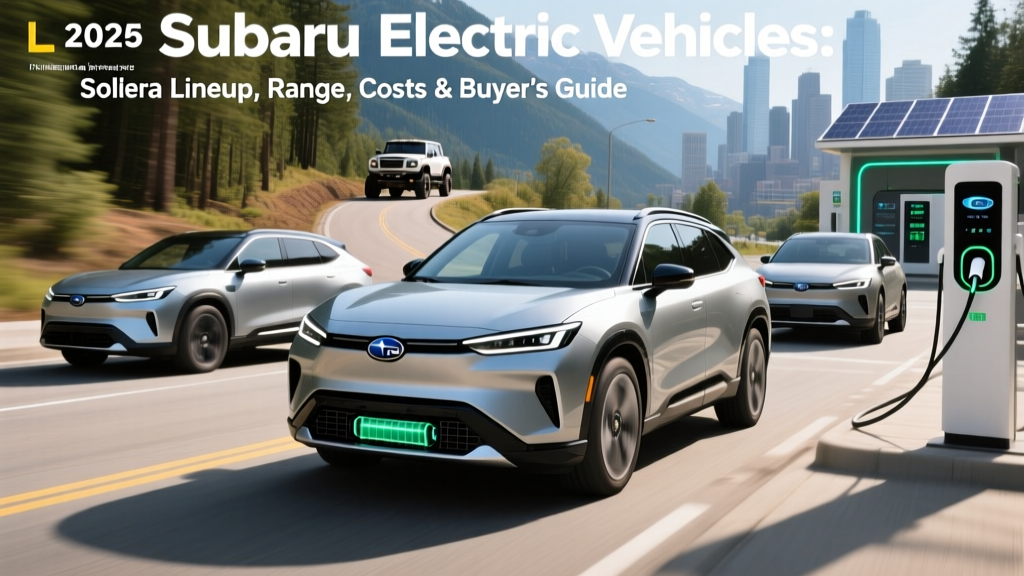
For 2026, Subaru's electric lineup centers on the Solterra, a compact electric SUV co-developed with Toyota (which sells it as the bZ4X). The 2026 Solterra delivers 227 miles of EPA-estimated range on its 72.8 kWh (usable) lithium-ion battery, standard Symmetrical All-Wheel Drive producing 215 horsepower, and DC fast charging up to roughly 100 kW. Pricing starts around $39,995 (base Premium trim). It qualifies for a partial or full federal tax credit under IRS §30D, though exact eligibility depends on battery-sourcing compliance, your income, and the $39,995+ MSRP. The Solterra is best for Subaru loyalists who need AWD, light off-road capability, and a practical daily commuter — but its modest range and average charging speed make it less ideal for frequent long-distance drivers compared to rivals like the Hyundai Ioniq 5 or Tesla Model Y.
The 2026 Subaru Solterra: What You're Actually Buying
Subaru's approach to electrification has been cautious. Rather than building an EV-only platform from scratch, Subaru partnered with Toyota on the e-TNGA architecture. The result is a vehicle that feels unmistakably like a Subaru — raised ride height, X-Mode for low-traction surfaces, 8.3 inches of ground clearance — but with an electric powertrain that, frankly, trails the segment leaders in efficiency and charging speed.
For 2026, Subaru has made incremental improvements to the Solterra's thermal management system, slightly improving DC fast-charge consistency in cold weather. However, the core hardware remains largely unchanged from the refreshed 2025 model year.
| Specification | Detail |
|---|---|
| EPA Range (AWD, 18" wheels) | 227 miles |
| EPA Range (AWD, 20" wheels) | 222 miles |
| Usable Battery Capacity | 72.8 kWh (Lithium-ion, NMC chemistry) |
| Drivetrain | Dual-motor Symmetrical AWD |
| Horsepower / Torque | 215 hp / 248 lb-ft |
| 0-60 mph | ~6.5 seconds |
| Max DC Fast Charge Rate | ~100 kW (peak) |
| 10-80% DC Fast Charge Time | ~35 minutes |
| Level 2 (240V) Charge Rate | 7.2 kW |
| Level 2 Full Charge Time | ~10.5 hours |
| Efficiency (combined) | 102 MPGe |
| Ground Clearance | 8.3 inches |
| Cargo Volume (rear seats up) | 27.7 cu ft |
| Battery/Powertrain Warranty | 8 years / 100,000 miles |
| Base MSRP (Premium trim) | $39,995 |
| Touring Trim MSRP | ~$46,995 |
Real-World Range Expectations
The EPA rates the 2026 Solterra at 227 miles with 18-inch wheels. In real-world highway driving at 70-75 mph, expect 190-210 miles before needing to charge. In cold weather (below 30°F), range can drop to 155-175 miles due to battery chemistry limitations and cabin heating demand. Subaru's standard heat pump helps mitigate this, but not as effectively as systems in the Ioniq 5 or Model Y. Plan road trips around ~170-mile legs in winter to maintain a safety buffer.
Charging the 2026 Solterra: Speeds, Connectors, and Real Costs
Charging is where the Solterra reveals its most significant competitive gap. While rivals like the Hyundai Ioniq 5 and Kia EV6 can peak at 240+ kW on DC fast chargers (achieving 10-80% in under 20 minutes), the Solterra tops out around 100 kW. That translates to longer stops on road trips.
| Charging Level | Power (kW) | Miles Added per Hour | Typical Use Case |
|---|---|---|---|
| Level 1 (120V household) | ~1.4 kW | ~5 miles/hr | Emergency top-up only |
| Level 2 (240V, 32A) | 7.2 kW | ~26 miles/hr | Home daily charging |
| DC Fast Charge (CCS) | ~100 kW peak | N/A (~35 min 10-80%) | Road trips, public charging |
The Solterra uses the CCS1 connector for DC fast charging. Subaru has not announced a transition to the NACS (Tesla-style) connector for the 2026 model year, though the brand has confirmed future models will adopt NACS. For now, you'll rely on Electrify America, EVgo, ChargePoint, and other CCS-compatible networks — or use a Tesla CCS adapter for access to Supercharger stalls that support CCS.
Cost to charge at home: At the national average electricity rate of ~$0.16/kWh, fully charging the Solterra's 72.8 kWh battery from empty costs roughly $11.65. Over 1,000 miles of driving (consuming about 35 kWh/100 mi), you'd spend approximately $56 in electricity. Compare that to a similarly sized gas SUV like the Subaru Outback getting 28 MPG combined: at $3.40/gallon, that same 1,000 miles would cost about $121 in fuel. That's roughly a $65 savings per 1,000 miles — or about $780/year if you drive 12,000 miles annually.
Solterra vs Gas Subaru: Cost and Ownership Comparison
Most Solterra shoppers cross-shop against the Subaru Outback or Forester. Here's how a 5-year ownership comparison looks between the Solterra Premium ($39,995) and a comparably equipped Outback Premium (~$34,500).
| Cost Category | 2026 Solterra AWD | 2026 Outback AWD (2.5L) |
|---|---|---|
| Purchase Price (MSRP) | $39,995 | $34,500 |
| Est. Federal Tax Credit (§30D) | Up to $7,500* | $0 |
| Effective Purchase Price | ~$32,495 | $34,500 |
| Fuel/Energy (5 years) | ~$3,900 | ~$7,250 |
| Maintenance (5 years) | ~$1,200 | ~$3,200 |
| Insurance (5-year est.) | ~$9,500 | ~$7,800 |
| 5-Year Total (before depreciation) | ~$47,095 | ~$52,750 |
*Federal tax credit eligibility depends on battery critical-mineral sourcing, buyer income caps ($150K single / $300K joint), and MSRP limits ($80K for SUVs). Verify current-year rules at IRS.gov. Point-of-sale transfer is available at participating dealers.
The Solterra's higher insurance premiums (typically 15-25% more than gas equivalents) partially offset its fuel and maintenance savings. EVs generally cost more to insure due to higher repair costs after collisions and battery replacement valuations. Get quotes before purchasing — your mileage will vary significantly by state, age, and driving record.
First-Time EV Buyer: What to Know Before Choosing the Solterra
Common EV Misconceptions — Addressed with Facts
| Myth | Fact |
|---|---|
| "EV batteries need replacing every few years." | Subaru warrants the Solterra battery for 8 years/100,000 miles against capacity loss below 70%. Real-world data from similar NMC packs shows 8-12% degradation after 100,000 miles, meaning you'd still have ~200 miles of range. |
| "I can't drive an EV in cold weather." | You can, but expect 20-30% range loss below freezing. The Solterra's heat pump helps, but preconditioning while plugged in is essential to preserve range. |
| "Public charging is unreliable everywhere." | Network uptime varies. Electrify America and Tesla Superchargers consistently report 90%+ uptime. Use PlugShare to check stations along your regular routes before buying. |
| "Home charging installation is prohibitively expensive." | A basic Level 2 (240V/32A) install on an existing 200-amp panel typically costs $500-$1,500 for equipment plus electrician labor. Panel upgrades (to 200A) add $1,500-$3,500 but are only needed in older homes. |
| "The Solterra can tow like a gas Subaru." | The Solterra is rated for only 2,000 lbs towing. The gas Outback tows up to 3,500 lbs. If you tow a camper or boat regularly, the Solterra is not the right fit. |
Home Charging Reality Check
The Solterra's 7.2 kW Level 2 onboard charger is slower than the 11.5 kW chargers found in the Ioniq 5 or Ford Mustang Mach-E. That means overnight charging is fine (you'll replenish ~200 miles in 8 hours), but if you arrive home nearly empty, a full charge takes 10+ hours. This matters if you drive 100+ miles daily and can't charge at work.
If you cannot install home charging — because you rent, live in an apartment, or have street parking only — the Solterra's modest DC fast-charge speed becomes a more serious limitation. Relying solely on public Level 2 chargers or DC fast charging is more expensive ($0.30-$0.48/kWh at public DC stations) and less convenient. Evaluate your charging access honestly before committing.
Decision Framework: Should You Buy the 2026 Solterra?
Choose the Solterra If:
- You want AWD and light off-road capability in an EV. The Solterra's X-Mode and 8.3 inches of ground clearance are genuinely useful for snow, dirt roads, and trailheads — areas where most EV crossovers fall short.
- Your daily commute is under 80 miles round-trip. With 227 EPA miles, the Solterra handles daily driving easily with home charging, even accounting for weather and aging.
- You're a Subaru loyalist who values the brand's safety reputation, dealer network, and EyeSight driver-assist suite (SAE Level 2 — requires active driver supervision).
- You qualify for the federal tax credit. With the credit, the Solterra's effective price drops to the low $30K range, making it competitive with gas alternatives on purchase price alone.
- You have reliable home charging access (garage or driveway with a 240V outlet).
Look Elsewhere If:
- You frequently drive 250+ miles between charges. The Solterra's ~200-mile real-world highway range and 35-minute 10-80% charge time make it one of the slower road-trip EVs. The Ioniq 5 (303 mi EPA, 18-min charge) or Model Y (320 mi EPA, 20-min charge) are far better.
- You need fast public charging. If you rely on DC fast charging regularly, the Solterra's ~100 kW peak rate will frustrate you. Rivals charging at 200-250 kW cut wait times nearly in half.
- You tow more than 2,000 lbs. Consider a Ford F-150 Lightning, Rivian R1S, or stick with a gas/hybrid SUV.
- You want cutting-edge EV tech. The Solterra's infotainment, one-pedal driving implementation, and charge speeds reflect Toyota/Subaru's conservative approach. It's competent but not class-leading.
2026 Subaru EV Lineup: Beyond the Solterra
As of early 2026, the Solterra remains Subaru's only battery-electric vehicle available in the US market. Subaru has announced plans for additional EVs — including a larger three-row electric SUV expected around 2027 — but these are not yet available for purchase or pre-order with confirmed specs.
Subaru has also expanded its plug-in hybrid (PHEV) offerings as a bridge for buyers not ready to go fully electric. The Crosstrek Hybrid (PHEV) remains in the lineup with approximately 17 miles of electric-only range before the gas engine engages. For buyers who lack home charging or frequently drive remote areas, a Subaru PHEV or conventional hybrid (like the Outback Hybrid) may be a more practical choice today.
Safety, Warranty, and Resale Considerations
The 2026 Solterra earned the IIHS Top Safety Pick+ designation, with standard EyeSight 4.0 providing automatic emergency braking, adaptive cruise control, and lane-centering assist. Note that EyeSight is a SAE Level 2 driver-assistance system — it does not drive the car autonomously and requires your hands on the wheel and eyes on the road at all times.
Subaru's battery warranty covers 8 years/100,000 miles, with a capacity retention threshold of 70%. This is in line with industry standards (most competitors offer 8 years/100,000 miles). The vehicle limited warranty is 3 years/36,000 miles, with a 5-year/60,000-mile powertrain warranty.
EV resale values have been volatile. The Solterra experienced steeper-than-average depreciation in its first two model years (2023-2024), partly due to the competitive segment and middling charging speeds. If you plan to sell or trade in within 3-4 years, factor in potentially higher depreciation than a gas Subaru. Leasing may be the smarter financial move, especially since some lease structures pass the $7,500 commercial clean vehicle credit through as a lease incentive — consult your tax professional for current rules.
Frequently Asked Questions
Does the 2026 Subaru Solterra qualify for the $7,500 federal tax credit?
Partially or fully, depending on current-year battery-sourcing compliance. Under IRS §30D, the credit is split into two halves: $3,750 for critical-minerals sourcing and $3,750 for battery-component sourcing. The Solterra's battery supply chain has been improving, but you must verify eligibility at the point of sale or on fueleconomy.gov. Buyer income caps ($150K single / $300K joint AGI) and the $80,000 MSRP cap for SUVs also apply.
How does the Solterra compare to the Toyota bZ4X?
They share the e-TNGA platform, battery, and powertrain, but the Solterra includes standard AWD (the bZ4X offers FWD on its base trim), more ground clearance, X-Mode, and Subaru's EyeSight safety suite. The bZ4X FWD variant achieves slightly higher EPA range (~252 miles) due to the single-motor configuration. Pricing is comparable.
Can I use Tesla Superchargers with the 2026 Solterra?
Not natively — the Solterra uses the CCS1 connector. However, you can purchase a Tesla-approved CCS adapter (~$250) to access Tesla Superchargers that support non-Tesla CCS vehicles. Subaru has confirmed future models will adopt the NACS connector, but the 2026 Solterra retains CCS.
What is the real-world highway range of the Solterra?
Expect approximately 190-210 miles at 70-75 mph in moderate temperatures (50-80°F). In cold weather (below 30°F), range drops to roughly 155-175 miles. The EPA's 227-mile estimate reflects a mixed city/highway cycle; sustained highway driving is less efficient for EVs due to the lack of regenerative braking opportunities.
Is the Solterra good for off-road driving?
For light off-road use — fire roads, snowy passes, muddy trailheads — yes. The 8.3 inches of ground clearance, X-Mode traction management, and AWD torque distribution are genuinely capable. For serious rock-crawling or deep sand, it's not a dedicated off-roader. Think of it as a raised electric crossover with real all-weather chops, similar to a lifted Outback.
How long will the Solterra battery last before replacement?
Based on NMC battery degradation data from similar platforms, expect 8-12% capacity loss over 100,000 miles and 8 years. That means a Solterra with 227 miles of range when new would retain approximately 200-208 miles after 100,000 miles. Full battery replacement (if needed out of warranty) is estimated at $12,000-$18,000 based on current pricing for similar-capacity packs, though costs are projected to decline. The 8-year/100,000-mile warranty protects against premature degradation below 70% capacity.