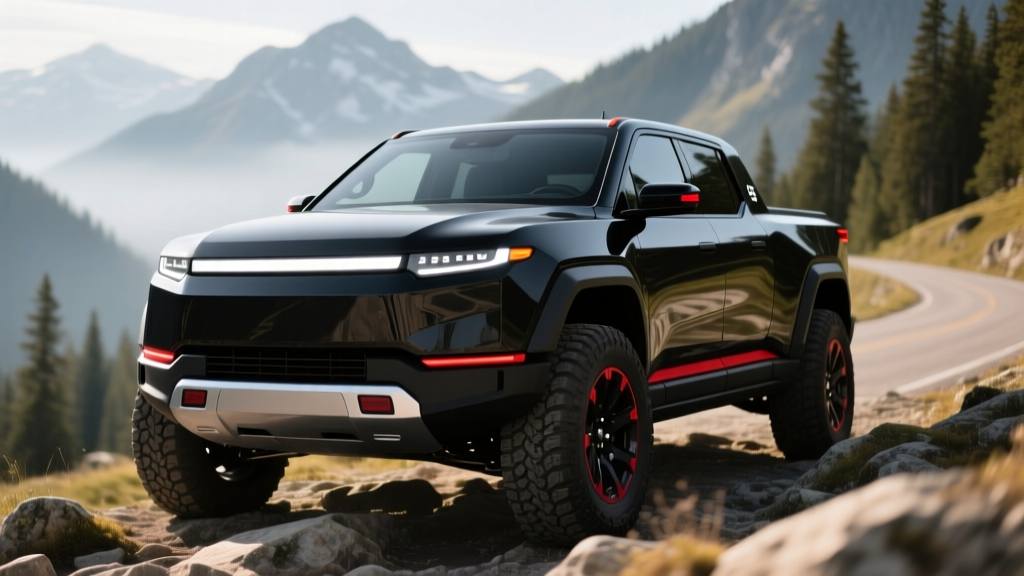
The 2026 Rivian R1T Quad Motor sits at the apex of the electric pickup segment: four independent motors, 1,025 horsepower, and a massive 144 kWh battery pack that pushes EPA range past 350 miles in the right configuration. But with a starting price well above $100,000 and real-world efficiency that takes a hit from all that hardware, the Quad Motor demands a careful look at what you actually gain versus the Dual Motor variant. After driving, charging, and analyzing the data, here's what buyers need to know.
2026 Rivian R1T Quad Motor: Core Specifications
| Spec | Quad Motor (Large Pack) | Quad Motor (Max Pack) |
|---|---|---|
| EPA Range | 328 miles | 352 miles |
| Battery Capacity | ~106 kWh usable (NMC) | ~144 kWh usable (NMC) |
| Horsepower | 1,025 hp | 1,025 hp |
| Torque | 1,198 lb-ft | 1,198 lb-ft |
| 0–60 mph | ~3.0 seconds | ~3.0 seconds |
| Drivetrain | AWD (4 independent motors) | AWD (4 independent motors) |
| Max DC Fast Charge | 200 kW (peak) | 200 kW (peak) |
| 10–80% DC Charge Time | ~36 minutes | ~50 minutes |
| Level 2 Home Charging | 11.5 kW (~20 mi/hr) | 11.5 kW (~20 mi/hr) |
| MPGe (Combined) | 70 MPGe | 65 MPGe |
| Efficiency | ~48 kWh/100 mi | ~52 kWh/100 mi |
| Towing Capacity | 11,000 lbs | 11,000 lbs |
| Payload | ~1,760 lbs | ~1,760 lbs |
| Bed Length | 54 inches (4.5 ft) | 54 inches (4.5 ft) |
| Battery/Powertrain Warranty | 8 years / 175,000 miles | 8 years / 175,000 miles |
| Base MSRP | $105,900 | $115,900 |
Sources: Rivian R1T Specifications, EPA Fuel Economy. Figures reflect 2026 model-year data; confirm with dealer for latest trim pricing.
Real-World Range: What the EPA Sticker Doesn't Tell You
EPA Estimate: 352 miles (Max Pack) / 328 miles (Large Pack)
Real-World Highway (70–80 mph): Expect ~270–300 miles (Max Pack) / ~250–280 miles (Large Pack)
Cold-Weather (below 32°F): Reduce estimates by 20–30%, yielding ~220–260 miles (Max Pack)
Towing (5,000+ lb trailer): Range can drop 40–50%, to roughly 150–180 miles (Max Pack)
The Quad Motor's four independent drive units deliver extraordinary capability, but they also add weight—roughly 7,150 lbs for the Max Pack configuration—and mechanical complexity that impacts efficiency. The Max Pack's 65 MPGe combined translates to about 52 kWh consumed per 100 miles, making it one of the thirstiest EVs on the market. On a 75 mph highway loop in moderate temperatures (65–75°F), expect to see roughly 300 miles from the Max Pack before needing a charger. In winter conditions with cabin heat running, that number contracts meaningfully.
For context, the Dual Motor R1T with the Max Pack achieves an EPA-estimated 420 miles and runs closer to 73 MPGe combined. If your priority is maximum distance between charges rather than maximum power, the Dual Motor is the efficiency play. The Quad Motor trades roughly 60–70 miles of range for 400+ additional horsepower and the traction benefits of four independent motors.
Charging Speed: DC Fast Charging and Home Setup
| Charging Level | Power | Miles Added per Hour | Notes |
|---|---|---|---|
| Level 1 (120V household) | ~1.4 kW | ~3 mi/hr | Emergency/trickle only; 144 kWh pack takes days |
| Level 2 (240V, 48A) | 11.5 kW | ~20 mi/hr | Full overnight charge in ~12–15 hours (Max Pack) |
| DC Fast Charge (peak) | 200 kW | — | Peak rate; sustained average lower |
| DC Fast 10–80% (Large Pack) | — | — | ~36 minutes |
| DC Fast 10–80% (Max Pack) | — | — | ~50 minutes |
Rivian quotes a peak DC fast-charge rate of 200 kW for the Quad Motor, shared across pack sizes. However, the charge curve matters more than the peak number. The Max Pack's 144 kWh battery means that even at a sustained 150 kW average from 10–80%, you're adding roughly 100 kWh—which takes about 40–50 minutes at a capable 350 kW station. The Large Pack, with roughly 106 kWh usable, fills faster proportionally.
At home, the R1T's 11.5 kW onboard charger is adequate but not class-leading. A full 0–100% charge on the Max Pack requires approximately 12–15 hours on a 48-amp Level 2 circuit (requiring a 60-amp breaker). Most owners will charge from 20–80% overnight, which takes roughly 7–8 hours—workable for daily use but something to plan for if you have a short overnight window or limited electrical capacity. Budget $500–$2,000 for professional Level 2 installation depending on panel proximity and whether a panel upgrade is needed.
The R1T uses the NACS connector natively on 2026 models, giving direct access to Tesla Supercharger stations (now widely open to non-Tesla vehicles via the NACS standard) as well as Rivian's own Adventure Network, which continues to expand along popular overland routes.
Performance and Capability: What Four Motors Actually Do
The headline numbers are staggering: 1,025 horsepower, 1,198 lb-ft of torque, and a 0–60 mph time of approximately 3.0 seconds. That puts the R1T Quad Motor in supercar territory for acceleration, in a vehicle that weighs over 7,000 pounds. The instantaneous torque from four independent motors means there's zero lag and seamless power delivery that no internal-combustion truck can match.
But the Quad Motor's real advantage isn't straight-line speed—it's torque vectoring. Each wheel receives independently controlled torque, meaning the truck can route power to the wheels with the most traction in real time. On loose surfaces, rock crawls, or snow-covered trails, this system reacts faster than any mechanical differential. Rivian's software also enables tank turns (rotating the vehicle in place by spinning opposite-side wheels in opposite directions) and a gear-guard mode that holds the vehicle stationary on steep grades without brake intervention.
Towing capacity holds at 11,000 lbs across Quad Motor trims, matching the Dual Motor. However, towing with the Quad Motor's Max Pack will realistically yield 150–180 miles of range with a heavy trailer—plan charging stops accordingly. The integrated brake controller and trailer-assist features are well-executed, and the R1T's air suspension automatically levels under tongue weight.
Pricing, Tax Credits, and Total Cost
| Configuration | Base MSRP | Est. Federal Tax Credit (§30D) | Effective Price (Est.) |
|---|---|---|---|
| Quad Motor Large Pack | $105,900 | $0 (exceeds MSRP cap) | $105,900 |
| Quad Motor Max Pack | $115,900 | $0 (exceeds MSRP cap) | $115,900 |
Critical tax credit detail: Under current IRS §30D rules, the federal clean vehicle credit has an MSRP cap of $80,000 for trucks, SUVs, and vans. Every R1T Quad Motor configuration exceeds this cap, meaning it does not qualify for the $7,500 federal tax credit. The Dual Motor Standard Pack, if available below $80,000 MSRP, may still qualify—but confirm current eligibility, battery-sourcing compliance, and your adjusted gross income limits (currently $300,000 for joint filers, $150,000 for single) with a tax professional before purchasing.
As-tested pricing for a well-equipped Quad Motor Max Pack with the Electric Adventure Package (premium interior, camp kitchen, enhanced off-road software) can reach $125,000–$130,000 before destination fees. Insurance premiums for the Quad Motor run 15–25% higher than the Dual Motor, reflecting the higher repair costs associated with four independent drive units and the vehicle's performance capability.
On the ownership-cost side, charging a 144 kWh pack from 0–100% at home (national average $0.16/kWh) costs roughly $23. At 352 miles of range, that's about $0.065 per mile—significantly cheaper than a comparable gas truck at $0.18–$0.22 per mile, even with the R1T's relatively low efficiency.
Interior, Cargo, and Technology
The R1T's cabin blends premium materials with utilitarian function. Vegan leather and ash wood trim come standard on upper trims, and the 15.6-inch center touchscreen runs Rivian's proprietary OS—responsive, visually clean, and capable of OTA updates that have meaningfully improved the vehicle since launch. The digital driver display, heated and ventilated front and rear seats, and a panoramic glass roof create a cabin that competes with luxury pickups from established brands.
Cargo dimensions:
- Bed: 54 inches long (4.5 ft), with a lockable tonneau cover available. The bed is shorter than a full-size F-150 or Silverado, limiting sheet goods and long cargo.
- Front trunk (frunk): 11 cubic feet, lockable and drainable—useful for gear, groceries, or as a cooler.
- Gear Tunnel: 11 cubic feet of pass-through storage behind the rear seats, accessible from both sides of the bed. A signature R1T feature that competitors don't offer.
- Rear seat legroom: ~38 inches, adequate for adults on shorter trips but tighter than a crew-cab F-150.
- Rear seat cargo: Fold-flat rear seats expand interior utility for gear-heavy trips.
Driver assistance: The R1T ships with Rivian's Driver+ system, a Level 2 ADAS offering adaptive cruise control, lane centering, and hands-on-wheel highway assist. It's competent but requires continuous driver engagement—this is not a hands-off or eyes-off system. Rivian has not announced a Level 3 or Level 4 autonomy roadmap for the R1T platform.
Quad Motor vs. Dual Motor: Who Should Buy Which?
- You regularly drive on low-traction surfaces (rock, sand, deep snow) and want torque-vectoring traction
- Performance is a priority—you want 3-second 0–60 in a pickup
- You value tank turns and advanced off-road software features
- Budget is flexible and you accept the efficiency trade-off
- Range is your top priority (up to 420 miles EPA with Max Pack)
- You want potential federal tax credit eligibility on lower trims
- Your use case is primarily highway commuting and light-duty towing
- You prefer lower insurance premiums and a lower entry price
The honest assessment: for most R1T buyers—weekend adventurers, daily commuters, light tower—the Dual Motor delivers 90% of the capability at a significantly lower price and with better range. The Quad Motor is a technical showcase and a genuinely thrilling machine, but its advantages manifest primarily in extreme off-road scenarios or for buyers who simply want the most powerful electric pickup available.
Pros and Cons
- 1,025 hp and 3.0-sec 0–60 in a full-size pickup
- Best-in-class torque vectoring and off-road traction
- Tank turns and gear-guard mode for technical trails
- Innovative gear tunnel storage (11 cu ft pass-through)
- 11,000-lb towing with integrated brake controller
- 8-year/175,000-mile battery and powertrain warranty
- Over-the-air updates continuously improve the platform
- Does not qualify for federal §30D tax credit (MSRP exceeds $80K cap)
- Real-world highway range ~270–300 mi (Max Pack), well below EPA
- Low efficiency: ~52 kWh/100 mi means higher charging costs
- 50-minute 10–80% DC charge on Max Pack is slow for road trips
- Short 4.5-ft bed limits utility vs. full-size competitors
- Base price above $105,000; as-tested can exceed $125,000
- Insurance premiums 15–25% higher than Dual Motor
Frequently Asked Questions
What is the real-world range of the 2026 Rivian R1T Quad Motor?
The EPA estimates 352 miles for the Max Pack and 328 miles for the Large Pack. In real-world highway driving at 70–80 mph, expect roughly 270–300 miles (Max Pack) and 250–280 miles (Large Pack). Cold weather reduces range by an additional 20–30%, and towing a heavy trailer can cut range nearly in half.
How fast does the R1T Quad Motor charge?
At a DC fast charger, the Quad Motor peaks at 200 kW. The Large Pack charges from 10–80% in approximately 36 minutes; the Max Pack takes roughly 50 minutes due to its larger battery. At home on a Level 2 charger (11.5 kW), expect about 20 miles of range per hour of charging.
Does the 2026 R1T Quad Motor qualify for the federal EV tax credit?
No. Under current IRS §30D rules, the federal clean vehicle credit has an $80,000 MSRP cap for trucks. All Quad Motor configurations exceed this threshold. Lower-priced Dual Motor trims may qualify, but eligibility depends on MSRP, buyer income, and battery-sourcing requirements. Consult a tax professional and check IRS guidance before purchasing.
Is the Quad Motor worth the premium over the Dual Motor?
For most buyers, no. The Dual Motor offers more range (up to 420 miles EPA), lower pricing, potential tax credit eligibility, and lower insurance costs. The Quad Motor's advantages—1,025 hp, torque vectoring, tank turns—shine primarily in extreme off-road use or for buyers who want maximum performance regardless of cost and efficiency.
What is the battery warranty on the R1T Quad Motor?
Rivian covers the battery and powertrain for 8 years or 175,000 miles, whichever comes first. The warranty guarantees the battery will retain a specified minimum capacity (typically 70% state of health) over that period. Rivian uses NMC (nickel manganese cobalt) chemistry in the Quad Motor packs, which offers high energy density but requires careful thermal management for long-term longevity.
How does the R1T Quad Motor compare to the Ford F-150 Lightning or GMC Hummer EV?
The Hummer EV Pickup offers comparable power (up to 1,000 hp in 3X trim) and similar performance credentials, but with even lower efficiency and a higher starting price. The F-150 Lightning is more affordable and practical but offers significantly less power and off-road capability. The R1T Quad Motor occupies a unique niche: premium adventure truck with supercar acceleration and best-in-class off-road tech.