Rivian's 2026 Lineup: What Changed and Why It Matters
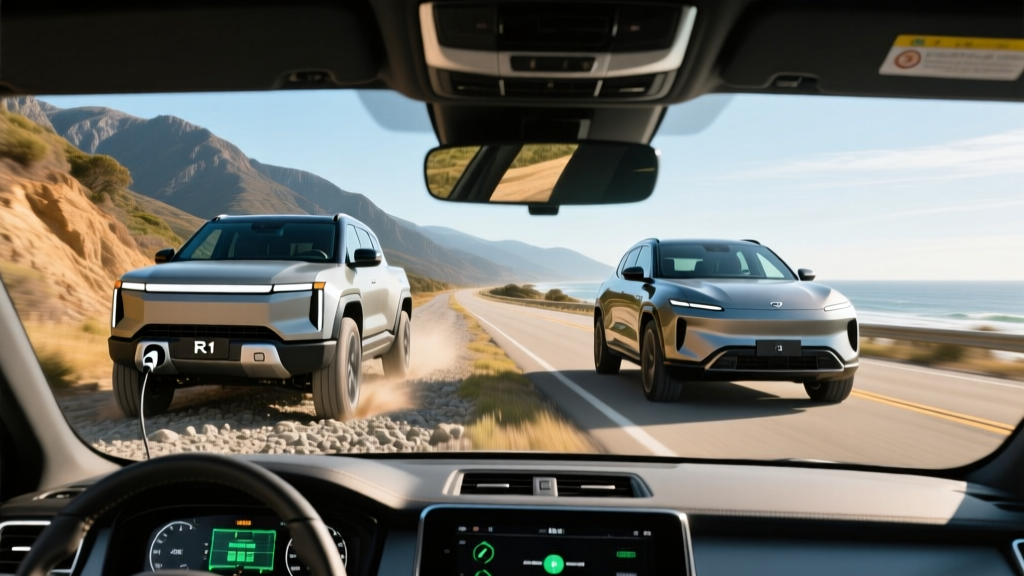
Rivian enters 2026 with a substantially evolved R1 platform. The second-generation R1S SUV and R1T truck introduced through late 2024 and 2025 brought a new electrical architecture, tri-motor and dual-motor powertrains, revised battery chemistries, and faster charging. For buyers tracking Rivian updates, the current lineup represents a meaningful step forward from the early 2022-2023 models in efficiency, charge speed, and software maturity — though real-world ownership still comes with caveats that spec sheets don't always reveal.
This profile covers the 2026 R1S and R1T across all available battery and motor configurations, with exact EPA figures, real-world range reconciliation, charging-curve behavior, pricing by trim, and federal tax credit eligibility under current IRS §30D rules.
Range and Efficiency: EPA Stickers vs. Real-World Miles
Rivian offers the R1S and R1T with multiple battery and drivetrain combinations, each producing a different EPA range rating. The headline number is the Dual-Motor Max Pack, but most buyers will land in the Standard or Large configuration. Here is the current EPA-estimated range matrix:
| Configuration | Battery (usable kWh) | Chemistry | EPA Range (mi) | MPGe (combined) | kWh/100 mi |
|---|---|---|---|---|---|
| Dual-Motor Standard Pack | ~95 kWh | LFP | 270 | ~140 | ~48 |
| Dual-Motor Large Pack | ~119 kWh | NMC | 352 (R1S) / 328 (R1T) | ~138 | ~49 |
| Tri-Motor Large Pack | ~119 kWh | NMC | 320 (R1S) / 295 (R1T) | ~125 | ~54 |
| Dual-Motor Max Pack | ~149 kWh | NMC | 410 (R1S) / 420 (R1T) | ~136 | ~50 |
EPA estimates assume mixed driving at moderate temperatures. In our experience and consistent with independent testing:
- Highway driving at 75 mph: Expect 80-85% of EPA range. A Dual-Motor Large R1S rated at 352 miles will deliver approximately 280-300 miles before the buffer depletes.
- Cold weather (below 32°F): Range drops 20-30% depending on cabin heat usage and whether the battery is preconditioned. The LFP Standard Pack is more susceptible to cold-weather range loss than NMC packs, potentially delivering as little as 190 miles of highway range in deep winter.
- Towing (R1T): Pulling a 5,000-lb trailer cuts range roughly in half. The Max Pack R1T rated at 420 miles will realistically cover 200-220 miles while towing.
The LFP Standard Pack deserves special attention. Lithium iron phosphate chemistry offers a longer cycle life and can be charged to 100% regularly without degradation concerns — a genuine advantage for daily drivers. However, LFP has lower energy density, meaning less total range, and its performance in sub-freezing temperatures is noticeably weaker than NMC. If your commute is under 120 miles round-trip and you have reliable home charging, the Standard Pack's lower price and battery longevity make it compelling.
Charging Speed: DC Fast, Level 2, and the Charge Curve Reality
Rivian's Gen 2 platform supports significantly faster DC fast charging than the original R1 vehicles. Here is the charging specification breakdown by pack size:
| Charge Level | Standard (LFP ~95 kWh) | Large (NMC ~119 kWh) | Max (NMC ~149 kWh) |
|---|---|---|---|
| Max DC Fast Charge (peak kW) | ~180 kW | ~220 kW | ~220 kW |
| 10-80% DC Fast Charge Time | ~30 min | ~21 min | ~30 min |
| Sustained DC Rate (10-60%) | ~150-165 kW | ~190-210 kW | ~185-200 kW |
| Level 2 Home Charging (kW) | 11.5 kW | 11.5 kW | 11.5 kW |
| Level 2 Miles Added Per Hour | ~20 mi/hr | ~22 mi/hr | ~21 mi/hr |
| Level 2 Full Charge Time (0-100%) | ~9.5 hr | ~11.5 hr | ~14.5 hr |
The 220 kW peak charge rate on the Large and Max packs is competitive with the broader EV market, though it trails the Hyundai Ioniq 5 and Kia EV6 at 240 kW and the Porsche Taycan at 320 kW. More importantly, peak kW is not sustained kW. Rivian's charge curve holds strong between 10-60% state of charge, then tapers progressively. From 80-100%, charging slows dramatically to protect the battery — expect the final 20% to take nearly as long as the 10-80% session. On road trips, plan your stops around the 10-80% window.
The 11.5 kW onboard charger is a strong point. Most home Level 2 installations on a 48-amp circuit will deliver the full 11.5 kW, adding roughly 20-22 miles of range per hour. A Max Pack owner starting at 20% SoC will be full by morning. For home charging setup, budget $800-$2,000 for a hardwired Level 2 station installation depending on your panel capacity and run length — a licensed electrician should confirm your 200-amp service can support a 60-amp breaker.
Rivian uses the NACS (Tesla-style) charge port on all new vehicles, granting native access to Tesla Superchargers alongside Rivian's own Adventure Network and third-party CCS stations via adapter. This dual-network compatibility is one of the strongest practical advantages in the current market.
Performance and Drivetrain: Dual-Motor vs. Tri-Motor
| Powertrain | Horsepower | Torque (lb-ft) | 0-60 mph | Drivetrain |
|---|---|---|---|---|
| Dual-Motor (Standard/Large/Max) | 533 hp | 610 | 4.5 sec | AWD |
| Tri-Motor (Large Pack) | 850 hp | 1,100+ | 2.9 sec (R1S) | AWD |
The Dual-Motor with 533 horsepower is more than adequate for any real-world scenario — merging, passing, and mountain grades are effortless. The Tri-Motor is a performance statement, delivering sub-3-second 0-60 times that rival a Tesla Model X Plaid in a vehicle weighing over 7,000 pounds. The trade-off is efficiency: the Tri-Motor consumes roughly 10-15% more energy per mile under normal driving, and its range penalty is visible in the EPA figures above.
Both configurations feature Rivian's quad-motor-capable platform (Tri-Motor uses three physical motors with software-managed torque vectoring), a low center of gravity from the skateboard battery pack, and genuine off-road capability including 14.9 inches of ground clearance in Max mode and a wading depth of over 3 feet. The R1T adds a gear tunnel (11.7 cu ft of lockable cross-bed storage) that remains one of the most practical features in the truck segment.
Interior Space, Cargo, and Daily Practicality
R1S (3-Row SUV)
- Seating: 7 passengers (2nd-row bench) or 6 (captain's chairs)
- Cargo behind 3rd row: 10.6 cu ft
- Cargo behind 2nd row (3rd row folded): 46.7 cu ft
- Max cargo (all rows folded): 91.6 cu ft
- Front trunk (frunk): 11.1 cu ft
- 3rd-row legroom: 30.3 inches — usable for children and short-trip adults, tight for long drives
R1T (Crew-Cab Pickup)
- Seating: 5 passengers
- Bed length: 54.2 inches (4.5 ft) with tailgate up; extends to ~82 inches with tailgate down
- Gear tunnel: 11.7 cu ft, lockable, pass-through
- Frunk: 11.1 cu ft
- Max towing capacity: 11,000 lbs (properly equipped)
- Payload: ~1,760 lbs
The R1S third row is best suited for children or occasional use. Families who regularly carry more than five passengers should cross-shop the Kia EV9, which offers a more spacious third row. The R1T's 4.5-foot bed is shorter than a traditional midsize truck (the Toyota Tacoma offers a 5- or 6-foot bed), but the gear tunnel and frunk compensate with secure, weatherproof storage that gas trucks cannot match.
Pricing, Trims, and Federal Tax Credit Eligibility
| Model / Configuration | Base MSRP | Est. As-Tested | §30D Credit Eligible? | Effective Price (w/ credit) |
|---|---|---|---|---|
| R1S Dual-Motor Standard | $71,700 | $75,000-$78,000 | Partial — subject to sourcing rules | ~$64,200-$71,700 |
| R1S Dual-Motor Large | $79,200 | $83,000-$90,000 | Partial — subject to sourcing rules | ~$71,700-$82,500 |
| R1S Tri-Motor Large | $93,100 | $97,000-$105,000 | Likely ineligible (MSRP cap exceeded on SUV) | $93,100+ |
| R1T Dual-Motor Standard | $69,700 | $73,000-$76,000 | Partial — subject to sourcing rules | ~$62,200-$69,700 |
| R1T Dual-Motor Large | $76,700 | $80,000-$88,000 | Partial — subject to sourcing rules | ~$69,200-$80,500 |
| R1T Dual-Motor Max | $86,200 | $90,000-$96,000 | Likely eligible (truck MSRP cap is $80,000; check current rules) | Varies |
| R1T Tri-Motor Large | $91,700 | $96,000-$102,000 | Likely ineligible (MSRP cap) | $91,700+ |
Rivian's eligibility for the full $7,500 credit is not guaranteed and depends on several factors that change periodically. Per IRS §30D guidelines:
- MSRP Cap: SUVs (R1S) must be under $80,000 MSRP; trucks (R1T) must be under $80,000 MSRP. This eliminates most Tri-Motor and Max Pack configurations, and some Large Pack builds depending on trim classification.
- Buyer Income Cap: Modified AGI must not exceed $300,000 (married filing jointly), $225,000 (head of household), or $150,000 (single).
- Battery Component Sourcing: A percentage of battery components must be manufactured or assembled in North America, and critical minerals must be sourced from the US or FTA partners. Rivian's battery supply chain has been evolving — the LFP Standard Pack cells have faced sourcing challenges that can reduce or eliminate the credit.
- Point-of-Sale Transfer: Eligible buyers can transfer the credit to the dealer at purchase, reducing the out-of-pocket price immediately rather than waiting for tax filing.
Always verify current eligibility on fueleconomy.gov and consult a tax professional before relying on the credit in your purchase decision.
Warranty, Software, and Standout Technology
Rivian's warranty coverage is competitive but not class-leading:
- Battery & Drive Units: 8 years / 175,000 miles (whichever comes first), with a capacity retention threshold of 70% — meaning Rivian warrants the pack will hold at least 70% of original capacity within that period.
- Vehicle Limited Warranty: 5 years / 60,000 miles bumper-to-bumper.
- Roadside Assistance: 5 years / 60,000 miles.
The 175,000-mile battery warranty exceeds the industry-standard 100,000 miles and reflects confidence in pack longevity. Rivian's battery management system includes active thermal conditioning, and the Gen 2 architecture uses a more efficient heat pump that reduces cabin energy draw in cold weather.
Software and Driver Assistance
Rivian's infotainment runs on a proprietary system displayed on a 15.6-inch center touchscreen and a 12.3-inch driver cluster. The interface is clean and responsive, with over-the-air (OTA) updates that have meaningfully improved the vehicle since launch — adding features like enhanced navigation routing with charge planning, improved regenerative braking profiles, and camp mode. However, Rivian does not currently support Apple CarPlay or Android Auto, relying instead on native app integrations. This remains a friction point for some buyers.
The Rivian Driver+ system is an SAE Level 2 driver-assistance suite combining adaptive cruise control and lane-centering on highways. It is competent and smooth but requires the driver to maintain hands on the wheel and full attention. It is not a hands-free system like GM's Super Cruise or Ford's BlueCruise, and it does not approach autonomous capability. Expect periodic software improvements via OTA, but do not confuse this with any Level 4 self-driving system.
Unique Features
- Adventure Network: Rivian's proprietary DC fast-charging network along adventure routes (national parks, ski areas, overlanding corridors). Growing but still limited compared to Tesla Supercharger coverage.
- Drive Modes: All-Purpose, Sport, Conserve, Snow, Off-Road, Soft Sand, and Towing — each adjusts suspension height, throttle mapping, and regen behavior.
- Camp Kitchen (R1T option): A slide-out electric kitchen with induction cooktop integrated into the gear tunnel — niche but genuinely useful for overlanders.
- Vehicle-to-Load (V2L): Both R1S and R1T can power external devices and accessories through bed and cabin outlets, useful for camping and job-site power.
Rivian vs. Competitors: Where It Wins and Where It Doesn't
- You need a 3-row electric SUV with genuine off-road capability and 7-passenger seating
- You value over-the-air software evolution and an expanding proprietary charging network
- You want a premium interior with adventure-oriented features (wading depth, air suspension, drive modes)
- Your budget accommodates a $72,000-$95,000 vehicle before incentives
- You need a crew-cab electric truck with a usable bed and class-leading gear tunnel storage
- Towing up to 11,000 lbs is a priority (but understand the range penalty)
- You want a daily-driver truck that doesn't feel like a commercial vehicle
- Maximum range is your priority: The Tesla Model X (348 mi EPA) and Chevrolet Silverado EV (up to 440 mi) exceed the R1S in some configurations, though the R1T Max Pack at 420 miles is highly competitive among trucks.
- Third-row space is critical: The Kia EV9 offers a more usable third row at a significantly lower price ($54,900 base), though it lacks the R1S's off-road capability and towing capacity.
- Fastest charging matters: Hyundai/Kia's E-GMP platform charges at 240 kW with a flatter curve; Porsche/Audi at 320/270 kW. Rivian's 220 kW is adequate but not best-in-class.
- Apple CarPlay/Android Auto is non-negotiable: Rivian's native-only infotainment will frustrate users deeply embedded in Apple or Google ecosystems.
- Class-leading off-road capability and wading depth
- 175,000-mile battery warranty exceeds industry norm
- NACS charge port — native Tesla Supercharger access
- Gear tunnel (R1T) is a uniquely practical feature
- Consistent OTA improvements since launch
- LFP Standard Pack option for daily drivers prioritizing battery longevity
- 220 kW peak DC charge rate trails Hyundai/Kia/Porsche
- No Apple CarPlay or Android Auto
- Third-row space (R1S) is tight for adults on long trips
- Towing cuts range roughly in half — plan accordingly
- Tax credit eligibility is inconsistent across configurations
- Driver+ is competent but not hands-free
Who Should Buy a 2026 Rivian — And Who Shouldn't
The Rivian R1S and R1T are best suited for buyers who need genuine utility — towing, off-road travel, cargo flexibility, and family seating — wrapped in a premium, software-defined EV. The R1S fills a narrow niche as the only serious off-road-capable 3-row electric SUV, while the R1T competes directly with the Ford F-150 Lightning and Chevrolet Silverado EV but offers a more refined daily-driving experience and the innovative gear tunnel.
If your primary use case is commuting under 80 miles per day with home charging, the Standard Pack LFP configuration is the smartest buy — lower price, longer battery cycle life, and the ability to charge to 100% daily without degradation worry. For road-trip-heavy owners, the Large or Max Pack with NMC chemistry and preconditioning capability delivers the best real-world highway range.
Buyers whose priority is maximum interior volume at the lowest price should look at the Kia EV9 (SUV) or Ford F-150 Lightning (truck). Buyers who want the fastest charging and most extensive public network may prefer Tesla's ecosystem. But for the adventure-oriented EV buyer who values build quality, software evolution, and a growing brand, the 2026 Rivian lineup delivers a compelling and improving package.
Frequently Asked Questions
What is the real-world range of the 2026 Rivian R1S and R1T?
EPA estimates range from 270 miles (Standard Pack) to 420 miles (R1T Max Pack). In real-world highway driving at 75 mph, expect 80-85% of the EPA figure. Cold weather below freezing reduces range an additional 20-30%. Towing with the R1T cuts range roughly in half regardless of pack size.
How fast does the Rivian charge at home and on DC fast chargers?
On DC fast chargers, the Large and Max packs peak at 220 kW with a 10-80% charge time of approximately 21-30 minutes depending on pack size. Home Level 2 charging at 11.5 kW adds about 20-22 miles of range per hour, with a full charge taking 9.5 to 14.5 hours depending on battery size.
Does the 2026 Rivian qualify for the $7,500 federal EV tax credit?
Eligibility depends on the specific configuration. The IRS §30D credit has MSRP caps ($80,000 for SUVs and trucks), buyer income limits, and battery-sourcing requirements. Many Dual-Motor Standard and Large configurations may qualify for the full or partial credit, while Tri-Motor and high-trim builds often exceed the MSRP cap. Always verify current eligibility on fueleconomy.gov and consult a tax professional.
Is the Rivian R1T worth buying over the Ford F-150 Lightning?
The R1T offers a more refined ride, better off-road capability, the unique gear tunnel, and a more premium interior. The F-150 Lightning provides a larger bed (5.5 or 6.5 ft), Pro Power Onboard, a lower starting price, and broader dealer service access. Choose the R1T for daily-driving refinement and adventure use; choose the Lightning for work-truck utility and value.
Does Rivian support Apple CarPlay or Android Auto?
No. Rivian uses a proprietary infotainment system with native apps for navigation, music, and phone integration. While the system is responsive and improving via OTA updates, users who rely on CarPlay or Android Auto interfaces will need to adapt to Rivian's native environment.
How long will the Rivian battery last?
Rivian warranties the battery pack for 8 years or 175,000 miles with a 70% capacity retention threshold. NMC packs in the Large and Max configurations are expected to lose approximately 10-15% capacity over 150,000 miles under normal use. The LFP Standard Pack offers longer cycle life and can be charged to 100% routinely, making it well-suited for high-mileage daily drivers.