Quick Verdict: Is Leasing a Rivian the Smart Move in 2026?
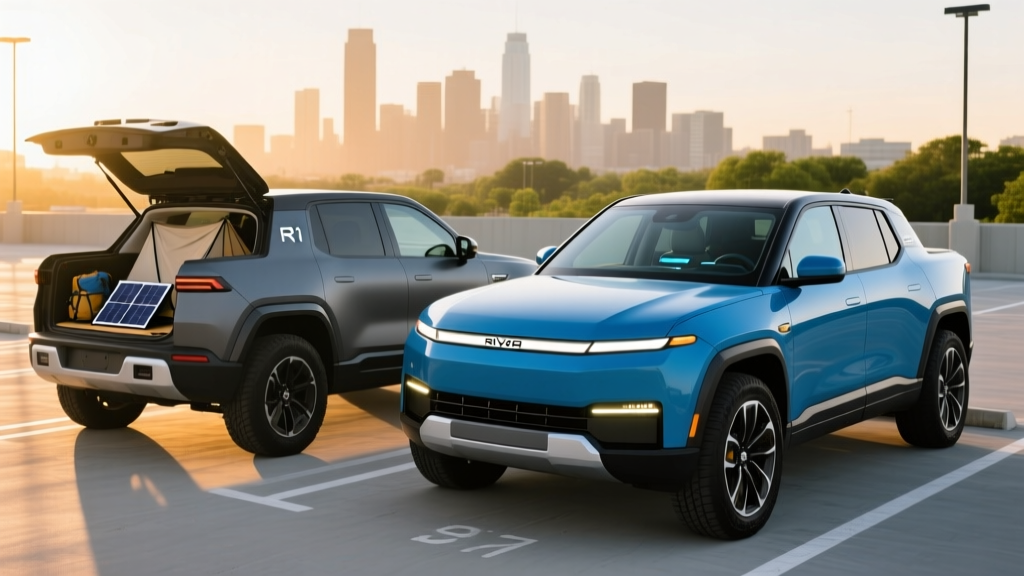
Rivian's R1T pickup and R1S SUV remain two of the most capable electric adventure vehicles on the market. For 2026, both models benefit from the company's second-generation skateboard platform, improved battery chemistries, and expanded charging infrastructure partnerships. But with starting prices near $70,000, many buyers are turning to Rivian lease options as a way to access these vehicles without committing to the full purchase price — or worrying about long-term depreciation on a relatively young brand.
This review breaks down everything you need to evaluate a Rivian lease: real-world range, charging speeds, performance, pricing, federal tax credit eligibility, and how the R1T and R1S stack up against competitors like the Tesla Cybertruck, Ford F-150 Lightning, and GMC Hummer EV.
2026 Rivian R1T and R1S: Core Specifications at a Glance
| Spec | R1T (Dual-Motor AWD) | R1S (Dual-Motor AWD) |
|---|---|---|
| EPA Range (Standard Battery) | 270 mi | 260 mi |
| EPA Range (Max Battery) | 420 mi | 400 mi |
| Battery Capacity (Max Pack) | ~149 kWh usable (NMC) | ~149 kWh usable (NMC) |
| Battery Capacity (Standard Pack) | ~105 kWh usable (LFP) | ~105 kWh usable (LFP) |
| Max DC Fast Charge | 220 kW peak | 220 kW peak |
| 10–80% DC Charge Time | ~21 minutes | ~21 minutes |
| Level 2 Home Charge Rate | 11.5 kW (~25 mi/hr) | 11.5 kW (~25 mi/hr) |
| 0–60 mph | 4.5 sec (Dual) / 3.0 sec (Tri-Motor) | 4.5 sec (Dual) / 3.0 sec (Tri-Motor) |
| Horsepower | 533 hp (Dual) / 850 hp (Tri) | 533 hp (Dual) / 850 hp (Tri) |
| Drivetrain | AWD (Dual/Tri-Motor) | AWD (Dual/Tri-Motor) |
| Efficiency (Max Pack) | 73 MPGe / 46 kWh/100mi | 69 MPGe / 49 kWh/100mi |
| Towing Capacity | 11,000 lbs | 7,700 lbs |
| Cargo Volume | 54 cu ft bed + 11 cu ft frunk + Gear Tunnel | 104.7 cu ft (max, seats folded) |
| Battery/Powertrain Warranty | 8 yr / 125,000 mi | 8 yr / 125,000 mi |
Source: fueleconomy.gov and Rivian official specifications. Tri-Motor configurations available on Adventure and Ascend trims.
Real-World Range: What the EPA Sticker Doesn't Tell You
R1T Max Pack: EPA 420 mi — Expect ~340–370 mi highway at 70 mph; ~280–310 mi in cold weather (below 32°F) with cabin heat.
R1S Max Pack: EPA 400 mi — Expect ~320–350 mi highway; ~260–290 mi in freezing conditions.
R1T/R1S Standard Pack (LFP): EPA 270/260 mi — Expect ~220–240 mi highway; ~180–200 mi in cold weather.
Rivian's Max Pack delivers genuinely impressive range on paper, but real-world factors compress those numbers significantly. The R1T's boxy, truck-style aerodynamics create substantial drag at highway speeds, and the vehicle's 7,000+ lb curb weight demands more energy per mile than a sleeker sedan or crossover. In our experience, sustained 70–75 mph interstate driving typically yields 80–88% of the EPA estimate in moderate temperatures.
Cold weather compounds this further. Below freezing, expect a 20–30% range reduction due to battery chemistry limitations, cabin heating demands, and increased rolling resistance. The R1T and R1S use a heat pump for cabin climate control, which helps mitigate losses compared to resistive heating, but physics still wins in sub-zero conditions. If you live in northern climates and plan road trips in winter, the Max Pack is practically essential — the Standard Pack's ~180–200 mi cold-weather range creates genuine planning constraints on longer routes.
For context, the LFP Standard Pack is best suited to daily commuting and weekend trips within a ~100-mile radius, while the NMC Max Pack is the road-trip and towing configuration. If you'll be towing, plan for range to drop by 40–50% depending on trailer weight and aerodynamics.
Charging Speed: DC Fast Charging and Home Setup
| Charging Level | Power (kW) | Speed (Miles/Hour) | Notes |
|---|---|---|---|
| Level 1 (120V household) | ~1.4 kW | ~3 mi/hr | Emergency/top-off only |
| Level 2 (240V, 48A) | 11.5 kW | ~25 mi/hr | Full overnight charge in 9–13 hr |
| DC Fast Charge (peak) | 220 kW | ~140 mi/hr (peak) | 10–80% in ~21 min |
| DC Fast Charge (sustained avg) | ~140–160 kW | ~90–110 mi/hr (avg) | Real-world average across curve |
Rivian's second-generation vehicles support a peak DC fast-charge rate of 220 kW via the NACS connector (native on 2025+ models; earlier models require an adapter). On a 350 kW Electrify America or Tesla Supercharger V4 stall, the R1T and R1S can add up to 140 miles of range in approximately 10 minutes at peak rate.
However, peak rate is not sustained rate. The charge curve tapers meaningfully above 60% state of charge, and by 80% SoC, charging slows to roughly 60–80 kW. This is why Rivian quotes a 10–80% time of approximately 21 minutes — the last 20% of the battery takes considerably longer due to cell-protection protocols. On road trips, plan your stops around 10–80% charging windows for maximum efficiency; charging from 80–100% can add another 25–35 minutes.
For home charging, Rivian's onboard charger supports up to 11.5 kW on a 240V/48A Level 2 circuit. This means a full charge from empty takes roughly 9 hours for the Standard Pack and up to 13 hours for the Max Pack — easily achievable overnight. You'll need a NEMA 14-50 outlet or hardwired Level 2 charger (such as a ChargePoint Home Flex or Tesla Wall Connector with a J1772 adapter) installed by a licensed electrician. Installation costs typically range from $500 to $2,000 depending on panel capacity and wiring distance.
2026 Rivian Lease Options: Pricing, Trims, and Monthly Costs
| Configuration | Base MSRP | Typical Lease (36 mo / 10K mi/yr) | Due at Signing |
|---|---|---|---|
| R1T Dual-Motor AWD (Standard Pack) | $69,900 | $699–$849/mo | $3,000–$5,500 |
| R1T Dual-Motor AWD (Max Pack) | $82,400 | $899–$1,099/mo | $4,000–$6,500 |
| R1T Tri-Motor AWD (Max Pack) | $99,900 | $1,149–$1,399/mo | $5,000–$8,000 |
| R1S Dual-Motor AWD (Standard Pack) | $74,900 | $749–$899/mo | $3,500–$5,500 |
| R1S Dual-Motor AWD (Max Pack) | $87,400 | $949–$1,149/mo | $4,500–$7,000 |
| R1S Tri-Motor AWD (Max Pack) | $104,900 | $1,199–$1,499/mo | $5,500–$8,500 |
Lease estimates are approximate ranges based on typical money factors and residual values for 2026 model-year Rivians. Actual offers vary by region, credit tier, dealer, and available incentives. Destination charges ($1,800) and options packages not included.
Rivian lease options in 2026 are primarily offered through Rivian's direct-to-consumer model, though select partner dealerships and third-party leasing companies (such as Ally Financial and U.S. Bank) also facilitate leases. The key advantage of leasing a Rivian is risk mitigation: you're insulated from the brand's still-developing resale value trajectory, battery depreciation uncertainty, and the rapid pace of EV platform updates.
Lease terms typically run 24, 36, or 39 months with annual mileage allowances of 10,000, 12,000, or 15,000 miles. Excess mileage penalties run $0.25–$0.30 per mile. Most Rivian leases include GAP coverage, but verify this in your contract. One important consideration: lease transfer policies vary, and Rivian's relatively young leasing program means the secondary lease-transfer market is less established than for legacy brands.
Federal Tax Credit and Lease Implications
- Maximum credit: Up to $7,500 (split: $3,750 critical minerals + $3,750 battery components)
- MSRP cap: $80,000 for trucks (R1T); $80,000 for SUVs/vans (R1S) — Tri-Motor trims exceed this cap
- Buyer income cap: AGI ≤ $150,000 (single) / $225,000 (head of household) / $300,000 (joint)
- Battery sourcing: Must meet escalating critical minerals and battery component requirements per IRS §30D rules
- Point-of-sale transfer: Eligible buyers can transfer the credit to the dealer for an upfront price reduction
Here's the leasing complication: the federal §30D tax credit applies to purchased vehicles, not leased ones. When you lease a Rivian, the lessor (the financing company) technically owns the vehicle and would claim the credit. Some lessors pass the credit's value through as a capitalized cost reduction — effectively lowering your monthly payment — but this is not guaranteed and must be confirmed in the lease agreement.
However, there is a workaround via the commercial clean vehicle credit (§45W), which applies to leased EVs without the same MSRP or income caps. Many leasing companies structure their EV leases to claim §45W and pass savings to the lessee. Ask your Rivian advisor or leasing partner explicitly: "Is the federal tax credit value reflected in the capitalized cost of this lease?"
For buyers who qualify for the full $7,500 §30D credit, purchasing a Dual-Motor Standard Pack R1T ($69,900 MSRP) brings the effective price to roughly $62,400 before state incentives — a meaningful difference that may tilt the buy-vs-lease calculus.
Performance, Cargo, and Daily Livability
The R1T and R1S share Rivian's dual- and tri-motor powertrain options. The Dual-Motor AWD configuration produces 533 horsepower and 610 lb-ft of torque, delivering a 4.5-second 0–60 mph time — brisk for vehicles exceeding 7,000 lbs. The Tri-Motor setup (available on Adventure and Ascend trims) pushes output to an estimated 850 hp with a 3.0-second 0–60 mph, putting it in sports-car territory despite the truck/SUV form factor.
For the R1T, the 4.5-foot bed (54 cu ft) is shorter than a traditional full-size truck bed, but the Gear Tunnel — a lockable, pass-through storage compartment behind the cab — adds significant utility for long, narrow items like skis or camping gear. The 11 cu ft front trunk (frunk) is one of the largest in the EV segment, with a drain plug for use as a cooler.
The R1S offers three rows of seating with up to 104.7 cu ft of cargo volume (second and third rows folded). Third-row legroom is tight at 30.2 inches — suitable for children on longer trips but cramped for adults. Behind the third row, cargo space drops to 20.1 cu ft, comparable to a compact crossover.
Ride quality is a standout. Rivian's air suspension provides up to 14.4 inches of ground clearance in off-road mode, yet settles into a comfortable, car-like ride on pavement. The electro-hydraulic roll control system eliminates traditional anti-roll bars, resulting in surprisingly flat cornering for a vehicle of this mass.
Tech, Driver Assistance, and Software
Rivian runs its own vertically integrated software stack, displayed on a 15.6-inch center touchscreen and a 12.3-inch driver cluster. The interface is clean and responsive, with native integration for trip planning that accounts for terrain, temperature, and charging stops. Over-the-air updates are frequent and substantive — Rivian has added features like enhanced regenerative braking profiles and new drive modes via OTA well after delivery.
The Driver+ system is Rivian's Level 2 driver-assistance suite (per NHTSA SAE classification). It includes adaptive cruise control with lane centering on divided highways, automatic emergency braking, blind-spot monitoring, and rear cross-traffic alert. It is not a self-driving system — the driver must remain engaged, with hands on the wheel, at all times. Unlike Ford BlueCruise or GM Super Cruise, Rivian's system does not yet offer hands-free operation on mapped highway segments, though the company has signaled this capability is in development.
Notable tech drawbacks: Rivian does not currently support Apple CarPlay or Android Auto, relying instead on its native infotainment. While the native system is competent, some buyers accustomed to phone-mirroring find this a meaningful omission. Additionally, the R1T and R1S lack a traditional rearview mirror — a camera-based system replaces it, which takes adjustment and can struggle in heavy rain or direct low-angle sunlight.
Rivian vs. Competitors: Is It Worth Leasing Over Rivals?
At the $70,000–$105,000 price range, Rivian competes with the Tesla Cybertruck, Ford F-150 Lightning (discontinued after 2024, but remaining inventory and used market), GMC Hummer EV, and the Chevrolet Silverado EV. Here's how the R1T compares on key metrics:
| Metric | Rivian R1T (Dual Max) | Tesla Cybertruck (AWD) | GMC Hummer EV 3X |
|---|---|---|---|
| EPA Range | 420 mi | 340 mi | 329 mi |
| 0–60 mph | 4.5 sec | 4.1 sec | 3.0 sec |
| Towing | 11,000 lbs | 11,000 lbs | 7,500 lbs |
| DC Fast Charge (peak) | 220 kW | 250 kW | 350 kW (800V) |
| Base MSRP | $82,400 | $79,990 | $104,500 |
| Battery Warranty | 8 yr / 125,000 mi | 8 yr / 120,000 mi | 8 yr / 100,000 mi |
The R1T's advantage is range and overall refinement. The Cybertruck charges faster and offers a stainless-steel exoskeleton that's polarizing but durable. The Hummer EV delivers raw power and 800V charging architecture but costs significantly more and delivers less range. For buyers prioritizing adventure utility, real-world range, and a more traditional (if modern) design language, the R1T occupies a compelling middle ground.
Pros, Cons, and Who Should Lease a Rivian
- Class-leading EPA range with Max Pack (420 mi R1T)
- Exceptional off-road capability with air suspension and quad-motor torque vectoring
- Massive frunk and Gear Tunnel for adventure gear
- Frequent, meaningful OTA software updates
- Strong battery warranty (8 yr / 125,000 mi)
- 11,000-lb towing capacity (R1T)
- Tri-Motor trims exceed $80K MSRP cap for federal tax credit
- No Apple CarPlay or Android Auto
- Real-world highway and cold-weather range drops 15–30%
- Rear camera mirror takes adjustment; struggles in rain/glare
- R1S third row is cramped for adults
- Service center network still expanding in rural areas
- Adventure-oriented families who need off-road capability, cargo versatility, and enough range for camping trips without a trailer.
- Buyers hedging depreciation risk on a relatively young EV brand with evolving platform technology.
- Daily commuters with weekend-trip habits who value the Gear Tunnel, frunk, and one-pedal driving in stop-and-go traffic.
- Those who can't qualify for the §30D credit (due to income or the vehicle's MSRP) and find lease structures that pass through §45W savings.
- Buyers who need maximum towing range (consider a diesel or PHEV truck for heavy-trailer use cases).
- Those who prioritize phone-mirroring infotainment (CarPlay/Android Auto).
- Urban-only drivers who don't need the size, ground clearance, or AWD — a smaller EV like the Hyundai Ioniq 5 or Tesla Model Y offers better efficiency at lower cost.
Frequently Asked Questions About Rivian Lease Options
What is the real-world range of the Rivian R1T and R1S?
The R1T Max Pack is EPA-rated at 420 miles, but expect approximately 340–370 miles on the highway at 70 mph in moderate temperatures, and 280–310 miles in freezing conditions. The Standard Pack (LFP) delivers roughly 220–240 highway miles. The R1S trails by about 20 miles across all configurations due to its slightly heavier, more enclosed body.
How fast does a Rivian charge at home and on the road?
On a 240V Level 2 home charger (48A), the R1T and R1S charge at 11.5 kW, adding roughly 25 miles per hour — a full overnight charge in 9–13 hours depending on pack size. On DC fast chargers, peak rate is 220 kW, with a 10–80% charge in approximately 21 minutes. Sustained average across the charging curve is closer to 140–160 kW.
How much does a Rivian cost after tax credits?
If you purchase (not lease) a Dual-Motor R1T Standard Pack at $69,900 and qualify for the full $7,500 federal §30D credit, your effective price drops to approximately $62,400 before state incentives. The Max Pack at $82,400 exceeds the $80,000 MSRP cap for trucks, making it ineligible for §30D. Lease customers should ask whether the lessor passes the credit value through as a cap-cost reduction.
Does the Rivian R1T or R1S qualify for the federal EV tax credit?
It depends on trim and buyer income. Dual-Motor Standard Pack configurations (MSRP under $80,000) are eligible if the buyer meets IRS income caps ($150K single / $300K joint) and the vehicle's battery meets critical-mineral and component sourcing requirements. Tri-Motor and Max Pack configurations exceeding $80,000 MSRP are not eligible for §30D when purchased, though §45W may apply in lease scenarios.
Is it better to buy or lease a Rivian in 2026?
Leasing makes sense if you want to mitigate depreciation risk on a newer brand, prefer lower monthly payments, or don't qualify for the §30D purchase credit but can access §45W pass-through savings via the lessor. Buying makes sense if you qualify for the full $7,500 credit on a sub-$80K trim, plan to keep the vehicle 5+ years, and want to build equity. Consider that Rivian's residual values are still establishing a track record — leasing transfers that uncertainty to the lessor.
What's the biggest risk of leasing a Rivian?
The primary risks are the relatively unproven long-term reliability of Rivian's platform (the company was founded in 2009 but only began deliveries in 2021), the expanding-but-limited service center network in some regions, and potential lease-end disposition fees or excess wear charges. Verify the lease terms for mileage penalties, wear standards, and whether you have a purchase option at lease end — and at what residual price.