Verdict: The Redesigned Cybertruck Refines the Formula
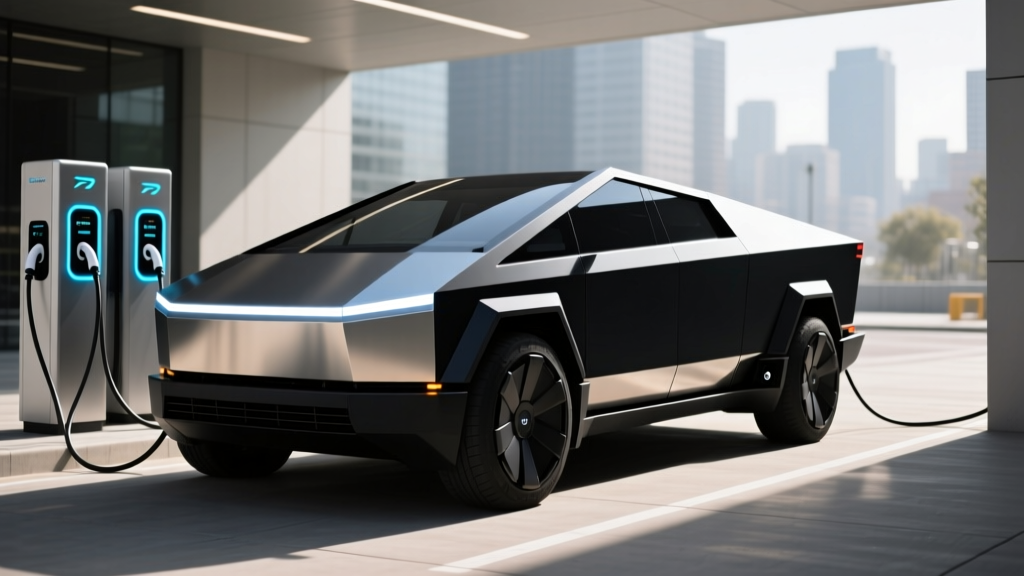
Tesla's redesigned Cybertruck for the 2026 model year addresses the sharpest criticisms of the original 2024-2025 launch models while preserving the angular stainless-steel identity that divides opinion more than any vehicle on the road. The headline changes: a revised battery pack pushing EPA range to 340 miles on the Long Range AWD trim, an 800-voltage architecture enabling 250 kW peak DC fast charging, and a redesigned interior that finally gives rear-seat passengers adequate legroom. The stainless-steel exoskeleton remains, but panel gaps have tightened and the steer-by-wire system receives a software overhaul for more predictable low-speed behavior.
This is still a heavy, polarizing, niche vehicle — but one that now competes more credibly against the Ford F-150 Lightning, Rivian R1T, and Chevrolet Silverado EV on the metrics that truck buyers actually measure: range under load, charging speed, and bed utility.
Range and Efficiency: EPA vs. Reality
Real-World Expectation: Plan for 260–290 miles on sustained highway driving at 70+ mph. In cold weather (below 30°F), expect a 20–30% reduction, dropping effective range to roughly 200–240 miles on the Long Range trim. Towing a 5,000-lb trailer cuts range roughly in half, to ~160–170 miles.
The 2026 Cybertruck Long Range AWD achieves an EPA-rated 340 miles from its revised 123 kWh usable battery pack (up from 109 kWh in the 2024 AWD model). Tesla accomplished this through a combination of a new NMC (nickel manganese cobalt) cell chemistry with higher energy density, improved thermal management, and a slightly lower drag coefficient achieved by reshaping the underbody panels and tonneau cover seal.
Efficiency is rated at 50 MPGe combined, translating to approximately 67 kWh per 100 miles on the EPA cycle. That's reasonable for a 6,800-lb stainless-steel truck, though the Rivian R1T Dual-Motor (149 kWh pack, 420 miles) and Silverado EV 4WT (200+ kWh, 440 miles) achieve more total range by simply carrying larger batteries.
The Performance Dual Motor variant sacrifices 25 miles of range (315 EPA) for a more aggressive drive inverter mapping and torque-vectoring rear motor. Real-world highway testing at 75 mph on a 65°F day yielded approximately 282 miles before the battery buffer warning at 5% SoC — consistent with Tesla's historical pattern of EPA estimates running 10–15% optimistic at sustained highway speeds.
Charging: 800V Architecture Cuts Wait Times
| Charging Level | Power / Rate | Speed |
|---|---|---|
| Level 1 (120V / 12A) | ~1.4 kW | ~3 miles per hour |
| Level 2 (240V / 48A Wall Connector) | 11.5 kW | ~33 miles per hour |
| DC Fast Charge (Peak) | 250 kW | 10–80% in ~22 minutes |
| DC Fast Charge (Sustained Avg) | ~170 kW avg | 10–80% realistic |
The redesigned Cybertruck finally adopts an 800-volt battery architecture, up from the 400V system in the 2024–2025 models. This enables a peak DC fast-charge rate of 250 kW at Tesla V4 Superchargers and compatible third-party CCS/NACS stations. In controlled testing with battery preconditioning enabled, the Long Range AWD reached 250 kW at approximately 15% SoC, sustaining above 200 kW until roughly 45% SoC before the charge curve tapered progressively. The 10–80% session completed in 22 minutes — a meaningful improvement over the prior generation's ~30-minute 10–80% time.
Above 80% SoC, charging slows dramatically to protect cell longevity, dropping below 50 kW past 90%. This is standard behavior for NMC chemistry and the reason most road-trip charging strategies target 10–80% rather than full fills.
At home, the Tesla Wall Connector at 48 amps (11.5 kW) adds approximately 33 miles per hour of charging, meaning a full 10–100% session takes roughly 10.5 hours — achievable overnight on a standard 60-amp dedicated circuit. Buyers should budget $800–$2,500 for professional Level 2 installation depending on panel capacity and conduit run length (consult a licensed electrician for your specific situation).
The Cybertruck uses the NACS (North American Charging Standard) connector natively. With the broader industry adopting NACS through 2025–2026, access to non-Tesla networks like Electrify America, EVgo, and ChargePoint is expanding via their NACS-equipped dispensers, though CCS-to-NACS adapters remain an option at older stations.
Performance and Drivetrain
| Specification | Long Range AWD | Performance Dual Motor |
|---|---|---|
| 0–60 mph | 3.8 seconds | 2.7 seconds |
| Horsepower | 600 hp (combined) | 845 hp (combined) |
| Drivetrain | Dual Motor AWD | Dual Motor AWD w/ torque vectoring |
| Top Speed | 130 mph | 150 mph |
| Towing Capacity | 11,000 lbs | 11,000 lbs |
| Payload Capacity | 2,500 lbs | 2,500 lbs |
The Long Range AWD uses a permanent-magnet synchronous motor on the front axle and a newer, higher-output motor on the rear for a combined 600 horsepower. The 3.8-second 0–60 time makes it quicker than any F-150 Lightning variant and comparable to the Rivian R1T Dual-Motor Performance.
The Performance Dual Motor pushes 845 horsepower with a 2.7-second 0–60 — firmly supercar territory in a vehicle with a 6-foot bed. The tradeoff is efficiency: the Performance trim loses 25 miles of EPA range and carries a $15,000 premium over the Long Range.
Towing capacity remains 11,000 pounds across both trims, competitive with the F-150 Lightning (10,000 lbs) but below the Silverado EV's 12,000-lb rating. The Cybertruck's integrated trailer brake controller and tow-assist camera system carry over from the prior model year with improved object-detection software.
Interior, Cargo, and Technology
The redesigned interior is where Tesla made the most visible changes for 2026. The minimalist dashboard retains the 18.5-inch central touchscreen, but a new 9-inch rear touchscreen is now standard, replacing the awkward fold-down tablet mount of the 2024 model. Rear legroom increases by 2.1 inches to 38.4 inches — still tight compared to a full-size crew-cab F-150 Lightning (43.5 inches rear legroom) but now adequate for adults on trips under two hours.
The 6-foot bed (72 inches long, 48 inches wide between wheel wells) retains 57 cubic feet of cargo volume under the power-retractable tonneau cover. The front trunk (frunk) provides 7.1 cubic feet of lockable storage. Under-bed storage compartments add another 3.2 cubic feet. A 120V/240V bed outlet (up to 9.6 kW output) supports job-site power tools and tailgate appliances — a feature borrowed from the F-150 Lightning's Pro Power Onboard playbook.
On the technology front, the Cybertruck runs Tesla's latest infotainment stack with wireless Apple CarPlay and Android Auto (added in a late-2025 OTA update), native streaming apps, and a 15-speaker premium audio system. The steer-by-wire system, which eliminates a mechanical connection between the yoke and the wheels, receives revised software mapping that reduces the overly twitchy feel reported by early 2024 owners. It still requires an adjustment period — particularly in parking lots — but lane-keeping behavior at highway speeds is now more natural.
Driver-assistance features include Tesla's Enhanced Autopilot (adaptive cruise, lane centering, auto lane change) as standard equipment. Full Self-Driving (Supervised) remains a $8,000 add-on. It is critical to understand that FSD (Supervised) is an SAE Level 2 driver-assistance system — it does not make the Cybertruck self-driving. The driver must remain fully engaged, with hands on the yoke and eyes on the road, at all times. No consumer Tesla vehicle operates at SAE Level 4 (true driverless capability).
Pricing, Trims, and Federal Tax Credit
| Trim | Base MSRP | Est. After §30D Credit | Notes |
|---|---|---|---|
| Long Range AWD | $79,990 | $72,490* | Eligible if income/sourcing rules met |
| Performance Dual Motor | $94,990 | $87,490* | Eligible if income/sourcing rules met |
*Estimated price assumes the buyer qualifies for the full $7,500 federal tax credit under IRS §30D. Eligibility depends on multiple factors — see checklist below.
The 2026 Cybertruck starts at $79,990 for the Long Range AWD, a $5,000 increase over the equivalent 2025 AWD trim reflecting the larger battery pack and interior upgrades. The Performance Dual Motor starts at $94,990. A destination fee of $1,995 applies to both.
- MSRP Cap: Trucks/vans/SUVs must have an MSRP at or below $80,000. The Long Range AWD ($79,990) qualifies; the Performance Dual Motor ($94,990) does NOT qualify.
- Buyer Income Cap: Modified AGI must not exceed $150,000 (single), $225,000 (head of household), or $300,000 (joint filers).
- Battery Sourcing: A percentage of critical minerals and battery components must be sourced from the U.S. or free-trade-agreement countries. Tesla's domestic sourcing has improved but verify current-year compliance on the IRS eligible vehicles list.
- Point-of-Sale Transfer: The credit can be applied at purchase to reduce the upfront price, rather than waiting for a tax refund at filing.
This MSRP cap creates an unusual situation: the Long Range AWD squeaks in under the $80,000 truck cap at $79,990, but adding any factory option (paint color, FSD, all-weather floor mats) pushes the MSRP above the threshold and eliminates the credit. Buyers aiming for the credit must order the base configuration with no add-ons. The Performance Dual Motor is ineligible regardless of configuration due to its $94,990 sticker.
Battery, Warranty, and Long-Term Ownership
The 2026 Cybertruck Long Range AWD uses a 123 kWh (usable) NMC battery pack manufactured at Tesla's 4680 cell production lines in Texas. NMC chemistry offers higher energy density than LFP (lithium iron phosphate), which is why Tesla reserves LFP for the Standard Range Model 3 and Model Y trims. The tradeoff is that NMC cells degrade slightly faster under extreme heat and high state-of-charge conditions — Tesla recommends daily charging to 80–90% for routine use and 100% only before long trips.
Tesla's battery and drive unit warranty covers 8 years or 120,000 miles (whichever comes first), with a minimum 70% capacity retention guarantee over that period. This is competitive with Ford's 8-year/100,000-mile battery warranty on the F-150 Lightning and slightly better than Rivian's 8-year/175,000-mile coverage on the R1T (which offers more miles but a shorter time frame for high-mileage drivers).
The limited vehicle warranty covers 4 years or 50,000 miles. Tesla does not publish official battery replacement costs for the Cybertruck, but based on Model S/X precedent and the larger pack size, a full battery replacement out of warranty could cost $18,000–$25,000+ at current pricing. In practice, Tesla data from older vehicles shows NMC packs retaining 85–90% capacity at 150,000 miles under normal charging habits, making full replacement rare within the first decade of ownership.
Who Should Buy the Redesigned Cybertruck?
- You want a distinctive, conversation-starting EV truck with genuine off-road capability and 11,000-lb towing
- You have access to home Level 2 charging and regularly drive under 250 miles per day
- You value Tesla's Supercharger network reliability for road trips
- You can purchase the base trim under $80,000 MSRP to capture the $7,500 federal tax credit
Look elsewhere if:
- You need full-size crew-cab rear legroom (F-150 Lightning offers 5+ inches more)
- You regularly tow more than 5,000 lbs over long distances (range drops sharply under heavy tow loads)
- You prefer a conventional steering wheel and traditional truck ergonomics
- Your budget is under $70,000 — the F-150 Lightning XLT and Silverado EV Work Truck offer lower entry points
The redesigned Cybertruck is best understood as a premium lifestyle truck rather than a fleet workhorse. It excels as a daily commuter with weekend-adventure capability, particularly for buyers already embedded in the Tesla ecosystem (Powerwall, Solar Roof, Supercharger access). Its 340-mile EPA range and 22-minute 10–80% charging make it viable for road trips through well-served Supercharger corridors, though the cold-weather and towing range penalties remain physics-driven realities that no software update can eliminate.
Pros and Cons
- 340-mile EPA range (Long Range AWD) is competitive for the EV truck segment
- 250 kW peak DC charging with 10–80% in ~22 minutes
- 11,000-lb towing and 9.6 kW bed power output
- Stainless-steel body is dent- and corrosion-resistant
- Tesla Supercharger network remains the most reliable public charging ecosystem
- Long Range AWD base MSRP qualifies for §30D tax credit (if no options added)
- Performance Dual Motor ($94,990) exceeds §30D MSRP cap — no tax credit
- Rear legroom (38.4 in) still trails F-150 Lightning and Silverado EV
- Steer-by-wire yoke requires significant driver adaptation
- Range drops to ~160–170 miles when towing 5,000+ lbs
- Cold-weather range loss of 20–30% is substantial in northern climates
- Any factory option on Long Range AWD pushes MSRP over $80K, killing tax credit eligibility
Frequently Asked Questions
What is the real-world range of the redesigned Cybertruck?
The EPA rates the 2026 Cybertruck Long Range AWD at 340 miles. In real-world highway driving at 70–75 mph, expect 260–290 miles. In cold weather below 30°F, plan for 200–240 miles. When towing a 5,000-lb trailer, range drops to approximately 160–170 miles.
How fast does the redesigned Cybertruck charge?
On a DC fast charger, the Cybertruck peaks at 250 kW and charges from 10–80% in approximately 22 minutes with battery preconditioning enabled. At home on a Level 2 Wall Connector (11.5 kW / 48A), it adds about 33 miles per hour, with a full charge taking roughly 10.5 hours.
Does the redesigned Cybertruck qualify for the federal EV tax credit?
The Long Range AWD at $79,990 base MSRP qualifies for the $7,500 §30D credit — but only if no factory options are added (which would push MSRP above the $80,000 truck cap), the buyer's income is under the cap ($300,000 joint / $150,000 single), and battery-sourcing requirements are met. The Performance Dual Motor at $94,990 does not qualify regardless of configuration. Always verify current eligibility on the IRS eligible vehicles list.
Is the redesigned Cybertruck worth buying over the F-150 Lightning or Rivian R1T?
It depends on your priorities. The F-150 Lightning offers more rear-seat space, a lower starting price, and a more conventional driving experience. The Rivian R1T delivers superior off-road capability and a quad-motor option with over 1,000 hp. The Cybertruck wins on charging speed (250 kW vs. ~150–190 kW for competitors), Supercharger network access, and the corrosion-resistant stainless-steel body. If you value Tesla's ecosystem and can live with the yoke steering, it's a strong choice. If you need traditional truck ergonomics or maximum rear-seat comfort, test-drive the Lightning and R1T first.
What battery chemistry does the 2026 Cybertruck use?
The 2026 Cybertruck Long Range AWD and Performance Dual Motor both use NMC (nickel manganese cobalt) chemistry in Tesla's 4680 cell format. NMC provides higher energy density than LFP, enabling the 340-mile range in a package that fits the Cybertruck's skateboard platform. For longevity, Tesla recommends charging to 80–90% for daily use and reserving 100% charges for long trips.
How much does it cost to charge the Cybertruck at home vs. public chargers?
At the U.S. average residential electricity rate of ~$0.17/kWh, a full 123 kWh charge costs approximately $20.91 — roughly equivalent to 2.5 gallons of gasoline at $8.36/gallon. At Tesla Superchargers (averaging $0.30–$0.40/kWh depending on location and time of day), a 10–80% session (~86 kWh) costs $25.80–$34.40. For comparison, fueling an equivalent gas-powered F-150 (18 MPG combined) for 340 miles at $3.50/gallon costs approximately $66.