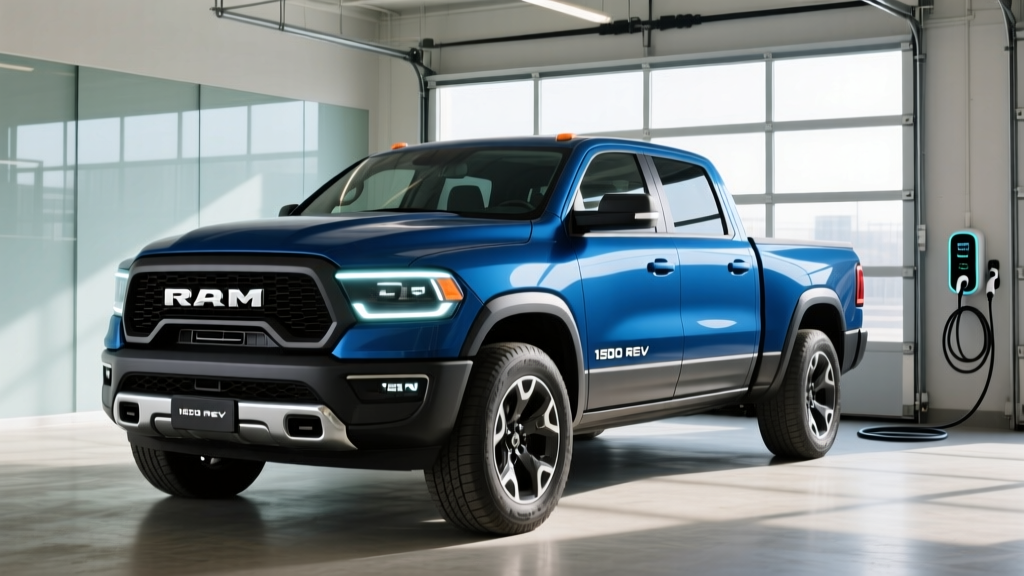
The Ram 1500 REV is Stellantis's long-awaited answer to the Ford F-150 Lightning, Rivian R1T, and Chevrolet Silverado EV. After a protracted development and multiple delays, the all-electric half-ton is finally reaching dealer lots for the 2026 model year. If you've been searching for a Ram 1500 REV for sale, this review covers everything you need to know before signing a purchase order — from real-world range expectations to the tax-credit math that determines what you'll actually pay.
Ram enters the electric truck segment late, but with a skateboard architecture purpose-built for battery-electric propulsion rather than a converted ICE platform. The result is a truck with competitive range, a surprisingly flat load floor, and towing capability that matters to traditional truck buyers. But late arrival also means Ram has to nail execution against battle-tested rivals. Let's see how it stacks up.
Range, Battery, and Real-World Efficiency
The 2026 Ram 1500 REV offers two battery configurations depending on trim. The standard pack is a 168 kWh (usable) lithium-ion NMC (nickel-manganese-cobalt) battery, while the available Max Range package pushes capacity to an estimated 229 kWh — one of the largest battery packs in any production passenger vehicle.
| Spec | Standard Range | Max Range |
|---|---|---|
| Battery Capacity (usable) | 168 kWh (NMC) | 229 kWh (NMC) |
| EPA Estimated Range | 350 miles | 500 miles (est.) |
| EPA Efficiency | ~62 MPGe / 54 kWh/100mi | ~60 MPGe / 56 kWh/100mi |
| Drivetrain | Dual-motor AWD | Dual-motor AWD |
The NMC chemistry choice prioritizes energy density over the cycle-life advantages of LFP (lithium iron phosphate). For a truck this size, the energy-density trade-off makes sense — an LFP pack with equivalent capacity would add substantial weight. Ram includes an active thermal management system with a heat pump, which helps mitigate cold-weather range loss and optimizes battery preconditioning for DC fast charging.
Charging Speed: DC Fast, Level 2, and Home Setup
Charging speed is where the REV's 800-volt architecture pays dividends. The truck supports up to 150 kW peak DC fast charging on the standard battery — though Ram initially targeted higher rates, the production spec settles at a competitive but not class-leading rate.
| Charging Level | Power | Speed / Time |
|---|---|---|
| DC Fast Charge (peak) | 150 kW | 10–80% in ~30 min (std. battery) |
| DC Fast Charge (sustained avg.) | ~110 kW avg. | Charge curve tapers significantly above 80% |
| Level 2 (home / public AC) | 11.5 kW onboard charger | ~25 miles of range per hour |
| Level 1 (120V household) | ~1.4 kW | ~3 miles of range per hour |
At home on a 48-amp Level 2 charger (requiring a 60-amp dedicated circuit), you'll recover roughly 25 miles of range per hour of charging. For a truck with a 168 kWh battery, a full 10–100% Level 2 session takes approximately 15 hours. Most owners will plug in nightly and rarely need a full charge from empty — a typical 200-mile daily round trip requires about 8 hours on Level 2, easily accomplished overnight.
The 800V architecture also enables bidirectional charging. Ram supports V2L (vehicle-to-load) through bed and cabin outlets, providing up to 7.2 kW of off-board power — enough to run job-site tools, a campsite, or essential home circuits during an outage. V2H (vehicle-to-home) integration requires compatible equipment and is available through Stellantis's energy partnership.
Performance, Towing, and Payload
The dual-motor all-wheel-drive powertrain produces 654 horsepower and 620 lb-ft of torque. Ram quotes a 0–60 mph time of 4.4 seconds for the standard-range model — brisk for a truck that weighs over 6,500 pounds.
| Spec | Value |
|---|---|
| Horsepower | 654 hp |
| Torque | 620 lb-ft |
| 0–60 mph | 4.4 seconds |
| Drivetrain | Dual-motor AWD |
| Max Towing Capacity | 10,700 lbs (est.) |
| Max Payload | ~1,800 lbs (est.) |
| Approach / Departure Angle | 25.3° / 24.5° |
Towing is where electric trucks face their sternest test. The REV's estimated 10,700-pound max tow rating is competitive with the F-150 Lightning's 10,000-pound figure but below the Silverado EV's 12,500-pound peak. Be aware: towing at max capacity cuts range roughly in half. If you're pulling 8,000+ pounds on the highway, expect 150–180 miles of effective range from the standard pack. This is physics, not a Ram deficiency — every electric truck faces the same penalty.
The skateboard platform gives the REV a flat floor and a low center of gravity. Ram has also engineered a front trunk (frunk) with approximately 15 cubic feet of lockable, weatherproof storage — useful for gear you want to keep separate from the bed.
Interior, Cargo Space, and Technology
The REV launches exclusively in Crew Cab configuration with a 5-foot-7 bed. Interior space is generous, taking advantage of the flat floor to offer more usable rear-seat room than the outgoing ICE Ram 1500.
| Dimension | Measurement |
|---|---|
| Front Headroom | 40.9 in |
| Front Legroom | 41.0 in |
| Rear Headroom | 39.8 in |
| Rear Legroom | 45.2 in |
| Bed Length | 5 ft 7 in |
| Frunk Volume | ~15 cu ft |
| Total Cargo Volume (bed + frunk) | ~67 cu ft (combined est.) |
The centerpiece of the cabin is an available 14.5-inch touchscreen running Uconnect 5, with a separate 10.25-inch passenger display on higher trims. A 12.3-inch digital instrument cluster handles driver information. Wireless Apple CarPlay and Android Auto are standard. The center console features a configurable pass-through, and the available power-folding rear seats create a near-flat load floor inside the cabin for longer items.
Driver-assistance features include adaptive cruise control with stop-and-go, lane-centering, blind-spot monitoring with trailer coverage, and a 360-degree camera system. These constitute an SAE Level 2 driver-assist system — the driver must remain fully engaged at all times. This is not autonomous driving.
Pricing, Trims, and Federal Tax Credit Eligibility
Ram positions the REV across five trims, starting with the Tradesman work truck and climbing through Big Horn, Laramie, Limited, and the new Tungsten luxury tier.
| Trim | Base MSRP | Est. After §30D Credit* |
|---|---|---|
| Tradesman | $58,095 | ~$50,595 |
| Big Horn | $63,095 | ~$55,595 |
| Laramie | $70,095 | ~$62,595 |
| Limited | $80,095 | ~$72,595 |
| Tungsten | $87,095 | ~$79,595 |
*"Est. After §30D Credit" assumes full $7,500 federal tax credit eligibility. Not all buyers qualify.
- MSRP Cap: Trucks/vans/SUVs must have an MSRP at or below $80,000. The Limited and Tungsten trims exceed this cap and are not eligible for the credit.
- Buyer Income Limits: Modified AGI must not exceed $150,000 (single), $225,000 (head of household), or $300,000 (joint filers).
- Battery Sourcing: The $7,500 credit splits into two halves — $3,750 for critical-minerals sourcing and $3,750 for battery-component manufacturing. Sourcing requirements tighten annually. Check the latest IRS guidance on §30D eligibility before purchasing.
- Point-of-Sale Transfer: Eligible buyers can transfer the credit to the dealer at purchase, reducing the upfront price rather than waiting for a tax refund.
Always verify current eligibility on fueleconomy.gov and consult a tax professional for your specific situation.
Destination charges add approximately $2,095 to all trims. The Max Range battery is a substantial add-on — expect a $10,000–$15,000 premium depending on trim. Fully loaded Tungsten models with the Max Range pack can exceed $100,000.
Warranty and Long-Term Ownership
Ram backs the REV with a comprehensive warranty package that addresses the battery-longevity concern head-on:
| Coverage | Term |
|---|---|
| Basic Bumper-to-Bumper | 3 years / 36,000 miles |
| Powertrain | 5 years / 60,000 miles |
| Battery Pack | 8 years / 100,000 miles (retains ≥70% capacity) |
| Corrosion (perforation) | 5 years / unlimited miles |
| Roadside Assistance | 5 years / 60,000 miles |
The battery warranty guarantees at least 70% capacity retention over 8 years or 100,000 miles, which is the industry-standard threshold mandated for EPA compliance. NMC batteries typically degrade 10–15% over the first 100,000 miles under normal use — meaning most owners will retain 85%+ capacity well within the warranty window. Avoid habitual DC fast charging above 90% SoC and try not to let the battery sit at 0% or 100% for extended periods to maximize longevity.
Ram 1500 REV vs. the Competition
If you're cross-shopping a Ram 1500 REV for sale, you're almost certainly looking at these rivals:
| Spec | Ram 1500 REV | Ford F-150 Lightning | Chevy Silverado EV | Rivian R1T |
|---|---|---|---|---|
| EPA Range (std.) | 350 mi | 320 mi (Extended: 320 mi) | 390 mi (est.) | 352 mi (Max pack) |
| Peak DC Charge | 150 kW | 150 kW | 200+ kW | 200+ kW |
| 0–60 mph | 4.4 sec | 4.0 sec | ~4.5 sec | 3.0 sec (tri-motor) |
| Max Towing | 10,700 lbs | 10,000 lbs | 12,500 lbs | 11,000 lbs |
| Starting MSRP | $58,095 | $54,995 | $55,900 (est.) | $69,900 |
| Frunk | Yes (~15 cu ft) | Yes (14.1 cu ft) | No (eTrunk: ~10 cu ft) | Yes (11 cu ft) |
The F-150 Lightning remains the volume leader with proven reliability data and a slightly lower entry price. The Silverado EV offers more range and higher tow capacity but in a larger, heavier package. The Rivian R1T is more of a lifestyle-adventure truck at a premium price. The REV's differentiator is its available 500-mile Max Range battery — if you need range above all else, nothing else in the segment comes close.
✓ Pros
- Class-leading 500-mile Max Range option
- Spacious crew cab with flat floor and generous rear legroom
- 800V architecture with bidirectional V2L/V2H capability
- 15 cu ft frunk adds practical secure storage
- Competitive towing at 10,700 lbs
- Strong Uconnect 5 infotainment with passenger screen
✗ Cons
- 150 kW peak DC charging lags Silverado EV and Rivian
- Late to market — limited real-world reliability data
- Top trims exceed $80K MSRP cap (no tax credit)
- Heavy curb weight impacts efficiency when towing
- Max Range pack availability and pricing not fully confirmed
- Only available in Crew Cab / short bed configuration
Who Should Buy the Ram 1500 REV?
Choose the Ram 1500 REV if:
- You want maximum electric range in a full-size truck (the 500-mile Max Range is unmatched)
- You need a spacious crew cab with best-in-class rear legroom for family duty
- You value a large, lockable frunk for work or recreation gear
- Bidirectional power (V2L/V2H) is important for job-site use or home backup
- You're a current Ram loyalist who prefers the brand's ride quality and interior design
Look elsewhere if:
- DC fast-charging speed is your top priority (consider Silverado EV or Rivian)
- You need a regular cab or long-bed configuration
- You want the most proven track record (F-150 Lightning has years of fleet data)
- Your budget is under $55,000 — the Lightning and Silverado EV start lower
Frequently Asked Questions
What is the real-world range of the Ram 1500 REV?
The standard-range REV carries an EPA estimate of 350 miles. In real-world highway driving at 70–75 mph, expect roughly 280–310 miles. Cold weather (below 30°F) can reduce range by 15–25%. The Max Range variant targets 500 miles EPA, but final certification is pending.
How fast does the Ram 1500 REV charge?
On a DC fast charger, the REV peaks at 150 kW and charges from 10–80% in approximately 30 minutes for the standard battery. At home on a 48-amp Level 2 charger (11.5 kW), you'll add about 25 miles of range per hour — roughly 15 hours for a full charge from 10%.
Does the Ram 1500 REV qualify for the $7,500 federal tax credit?
Potentially, but with important caveats. Trims with an MSRP at or below $80,000 (Tradesman, Big Horn, Laramie) are eligible on the vehicle-price side. Buyer income must fall under IRS thresholds ($150K single / $300K joint). Battery critical-mineral and component sourcing requirements must also be met — these tighten annually. Verify current eligibility at fueleconomy.gov and with your tax professional.
How much does a Ram 1500 REV cost after incentives?
The base Tradesman starts at $58,095 before destination. With the full $7,500 federal credit and point-of-sale transfer, the effective price drops to approximately $50,595. State incentives (which vary widely — check your local energy office) can reduce this further. Fully loaded Tungsten models with the Max Range pack can exceed $100,000 and do not qualify for the federal credit due to the MSRP cap.
Is the Ram 1500 REV worth buying over the F-150 Lightning?
It depends on your priorities. The Lightning has a lower starting price, more established dealer support, and proven fleet reliability. The REV counters with a larger available battery (500-mile range target), more rear-seat legroom, and a larger frunk. If range and interior space are paramount, the REV has the edge. If price and proven track record matter more, the Lightning remains the safer bet.
Can the Ram 1500 REV power my home during an outage?
Yes, with the proper setup. The REV supports V2L (vehicle-to-load) through bed and cabin outlets at up to 7.2 kW, and V2H (vehicle-to-home) with compatible bidirectional charging equipment. A fully charged standard-range battery (168 kWh usable) could power an average home's essential loads for multiple days.