Quick Verdict: The Sports Sedan That Refuses to Compromise
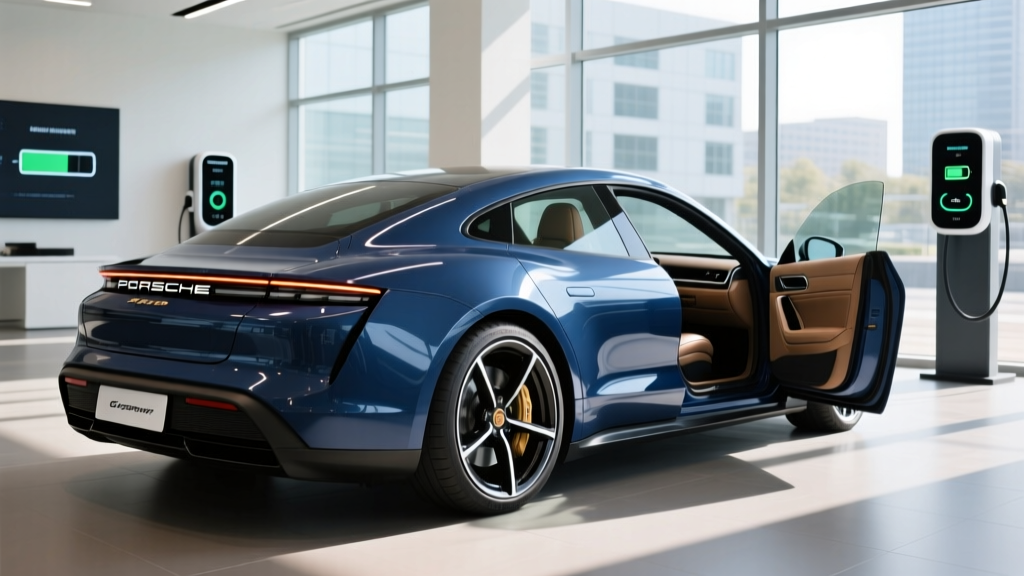
The 2026 Porsche Taycan enters its second generation with a revised battery architecture, faster DC charging, and a slightly expanded lineup that now includes a base rear-wheel-drive model priced under $100,000. Porsche's engineering team addressed the two biggest complaints from the original Taycan's 2020 debut — modest EPA range and slower-than-expected charging speeds — by adopting a higher-energy-density NMC cell and a new thermal-management system that sustains peak charge rates longer.
The result is a luxury EV sports sedan that finally closes the gap with the Tesla Model S and Lucid Air on efficiency while maintaining the handling, build quality, and driver engagement that define the Porsche badge. It is not the longest-range option in the segment, and it still misses the federal tax credit entirely due to price and sourcing rules, but for driving-dynamics purists who can charge at home, the Taycan's compromises are easier to live with than ever.
2026 Porsche Taycan Specifications at a Glance
| Spec | Base RWD | 4S AWD | GTS | Turbo | Turbo S |
|---|---|---|---|---|---|
| EPA Range | 283 mi | 302 mi | 296 mi | 318 mi | 306 mi |
| Battery (usable kWh) | 89 kWh (NMC) | 97 kWh (NMC) | 97 kWh (NMC) | 97 kWh (NMC) | 97 kWh (NMC) |
| Horsepower | 402 hp | 562 hp | 690 hp | 872 hp | 1,019 hp |
| 0–60 mph | 4.5 s | 3.5 s | 2.9 s | 2.5 s | 2.3 s |
| Drivetrain | RWD single-motor | AWD dual-motor | AWD dual-motor | AWD dual-motor | AWD dual-motor |
| Peak DC Charge | 270 kW | 320 kW | 320 kW | 320 kW | 320 kW |
| 10–80% DC Time | ~22 min | ~18 min | ~18 min | ~18 min | ~18 min |
| Level 2 (11 kW) | ~34 mi/hr | ~37 mi/hr | ~36 mi/hr | ~39 mi/hr | ~37 mi/hr |
| MPGe (combined) | 85 MPGe | 88 MPGe | 84 MPGe | 82 MPGe | 79 MPGe |
| Efficiency (kWh/100 mi) | 39 | 38 | 40 | 41 | 42 |
| Base MSRP | $92,350 | $109,250 | $142,850 | $185,500 | $220,300 |
Sources: fueleconomy.gov, Porsche USA press specifications.
Real-World Range: What the EPA Sticker Doesn't Tell You
EPA Combined: 283–318 miles depending on trim.
Real-World Expectation: Plan for 235–265 miles on a sustained 75 mph highway run in moderate temperatures. In cold weather (below 30°F), expect a further 15–22% reduction, dropping effective range to roughly 190–225 miles for the Turbo S.
Porsche quotes a 97 kWh usable battery for the Performance Battery Plus pack (standard on 4S and above, optional on the base RWD). That's a meaningful bump from the outgoing model's 83.7 kWh usable. The chemistry remains NMC (nickel manganese cobalt), optimized for power delivery and cycle life rather than the absolute energy density of an LFP cell — which is why you won't find a cheaper LFP variant in this lineup.
In mixed driving — city errands, suburban commutes, occasional highway stints — most owners report landing within 5% of the EPA figure. But the Taycan is a heavy, powerful sedan, and physics demands a toll at sustained highway speeds. The Turbo S's 42 kWh/100 mi efficiency is noticeably thirstier than a Lucid Air Grand Touring's ~26 kWh/100 mi. If range-per-charge is your top priority, the Taycan is not the segment leader.
One advantage Porsche carries: the 800-volt architecture means the car recovers energy aggressively under regenerative braking (up to 290 kW of recuperation). City drivers who rely on regen rather than friction brakes will see efficiency numbers closer to the EPA sticker, sometimes exceeding it in stop-and-go traffic.
Charging Speed and Infrastructure
The headline improvement for 2026 is the peak DC fast-charge rate of 320 kW on trims equipped with the Performance Battery Plus. That puts the Taycan on par with the Hyundai Ioniq 5 N and approaching the Hyundai/Kia 800V class leaders. More important than the peak number is the charge curve — Porsche's thermal preconditioning system sustains above 250 kW from 10% to roughly 55% state of charge before tapering, which is where many competitors fall off earlier.
| Level | Power | Connector | Miles Added per Hour | Notes |
|---|---|---|---|---|
| Level 1 (120V) | ~1.4 kW | J1772 / NACS adapter | ~4 mi/hr | Emergency/trickle only |
| Level 2 (240V, 48A) | 11.5 kW | J1772 / NACS adapter | ~34–39 mi/hr | Overnight home charging; 10–100% in ~9 hrs |
| Level 2 (240V, 32A) | 7.7 kW | J1772 / NACS adapter | ~23–26 mi/hr | Common portable charger rate |
| DC Fast Charge | Up to 320 kW | CCS1 (native) / NACS via adapter | ~180+ mi in 10 min (peak) | 10–80% in ~18 min with preconditioning |
Home charging reality: The Taycan's onboard charger accepts up to 11.5 kW on Level 2, which is competitive but not class-leading (the Rivian R1S accepts up to 19.2 kW). For a 97 kWh battery, a full 0–100% charge on an 11.5 kW home circuit takes roughly 9 hours. Most owners will plug in overnight and wake up full — this is more than adequate for daily use.
Public charging note: Porsche includes three years of complimentary 30-minute charging sessions at Electrify America stations. The Taycan's native port is CCS1, but Porsche offers a NACS adapter for Tesla Supercharger access, which is increasingly essential as the Supercharger network has become the most reliable DC infrastructure in the U.S. Plan your road trips around stations that can deliver 150+ kW — anything below 50 kW will feel painfully slow given the battery size.
Performance, Drivetrain, and Driving Dynamics
The 2026 Taycan's performance hierarchy remains intact, from the accessible 402 hp base RWD to the absurd 1,019 hp Turbo S with Launch Control. The two-speed rear axle transmission — a Taycan hallmark since launch — returns for 2026, giving the car a genuine mechanical advantage in both low-speed acceleration and high-speed efficiency that single-speed rivals cannot match.
On the road, what separates the Taycan from the Tesla Model S Plaid or Lucid Air Sapphire is not straight-line speed (all three are brutally quick) but chassis composure. The optional Porsche Dynamic Chassis Control (PDCC) active anti-roll system, rear-axle steering, and standard adaptive air suspension deliver a ride that is simultaneously compliant over rough pavement and flat through high-speed corners. The steering feel, while electric, is the best-calibrated in the segment — communicative, weighted progressively, and never artificially heavy.
The base RWD model, new for this generation, is the value play. At 402 hp and 4.5 seconds to 60 mph, it is hardly slow, and the rear-drive layout gives it a lighter, more tossable character through twisty roads than the AWD variants. If you do not need all-weather traction or sub-3-second sprints, the RWD is the driver's choice.
Interior, Cargo, and Technology
The Taycan's cabin is a masterclass in material quality — real aluminum, open-pore wood, and available Race-Tex (a recycled microfiber) trim. The curved 12.6-inch digital instrument cluster, 12.3-inch center touchscreen, and optional 10.9-inch passenger display form a driver-focused cockpit that feels more premium than Tesla's minimalist approach and more modern than the Lucid Air's glass canopy.
Cargo and space:
- Rear trunk: 14.3 cu ft (sedan); 15.7 cu ft (Cross Turismo wagon variant)
- Front trunk (frunk): 2.9 cu ft — small but useful for charging cables
- Rear legroom: 32.7 inches — tight for tall adults on long trips
- Front headroom: 40.1 inches
The Taycan is a four-seat sports sedan, not a family hauler. The rear seat accommodates adults, but the transmission-tunnel-like center console intrusion (a legacy of the 800V architecture packaging) limits the middle seat to children. If cargo versatility matters, the Cross Turismo wagon body style adds roughly 5 cu ft of rear volume and a more practical hatchback liftgate.
Driver assistance: The Taycan ships with Porsche InnoDrive adaptive cruise with lane centering — a Level 2 system that requires continuous driver supervision. It is competent on highways but lacks the hands-free capability of GM's Super Cruise or Ford's BlueCruise. Porsche does not currently offer a hands-free driving system, and there is no announced Level 3 or Level 4 feature on the 2026 model.
Pricing, Tax Credits, and Ownership Cost
The 2026 Taycan starts at $92,350 for the base RWD, climbing to $220,300 for the Turbo S before options. Porsche's options list is famously expensive — a well-equipped 4S can easily clear $130,000 with the Premium Package, PDCC, rear-axle steering, and metallic paint.
| Trim | Base MSRP | As-Tested (Typical) | §30D Federal Credit Eligible? |
|---|---|---|---|
| Base RWD | $92,350 | ~$105,000 | No — exceeds $55,000 sedan MSRP cap |
| 4S AWD | $109,250 | ~$130,000 | No — exceeds MSRP cap |
| GTS | $142,850 | ~$160,000 | No — exceeds MSRP cap |
| Turbo | $185,500 | ~$210,000 | No — exceeds MSRP cap |
| Turbo S | $220,300 | ~$245,000 | No — exceeds MSRP cap |
Tax credit reality: Under IRS §30D rules, new EVs classified as sedans must have an MSRP at or below $55,000 to qualify for the up-to-$7,500 federal tax credit. The Taycan, starting at $92,350, does not come close. Additionally, the buyer income caps ($150,000 single / $300,000 joint modified AGI) and critical-mineral/battery-component sourcing requirements would further restrict eligibility even if the price were within range. No 2026 Taycan trim qualifies. See IRS §30D guidance for current rules.
Five-year ownership cost: Without a tax credit, the Taycan's total cost of ownership leans heavily on its strong residual value (Porsche EVs have held depreciation better than most luxury EVs) and relatively low fuel costs. Charging at home at the national average of $0.16/kWh, a Taycan 4S driven 12,000 miles per year costs roughly $730 annually in electricity — compared to approximately $2,800 in gasoline for an equivalently powerful BMW M5. Insurance, however, runs 15–25% higher than a comparable ICE Porsche Panamera due to repair-cost data on the 800V battery pack.
Warranty and Battery Longevity
Porsche provides the following coverage for the 2026 Taycan:
- Limited vehicle warranty: 4 years / 50,000 miles
- Battery pack warranty: 8 years / 100,000 miles (guaranteed minimum 70% state of health)
- Corrosion warranty: 12 years / unlimited miles
- Roadside assistance: 4 years / 50,000 miles
The 70% state-of-health retention guarantee over 8 years is industry-standard and matches BMW, Mercedes, and Tesla. Independent fleet data from earlier Taycan models suggests the NMC cells degrade roughly 8–12% over 100,000 miles under normal use — well within the warranty threshold. Porsche's liquid-cooled thermal management, which preconditions the battery during both fast charging and heavy driving, is a key factor in long-term longevity.
A full battery replacement out of warranty is estimated at $25,000–$35,000 depending on the pack configuration — a figure worth considering for second-ownership buyers.
Pros and Cons
Pros
- Best-in-class steering feel and chassis dynamics for a luxury EV sedan
- 320 kW peak DC charging with strong sustained charge curve
- 800V architecture enables rapid preconditioning and efficient regen
- Premium interior materials and build quality rivaling any German luxury brand
- Two-speed rear axle delivers genuine performance advantage
- Strong residual value compared to segment competitors
Cons
- No federal tax credit eligibility on any trim
- Real-world highway range trails Lucid Air and Tesla Model S significantly
- Rear seat legroom is tight for a sedan at this price point
- No hands-free Level 2+ driver assist (Porsche InnoDrive requires hands on wheel)
- Frunk is small (2.9 cu ft) — charging cables eat most of the space
- Options pricing is steep; a "base" Taycan rarely leaves the lot un-optioned
Who Should Buy the 2026 Porsche Taycan?
Choose the Taycan if: You prioritize driving dynamics, build quality, and charging speed over maximum range. You have reliable home Level 2 charging and rarely drive more than 200 miles between stops. You value the Porsche brand and are willing to pay a premium for chassis engineering that no Tesla or Lucid can match.
Look elsewhere if: Maximum range-per-charge is your priority (Lucid Air Grand Touring delivers 516 miles EPA). You need a genuine five-seat family sedan with a large trunk (BMW i5, Mercedes EQS). You want hands-free highway driving (GM Super Cruise on the Cadillac Celestiq or CT5). You are counting on the $7,500 federal tax credit to make the math work.
Frequently Asked Questions
What is the real-world range of the 2026 Porsche Taycan?
In mixed driving at moderate temperatures, expect to match or come within 5% of the EPA sticker — roughly 270–300 miles depending on trim. Sustained 75 mph highway driving drops that to 235–265 miles. Cold weather (below 30°F) can reduce range by an additional 15–22%, bringing the Turbo S down to approximately 190–225 effective miles.
How fast does the 2026 Taycan charge at home and on the road?
On a 48-amp Level 2 home charger (11.5 kW), the Taycan adds roughly 34–39 miles of range per hour, with a full charge taking about 9 hours. On a 320 kW DC fast charger with battery preconditioning active, the 10–80% charge takes approximately 18 minutes, with peak rates sustained to roughly 55% state of charge before tapering.
Does the 2026 Porsche Taycan qualify for the $7,500 federal EV tax credit?
No. Under current IRS §30D rules, sedans must have an MSRP at or below $55,000 to qualify. The cheapest Taycan starts at $92,350. Buyer income limits and battery-sourcing requirements would further restrict eligibility. Some state-level incentives may apply — check your local DMV or energy office.
Is the 2026 Taycan worth buying over the Tesla Model S or Lucid Air?
If driving engagement, interior quality, and build precision are your top criteria, the Taycan is the strongest choice in the segment. If maximum range (Lucid Air: 516 mi EPA) or hands-free driver assist (Tesla FSD Supervised, though still Level 2) are more important, the competitors offer clear advantages. The Taycan wins on dynamics; it loses on range-per-dollar.
Does the Taycan use NACS or CCS for charging?
The 2026 Taycan ships with a CCS1 charge port natively. Porsche offers a NACS adapter for access to Tesla Superchargers, which is strongly recommended for road-trip charging given the Supercharger network's reliability advantage over third-party CCS stations in most U.S. corridors.
How much does a battery replacement cost out of warranty?
Current estimates place a full 97 kWh Performance Battery Plus replacement at $25,000–$35,000 including labor. Under the 8-year/100,000-mile warranty, Porsche covers the battery if it falls below 70% state of health. Independent data suggests normal degradation of 8–12% over 100,000 miles.