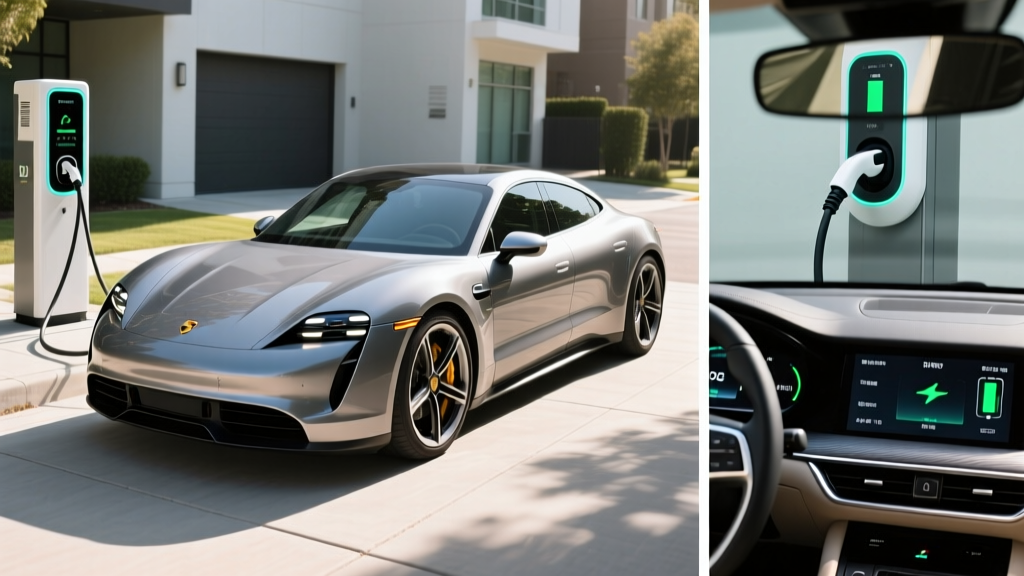
If you've been watching Porsche's electric flagship evolve, the 2026 Taycan represents the most complete version yet. With a mid-cycle refresh that dramatically improved range and charging speeds, the Taycan now competes on efficiency metrics—not just badge prestige. But with base prices starting near $93,000 and top trims eclipsing $200,000, a Taycan lease has become the preferred route for many buyers looking to experience Stuttgart's electric sports sedan without absorbing long-term depreciation risk.
This review covers the full 2026 Taycan lineup with hard numbers: EPA range, real-world highway expectations, the 800-volt charging architecture, tax credit eligibility under current IRS §30D rules, and whether leasing or buying makes more financial sense for this particular EV.
2026 Porsche Taycan: Core Specifications at a Glance
| Trim | Drivetrain | HP | 0-60 mph | EPA Range | Battery (usable kWh) | Base MSRP |
|---|---|---|---|---|---|---|
| Taycan (base) | RWD | 402 | 4.5s | 318 mi | 97.0 (NMC) | $92,950 |
| Taycan 4 | AWD | 402 | 4.4s | 303 mi | 97.0 (NMC) | $99,550 |
| Taycan 4S | AWD | 590 | 3.5s | 300 mi | 97.0 (NMC) | $112,650 |
| Taycan GTS | AWD | 690 | 3.1s | 283 mi | 97.0 (NMC) | $141,050 |
| Taycan Turbo | AWD | 870 | 2.7s | 279 mi | 97.0 (NMC) | $175,450 |
| Taycan Turbo GT | AWD | 1,019 | 2.1s | 269 mi | 97.0 (NMC) | $230,000 |
All 2026 trims use the updated Performance Battery Plus, a nickel-manganese-cobalt (NMC) lithium-ion pack with 97.0 kWh of usable capacity (105 kWh gross). Porsche stuck with NMC chemistry over LFP to prioritize energy density and power delivery—appropriate for a performance sedan where weight distribution and sustained high-output driving matter.
Real-World Range: What the EPA Sticker Doesn't Tell You
EPA estimate (base Taycan RWD): 318 miles
Real-world highway (70-80 mph, moderate temps): ~260-280 miles
Cold weather (below 32°F, highway): ~220-245 miles
City/mixed driving with regen: ~290-310 miles
The 2026 Taycan's range improvement over the pre-refresh model is substantial—the base RWD now achieves 318 miles EPA, up from roughly 225 miles on the original 2020 launch car. Porsche accomplished this through a larger battery, improved inverter efficiency, and a revised rear motor with a hairpin-wound stator that reduces losses.
But EPA combined cycles are optimistic for highway-heavy drivers. At sustained 75-80 mph speeds, expect the base Taycan to deliver around 260-280 miles before needing a charge stop. The Turbo GT, with its wider tires, higher drag coefficient, and aggressive performance mapping, drops to roughly 220-230 miles on the highway. The Taycan's heat pump (standard on all trims) helps mitigate cold-weather losses compared to competitors without one, but you'll still see a 20-25% reduction in freezing temperatures.
Efficiency ratings from fueleconomy.gov list the base Taycan at 83 MPGe combined, translating to roughly 38 kWh per 100 miles. The Turbo variants dip into the low-to-mid 70s MPGe range. For context, that's less efficient than a Tesla Model S (120 MPGe combined) but competitive with the Audi e-tron GT, which shares the Taycan's J1 platform.
Charging Speed: The Taycan's 800-Volt Advantage
Porsche's 800-volt architecture remains one of the most capable production charging systems available. The 2026 Taycan can accept up to 320 kW at a DC fast charger, and thanks to the flat charge curve the 800V system enables, it sustains high rates longer than most 400V competitors.
| Charging Level | Power (kW) | Speed (miles/hr) | Notes |
|---|---|---|---|
| Level 1 (120V outlet) | ~1.4 kW | ~3-4 mi/hr | Emergency/top-up only; ~4 days for full charge |
| Level 2 (240V, 48A) | 11.5 kW | ~30-33 mi/hr | Full charge in ~9 hours; ideal overnight home setup |
| Level 2 (240V, 80A) | 19.2 kW | ~50-55 mi/hr | Requires upgraded home circuit; ~5.5 hours full charge |
| DC Fast Charge (peak) | 320 kW | ~680 mi/hr (peak) | 10-80% in ~18 min on 350 kW charger |
| DC Fast Charge (50 kW) | 50 kW | ~130 mi/hr | 10-80% in ~55 min; typical older CCS station |
The headline number: 10-80% in approximately 18 minutes when connected to a 350 kW Electrify America or comparable CCS station. That's among the fastest production EVs available. The Taycan's charge curve stays above 200 kW through roughly 55% SoC before tapering, meaning real-world charge stops are genuinely quick.
One important note for 2026: Porsche now offers a NACS adapter for Tesla Supercharger access, expanding the Taycan's fast-charging network considerably. However, the Taycan's native port remains CCS1, and the adapter limits charging to 250 kW on V3 Superchargers—still fast, but below the car's 320 kW peak capability.
For home charging, the onboard 19.2 kW AC charger (upgraded from the prior 9.6 kW unit) is a significant practical improvement. With a hardwired 80-amp Level 2 circuit, you can add roughly 50 miles of range per hour of charging, meaning most daily driving needs are replenished in under two hours.
Performance and Driving Dynamics
The Taycan's reputation as a driver's EV is well-earned. Even the base RWD model hits 60 mph in 4.5 seconds, while the Turbo GT—with launch control engaged and 1,019 horsepower on tap—does it in 2.1 seconds, making it one of the quickest production cars ever built.
All AWD trims use a dual-motor setup with a permanent-magnet synchronous motor on each axle. The rear motor features a two-speed transmission (unique among production EVs) that provides aggressive initial acceleration in first gear and efficient high-speed cruising in second. This engineering choice gives the Taycan a noticeably different character from single-gear EVs—there's a perceptible shift around 45 mph that adds to the sports-car feel.
Standard air suspension with Porsche Active Suspension Management (PASM) adjusts damping in real time. The result is a car that can be genuinely comfortable on highway commutes yet flat and responsive on canyon roads. Rear-axle steering, available on 4S and above, shrinks the turning radius and adds agility at low speeds while improving stability at high speeds.
The Taycan's regenerative braking system recovers up to 290 kW, but Porsche deliberately tunes the regen to feel like a conventional performance car rather than enabling aggressive one-pedal driving. You'll use the brake pedal more than in a Tesla or Hyundai Ioniq 5, which some drivers prefer for its natural feel.
Pricing, Lease Economics, and Tax Credit Eligibility
| Trim | Base MSRP | As-Tested (typical options) | §30D Credit Eligible? | Lease Loophole? |
|---|---|---|---|---|
| Taycan (RWD) | $92,950 | $105,000-$115,000 | No — exceeds $55K sedan cap | Possible via lessor pass-through |
| Taycan 4 | $99,550 | $112,000-$125,000 | No | Possible |
| Taycan 4S | $112,650 | $130,000-$145,000 | No | Possible |
| Taycan GTS | $141,050 | $155,000-$170,000 | No | Possible |
| Taycan Turbo | $175,450 | $190,000-$210,000 | No | Possible |
| Taycan Turbo GT | $230,000 | $240,000+ | No | Possible |
Here's the critical tax credit reality: no Taycan trim qualifies for the $7,500 federal EV tax credit under the purchase pathway. IRS §30D rules cap the credit at sedars with an MSRP below $55,000. Even the base Taycan at $92,950 far exceeds this threshold. Additionally, buyer income caps ($150K single / $300K joint modified AGI) and battery critical-mineral sourcing requirements further complicate eligibility for luxury EVs.
However, the commercial lease loophole (IRC §45W) remains a viable path. When you lease rather than buy, the lessor (typically Porsche Financial Services) claims the $7,500 commercial clean vehicle credit and may pass it through as a capitalized-cost reduction, effectively lowering your monthly payment. This pathway has no MSRP cap, no buyer income cap, and no battery-sourcing requirements. Many Porsche dealers structure Taycan leases to incorporate this credit—always confirm with your dealer and consult a tax professional, as IRS rules can shift.
Taycan Lease vs. Buy: What the Numbers Look Like
A typical 2026 Taycan 4S lease through Porsche Financial Services might look like this: $112,650 MSRP, ~$130,000 as-tested with options, 36-month term, 10,000 miles/year, approximately $1,800-$2,200/month with the $7,500 commercial credit applied as a cap-cost reduction. Money due at signing typically ranges from $5,000 to $10,000 depending on the dealer and credit tier.
Buying the same car with a 60-month loan at 6.5% APR puts monthly payments around $2,400-$2,600 with $20,000 down—and no federal credit available. For most buyers, the lease route offers lower monthly outlay, the tax credit benefit, and the ability to hand the car back before major battery degradation concerns arise (though the 8-year/100,000-mile battery warranty provides substantial coverage).
Interior, Technology, and Daily Practicality
The Taycan's cabin is unmistakably Porsche—minimalist, driver-focused, and material-rich. The curved 14.8-inch digital instrument cluster sits behind a compact steering wheel, while a 10.9-inch central touchscreen handles infotainment. An optional 10.9-inch passenger display keeps your co-pilot engaged without distracting the driver.
Porsche Communication Management (PCM) in the 2026 model is noticeably faster than prior years, with wireless Apple CarPlay and Android Auto, over-the-air updates, and an improved voice assistant. The available head-up display with augmented-reality navigation overlays is one of the best implementations in any luxury EV.
On the driver-assistance front, the Taycan includes Porsche InnoDrive with adaptive cruise control and lane centering as an option. This is a SAE Level 2 system—the driver must maintain attention and keep hands available. It's competent for highway cruising but doesn't approach the hands-off capability of GM's Super Cruise on mapped roads. Porsche doesn't market it as autonomous driving, and neither should anyone else.
- Class-leading 320 kW DC fast charging (10-80% in ~18 min)
- Genuine sports-car driving dynamics with EV instant torque
- 318-mile EPA range on base RWD is competitive
- 800V architecture with NACS adapter for Supercharger access
- Premium interior materials and build quality
- Strong residual values support favorable lease terms
- Heat pump standard across all trims
- No federal purchase tax credit (MSRP exceeds $55K cap)
- Rear seat legroom is tight (32.5 inches) for a car this size
- Cargo space is modest: 14.3 cu ft trunk + 2.9 cu ft frunk
- Regen braking feel won't satisfy one-pedal-driving fans
- Options packages quickly add $15,000-$30,000 to base price
- Insurance costs run 20-30% higher than comparable gas Porsche models
- ADAS features lag behind Tesla, GM, and Hyundai in capability
Practicality is the Taycan's weakest category relative to rivals. The rear seats accommodate adults for short trips, but the 32.5 inches of legroom and sloping roofline make it a poor choice for tall passengers on long journeys. Cargo capacity totals just 17.2 cubic feet (trunk + frunk combined), which is less than a Tesla Model S (28 cu ft) and significantly less than the Lucid Air (32 cu ft). This is a grand tourer, not a family hauler.
Warranty Coverage and Long-Term Battery Outlook
Porsche covers the Taycan with a 4-year/50,000-mile limited warranty and an 8-year/100,000-mile battery warranty that guarantees at least 70% state-of-health (SoH) retention. If the battery drops below 70% capacity within that window, Porsche will repair or replace it to meet the threshold.
Based on data from earlier Taycan model years (2020-2023), real-world degradation has been modest. Most owners report 93-96% SoH after 40,000 miles, aided by the Taycan's sophisticated thermal management system that keeps cells in their optimal temperature window. The 800V architecture runs cells at lower current for a given power level, reducing thermal stress during both charging and discharging.
A full battery replacement out of warranty is expensive—estimated at $25,000-$35,000 including labor—but the strong degradation data suggests this is an unlikely scenario for most original owners and lessees.
How the Taycan Stacks Up Against Key Competitors
| Spec | 2026 Taycan 4S | 2026 Tesla Model S Plaid | 2026 Lucid Air Grand Touring | 2026 Audi e-tron GT RS |
|---|---|---|---|---|
| EPA Range | 300 mi | 359 mi | 512 mi | 278 mi |
| 0-60 mph | 3.5s | 1.99s | 3.0s | 3.1s |
| DC Fast Charge Peak | 320 kW | 250 kW | 300 kW | 320 kW |
| 10-80% Time | ~18 min | ~25 min | ~20 min | ~18 min |
| Base MSRP | $112,650 | $89,990 | $125,600 | $147,500 |
| Cargo (total cu ft) | 17.2 | 28.0 | 32.0 | 15.7 |
The Taycan wins on driving engagement and build quality but cedes range to the Lucid Air and value to the Tesla Model S. The Audi e-tron GT RS shares the Taycan's J1 platform and 800V architecture, making it the closest rival—but the Porsche edges it out on software refinement and brand cachet. If maximum range is your priority, the Lucid Air Grand Touring at 512 miles EPA is in a different league. If you want the sharpest driving instrument that happens to be electric, the Taycan still holds the crown.
Who Should Lease the 2026 Taycan?
- You prioritize driving dynamics and brand prestige over maximum range
- You have reliable home Level 2 charging and access to DC fast chargers for road trips
- You want to leverage the commercial lease tax credit loophole ($7,500 benefit)
- You plan to swap vehicles every 3 years and avoid long-term depreciation risk
- Most of your driving is solo or with one passenger (rear space is limited)
- You need family-hauler cargo and passenger space (consider Rivian R1S, Tesla Model X)
- Range is your top priority (Lucid Air, Tesla Model S)
- You want the latest autonomous driving features (Tesla FSD, GM Super Cruise)
- You want to purchase and claim the federal tax credit (no Taycan qualifies)
The Taycan lease makes the most sense for driving enthusiasts who value Porsche's engineering heritage, want the latest in fast-charging technology, and prefer the financial flexibility of a 36-month commitment over outright ownership. The commercial credit pass-through makes leasing financially superior to buying in most scenarios.
Frequently Asked Questions
What is the real-world range of the 2026 Porsche Taycan?
The base RWD Taycan achieves 318 miles EPA, but expect 260-280 miles in real-world highway driving at 70-80 mph. Cold weather (below freezing) reduces this to approximately 220-245 miles. Higher-performance trims like the Turbo GT deliver roughly 220-230 miles on the highway due to wider tires and more aggressive powertrain mapping.
How fast does the Taycan charge at home and on the road?
At a 350 kW DC fast charger, the Taycan peaks at 320 kW and charges from 10-80% in approximately 18 minutes. At home on a 240V/80A Level 2 circuit, the 19.2 kW onboard charger adds about 50 miles of range per hour, fully replenishing the battery in roughly 5.5 hours.
Does the 2026 Taycan qualify for the federal EV tax credit?
No Taycan qualifies for the $7,500 purchase credit under IRS §30D because all trims exceed the $55,000 MSRP cap for sedans. However, leasing through Porsche Financial Services may unlock the $7,500 commercial clean vehicle credit (§45W), which the lessor can pass through as a capitalized-cost reduction. Always confirm with your dealer and a tax professional.
Is it better to lease or buy a Taycan?
For most buyers, leasing is the financially superior option. You gain access to the commercial tax credit pass-through, avoid long-term depreciation risk on a six-figure luxury EV, and keep monthly payments lower than equivalent loan payments. Buying only makes sense if you drive very low annual miles, plan to keep the car 7+ years, and value ownership equity over the tax credit benefit.
What's the biggest drawback of owning a Taycan?
Practicality. The Taycan offers just 17.2 cubic feet of total cargo space and tight rear legroom (32.5 inches). It's a sports sedan first, not a daily family vehicle. Insurance costs also run 20-30% higher than equivalent gas-powered Porsches, and the regen braking feel may disappoint drivers accustomed to strong one-pedal driving in other EVs.
How does the Taycan compare to the Tesla Model S?
The Model S offers more range (359 vs. 300 miles EPA on comparable trims), more cargo space, faster straight-line acceleration (Plaid trim), and access to the Supercharger network natively. The Taycan counters with superior build quality, more engaging driving dynamics, faster peak charging (320 vs. 250 kW), and a more premium interior. It comes down to whether you value tech-forward minimalism (Tesla) or traditional luxury performance (Porsche).
Sources: EPA fuel economy data via fueleconomy.gov, Porsche USA official specifications, IRS Clean Vehicle Credits guidance. All pricing and specifications reflect 2026 model year data available at time of publication. Tax credit rules are subject to change; consult a qualified tax professional for personal eligibility.