Quick Answer: Is the 2026 Porsche Cayenne EV Worth It?
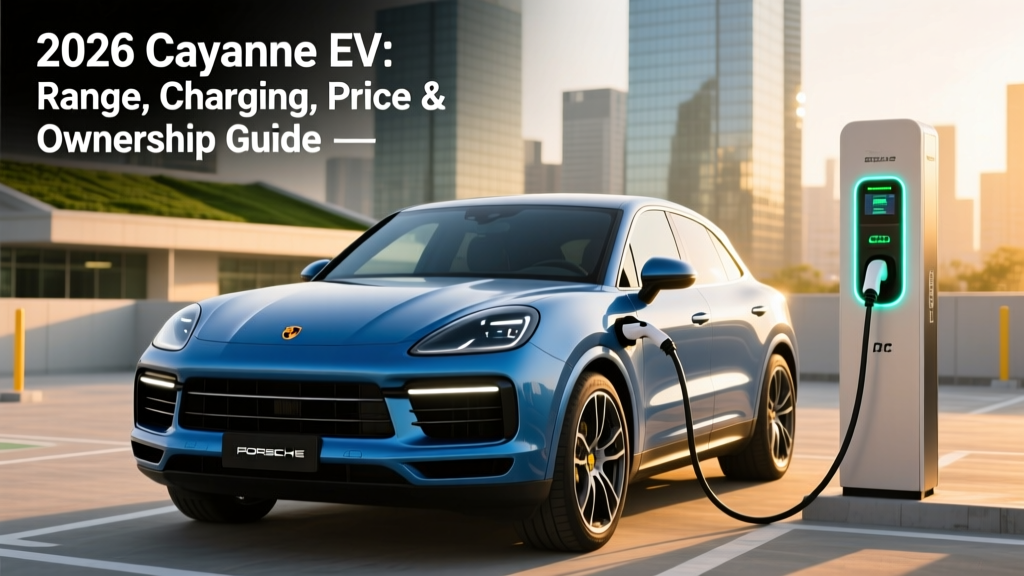
The 2026 Porsche Cayenne Electric is Porsche's first all-electric Cayenne, built on the Premium Platform Electric (PPE) architecture shared with the Macan EV and Audi Q6 e-tron. Based on Porsche's preliminary specs and the PPE platform's proven performance in the Macan EV, buyers can expect an EPA-estimated range near 310 miles (rear-wheel-drive base), a peak DC fast-charge rate around 270 kW (10–80% in approximately 21 minutes), and a starting MSRP near $92,000 before options. As a luxury SUV exceeding the IRS §30D $80,000 MSRP cap for SUVs, the Cayenne EV will not qualify for the $7,500 federal tax credit on most trims. It competes directly with the BMW iX, Mercedes EQS SUV, and Tesla Model X — trading outright range for Porsche-tuned driving dynamics and 800-volt charging speed.
2026 Cayenne EV: Core Specifications
These figures are based on Porsche's announced PPE platform data, Macan EV real-world benchmarks, and preliminary Cayenne EV disclosures. Final EPA certification is expected closer to the on-sale date.
| Spec | Cayenne EV (Base RWD est.) | Cayenne EV 4 / Turbo (est.) |
|---|---|---|
| Battery (usable) | ~96 kWh (NMC) | ~96 kWh (NMC) |
| Architecture | 800V PPE | 800V PPE |
| EPA Range (est.) | ~310 mi | ~270–290 mi |
| Peak DC Charge Rate | ~270 kW | ~270 kW |
| 10–80% DC Fast Charge | ~21 min | ~21 min |
| Level 2 AC Charge (max) | 11 kW (onboard) | 11 kW (onboard) |
| Horsepower | ~335 hp | ~402–603 hp |
| 0–60 mph | ~5.7 sec | ~4.4–3.3 sec |
| Starting MSRP (est.) | ~$92,000 | ~$105,000–$135,000 |
| Battery Warranty | 8 yr / 100,000 mi | 8 yr / 100,000 mi |
Real-world range caveat: The EPA sticker is a laboratory estimate. On sustained highway driving at 75 mph, expect roughly 10–15% range reduction (~265–280 miles for the base model). In cold weather (below 32°F), lithium-ion chemistry and cabin heating demands can drop usable range by 20–30%, bringing a 310-mile sticker down to approximately 215–250 miles. Porsche's standard heat pump should mitigate some of this loss compared to resistive heating systems, but the physics of cold batteries are unavoidable. Always plan road-trip charging stops using 70–75% of the EPA figure as your practical buffer.
Charging: 800V Speed Meets Real-World Infrastructure
The Cayenne EV's 800-volt PPE architecture is its charging ace. At a compatible 350 kW DC fast charger (Electrify America, EVgo, or Tesla Supercharger with NACS adapter), the Cayenne EV can accept up to 270 kW — but only under ideal conditions: battery preconditioned to optimal temperature, state of charge (SoC) between 10–50%, and ambient temperatures above 50°F.
| Charging Level | Power (kW) | Miles Added per Hour | Typical Use Case |
|---|---|---|---|
| Level 1 (120V outlet) | ~1.4 kW | ~4–5 mi/hr | Emergency / trickle top-up |
| Level 2 (240V, 48A home) | ~11.5 kW | ~35–40 mi/hr | Daily overnight charging |
| DC Fast (peak) | ~270 kW | ~800+ mi/hr (peak) | Road trips, 10–80% in ~21 min |
| DC Fast (50 kW station) | ~50 kW | ~150 mi/hr | Older public chargers |
Understanding the charge curve: The "270 kW" figure is a peak, not a sustained rate. Like all EVs, the Cayenne EV's charging speed tapers significantly as the battery fills. You'll see peak speeds from roughly 10–40% SoC, then a step-down to ~150–180 kW through 60%, and further tapering above 80%. The advertised 10–80% time of ~21 minutes accounts for this curve. Charging from 80–100% can take an additional 20+ minutes — avoid doing this on road trips unless necessary.
Connector note: For 2026, Porsche has adopted the NACS (Tesla-style) charging port on new vehicles sold in North America. This grants direct access to Tesla's Supercharger network (20,000+ stalls) without an adapter. The Cayenne EV will also remain compatible with CCS1 stations via adapter for non-Tesla networks.
Cayenne EV vs. Gas Cayenne vs. Competitors
The most common buyer question: does going electric in a Cayenne actually save money or improve the experience? Here's how the EV stacks up against the gas-powered Cayenne and key EV rivals.
| Metric | 2026 Cayenne EV (Base est.) | 2026 Cayenne Gas (Base) | BMW iX xDrive50 | Tesla Model X LR |
|---|---|---|---|---|
| Starting MSRP | ~$92,000 | ~$83,000 | ~$87,250 | ~$81,630 |
| EPA Range | ~310 mi | ~430 mi (19.5 gal tank) | ~307 mi | ~335 mi |
| MPGe / MPG Combined | ~85 MPGe | ~21 MPG | ~86 MPGe | ~102 MPGe |
| 0–60 mph | ~5.7 sec | ~5.9 sec | ~4.4 sec | ~3.8 sec |
| DC Fast Charge (10–80%) | ~21 min | N/A (5-min refuel) | ~31 min | ~25 min |
| Federal Tax Credit (§30D) | Not eligible (MSRP > $80K cap) | Not eligible | Not eligible (MSRP > $80K cap) | Potentially eligible (if under $80K trim + sourcing) |
| Est. Annual Fuel/Energy Cost | ~$700–$900 | ~$2,800–$3,200 | ~$700–$900 | ~$600–$750 |
Key takeaway: The Cayenne EV won't undercut the gas Cayenne on purchase price, and its range is ~120 miles shorter than a full tank. What it delivers is ~$2,000+ annual fuel savings (assuming 12,000 miles/year and national average electricity/gas prices), dramatically lower maintenance costs (no oil changes, fewer brake replacements thanks to regenerative braking), and Porsche's signature driving dynamics with instant electric torque. The BMW iX offers similar luxury at a slightly lower price; the Model X wins on range and charging network access but trails in interior build quality and ride refinement.
Total Cost of Ownership: 5-Year Breakdown
Purchase price is only part of the equation. Here's what five years of Cayenne EV ownership actually looks like compared to the gas Cayenne, assuming 12,000 miles/year, national-average energy costs ($0.16/kWh home, $3.50/gallon premium), and typical luxury-SUV insurance rates.
| Cost Category (5-Year) | Cayenne EV (est.) | Cayenne Gas (est.) |
|---|---|---|
| Purchase Price (base MSRP) | $92,000 | $83,000 |
| Federal Tax Credit | $0 (exceeds MSRP cap) | $0 |
| Estimated Depreciation (5yr) | ~$41,000 (45%) | ~$37,000 (45%) |
| Energy/Fuel Cost (60K mi) | ~$3,800 | ~$15,000 |
| Maintenance (5yr) | ~$2,200 | ~$5,500 |
| Insurance (5yr avg) | ~$18,000 | ~$15,500 |
| Estimated 5-Year Total Cost | ~$115,000 | ~$116,000 |
The 5-year totals are remarkably close. The Cayenne EV recoups its higher purchase price through dramatically lower energy and maintenance costs, but EV insurance premiums run 10–20% higher on average (due to battery replacement risk and specialized repair requirements), and luxury EV depreciation remains steeper than ICE equivalents in the current market. Your actual numbers depend heavily on local electricity rates, driving patterns, and whether you have access to free or discounted charging (some employers, hotels, and Porsche's own charging programs offer complimentary sessions).
Home charging economics: If you charge primarily at home on a Level 2 setup at $0.16/kWh, your cost per mile is roughly $0.05–$0.06. If you rely entirely on DC fast charging at $0.35–$0.48/kWh (typical Electrify America or EVgo rates), your cost per mile rises to $0.12–$0.16 — still cheaper than premium gas at ~$0.25/mile, but the gap narrows considerably. Home charging access is the single biggest financial variable in EV ownership.
Common Misconceptions About the Cayenne EV
| Myth | Fact |
|---|---|
| "The Cayenne EV qualifies for the $7,500 federal tax credit." | The IRS §30D credit caps eligible SUVs at $80,000 MSRP. The Cayenne EV starts near $92,000. No federal credit applies to any trim. Some state/local incentives may still apply — check your state energy office. |
| "310 miles of range means I can drive 310 miles." | EPA range is a lab test. Real-world highway driving, cold weather, and elevation changes reduce this by 10–30%. Plan for ~270 highway miles in mild weather, ~230 in winter. |
| "It charges at 270 kW the whole time." | 270 kW is a peak rate achieved only between ~10–40% SoC with a preconditioned battery. Average charge rate over a 10–80% session is closer to 170–190 kW. |
| "I don't need home charging; public chargers are fine." | Public DC fast charging costs 3–5x more per kWh than home charging, adds wear to the battery from repeated high-power sessions, and requires 20–40 minutes of your time per session. Daily EV ownership without home charging is expensive and inconvenient. |
| "The battery will need replacing in a few years." | Porsche warranties the battery for 8 years/100,000 miles against degradation below 70% capacity. Modern NMC batteries on PPE platforms are projected to retain 85–90% capacity at 100,000 miles based on Macan EV and Taycan fleet data. |
Who Should Buy the Cayenne EV? A Decision Framework
Choose the 2026 Cayenne EV if:
- You have reliable home charging (Level 2, 240V/48A) — this is non-negotiable for cost-effective daily ownership.
- Your daily driving is under 100 miles round-trip, leaving you a massive range buffer for errands and detours.
- You value driving dynamics over outright range. Porsche's chassis tuning, rear-axle steering (available), and instant EV torque deliver a driving experience the BMW iX and Tesla Model X can't match.
- You road-trip 3–5 times per year and are comfortable planning 20-minute DC fast-charge stops along major highway corridors (I-5, I-95, I-10, etc.).
- You want Porsche build quality and dealer service without the fuel cost and maintenance of a gas Cayenne.
Consider the Gas Cayenne or a PHEV Instead if:
- You cannot install a home charger (apartment, condo without EV infrastructure, street parking only). Public-only charging erases the cost advantage and adds daily friction.
- You regularly drive 300+ miles in a single day in regions with sparse DC fast-charging infrastructure (rural Mountain West, parts of the Great Plains).
- You live in extreme cold (frequent sub-zero temperatures) and lack a garage — cold-soaked batteries lose significant range and charge slower.
- Budget is a primary concern. The gas Cayenne starts ~$9,000 lower, and the Cayenne E-Hybrid (PHEV) offers ~25–30 miles of electric-only range for daily commuting plus a gas engine for longer trips, often at a lower MSRP.
Look at the BMW iX or Tesla Model X if:
- Price sensitivity matters. The Model X starts ~$10,000 lower and may qualify for the federal credit on specific configurations. The iX undercuts by ~$5,000.
- Maximum range is your top priority. The Model X Long Range delivers ~335 miles EPA, and Tesla's Supercharger network remains the most reliable in the U.S.
First-Time EV Buyer Essentials
If the Cayenne EV is your first electric vehicle, here's what no brochure will tell you:
1. Home charging installation costs $500–$2,500+. A Level 2 charger (like the Porsche Mobile Charger Connect or a ChargePoint Home Flex) costs $400–$700 for the unit. Professional electrical installation runs $500–$1,500 if your panel has capacity. If you need a 200-amp panel upgrade, add $1,500–$3,500. Get a quote from a licensed electrician before purchasing the car.
2. Learn kW vs. kWh immediately. kW (kilowatts) measures power — how fast energy flows, like water pressure. kWh (kilowatt-hours) measures energy — how much is stored, like gallons in a tank. The Cayenne EV has a ~96 kWh battery (energy) and charges at up to 270 kW (power). Confusing these is the #1 new-owner mistake.
3. Preconditioning matters for fast charging. Navigate to a DC fast charger using the car's built-in navigation, and the Cayenne EV will automatically warm the battery to optimal temperature before you arrive. Skipping this (e.g., using a third-party app to find chargers) can slow your charge rate by 30–50% in cold weather.
4. Regenerative braking changes how you drive. The Cayenne EV offers adjustable regen, including a near-one-pedal driving mode. Lifting off the accelerator slows the car significantly while recapturing energy. Most owners adapt within a week and prefer it, but expect a learning curve.
5. Insurance will be higher. EV insurance premiums run 10–20% above comparable gas vehicles. Shop quotes from multiple carriers before purchase — some insurers (like GEICO and Progressive) have improved EV pricing, while others still penalize battery replacement risk heavily.
Frequently Asked Questions
When does the 2026 Porsche Cayenne EV go on sale?
Porsche has confirmed the Cayenne Electric for the 2026 model year, with initial deliveries expected in late 2025 for European markets and early-to-mid 2026 for the United States. Final EPA range and pricing will be published closer to the on-sale date. Reserve through a Porsche dealer for allocation priority.
Will the Cayenne EV have a frunk (front trunk)?
Yes. The PPE platform's compact electric powertrain frees up front-end space. Expect a modest frunk suitable for charging cables and a small bag — similar to the Macan EV's front storage compartment. Total cargo volume (rear + frunk) should approach 35–40 cubic feet with rear seats up.
Can the Cayenne EV tow?
Porsche has not published final towing ratings. The Macan EV is rated for approximately 4,400 lbs, and the Taycan Cross Turismo manages ~3,500 lbs. Expect the Cayenne EV to tow in the 4,000–5,000 lb range — adequate for a small boat or utility trailer, but towing will reduce range by 30–50% depending on load and speed.
Does the Cayenne EV support vehicle-to-home (V2H) or vehicle-to-load (V2L)?
The PPE platform supports bidirectional charging in principle, but Porsche has not confirmed V2L or V2H functionality for the U.S.-spec Cayenne EV at launch. This may come via a future software update or hardware accessory.
How does the Cayenne EV compare to the Taycan?
The Taycan is a performance sedan; the Cayenne EV is a luxury SUV. The Taycan offers a sportier drive and slightly faster charging (up to 320 kW on the updated 2025+ model), but less cargo space, lower seating position, and similar pricing. Families and those needing SUV utility will prefer the Cayenne EV; driving enthusiasts may still choose the Taycan.
What happens if the battery degrades past warranty?
Porsche's battery warranty guarantees at least 70% capacity retention over 8 years/100,000 miles. Out-of-warranty battery replacement for a ~96 kWh NMC pack currently costs $18,000–$28,000 at a Porsche dealer. However, industry degradation data from Taycan fleets shows most PPE batteries retain 88–92% capacity at 100,000 miles — well above the warranty threshold. Full replacement is statistically unlikely within the first decade of ownership.