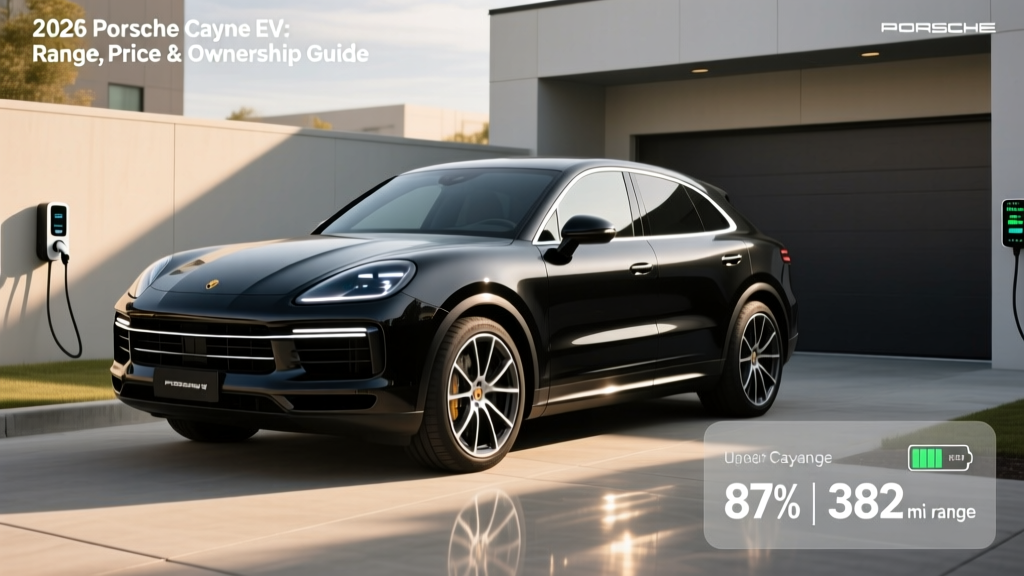
Quick Answer: The 2026 Porsche Cayenne EV is Porsche's first fully electric Cayenne, built on the 800-volt PPE (Premium Platform Electric) architecture shared with the Macan EV and Audi Q6 e-tron. It targets an EPA range of approximately 300 miles from a ~100 kWh (usable) battery, supports peak DC fast charging around 270 kW (10–80% in roughly 21 minutes), and starts near $92,000 before incentives. It replaces the gas V6 and V8 Cayenne with instant torque, far lower per-mile fueling costs, and a significantly lower center of gravity — but buyers must plan for home Level 2 charging and accept that real-world highway and cold-weather range will fall 15–25% below the EPA sticker.
What the 2026 Porsche Cayenne EV Actually Is
Porsche confirmed the Cayenne EV as part of its broader electrification strategy, positioning it above the Macan EV and alongside the Taycan in the brand's battery-electric lineup. Unlike the Taycan's J1 platform, the Cayenne EV uses the newer PPE architecture co-developed with Audi, which brings an 800-volt electrical system, improved energy density, and faster sustained charging rates.
For 2026, Porsche offers the Cayenne EV in rear-wheel-drive and dual-motor all-wheel-drive configurations, with the Cayenne EV Turbo variant pushing output past 600 horsepower. This is not a compliance car — Porsche is engineering it to match or exceed the gas Cayenne's performance benchmarks while delivering the refinement and cargo practicality the nameplate demands.
| Spec | Cayenne EV (AWD) | Cayenne EV Turbo (AWD) |
|---|---|---|
| Battery (usable) | ~100 kWh, NMC | ~100 kWh, NMC |
| EPA Range (est.) | ~300 mi | ~270 mi |
| Peak DC Charge Rate | 270 kW | 270 kW |
| 10–80% DC Charge Time | ~21 min | ~21 min |
| Level 2 (AC) Charge Rate | 11 kW (std) / 22 kW (opt) | 11 kW (std) / 22 kW (opt) |
| 0–60 mph | ~5.2 sec | ~3.5 sec |
| Horsepower | ~402 hp | ~630 hp |
| Drivetrain | Dual-motor AWD | Dual-motor AWD |
| Starting MSRP (est.) | $92,000 | $135,000 |
| Battery/Powertrain Warranty | 8 yr / 100,000 mi | 8 yr / 100,000 mi |
Note: Specifications are preliminary and based on Porsche's announced PPE platform data. Final EPA figures and pricing will be confirmed closer to the on-sale date. Sources: Porsche Newsroom, fueleconomy.gov.
Real-World Range: What the EPA Sticker Won't Tell You
Porsche targets roughly 300 miles of EPA-estimated range for the standard Cayenne EV AWD. But EPA numbers are laboratory-derived under specific drive cycles, and real-world results diverge based on how and where you drive.
EPA Estimated: ~300 miles (Cayenne EV AWD)
Real-World Expectations:
- Mixed suburban/highway (65–75 mph, 60–80°F): 260–280 miles
- Sustained highway at 75+ mph: 240–260 miles
- Cold weather (below 32°F) with cabin heat: 210–240 miles
- Cold weather + highway + mountain terrain: 190–220 miles
The Cayenne EV's large frontal area and SUV weight work against efficiency at highway speeds. The 800V system and standard heat pump help mitigate cold-weather losses — Porsche's Macan EV testing showed the heat pump recovers roughly 10–15% of range in freezing conditions compared to resistive heating — but physics still applies. A heavy SUV pushing through cold, dense air at 75 mph will consume energy faster than the EPA combined cycle suggests.
For buyers in northern climates, plan trips around a 220-mile usable range in winter. For temperate-climate owners who mostly drive under 70 mph, expect to see numbers much closer to the sticker.
Charging Speed: The 800V Advantage in Practice
The Cayenne EV's 800-volt architecture is its most consequential ownership feature. While many 400V competitors peak at 150–180 kW and taper sharply above 60% state of charge, the Cayenne EV can sustain higher charge rates deeper into the session.
| Charge Level | Power | Miles Added per Hour | Typical Use Case |
|---|---|---|---|
| Level 1 (120V household) | ~1.4 kW | ~4 mi/hr | Emergency top-off only |
| Level 2 (240V, 48A) | 11 kW | ~33 mi/hr | Standard home charging |
| Level 2 (240V, optional) | 22 kW | ~66 mi/hr | Faster home/workplace (requires 100A circuit) |
| DC Fast Charge (peak) | 270 kW | ~800+ mi/hr (peak) | Road trips, 10–80% in ~21 min |
Understanding the charge curve: The Cayenne EV will not sustain 270 kW from 10% to 80%. Expect peak power between roughly 10–40% state of charge, tapering to ~180 kW by 60%, and dropping to ~80–100 kW past 80%. This is normal lithium-ion behavior — charging slows to protect battery health. The 10–80% time of approximately 21 minutes reflects this averaged curve, not a sustained peak.
kW vs kWh refresher: kW (kilowatts) measures the rate of energy flow — like water pressure from a hose. kWh (kilowatt-hours) measures total energy stored — like the size of the bucket. The Cayenne EV's ~100 kWh battery charged at 270 kW will fill faster than a 100 kWh battery at 150 kW, but both hold the same total energy.
Connector note: Porsche has committed to adopting the NACS (North American Charging Standard) connector for its EVs in North America. The 2026 Cayenne EV is expected to ship with a native NACS port, granting access to Tesla Superchargers (now open to non-Tesla EVs via NACS) as well as Electrify America, EVgo, and other networks using NACS adapters or native stalls. Verify final connector configuration with your dealer before purchase.
Cayenne EV vs Gas Cayenne: Cost and Performance Comparison
The most common cross-shop for the Cayenne EV buyer is the outgoing gas Cayenne. Here's how the numbers stack up when you look past the sticker price.
| Metric | Cayenne EV (AWD) | Cayenne Gas (V6 AWD) |
|---|---|---|
| Base MSRP | $92,000 | $84,500 |
| Federal Tax Credit (§30D) | $0 (MSRP exceeds SUV cap) | $0 |
| Fuel/Energy Cost (15,000 mi/yr) | ~$1,050/yr* | ~$3,150/yr** |
| 5-Year Fuel/Energy Total | ~$5,250 | ~$15,750 |
| Maintenance (5-yr est.) | ~$2,800 | ~$5,500 |
| 0–60 mph | ~5.2 sec | ~5.9 sec |
| EPA Efficiency | ~82 MPGe (est.) | ~21 MPG combined |
| 5-Year Total Cost (purchase + fuel + maint.) | ~$97,250 | ~$100,250 |
*Assumes $0.14/kWh national average, ~3.0 mi/kWh efficiency, home charging dominant.
**Assumes $4.20/gal premium (91 octane), 21 MPG combined.
Source: fueleconomy.gov for gas Cayenne MPG data. Electricity rates vary by state — check your utility's EV time-of-use plan.
The Cayenne EV costs roughly $7,500 more upfront but saves approximately $8,400 in fuel and $2,700 in maintenance over five years. That puts the EV ahead by about $3,600 on pure operating economics — before factoring in any state incentives, HOV lane access, or the intangible of never visiting a gas station.
Federal tax credit reality: Under current IRS §30D rules, new clean vehicle credits cap at $80,000 MSRP for SUVs. The Cayenne EV's starting price of ~$92,000 exceeds this threshold, making it ineligible for the federal credit regardless of battery sourcing or buyer income. See IRS §30D guidelines for full eligibility rules. Some states offer separate rebates that may apply — check your state energy office.
Real Costs of Cayenne EV Ownership
Sticker price is only the entry point. Here's the full ownership picture for a first-year Cayenne EV buyer.
| Cost Category | Estimated Amount | Notes |
|---|---|---|
| Vehicle purchase (base AWD) | $92,000 | Before options, destination, dealer fees |
| Home Level 2 charger (hardware) | $500–$800 | Porsche Mobile Charger Connect or equivalent 48A unit |
| Home charger installation | $800–$2,500 | 240V/60A circuit; panel upgrade may add $1,500–$3,000 |
| Annual electricity (15,000 mi) | ~$1,050 | At $0.14/kWh; less with TOU plan & off-peak charging |
| Annual insurance | $3,200–$4,800 | EV premiums run 15–25% higher than gas equivalent |
| Annual maintenance | ~$400–$600 | Cabin filter, wipers, tire rotation; no oil/coolant changes |
| Tires (replacement cycle ~30,000 mi) | $1,800–$2,600 | EV-specific tires; higher wear from torque and weight |
Home charging is the economic linchpin. The Cayenne EV's cost advantage over gas collapses if you rely exclusively on public DC fast charging, where rates of $0.35–$0.55/kWh push per-mile costs close to premium gasoline. Budget $1,300–$3,300 for a professional Level 2 installation (licensed electrician required — get three quotes and confirm your panel has 60A of spare capacity). If your home electrical panel is maxed out at 100A, a panel upgrade to 200A can add $1,500–$3,000.
Insurance reality: EV insurance premiums run higher due to elevated repair costs, specialized parts, and total-loss thresholds that factor in battery replacement. Expect $3,200–$4,800 annually depending on your state, driving record, and coverage level. Get quotes from at least three carriers before signing the purchase agreement.
Tire wear: The Cayenne EV's instant torque and ~5,500-pound curb weight accelerate tire wear by roughly 20–30% compared to the gas Cayenne. Budget for EV-rated touring tires (Michelin Pilot Sport EV, Pirelli P Zero Elect) at $450–$650 per corner, with replacement around 25,000–35,000 miles.
Common Misconceptions About the Cayenne EV
| Myth | Fact |
|---|---|
| "The Cayenne EV qualifies for the $7,500 federal tax credit." | It does not. The §30D credit caps SUV eligibility at $80,000 MSRP. The Cayenne EV starts at ~$92,000. No federal credit applies regardless of income or battery sourcing. |
| "300 miles of range means I can drive 300 miles on a road trip." | The EPA figure assumes a mix of city and highway at moderate temperatures. Sustained 75-mph highway driving in summer yields ~250 miles; winter drops this to ~210–230. Plan charging stops accordingly. |
| "It charges at 270 kW the whole time." | 270 kW is peak rate, available only at low state of charge (roughly 10–40%). The charge curve tapers progressively to protect battery chemistry. Average rate across 10–80% is closer to 180–200 kW. |
| "I don't need a home charger — public stations are everywhere." | Public DC fast charging costs 2–4× more per kWh than home electricity, and charger uptime varies by network. Without home charging, the Cayenne EV's operating cost advantage over gas shrinks dramatically. |
| "The battery will need replacing in 5 years." | Porsche warranties the battery for 8 years/100,000 miles against degradation below 70% capacity. PPE-platform batteries use advanced NMC chemistry with robust thermal management. Real-world data from Taycan owners shows ~3–5% degradation at 60,000 miles. |
Who Should Buy the Cayenne EV — Decision Framework
Buy the Cayenne EV if:
- You have access to home Level 2 charging (240V garage or carport) and drive under 250 miles on most days
- You want Cayenne-level luxury and cargo space but are ready to leave gas behind
- You value instant torque, a low center of gravity, and near-silent daily driving
- Your state offers EV incentives that partially offset the lack of federal credit
- You road-trip fewer than 5 times per year and can plan around DC fast-charger stops
Stick with the gas Cayenne (or wait) if:
- You live in an apartment or condo without charging access and cannot install a Level 2 charger
- You regularly drive 350+ miles in a single day through areas with sparse charging infrastructure
- Your budget is strictly under $80,000 and you need the federal tax credit to make the math work
- You tow frequently — EV range drops 30–50% under heavy trailer loads
- You prefer to wait for final EPA certification and real-world third-party testing before committing
Consider the Cayenne E-Hybrid (PHEV) if:
- You want ~25–30 miles of electric-only range for daily commutes but need gas flexibility for long trips
- You can't install home charging but want some electric driving via workplace or public Level 2
- You want the Cayenne badge below $85,000 and still want to reduce fuel consumption
What First-Time EV Buyers Must Know Before Ordering
If the Cayenne EV is your first battery-electric vehicle, these operational realities will shape your daily experience:
1. Preconditioning matters for fast charging. The Cayenne EV's battery management system will precondition the pack when you navigate to a DC fast charger. This warms the battery to optimal temperature, enabling peak charge rates. If you arrive at a charger without preconditioning (especially in cold weather), expect significantly slower initial charge speeds — potentially 40–50% below peak until the pack warms.
2. Regenerative braking changes how you drive. Porsche offers adjustable regen levels, but the Cayenne EV will not default to aggressive one-pedal driving the way some competitors do. Expect a coasting-oriented default with regen available on demand. This is a deliberate Porsche engineering choice — it preserves the driving feel the brand is known for, but it means you'll use the brake pedal more than in a Tesla or Hyundai with strong one-pedal modes.
3. Winter range loss is real and predictable. Budget 20–30% range reduction in sustained sub-freezing temperatures. Use the seat and steering wheel heaters instead of cranking cabin heat to conserve energy. Precondition the cabin while still plugged in at home to start with a warm interior and a full battery.
4. The 12V battery still exists. Like all EVs, the Cayenne EV has a conventional 12V auxiliary battery that powers electronics, door locks, and the computer that manages the high-voltage system. If the 12V dies, the car won't start — even with a full traction battery. Porsche's DC-DC converter keeps the 12V charged during normal operation, but if the car sits unplugged for weeks, the 12V can drain.
5. Software updates change the car. Porsche delivers over-the-air updates that can modify throttle response, charging behavior, and infotainment features. Your Cayenne EV will not be the same car in year three as it was on delivery day — for better or sometimes for different. Stay current with update notes in the owner community.
Frequently Asked Questions
Does the 2026 Porsche Cayenne EV qualify for any federal tax credits?
No. Under current IRS §30D rules, the new clean vehicle credit caps at $80,000 MSRP for SUVs, vans, and pickup trucks. The Cayenne EV starts at approximately $92,000, placing it above the cap. Buyer income limits and battery-sourcing requirements are moot once the MSRP cap is exceeded. Some states (California, Colorado, Massachusetts, among others) offer separate EV rebates or tax credits that may apply — check your state's energy office for current programs.
How long does it take to charge the Cayenne EV at home overnight?
On a standard 240V/48A Level 2 charger delivering 11 kW, a full 0–100% charge of the ~100 kWh battery takes approximately 9–10 hours. Most owners who plug in at 20–30% remaining will reach 80–90% by morning in 5–6 hours. The optional 22 kW onboard charger (requires a 100A circuit and compatible EVSE) cuts this roughly in half.
Can the Cayenne EV tow, and how does towing affect range?
Porsche has not released final towing capacity for the Cayenne EV, but the PPE platform supports towing — expect a rating in the 4,000–5,000 pound range based on the Macan EV's architecture. Towing at capacity typically reduces EV range by 30–50% due to dramatically increased aerodynamic drag and rolling resistance. A 300-mile range drops to 150–210 miles under a heavy trailer. Plan accordingly.
Is the Cayenne EV's battery covered under warranty, and what does replacement cost?
Porsche covers the high-voltage battery for 8 years or 100,000 miles, warranting it against capacity loss below 70% of original. If a replacement is needed out of warranty, current industry estimates for a ~100 kWh NMC pack range from $18,000 to $28,000 including labor, though battery costs continue to decline. No widespread Cayenne EV battery replacements exist yet — the model is new — but Taycan data suggests degradation remains well within warranty thresholds at high mileage.
How does the Cayenne EV compare to the Tesla Model X or BMW iX?
The Cayenne EV competes most directly with the BMW iX (starting ~$87,000, ~300-mile range) and the Tesla Model X (starting ~$80,000, ~335-mile range). The Porsche differentiates on build quality, interior materials, chassis tuning, and brand cachet. The Model X wins on Supercharger network maturity and range; the iX competes on value and interior space. The Cayenne EV trades some range for driving dynamics and fit-and-finish that align with Porsche's positioning.