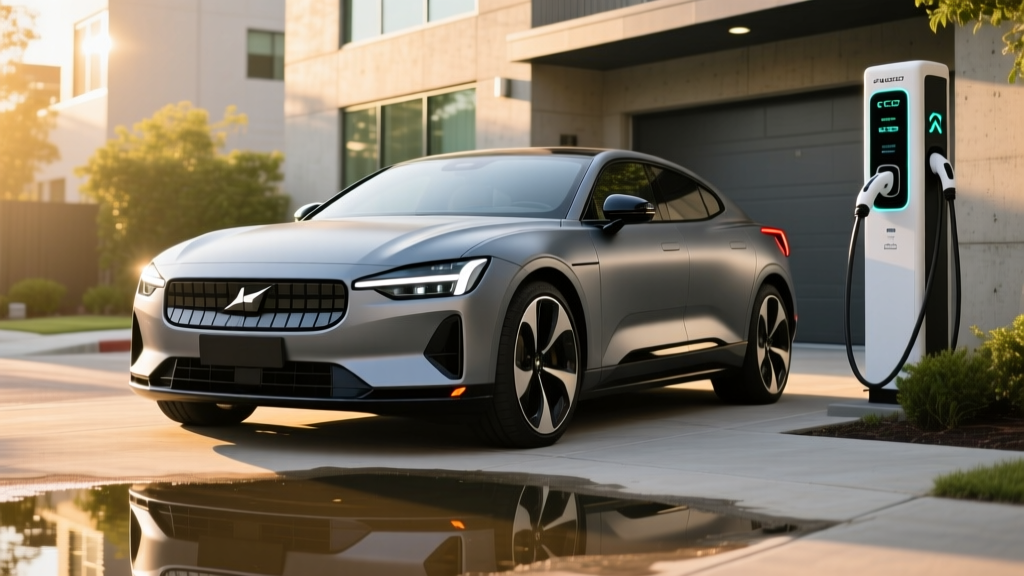
The 2026 Polestar 4 is the Swedish-Chinese brand's answer to the mid-size electric SUV coupe segment — a segment it effectively enters as a direct rival to the Porsche Macan Electric, BMW iX, and Tesla Model Y Performance. Built on Gea's Sustainable Experience Architecture (SEA) platform shared with the Zeekr 001 and Volvo EX30, the Polestar 4 ditches the traditional rear window entirely, replacing it with a camera-based digital rearview mirror. That single design choice signals the kind of unconventional engineering you'll find throughout this vehicle.
But unconventional doesn't always mean practical. After examining the full spec sheet, EPA data, and ownership economics, here's what real buyers need to know about the 2026 Polestar 4 before writing a check.
Quick Verdict: Who the Polestar 4 Is For
The 2026 Polestar 4 is best suited for design-conscious buyers who prioritize driving dynamics and tech-forward interiors over maximum cargo utility. If you're cross-shopping a Porsche Macan Electric or want something more distinctive than a Model Y but don't need three rows of seats, the Polestar 4 earns a serious look. Families who regularly haul bulky cargo or need rear visibility without screens should keep shopping.
- You want a performance SUV with sub-4-second 0-60 capability
- You value Scandinavian design and Google-based infotainment
- You mostly drive in cities and suburbs with reliable Level 2 charging access
- You're open to a camera-based rearview system
- You need maximum cargo volume for family gear or road trips
- You prefer a physical rear window for traditional visibility
- You frequently tow (the Polestar 4 is not rated for towing in the US)
Range, Battery, and Efficiency
The 2026 Polestar 4 is offered with a single battery pack across all trims: a 102 kWh usable lithium-ion NMC (nickel manganese cobalt) battery. NMC chemistry delivers higher energy density than LFP, which is how Polestar packs this much capacity into a relatively sleek SUV coupe footprint.
| Specification | Long Range Single Motor | Long Range Dual Motor |
|---|---|---|
| EPA Est. Range | 321 miles | 296 miles |
| Battery (Usable) | 102 kWh (NMC) | 102 kWh (NMC) |
| Efficiency (Combined) | 105 MPGe / 32 kWh/100mi | 97 MPGe / 35 kWh/100mi |
| Drivetrain | RWD | AWD (Dual Motor) |
| Horsepower | 272 hp | 544 hp |
| 0-60 mph | 7.1 seconds | 3.8 seconds |
The EPA rates the Long Range Single Motor at 321 miles, but expect real-world highway driving at 70-75 mph to yield approximately 260-280 miles in mild weather. In cold conditions (below 30°F), range can drop an additional 20-30%, putting winter highway range closer to 200-230 miles. The Dual Motor AWD variant's 296-mile EPA sticker translates to roughly 240-260 miles in real-world mixed driving. Polestar includes a heat pump across all trims, which helps mitigate cold-weather losses compared to EVs without one, but the laws of battery chemistry still apply.
For context, the Porsche Macan Electric (Long Range) delivers an EPA-estimated 308 miles from a slightly smaller 100 kWh pack, while the Tesla Model Y Long Range AWD achieves 320 miles from roughly 75 kWh — a testament to Tesla's efficiency advantage. The Polestar 4's 102 kWh pack is large, but its heavier curb weight (~5,100 lbs for the Dual Motor) and less aerodynamic SUV-coupe profile reduce efficiency versus lower sedans.
Charging Speed: DC Fast and Home Level 2
Charging is where the Polestar 4 shows its SEA-platform strengths — and a few limitations worth understanding.
| Charging Level | Power / Rate | Speed | Notes |
|---|---|---|---|
| Level 1 (120V) | 1.4 kW | ~3-4 mi/hr | Emergency/trickle only |
| Level 2 (240V, 48A) | 11 kW onboard | ~30-35 mi/hr | Full charge in ~10 hours |
| DC Fast Charge (peak) | 200 kW | 10-80% in ~30 min | CCS1 connector (NACS adapter available) |
The 200 kW peak DC fast-charge rate is competitive but not class-leading. The Hyundai Ioniq 5 and Kia EV6 peak at 240 kW on 800V architecture, and the Porsche Macan Electric hits 270 kW. At a 150-200 kW Electrify America or EVgo station, you'll see the Polestar 4 ramp up to around 180-200 kW in the 10-30% state-of-charge window, then taper progressively. Expect the 10-80% session to take approximately 30 minutes under ideal battery preconditioning conditions.
One important note on preconditioning: the Polestar 4's navigation system will automatically warm the battery when you route to a DC fast charger. Always use this feature in cold weather — arriving at a charger with a cold battery can double your charging time. The 200 kW peak is only achievable with a warm battery (above ~70°F/21°C at the cell level).
At home on a Level 2 charger (240V, 48-amp circuit), the 11 kW onboard charger adds roughly 30-35 miles of range per hour. A full 10-100% charge from near-empty takes about 10 hours — fine for overnight charging. We recommend a 60-amp dedicated circuit installed by a licensed electrician for optimal Level 2 performance, which typically costs $800-$2,000 depending on your panel capacity and run length.
Performance and Driving Dynamics
The Dual Motor Polestar 4's 544 horsepower and 3.8-second 0-60 time put it squarely in performance SUV territory. For reference, that's quicker than a Porsche Macan 4S and nearly matches the BMW iX M60. The instant torque delivery from dual electric motors makes the Polestar 4 feel even quicker than the numbers suggest in real-world passing and merging situations.
The Single Motor variant's 272 hp and 7.1-second 0-60 is adequate for daily commuting but won't excite anyone coming from a performance-oriented ICE vehicle. Most buyers in this price bracket will want the Dual Motor for the AWD traction and the dramatic performance uplift.
The suspension tuning leans toward the firm side — appropriate for a sport-oriented SUV coupe but noticeable on rough pavement. Polestar offers an adaptive damping system on higher trims that softens the ride in Comfort mode. The steering is precise and well-weighted, and the low center of gravity from the underfloor battery pack keeps body roll controlled through corners.
Interior, Tech, and the Missing Rear Window
The Polestar 4's interior is where the Scandinavian design ethos shines. A 15.4-inch landscape-oriented center touchscreen runs Google built-in — meaning Google Maps, Google Assistant, and the Play Store are native to the car. No phone mirroring required for core functions, though Apple CarPlay is supported wirelessly.
The digital rearview mirror system (sourced from a high-resolution camera mounted on the roof spoiler) takes adjustment. Image quality is excellent in daylight, and the wider field of view compared to a traditional mirror is genuinely useful. At night, some drivers report slight lag and glare from headlights that a physical mirror wouldn't exhibit. Polestar includes a conventional interior mirror frame that can display the camera feed or be switched off — but there is no physical glass rear window. This is a deal-breaker for some buyers and a non-issue for others after a week of acclimation.
Interior space is generous up front, with supportive seats and a flat floor thanks to the EV skateboard platform. Rear legroom measures approximately 39.4 inches, which is competitive with the BMW iX. However, the sloping roofline cuts into rear headroom for passengers over 6 feet tall.
Cargo volume behind the rear seats is 18.4 cubic feet — less than the Model Y (30.2 cu ft) and the BMW iX (35.5 cu ft) due to the coupe roofline and the space consumed by the rear camera hardware. Fold the rear seats and you get approximately 50.5 cubic feet, which is adequate for luggage and groceries but falls short of family-hauler duty. There is no front trunk (frunk).
Driver Assistance
The Polestar 4's Pilot Pack includes adaptive cruise control with lane centering, automated emergency braking, blind-spot monitoring, and evasive steering assist. This is a Level 2 driver-assistance system, meaning the driver must remain fully engaged with hands on the wheel and eyes on the road at all times. This is not autonomous or self-driving capability.
The ADAS suite is competent for highway cruising but doesn't offer hands-free driving like GM's Super Cruise or Ford's BlueCruise on mapped highways. Polestar has announced future over-the-air updates for enhanced Pilot functionality, but as of the 2026 model year, expect conventional Level 2 assist only.
Pricing, Trims, and Federal Tax Credit Eligibility
| Trim | Base MSRP | Est. After §30D Credit* | Key Features |
|---|---|---|---|
| Long Range Single Motor | $54,900 | ~$47,400 (if eligible) | 272 hp, 321 mi range, Google infotainment, Pilot Pack |
| Long Range Dual Motor | $62,900 | ~$55,400 (if eligible) | 544 hp, AWD, 296 mi range, adaptive damping |
| Dual Motor w/ Plus Pack | $67,500 | ~$60,000 (if eligible) | Harman Kardon audio, panoramic roof, 22" wheels |
*Federal tax credit estimates assume full §30D eligibility. Actual credit depends on battery sourcing, buyer income, and MSRP cap compliance. See details below.
Federal Tax Credit: §30D Eligibility Checklist
- MSRP Cap: The Polestar 4 is classified as an SUV, so the MSRP cap is $80,000. All current trims fall under this limit. (Source: IRS)
- Buyer Income Cap: Modified adjusted gross income must not exceed $300,000 (joint), $225,000 (head of household), or $150,000 (single).
- Battery Sourcing: To receive the full $7,500, the battery must meet both critical minerals and battery component requirements under the Inflation Reduction Act. Polestar's supply chain sourcing for US-market vehicles has been in flux — the critical minerals requirement may limit the credit to $3,750 for some build dates. Confirm with your dealer at order time.
- Point-of-Sale Transfer: As of 2024, the credit can be transferred to the dealer at purchase, reducing your out-of-pocket cost immediately rather than waiting for tax filing. (Source: IRS)
- Assembly Location: The Polestar 4 is manufactured in Hangzhou Bay, China. This does not disqualify it from §30D for purchases (only the commercial vehicle credit under §45W has North American assembly requirements for leasing), but battery component sourcing rules still apply.
Given the complexity of §30D sourcing rules — which change as manufacturers shift supply chains — we strongly recommend consulting a tax professional and verifying eligibility on the IRS clean vehicle portal before committing to a purchase order.
Warranty and Ownership Costs
Polestar provides a competitive warranty package for the 2026 Polestar 4:
- Battery & Drive Unit: 8 years / 100,000 miles (whichever comes first), with a capacity retention threshold of 70%
- Basic Vehicle: 4 years / 50,000 miles
- Corrosion Protection: 12 years, unlimited miles
- Roadside Assistance: 4 years / unlimited miles
The 70% capacity retention threshold is standard for the industry — it means Polestar will repair or replace the battery if it degrades below 70% of original capacity within the warranty period. Based on NMC chemistry degradation curves and data from similar SEA-platform vehicles (Zeekr 001, Smart #1), expect roughly 5-8% degradation over the first 100,000 miles under normal use patterns. Avoiding repeated DC fast charging above 90% state-of-charge and frequent deep discharges below 10% will help preserve long-term battery health.
Insurance costs for the Polestar 4 are likely to run 15-25% higher than a comparable gas-powered SUV in this class, consistent with EV insurance premiums industry-wide. Get a quote before ordering — the Dual Motor variant's 544 hp will push premiums higher than the Single Motor.
How It Compares: Polestar 4 vs. Key Rivals
| Spec | 2026 Polestar 4 (Dual Motor) | Porsche Macan 4 Electric | Tesla Model Y LR AWD | BMW iX xDrive50 |
|---|---|---|---|---|
| EPA Range | 296 mi | 308 mi | 320 mi | 324 mi |
| Battery (usable) | 102 kWh | 100 kWh | ~75 kWh | 105.2 kWh |
| Peak DC Charge | 200 kW | 270 kW | 250 kW | 195 kW |
| 10-80% Time | ~30 min | ~21 min | ~25 min | ~31 min |
| 0-60 mph | 3.8 sec | 4.9 sec | 4.8 sec | 4.4 sec |
| Horsepower | 544 hp | 402 hp | 384 hp | 516 hp |
| Cargo (rear seats up) | 18.4 cu ft | 18.0 cu ft | 30.2 cu ft | 35.5 cu ft |
| Base MSRP | $62,900 | $78,800 | $48,590 | $87,250 |
Pros, Cons, and Bottom Line
- Class-leading acceleration at this price point (3.8s, 544 hp)
- Distinctive Scandinavian design with premium interior materials
- Google built-in infotainment is responsive and well-integrated
- Heat pump standard across all trims
- Competitive 321-mile EPA range (Single Motor)
- Under $80K MSRP cap for federal tax credit eligibility
- No physical rear window — camera system requires acclimation
- Cargo volume (18.4 cu ft) trails most mid-size SUV competitors
- 200 kW DC peak charge rate is slower than 800V rivals
- China-built, which may affect some buyers' purchasing decisions
- Hands-free Level 2+ driving (like Super Cruise) not available
- No frunk for additional storage
The 2026 Polestar 4 occupies a specific niche: it's the EV SUV coupe for buyers who find the Model Y too common, the Porsche Macan too expensive, and the BMW iX too conservative. Its performance-per-dollar ratio is genuinely impressive, and the design execution is among the best in the segment. But the cargo compromises, the camera-only rearview, and the middling fast-charge speed mean it isn't the right EV for every buyer. Test-drive it — especially at night, to evaluate the digital rearview mirror — before committing.
Frequently Asked Questions
What is the real-world range of the 2026 Polestar 4?
The EPA rates the Single Motor at 321 miles and the Dual Motor at 296 miles. In real-world highway driving at 70-75 mph, expect approximately 260-280 miles (Single Motor) and 240-260 miles (Dual Motor) in mild weather. Cold weather (below 30°F) can reduce range by an additional 20-30%, yielding roughly 200-230 miles for the Single Motor on winter highway trips. (Source: EPA/fueleconomy.gov)
How fast does the Polestar 4 charge at home and on the road?
On a DC fast charger, the Polestar 4 peaks at 200 kW and charges from 10-80% in approximately 30 minutes with a preconditioned battery. At home on a Level 2 (240V) charger, the 11 kW onboard charger adds about 30-35 miles per hour, with a full charge taking roughly 10 hours. Level 1 (120V) trickle charging adds only 3-4 miles per hour.
Does the 2026 Polestar 4 qualify for the $7,500 federal EV tax credit?
The Polestar 4's MSRP falls under the $80,000 SUV cap, making it potentially eligible. However, the full $7,500 credit depends on meeting both critical minerals and battery component sourcing requirements under §30D. Because Polestar's supply chain sourcing may only partially satisfy these requirements, some build dates may qualify for only $3,750. Buyer income caps also apply ($150K single / $300K joint). Verify on the IRS clean vehicle portal before purchasing.
Is the Polestar 4 worth buying over a Tesla Model Y or Porsche Macan Electric?
If you prioritize raw performance value and distinctive design, the Polestar 4 Dual Motor delivers 544 hp for $62,900 — a significant discount to the Macan 4 Electric ($78,800) with quicker acceleration. The Model Y remains the efficiency, range, cargo, and charging infrastructure champion at a lower price. The Polestar 4 is the right pick if you want something less ubiquitous than a Tesla but can't justify Porsche pricing.
How does the digital rearview mirror work, and is it safe?
A high-resolution camera mounted on the rear spoiler feeds a live image to a display where a traditional rearview mirror would be. The wider field of view is an advantage, and image quality is strong in daylight. At night, some drivers notice slight latency and headlight bloom. The system meets all NHTSA rear-visibility requirements. Most owners report full acclimation within one to two weeks, but we recommend a nighttime test drive before purchasing.
What is the battery warranty on the Polestar 4?
Polestar covers the high-voltage battery and drive unit for 8 years or 100,000 miles, whichever comes first. The warranty guarantees the battery will retain at least 70% of its original capacity during that period. If degradation exceeds 30%, Polestar will repair or replace the battery at no cost.
Can the Polestar 4 tow?
The US-market 2026 Polestar 4 is not currently rated for towing. If you need tow capability, consider the BMW iX (rated up to 2,500 lbs) or the Tesla Model Y (rated up to 3,500 lbs with the tow package).