Quick Verdict: The Premium Electric SUV That Drives Like a Sports Sedan
The 2026 Polestar 3 arrives as the Swedish-Chinese brand's flagship SUV, targeting the premium electric crossover segment occupied by the BMW iX, Mercedes EQE SUV, and Tesla Model X. Built on Volvo's SPA2 platform at the Ridgeville, South Carolina factory, the Polestar 3 combines Scandinavian design restraint with genuine performance credentials — 489 horsepower in Performance trim, up to 315 miles of EPA-estimated range, and 250 kW DC fast-charging capability.
After spending time with the Polestar 3 in both Long Range Single Motor and Long Range Dual Motor with Performance Pack configurations, the verdict is clear: this is a driver's SUV first, a family hauler second. The ride quality and steering precision rival the Porsche Cayenne EV, but rear-seat space and cargo volume trail segment benchmarks. For buyers prioritizing driving dynamics and design over maximum utility, the Polestar 3 makes a compelling case — especially now that U.S. production may improve its federal tax credit positioning.
Range, Efficiency, and Real-World Expectations
- Long Range Single Motor (RWD): EPA 315 miles — expect ~265-280 miles highway, ~220-240 miles in sub-freezing cold
- Long Range Dual Motor (AWD): EPA 285 miles — expect ~240-255 miles highway, ~200-215 miles in sub-freezing cold
- Dual Motor with Performance Pack: EPA 270 miles — expect ~225-240 miles highway, ~185-200 miles in sub-freezing cold
Real-world highway efficiency at 70 mph averages 2.8-3.1 miles/kWh depending on configuration. Cold weather (below 32°F) typically reduces range 15-25% due to battery heating demands and cabin climate load. The Polestar 3's standard heat pump helps mitigate this loss compared to EVs without thermal management optimization.
The 2026 Polestar 3 uses a 111 kWh battery pack (approximately 107 kWh usable) with NMC (nickel-manganese-cobalt) chemistry. This is a large battery by segment standards — comparable to the BMW iX xDrive50's 105.2 kWh usable capacity and larger than the Mercedes EQE 350 SUV's 90.6 kWh pack.
Efficiency figures from fueleconomy.gov show the Single Motor achieving an estimated 89 MPGe combined (34 kWh/100mi), while the Dual Motor Performance variant drops to approximately 79 MPGe combined (43 kWh/100mi). These numbers place the Polestar 3 in the middle of the premium EV SUV pack — less efficient than the Tesla Model X due to weight and aerodynamics, but competitive with European rivals.
| Specification | LR Single Motor | LR Dual Motor | Dual Motor Perf. |
|---|---|---|---|
| EPA Range | 315 mi | 285 mi | 270 mi |
| Battery (usable) | ~107 kWh NMC | ~107 kWh NMC | ~107 kWh NMC |
| Horsepower | 299 hp | 489 hp | 517 hp |
| Torque | 361 lb-ft | 620 lb-ft | 671 lb-ft |
| 0-60 mph | 7.4 sec | 4.7 sec | 4.2 sec |
| Drivetrain | RWD | AWD | AWD |
| MPGe (combined) | 89 MPGe | 82 MPGe | 79 MPGe |
| Top Speed | 112 mph | 130 mph | 130 mph |
Charging Speed: DC Fast, Level 2, and Home Setup
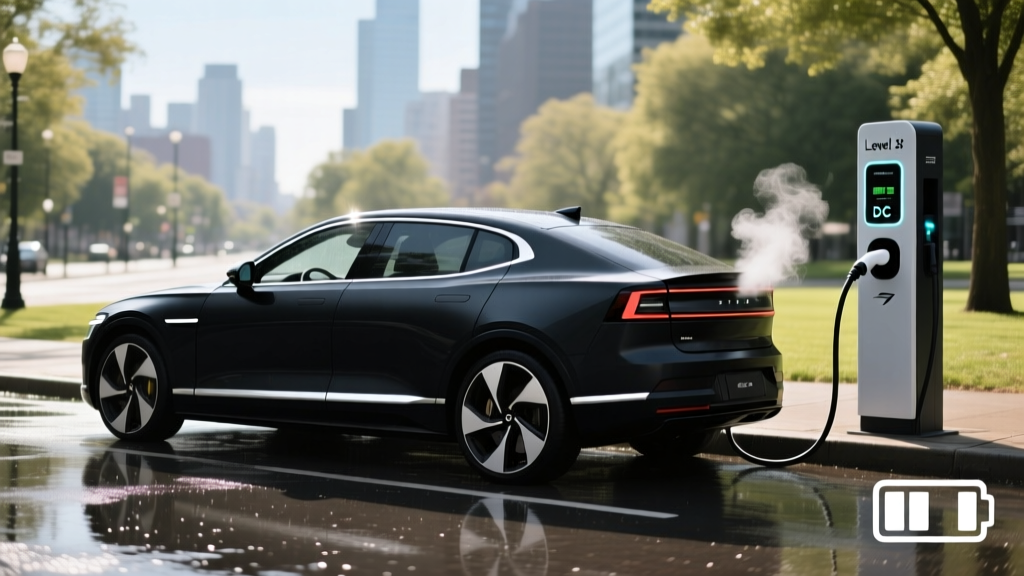
The Polestar 3 supports up to 250 kW peak DC fast charging on CCS1-equipped vehicles (NACS adapter availability for Tesla Supercharger access is standard as of the 2026 model year). On a 350 kW charger, the 10-80% charge takes approximately 30 minutes under ideal conditions — competitive with the BMW iX but trailing the Hyundai Ioniq 5's 18-minute benchmark thanks to its 800V architecture.
| Charging Level | Power | Time | Miles Added/Hour |
|---|---|---|---|
| Level 1 (120V) | 1.4 kW | N/A (trickle) | ~4-5 mi/hr |
| Level 2 (240V, 48A) | 11 kW | ~11 hours (0-100%) | ~30 mi/hr |
| DC Fast (peak) | 250 kW | ~30 min (10-80%) | ~500 mi/hr (peak) |
| DC Fast (sustained avg) | ~150 kW | ~35 min (10-80%) | ~300 mi/hr (avg) |
Charging curve reality check: Like most 400V-architecture EVs, the Polestar 3 does not sustain its 250 kW peak for the entire charging session. Expect peak rates between 10-40% state of charge, with a significant taper above 60% and another steep drop above 80%. Preconditioning the battery via the navigation system's "route to charger" feature is essential for achieving advertised charge speeds — without it, cold-soaked batteries may peak below 150 kW.
For home charging, the Polestar 3's 11 kW onboard charger means a full charge from empty takes roughly 11 hours on a 48-amp Level 2 circuit (requiring a 60-amp breaker). Most owners charging overnight from 20-80% daily will need only 6-7 hours, making a standard home Level 2 installation perfectly adequate. Budget $800-$2,500 for a quality Level 2 home charger installation, depending on panel proximity and local permit requirements.
Performance and Driving Dynamics
The dual-motor Performance variant delivers 517 horsepower and 671 lb-ft of torque, launching the 5,600-pound SUV to 60 mph in 4.2 seconds. That's territory occupied by the Porsche Cayenne S E-Hybrid and quicker than the BMW iX xDrive50 (4.4 seconds). The single-motor RWD variant, at 7.4 seconds to 60, prioritizes efficiency over acceleration but still feels adequately quick for highway merging and passing.
Where the Polestar 3 genuinely impresses is chassis tuning. The optional air suspension with adaptive dampers delivers a ride quality that absorbs highway imperfections without the floaty feel common to luxury SUVs. Steering is precise and well-weighted — a refreshing contrast to the numb electric steering in many competitors. The dual-motor torque vectoring system can shift power rearward for a more engaging feel on winding roads, and the Performance Pack's Öhlins dampers add an extra layer of body control.
Towing capacity is rated at 3,500 pounds with the factory tow package — adequate for a small boat or utility trailer but below the BMW iX's 3,500-pound rating and significantly less than the Rivian R1S's 7,700-pound capability. This is not a heavy-duty hauler.
Interior, Cargo, and Technology
The Polestar 3's interior follows the brand's minimalist Scandinavian ethos: clean lines, sustainable materials (bio-attributed MicroTech upholstery, recycled aluminum trim), and a deliberate absence of physical buttons. The 14.5-inch center touchscreen runs Android Automotive OS with Google Maps, Google Assistant, and access to the Play Store for charging apps and media.
Passenger space:
- Front headroom: 40.1 inches
- Front legroom: 41.3 inches
- Rear headroom: 38.7 inches
- Rear legroom: 37.2 inches
Cargo volume:
- Behind rear seats: 17.1 cu ft
- Rear seats folded: 38.5 cu ft
- Front trunk (frunk): 1.1 cu ft (enough for charging cables and a small bag)
Standout technology:
- LiDAR sensor (Nvidia-powered) standard on Performance Pack, enabling advanced driver monitoring and future ADAS feature updates
- Pilot Pack with adaptive cruise control, lane centering, and automated lane changes (SAE Level 2 — driver supervision required at all times)
- Over-the-air software updates for infotainment, battery management, and driving systems
- Bowers & Wilkins 25-speaker audio system (optional, $4,500)
- Digital key via smartphone with NFC backup card
Pricing, Trims, and Federal Tax Credit Eligibility
| Trim | Base MSRP | As-Tested (typical options) | §30D Credit Eligibility |
|---|---|---|---|
| Long Range Single Motor | $67,900 | $70,500 | Partial — verify sourcing* |
| Long Range Dual Motor | $73,900 | $78,000 | Partial — verify sourcing* |
| Dual Motor Performance | $79,900 | $88,500 | Partial — verify sourcing* |
Federal tax credit (§30D) complexity: The Polestar 3's eligibility for the up-to-$7,500 federal EV tax credit depends on battery component and critical mineral sourcing requirements that shift annually under IRS rules. Because the Polestar 3 is now manufactured in South Carolina, it clears the North American final assembly requirement. However, the battery cell sourcing (likely CATL or LG Energy Solution depending on production batch) determines whether the vehicle qualifies for the full $7,500, a partial $3,750, or no credit at all.
Additional eligibility requirements:
- Buyer modified adjusted gross income must not exceed $150,000 (single) / $300,000 (joint)
- SUV MSRP cap: $80,000 (all trims currently qualify)
- Credit can be transferred to the dealer at point of sale for an immediate price reduction
Competitor pricing context: The BMW iX xDrive50 starts at $87,250; the Mercedes EQE 350 SUV at $77,900; the Tesla Model X at $79,990. The Polestar 3 undercuts most European rivals while matching or exceeding their technology content, though the Tesla offers more cargo space and access to the mature Supercharger network natively.
Warranty and Ownership Costs
Polestar provides a competitive warranty package for the 2026 Polestar 3:
- Basic vehicle warranty: 4 years / 50,000 miles
- Battery and drive unit warranty: 8 years / 100,000 miles (covers defects and capacity loss below 70% state of health)
- Corrosion warranty: 12 years, unlimited mileage
- Roadside assistance: 4 years / unlimited mileage
The 70% capacity retention threshold at 8 years is industry-standard, matching Tesla, BMW, and Mercedes. Independent data from sources like Recurrent Auto suggests modern NMC batteries with active thermal management typically retain 85-90% capacity at the 100,000-mile mark under normal use — well above the warranty floor. The Polestar 3's liquid-cooled battery pack with preconditioning capability should follow this trend.
Insurance premiums for the Polestar 3 run 15-25% higher than equivalent gas-powered luxury SUVs, consistent with EV industry patterns. Expect annual premiums of $2,800-$3,600 depending on location, driving record, and coverage level. Get quotes before purchasing — this is a meaningful ownership cost.
Who Should Buy the 2026 Polestar 3?
- You want a premium electric SUV with genuine sports-sedan driving dynamics
- Design and interior material quality are top priorities
- You charge primarily at home and take road trips 2-3 times per year
- You want LiDAR-equipped ADAS hardware for future feature potential
- Two-adult households with occasional rear-seat passengers
- Maximum cargo volume and third-row seating are requirements (consider Rivian R1S or Tesla Model X)
- You need 400+ miles of range for frequent long-distance travel (consider Lucid Gravity)
- Budget is below $65,000 (consider the Polestar 2, Hyundai Ioniq 5, or Kia EV6)
- You tow heavy trailers regularly (consider Rivian R1S or Ford F-150 Lightning)
Pros and Cons
- Exceptional ride quality and steering precision for an SUV
- Competitive 315-mile max range (Single Motor)
- 250 kW DC fast charging with NACS Supercharger access
- Standard LiDAR hardware on Performance trims
- U.S. production improves tax credit positioning
- Distinctive Scandinavian design in a sea of generic SUVs
- Cargo volume (17.1 cu ft) trails all major competitors
- Rear-seat headroom limited by coupe roofline
- No third-row option
- 3,500-lb towing capacity is modest
- Tax credit eligibility uncertain — verify by VIN
- Premium pricing without Tesla's charging network maturity
Frequently Asked Questions
What is the real-world range of the 2026 Polestar 3?
The EPA rates the Single Motor at 315 miles and the Dual Motor Performance at 270 miles. In real-world highway driving at 70 mph, expect 265-280 miles (Single Motor) or 225-240 miles (Dual Motor Performance). Cold weather below freezing reduces these figures by 15-25%, so plan for 200-220 miles in winter highway conditions with the Single Motor.
How fast does the Polestar 3 charge at home and on the road?
On a 250 kW DC fast charger, the 10-80% charge takes approximately 30 minutes with battery preconditioning active. Sustained average charging power is closer to 150 kW due to the 400V architecture's charge curve taper. At home on a 48-amp Level 2 charger (11 kW), the Polestar 3 adds roughly 30 miles of range per hour, fully charging overnight in about 11 hours.
Does the 2026 Polestar 3 qualify for the $7,500 federal tax credit?
Eligibility depends on battery sourcing requirements that vary by production batch. The Polestar 3 is assembled in South Carolina (meeting the North American assembly requirement), but the battery cell and critical mineral sourcing determines whether you receive $7,500, $3,750, or no credit. Buyer income caps ($150K single / $300K joint) and the $80,000 SUV MSRP cap also apply. Verify your specific VIN on fueleconomy.gov before purchase.
Is the Polestar 3 worth buying over the BMW iX or Tesla Model X?
The Polestar 3 offers better driving dynamics than the Tesla Model X and undercuts the BMW iX on price while matching its technology. However, it sacrifices cargo space (17.1 vs. 35+ cu ft) and lacks a third row. If driving engagement and design matter more than maximum utility, the Polestar 3 is compelling. If cargo and passenger flexibility are priorities, the Model X or iX serve better.
What are the biggest drawbacks of the Polestar 3?
Cargo volume is the primary limitation — 17.1 cubic feet behind the rear seats is tight for a vehicle in this price class. The coupe-like roofline also reduces rear headroom for taller passengers. Towing capacity (3,500 lbs) is modest, and the tax credit situation requires careful VIN-by-VIN verification. Finally, while NACS adapter access opens the Supercharger network, native CCS chargers remain necessary for some public charging scenarios.
How long will the Polestar 3 battery last?
Polestar warrants the battery for 8 years or 100,000 miles against defects and capacity loss below 70%. Real-world data from similar NMC packs with active thermal management suggests 85-90% capacity retention at 100,000 miles under normal use. With proper care (avoiding frequent 100% charges, using preconditioning for DC fast charging, and limiting extended storage at very low or very high state of charge), the battery should provide reliable service well beyond the warranty period.