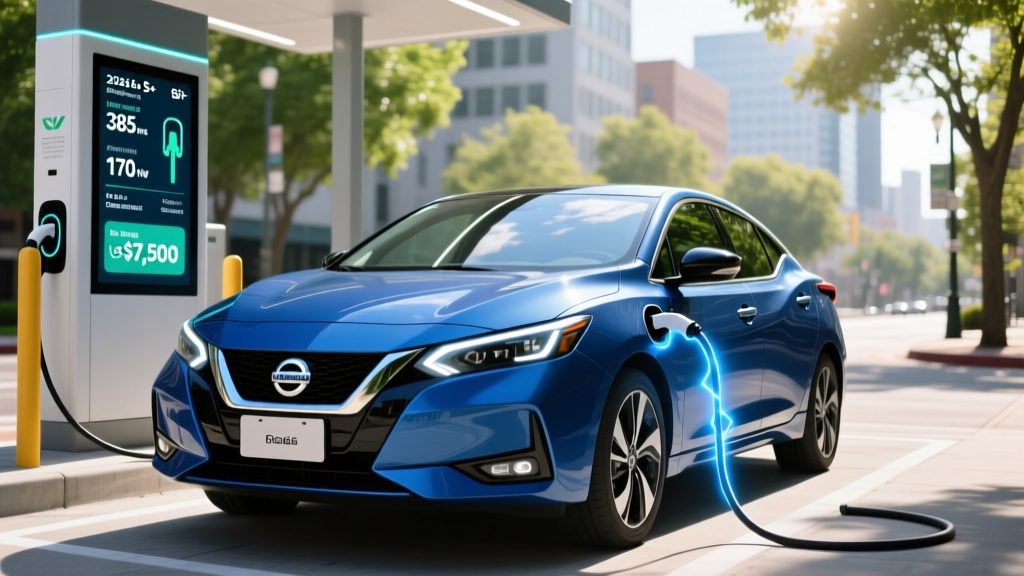
The Nissan Leaf has been the everyman's electric car for over a decade, and the 2026 Nissan Leaf S+ continues that mission with a refreshed formula: a usable 60 kWh battery, CCS fast-charging, and a starting price that undercuts most rivals. But in a market now crowded with the Hyundai Kona Electric, Chevrolet Equinox EV, and Tesla Model 3, does the Leaf S+ still earn its place? We break down every spec that matters — range, charging curves, real-world efficiency, and tax-credit math — so you can decide with data, not marketing.
Quick Verdict: The Value-First Commuter EV
The 2026 Leaf S+ is a front-wheel-drive, single-motor hatchback that prioritizes affordability and daily-driver practicality over performance or road-trip prowess. Its 212-mile EPA range and ~100 kW peak DC fast-charging rate make it ideal for commuters who charge at home and occasionally venture beyond their metro area. It is not a cross-country cruiser, but at a base MSRP near $30,000 — potentially dropping below $23,000 after federal and state incentives — it is one of the least expensive new EVs you can buy in 2026.
2026 Nissan Leaf S+ Specifications at a Glance
| Spec | Value |
|---|---|
| EPA Range | 212 miles |
| Battery (Usable / Gross) | ~58 kWh usable / 60 kWh gross |
| Battery Chemistry | NMC (Nickel Manganese Cobalt) |
| Motor / Drivetrain | Single FWD / 160 kW (214 hp) |
| 0–60 mph | ~6.9 seconds |
| Peak DC Fast Charge | ~100 kW |
| 10–80% DC Charge Time | ~40 minutes |
| Level 2 Charge Rate | 7.2 kW (onboard charger) |
| Combined Efficiency | 111 MPGe / 30 kWh/100 mi |
| Cargo Volume (rear seats up / down) | 23.6 / 31.6 cu ft |
| Base MSRP (S+ trim) | $29,990 (est.) |
| Battery Warranty | 8 years / 100,000 miles |
Range and Efficiency: EPA Sticker vs. the Real World
Nissan rates the 2026 Leaf S+ at 212 miles of combined EPA range. That figure is derived from a mix of city and highway driving cycles and assumes moderate temperatures. In practice, your mileage will vary — sometimes significantly.
• City/suburban mixed driving (60–80°F): 200–215 miles — the Leaf's regenerative braking and low-speed efficiency let you match or slightly beat the EPA number.
• Sustained highway (70–75 mph): Expect 170–190 miles. Higher speeds increase aerodynamic drag, and the Leaf's hatchback shape is less slippery than a sedan like the Tesla Model 3.
• Cold weather (below 32°F): 140–170 miles. NMC chemistry loses efficiency in the cold, and cabin heating draws from the pack. The Leaf S+ does offer a standard heat pump for 2026, which mitigates some of this loss compared to older resistive-heater models, but you should still plan for a 20–30% range reduction in deep winter.
• Hot weather with A/C (above 95°F): 185–200 miles. Battery cooling and cabin A/C impose a moderate penalty.
Efficiency is rated at 111 MPGe combined (30 kWh per 100 miles), per fueleconomy.gov. That's competitive with the Hyundai Kona Electric (120 MPGe) but trails the Tesla Model 3 RWD (132 MPGe). At a national average electricity price of $0.16/kWh, the Leaf S+ costs roughly $4.80 per 100 miles to fuel — compared to about $12.50 for a 30 MPG gas car at $3.75/gallon.
Charging Speed: DC Fast, Level 2, and the Curve
One of the Leaf's historic weaknesses — its CHAdeMO connector — has been fully retired. The 2026 Leaf S+ uses the CCS1 (Combined Charging System) standard, opening access to Electrify America, EVgo, ChargePoint, and most other major U.S. DC networks. (An adapter for Tesla Superchargers with the CCS-to-NACS magic dock may be available depending on your region.)
| Charging Level | Power (kW) | Miles Added per Hour | Notes |
|---|---|---|---|
| Level 1 (120V household) | ~1.2 kW | ~4 miles/hr | Emergency/trickle only; a full charge takes 48+ hours |
| Level 2 (240V home/public) | 7.2 kW | ~25 miles/hr | Full charge from empty in ~8–9 hours; standard overnight solution |
| DC Fast Charge | ~100 kW peak | ~200+ miles/hr (peak) | 10–80% in ~40 min; taper above 80% extends full charge to 60+ min |
Charging-curve reality: The Leaf S+ peaks near 100 kW only between roughly 10% and 40% state of charge (SoC). From 40–60%, power drops to about 70 kW, and from 60–80%, it falls further to roughly 45–55 kW. This taper is typical for NMC batteries without an 800V architecture. The 10–80% time of approximately 40 minutes is acceptable for a grocery-run top-up but noticeably slower than the Hyundai Ioniq 5 (18 minutes at 350 kW chargers) or the Tesla Model 3 (~25 minutes). If road trips are a regular part of your life, this taper will be felt.
For home charging, a Level 2 wallbox at 7.2 kW means you'll recover roughly 25 miles of range per hour plugged in. A full overnight session (8 hours) adds about 200 miles — more than enough for most daily commutes. Installation of a 240V/40A circuit typically costs $800–$2,000 depending on your electrical panel's capacity and the run length from panel to garage; consult a licensed electrician for your specific quote.
Performance and Driving Impressions
The 2026 Leaf S+ uses a single front-mounted motor producing 214 horsepower (160 kW) and approximately 250 lb-ft of torque. Nissan quotes a 0–60 mph time of around 6.9 seconds, which is brisk enough for confident highway merging but not sporty by EV standards — the Tesla Model 3 RWD hits 60 in about 5.8 seconds, and dual-motor AWD options are not available on the Leaf.
Ride quality is tuned for comfort. The suspension absorbs potholes and speed bumps competently, and cabin noise levels are low at city speeds. At highway velocities, some wind noise enters around the A-pillars, and the tire choice on the base trim emphasizes efficiency over grip. Regenerative braking is adjustable via Nissan's e-Pedal mode, which enables near one-pedal driving in stop-and-go traffic — a feature longtime Leaf owners appreciate.
Handling is adequate but unexciting. The Leaf is a tall hatchback with a relatively high center of gravity compared to a sedan, and the FWD-only layout means torque steer can surface under hard acceleration from a stop. This is a commuter appliance, not a canyon carver, and that's fine for its intended audience.
Interior, Cargo, and Technology
The Leaf S+ seats five, though the rear middle seat is best reserved for short trips. Front legroom is generous at 42.1 inches, while rear legroom comes in at 33.5 inches — tighter than the Volkswagen ID.4 but on par with the Kona Electric. Cargo space behind the rear seats is 23.6 cubic feet, expanding to 31.6 cubic feet with the 60/40 split rear seats folded. There is no front trunk (frunk); the space under the hood houses the motor and power electronics.
Infotainment: The S+ trim comes with an 8-inch touchscreen (a 12.3-inch screen is available on higher trims), wireless Apple CarPlay, wired Android Auto, and four USB ports (two USB-A, two USB-C). The interface is functional but dated compared to Tesla's or Hyundai's systems. A 6-speaker audio system is standard.
Driver assistance (ProPILOT Assist): Nissan includes ProPILOT Assist on the S+ trim, which bundles adaptive cruise control with stop-and-go, lane-centering steering assist, and lane-keeping support. This is an SAE Level 2 system — meaning the driver must keep hands on the wheel and eyes on the road at all times. It is not autonomous driving. ProPILOT works well on well-marked highways but can struggle with faded lane lines, construction zones, and sharp curves. It does not offer automatic lane changes or navigation-based speed adjustment.
Safety: The Leaf has historically earned strong crash-test scores. Check the latest ratings at NHTSA and IIHS for the 2026 model year, as results can change with updated test protocols. Standard safety features include automatic emergency braking with pedestrian detection, blind-spot warning, rear cross-traffic alert, and rear automatic braking.
Pricing, Trims, and Federal Tax Credit Eligibility
The 2026 Nissan Leaf is offered in two main trims, with the S+ being the higher-capacity, longer-range variant:
| Trim | Battery | EPA Range | Base MSRP (est.) |
|---|---|---|---|
| S (base) | ~40 kWh | ~150 miles | $27,500 |
| S+ (reviewed) | ~60 kWh | 212 miles | $29,990 |
Destination charges add approximately $1,095. Popular options on the S+ include a cold-weather package (heated seats, heated steering wheel, heated mirrors) for ~$700 and a technology package (360° camera, upgraded audio) for ~$1,200. A well-equipped S+ typically lands around $32,000–$33,500 before incentives.
Does the 2026 Leaf S+ Qualify for the Federal EV Tax Credit?
Under IRS §30D rules for 2026, the Leaf S+ is a strong candidate for the full $7,500 federal tax credit, but eligibility depends on several conditions that you must verify for your specific situation:
- MSRP cap: The vehicle must have an MSRP at or below $55,000 for sedans/hatchbacks. The Leaf S+ clears this easily at ~$30,000.
- Buyer income cap: Your modified adjusted gross income (MAGI) must not exceed $150,000 (single), $225,000 (head of household), or $300,000 (married filing jointly).
- Battery sourcing: The battery's critical minerals and components must meet phased-in domestic-content and sourcing thresholds that tighten each year. Nissan has indicated the Leaf's battery supply chain meets 2026 requirements, but confirm with your dealer at point of sale.
- Point-of-sale transfer: As of 2024+, you can transfer the credit to the dealer for an immediate price reduction at purchase rather than waiting to claim it on your tax return. This effectively lowers your out-of-pocket cost on day one.
If you qualify for the full $7,500, the Leaf S+ effective price drops to approximately $22,490 — making it one of the cheapest new EVs in the U.S. market. Some states (California, Colorado, Massachusetts, and others) stack additional rebates of $2,000–$5,000 on top. Check your state's energy office or the AFDC state incentive database for local programs.
Who Should Buy the 2026 Nissan Leaf S+?
- Commute 30–80 miles round-trip and charge at home overnight
- Want one of the least expensive new EVs after the federal credit
- Prefer a hatchback with usable cargo space over a crossover
- Value simplicity and proven reliability over cutting-edge tech
- Don't frequently drive more than 180 miles in a single day
- Regularly road-trip beyond 200 miles and need fast DC charging
- Want all-wheel drive or sub-5-second acceleration
- Need more than 32 cu ft of cargo volume (consider the VW ID.4 or Hyundai Ioniq 5)
- Live in a region with extreme cold and need maximum range retention
- Want the latest infotainment or Level 3+ driver-assist features
Pros and Cons
- Low base price; potentially under $23K after federal credit
- Comfortable ride and quiet cabin at city speeds
- Standard ProPILOT Assist (Level 2 adaptive cruise + lane centering)
- CCS charging replaces legacy CHAdeMO
- Heat pump standard for improved cold-weather efficiency
- Proven platform with over a decade of real-world reliability data
- 100 kW peak DC charging is slow vs. 150–350 kW rivals
- 212-mile EPA range limits road-trip flexibility
- FWD only — no AWD option for snow-belt buyers
- Infotainment feels dated; smaller base screen
- No frunk; cargo volume trails compact EV crossovers
- Rear-seat legroom is tight for taller passengers
How the Leaf S+ Stacks Up Against Key Competitors
| Spec | 2026 Nissan Leaf S+ | 2026 Hyundai Kona Electric | 2026 Tesla Model 3 RWD | 2026 Chevy Equinox EV 2LT |
|---|---|---|---|---|
| EPA Range | 212 mi | 261 mi | 272 mi | 319 mi |
| Battery (kWh) | ~60 | ~65 | ~60 | ~85 |
| Peak DC Charge | ~100 kW | ~100 kW | ~170 kW | ~150 kW |
| 10–80% DC Time | ~40 min | ~43 min | ~25 min | ~32 min |
| Horsepower | 214 hp | 201 hp | 271 hp | 213 hp |
| Base MSRP | $29,990 | $32,975 | $38,990 | $34,900 |
| Federal Credit | Up to $7,500 | Up to $7,500 | Up to $7,500 | Up to $7,500 |
| Drivetrain | FWD | FWD | RWD | FWD |
The Leaf S+ wins on entry price but trails on range and charging speed. The Kona Electric offers 50 more miles of range for about $3,000 more — a trade-off worth making if you can stretch the budget. The Model 3 dominates on efficiency, charging speed, and tech, but costs nearly $10,000 more before incentives. The Equinox EV is the range leader in this group but is a larger, heavier crossover. For pure budget shoppers who charge at home, the Leaf S+ remains compelling.
Warranty and Long-Term Ownership
Nissan covers the Leaf S+ battery and electric powertrain for 8 years or 100,000 miles, whichever comes first. The battery warranty guarantees that capacity will not fall below a specified threshold (historically 9 bars out of 12 on Nissan's capacity gauge, roughly equating to ~70–75% state of health). The basic vehicle warranty is 3 years / 36,000 miles.
Based on data from earlier-generation Leafs, NMC battery degradation in the current liquid-cooled pack is modest — most owners report 5–8% capacity loss over the first 5 years and 60,000 miles. The addition of active liquid cooling (standard since the 62 kWh Leaf) was a major improvement over the early air-cooled packs that degraded rapidly in hot climates. For 2026, Nissan's thermal management system should keep degradation well within warranty limits for normal use.
Insurance costs for the Leaf S+ are generally moderate — expect $1,200–$1,800 annually depending on your state, age, and driving record, which is comparable to other compact EVs and slightly below the Tesla Model 3 average.
Frequently Asked Questions
What is the real-world range of the 2026 Nissan Leaf S+?
The EPA rates the Leaf S+ at 212 miles combined. In real-world driving, expect about 200–215 miles in mild city/suburban conditions, 170–190 miles on sustained highway trips at 70+ mph, and 140–170 miles in sub-freezing winter weather. The standard heat pump helps but does not eliminate cold-weather range loss.
How fast does the Leaf S+ charge at home and on the road?
At home on a Level 2 (240V) charger, the Leaf S+ charges at 7.2 kW, adding about 25 miles of range per hour — a full charge takes roughly 8–9 hours. On a DC fast charger, it peaks at about 100 kW and charges from 10–80% in approximately 40 minutes. Charging slows significantly above 80% SoC to protect battery health.
How much does the 2026 Leaf S+ cost after tax credits?
The base MSRP is approximately $29,990. If you meet IRS §30D income limits and battery-sourcing requirements, the $7,500 federal credit brings the effective price to around $22,490. Additional state rebates (where available) can reduce this further. Confirm eligibility with your dealer and a tax professional before purchase.
Is the 2026 Leaf S+ worth buying over the Kona Electric or Model 3?
If your priority is the lowest possible purchase price and you mostly drive within a 100-mile daily radius with home charging access, the Leaf S+ offers outstanding value. If you need more range, faster road-trip charging, or more advanced tech, the Kona Electric ($3K more, 261 mi range) or Model 3 ($9K more, 272 mi range, 170 kW charging) are worth the premium.
Does the 2026 Leaf S+ qualify for the full $7,500 federal EV tax credit?
It is a strong candidate, but qualification depends on your income (must be under IRS MAGI caps), the vehicle's MSRP (must be under $55,000 for a hatchback — the Leaf clears this), and battery component/critical-mineral sourcing compliance for 2026. Nissan has indicated compliance, but always verify at point of sale and consult IRS guidance or a tax professional.
Does the Leaf S+ have all-wheel drive?
No. The 2026 Leaf is front-wheel drive only across all trims. If AWD is a priority for winter driving, consider the Tesla Model 3 Long Range AWD, Hyundai Ioniq 5 AWD, or Volkswagen ID.4 AWD.
Can I use Tesla Superchargers with the 2026 Leaf S+?
The Leaf S+ uses the CCS1 connector. Tesla has begun opening select Supercharger stalls to non-Tesla EVs via the built-in Magic Dock (CCS adapter) at some locations. Availability varies by region. You can also use the Electrify America, EVgo, and ChargePoint networks natively with the Leaf's CCS port.