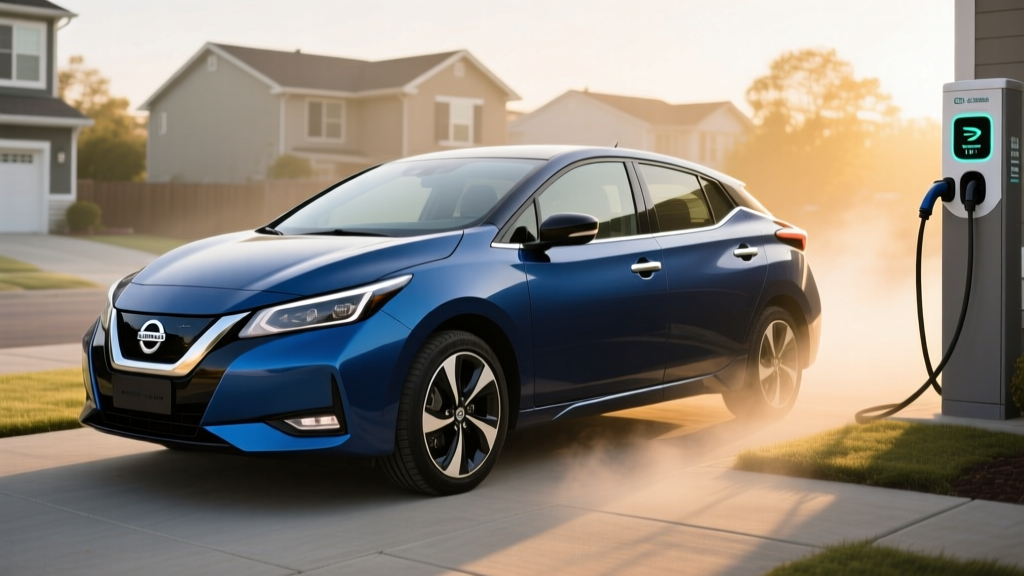
The Nissan Leaf Plus has occupied a specific niche in the EV market since its debut: an affordable, practical hatchback for daily commuting and suburban errands. As we move through the 2026 model year, the Leaf Plus continues with its 60 kWh battery pack and 214-horsepower motor — a formula that still appeals to cost-conscious buyers who charge primarily at home. But with DC fast-charging competitors moving to 150–250 kW peak rates and the broader industry shifting to the NACS connector, the Leaf Plus's CHAdeMO port and passive battery cooling deserve honest scrutiny.
This review covers every number a prospective buyer needs: real-world range expectations, exact charging speeds, tax credit eligibility under current IRS §30D rules, and how the Leaf Plus stacks up against newer rivals like the Chevrolet Equinox EV, Hyundai Kona Electric, and Volvo EX30.
2026 Nissan Leaf Plus: Core Specifications
| Specification | Value |
|---|---|
| EPA Range | 212 miles |
| Battery Capacity (Usable) | ~60 kWh (NMC lithium-ion) |
| Motor Output | 214 hp / 250 lb-ft torque |
| Drivetrain | Front-wheel drive (FWD) |
| 0–60 mph | ~6.9 seconds |
| EPA Efficiency | 111 MPGe combined (30 kWh/100 mi) |
| Max DC Fast-Charge Rate | ~100 kW peak (CHAdeMO) |
| Level 2 Charge Rate | 7.2 kW (onboard charger) |
| Cargo Volume (rear seats up / down) | 23.6 / 38.5 cu ft |
| Base MSRP (SV Plus) | ~$36,540 (incl. destination) |
| Battery Warranty | 8 years / 100,000 miles |
Range: What the EPA Sticker Doesn't Tell You
The EPA rates the 2026 Leaf Plus at 212 miles of combined range. That figure comes from fueleconomy.gov and represents a mixed city/highway test cycle under moderate temperatures. In practice, your mileage will vary — sometimes significantly.
EPA Combined: 212 miles
Highway (70 mph, 75°F): ~175–190 miles
City / Suburban (mixed, 75°F): ~220–230 miles
Cold Weather (30°F, highway): ~140–160 miles
Cold Weather (30°F, city): ~170–185 miles
The Leaf Plus lacks an active battery thermal management system (liquid cooling/heating). This means cold-weather range loss is more pronounced than in EVs with active thermal management, and DC fast-charging speeds drop further in low temperatures because the battery cannot precondition itself.
For daily commuters covering 30–50 miles round trip, the Leaf Plus offers ample buffer even in winter. But if you regularly drive 150+ miles one way or live in a climate with sustained sub-freezing winters, the real-world range contraction is a legitimate planning factor — not marketing pessimism.
Charging Speeds: CHAdeMO in an NACS World
Charging is where the Leaf Plus shows its age most clearly. The vehicle uses the CHAdeMO DC fast-charging connector, a standard that has been largely superseded in North America by CCS1 and, increasingly, Tesla's NACS (now adopted by Ford, GM, Rivian, Volvo, and others for 2025+ models).
| Charging Level | Power / Rate | Time / Miles Added |
|---|---|---|
| Level 1 (120V household) | ~1.2 kW | ~4 miles per hour of charging |
| Level 2 (240V home, 7.2 kW) | 7.2 kW | ~25 miles per hour; full charge in ~9 hours |
| DC Fast (CHAdeMO, peak) | ~100 kW peak | 10–80% in ~40–45 minutes |
DC fast-charging reality check: The Leaf Plus peaks near 100 kW only at low states of charge (roughly 10–30% SoC) and tapers significantly above 60%. A 10–80% session typically takes 40–45 minutes on a 150 kW+ CHAdeMO station. Compare this to a Hyundai Kona Electric (which uses CCS1 and peaks around 100 kW with a similar taper) or a Chevrolet Equinox EV (CCS/NACS, peaks near 190 kW, 10–80% in ~20 minutes).
The bigger concern is infrastructure. As networks like Electrify America and EVgo prioritize CCS1 and NACS connectors, CHAdeMO stalls are becoming less common at new installations. Existing CHAdeMO stations still work, but you may find fewer options on road trips, particularly in rural corridors. Nissan has not announced a NACS adapter or retrofit program for the Leaf as of early 2026.
Home Level 2 charging is where the Leaf Plus performs well. The 7.2 kW onboard charger replenishes the 60 kWh pack from empty in roughly 9 hours — easily overnight on a standard 240V/32A home charger. If you install a 48A Level 2 unit, the car's onboard charger caps at 7.2 kW regardless, so there's no benefit to oversizing the circuit for this vehicle alone.
Performance and Driving Dynamics
The Leaf Plus uses a single front-mounted AC synchronous motor producing 214 horsepower and 250 lb-ft of torque. Nissan quotes a 0–60 mph time in the low 7-second range; independent testing has clocked it around 6.9 seconds. That's brisk enough for confident highway merging and passing, though it doesn't match the sub-5-second sprints of dual-motor rivals.
Ride quality is comfortable and compliant — Nissan tuned the suspension for daily comfort rather than sportiness. The low center of gravity from the floor-mounted battery pack keeps body roll reasonable in corners, and the one-pedal driving mode (called e-Pedal) provides strong regenerative braking that can bring the car to a full stop without touching the brake pedal.
One limitation: the Leaf Plus is FWD only. There is no all-wheel-drive option, which matters for buyers in snow-belt states. Competitors like the Subaru Solterra and Hyundai Ioniq 5 offer AWD variants.
Pricing, Trims, and Federal Tax Credit Eligibility
The 2026 Leaf Plus is available in two trims:
| Trim | MSRP (incl. destination) | Key Features |
|---|---|---|
| SV Plus | ~$36,540 | 8-inch touchscreen, ProPILOT Assist, 17-inch wheels, heat pump, CHAdeMO port |
| SL Plus | ~$39,540 | Leather seats, Bose audio, 360° camera, ProPILOT Assist with Navi-link, LED headlights |
Federal tax credit (§30D): The Nissan Leaf's eligibility for the $7,500 federal EV tax credit depends on several IRS rules that are subject to change. As of early 2026, key requirements include:
- MSRP cap: The vehicle must be under $55,000 (sedans/hatchbacks) — both Leaf Plus trims qualify.
- Buyer income cap: Modified AGI must not exceed $150,000 (single) or $300,000 (joint).
- Battery sourcing: Critical minerals and battery components must meet escalating domestic-content thresholds. Nissan sources Leaf batteries for the North American market from facilities that have historically met these requirements, but the exact qualification can shift with updated Treasury guidance.
- Point-of-sale transfer: Eligible buyers can apply the credit as an instant dealer discount rather than waiting for a tax return.
Always verify current eligibility at the IRS qualified vehicles list before purchasing, as battery-sourcing compliance is updated periodically.
Interior, Cargo, and Technology
The Leaf Plus interior is functional and spacious for its footprint. Front-seat headroom and legroom are generous (41.2 inches front legroom), and the rear seat accommodates two adults comfortably (33.5 inches rear legroom) — though the center position is tight.
Cargo volume is a strong point: 23.6 cubic feet behind the rear seats and 38.5 cubic feet with the 60/40 split rear seats folded. That's competitive with compact crossovers and significantly more than the Hyundai Kona Electric's ~25.8 cu ft maximum. There is no front trunk (frunk).
Infotainment: The 8-inch touchscreen runs Nissan's infotainment system with wireless Apple CarPlay and wired Android Auto, navigation (on SL Plus), and a 360° surround-view camera (SL Plus). The system is straightforward but lacks the screen size and processing speed of newer competitors.
Driver assistance: Nissan's ProPILOT Assist is standard on all Plus trims. This is a Level 2 system (per SAE J3016) that combines adaptive cruise control with lane-centering steering. It works well on divided highways but requires continuous driver supervision — hands must remain on the wheel, and the system will issue warnings and disengage if it detects inattention. It is not autonomous driving.
Battery Longevity, Degradation, and Warranty
Nissan covers the Leaf Plus battery with an 8-year/100,000-mile warranty against capacity loss below 9 bars (out of 12) on the battery health gauge — roughly equivalent to 70–75% of original capacity. The powertrain is covered for 8 years/100,000 miles as well.
The Leaf's passive (air-cooled) battery thermal management has been a point of concern since the model's early generations. Without liquid cooling, the battery is more susceptible to heat-related degradation in hot climates and to reduced charging speeds in cold weather. Owners in the Southwest and Southeast should monitor their battery health gauge regularly and avoid repeated DC fast-charging sessions in high ambient temperatures.
Nissan has not adopted LFP chemistry for the Leaf Plus; it continues to use NMC (nickel manganese cobalt) cells, which offer higher energy density but are more sensitive to sustained high states of charge. Best practice for longevity: charge to 80% for daily use and reserve 100% charges for long trips.
- Affordable entry price, especially with tax credit
- Spacious cargo area for a hatchback
- Comfortable ride, good visibility
- e-Pedal one-pedal driving is smooth
- ProPILOT Assist standard on all trims
- Heat pump included (better cold-weather efficiency)
- CHAdeMO connector — declining infrastructure
- Passive battery cooling — heat degradation risk
- DC fast-charging is slow vs. competitors (~100 kW peak)
- FWD only — no AWD option
- Dated infotainment screen size and UI
- No frunk for additional storage
Who Should Buy the 2026 Nissan Leaf Plus?
Choose the Leaf Plus if:
- Your daily commute is under 80 miles round trip and you can charge at home overnight.
- You prioritize a low purchase price and qualify for the federal tax credit.
- You rarely take road trips over 150 miles one way.
- You live in a temperate climate where extreme cold or heat is infrequent.
- CHAdeMO chargers are available in your area for occasional DC fast-charging needs.
Look at competitors if:
- You need DC fast-charging speeds over 100 kW for regular road trips (consider the Equinox EV or Ioniq 5).
- You want AWD for snow or mountain driving (Subaru Solterra, Hyundai Ioniq 5 AWD).
- You want access to the Tesla Supercharger network via NACS (most 2025+ EVs).
- You live in a hot climate and want liquid-cooled battery longevity (nearly all competitors).
Frequently Asked Questions
What is the real-world range of the 2026 Nissan Leaf Plus?
The EPA rates it at 212 miles combined. In real-world driving, expect roughly 175–190 miles on the highway at 70 mph in moderate temperatures, and as low as 140–160 miles in freezing conditions on the highway. City driving in mild weather can exceed the EPA estimate thanks to regenerative braking.
How fast does the Leaf Plus charge at home and on DC fast chargers?
At home on a 240V Level 2 charger, the Leaf Plus charges at 7.2 kW, adding about 25 miles of range per hour and fully recharging overnight (~9 hours). On a DC fast charger, it peaks around 100 kW via CHAdeMO, reaching 10–80% in approximately 40–45 minutes — slower than most modern competitors.
Does the 2026 Nissan Leaf Plus qualify for the $7,500 federal tax credit?
It can, but eligibility depends on your income (under $150K single / $300K joint), the vehicle's MSRP (both trims are under the $55K cap), and current battery-sourcing compliance per IRS rules. Check the IRS qualified vehicles list before purchasing, as sourcing requirements update periodically.
Is the Nissan Leaf Plus worth buying over the Chevrolet Equinox EV or Hyundai Kona Electric?
If your priority is the lowest possible purchase price and you charge at home, the Leaf Plus remains competitive — especially after the tax credit. However, the Equinox EV offers longer range (~319 miles EPA), faster DC charging (~190 kW), and NACS access to Superchargers. The Kona Electric offers 261 miles of range and CCS1 charging. For road-trippers or hot-climate buyers, the Leaf Plus's CHAdeMO port and passive cooling are meaningful disadvantages.
How long will the Leaf Plus battery last?
Nissan warrants the battery for 8 years/100,000 miles against dropping below ~70–75% capacity. Real-world longevity depends heavily on climate and charging habits. Owners in moderate climates who avoid frequent DC fast-charging and don't regularly charge to 100% report minimal degradation over 5+ years. Hot-climate owners should monitor the battery health gauge closely due to the passive cooling system.
Can I use a Tesla Supercharger with the Nissan Leaf Plus?
No. The Leaf Plus uses the CHAdeMO DC fast-charging connector, which is not compatible with Tesla Superchargers or NACS-equipped chargers. There is no commercially available CHAdeMO-to-NACS adapter as of 2026. You'll rely on Electrify America, EVgo, ChargePoint, and other networks that still maintain CHAdeMO stalls.