The Nissan Leaf has been an EV staple since 2011, and for 2026 it receives a meaningful cabin refresh alongside a revised battery pack. While competitors like the Chevrolet Bolt EV and Hyundai Kona Electric have pushed the sub-$35,000 segment forward, the Leaf remains one of the most affordable new EVs on the US market. This review focuses on what's changed inside the 2026 Nissan Leaf — and whether its range, charging, and pricing still hold up against newer rivals.
2026 Nissan Leaf Interior: What's New
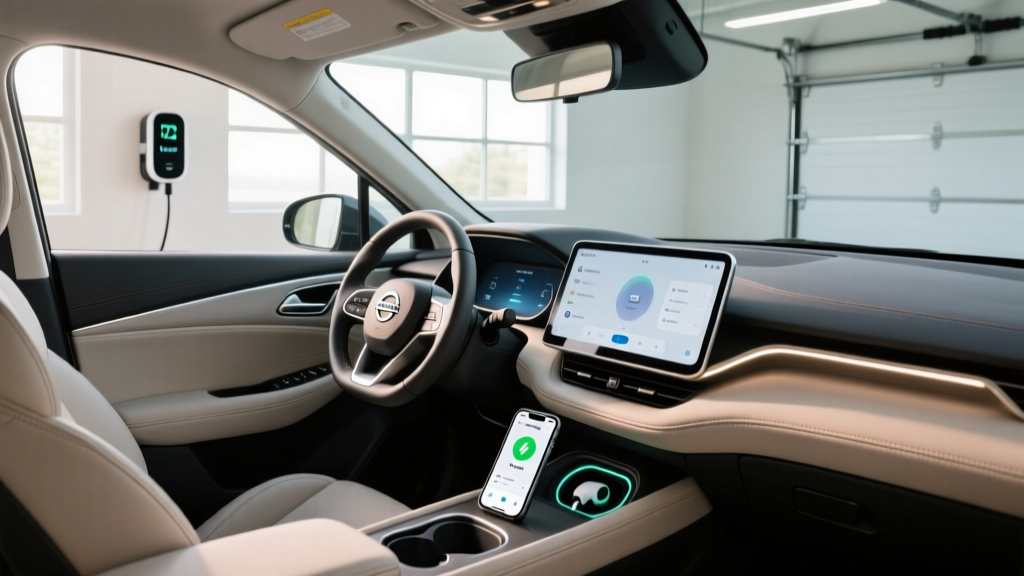
Nissan overhauled the Leaf's interior for 2026 with updated materials, a larger infotainment screen, and improved connectivity. The previous generation's dated 8-inch display is replaced by a 12.3-inch touchscreen running Nissan's latest infotainment software with wireless Apple CarPlay and wired Android Auto. A new flat-bottom steering wheel, soft-touch dashboard materials, and revised seat bolsters bring the cabin closer to what you'd find in the Ariya, though hard plastics still appear on the lower door panels and center console sides.
Front-seat comfort is solid, with 42.1 inches of legroom and 38.8 inches of headroom. The rear seat offers 33.5 inches of legroom — adequate for adults on shorter trips but tighter than the Kona Electric's 36.2 inches. Heated front seats are standard on SV and above; a heated steering wheel is available on the SL trim.
Cargo space remains at 23.6 cubic feet behind the rear seats, expanding to 30.0 cubic feet with the 60/40 split rear seatbacks folded. That's competitive within the segment, though the Leaf's cargo area is slightly compromised by the under-floor charging cable storage. There is no frunk (front trunk), as the Leaf's motor and power electronics occupy the entire front compartment.
Range, Battery, and Efficiency
Real-World Expectation: Expect 170–190 miles on mixed highway driving at 70 mph in moderate temperatures. In cold weather (below 32°F), range can drop to 140–160 miles due to cabin heating demands and reduced battery efficiency. City driving with regenerative braking can approach or slightly exceed the EPA figure.
The 2026 Leaf is offered with two battery configurations. The base S trim carries a 40 kWh (usable) lithium-ion pack with NMC (nickel-manganese-cobalt) chemistry, delivering the EPA-rated 149 miles. The SV and SL trims step up to a 60 kWh usable NMC pack rated at 212 miles. Nissan has not adopted LFP (lithium iron phosphate) chemistry for the Leaf, unlike some competitors moving toward LFP for its longer cycle life and lower cost — though LFP typically trades energy density for durability.
Efficiency on the 60 kWh model is rated at 114 MPGe combined (29 kWh/100 miles), per EPA data on fueleconomy.gov. That's respectable but trails the Bolt EV's 120 MPGe and the Kona Electric's 120 MPGe combined. The Leaf's passive air-cooled battery thermal management system — rather than active liquid cooling — contributes to slightly lower efficiency under sustained high-speed or hot-weather driving.
| Spec | Leaf S (40 kWh) | Leaf SV/SL (60 kWh) |
|---|---|---|
| EPA Range | 149 miles | 212 miles |
| Battery (usable) | 40 kWh, NMC | 60 kWh, NMC |
| Motor Output | 147 hp / 236 lb-ft | 214 hp / 250 lb-ft |
| Drivetrain | FWD | FWD |
| 0–60 mph | ~7.9 sec | ~6.5 sec |
| MPGe (combined) | 111 MPGe | 114 MPGe |
| DC Fast Charge (peak) | 50 kW (CHAdeMO) | 100 kW (CHAdeMO) |
| 10–80% DC Time | ~40 min | ~45 min |
| Level 2 Rate | 6.6 kW (~22 mi/hr) | 6.6 kW (~22 mi/hr) |
| Cargo Volume | 23.6 cu ft (rear up) / 30.0 cu ft (rear folded) | |
| Battery Warranty | 8 years / 100,000 miles (capacity loss coverage) | |
Charging Speed and Connector Reality
The 2026 Leaf continues to use the CHAdeMO DC fast-charging connector, not the increasingly dominant CCS1 or NACS (Tesla-style) standard. This is the Leaf's single biggest competitive liability in 2026. The CHAdeMO network has shrunk relative to CCS and NACS, meaning Leaf owners will find fewer compatible public fast chargers on road trips.
On the 60 kWh model, peak DC fast-charging tops out at approximately 100 kW — but that peak is not sustained. The charge curve tapers significantly above 60% state of charge (SoC), and the passive thermal management system further limits sustained rates during back-to-back fast charges or in hot weather. Expect a 10–80% charge in roughly 45 minutes under ideal conditions. The 40 kWh model is limited to about 50 kW peak, taking around 40 minutes for 10–80%.
| Charging Level | Power / Rate | Miles of Range Added per Hour |
|---|---|---|
| Level 1 (120V household) | ~1.4 kW | ~4–5 miles/hr |
| Level 2 (240V home/public) | 6.6 kW | ~22 miles/hr |
| DC Fast (CHAdeMO, 60 kWh) | Peak 100 kW | 10–80% in ~45 min |
| DC Fast (CHAdeMO, 40 kWh) | Peak 50 kW | 10–80% in ~40 min |
Home Level 2 charging at 6.6 kW will fully replenish the 60 kWh pack in about 9.5 hours from empty — fine for overnight charging. Most owners will plug in at 20–30% remaining and wake to a full battery by morning. If you're installing a Level 2 home charger, budget $500–$1,200 for the EVSE hardware and $800–$2,500 for electrician installation (depending on panel capacity and run length), per typical industry estimates.
Pricing, Trims, and Federal Tax Credit
The 2026 Nissan Leaf starts at $28,140 MSRP for the S trim (40 kWh) before destination charges. The SV (60 kWh) starts at approximately $33,140, and the range-topping SL at around $36,540. These prices make the Leaf one of the most affordable new EVs available, undercutting the Kona Electric and rivaling the Bolt EV.
| Trim | Base MSRP | Est. Federal Credit (§30D) | Effective Price (est.) |
|---|---|---|---|
| S (40 kWh) | $28,140 | Up to $3,750* | ~$24,390 |
| SV (60 kWh) | $33,140 | Up to $3,750* | ~$29,390 |
| SL (60 kWh) | $36,540 | Up to $3,750* | ~$32,790 |
*Federal tax credit amounts are estimates based on IRS §30D rules. The Leaf qualifies for partial credit dependent on critical-mineral and battery-component sourcing requirements that change annually. Buyer income caps apply ($150,000 single / $300,000 joint AGI). The credit can be transferred to the dealer at point of sale as a purchase discount. Always verify current eligibility at irs.gov and consult a tax professional.
The Leaf does not qualify for the full $7,500 credit due to battery-sourcing requirements. As of the 2026 tax year, Nissan's battery supply chain meets the critical-minerals threshold but not the full battery-component manufacturing requirement, resulting in a partial credit. This is a moving target — check current IRS guidance before purchasing.
Driving Performance and Tech Features
The 60 kWh Leaf SV/SL produces 214 horsepower and 250 lb-ft of torque from its front-mounted AC synchronous motor, delivering a 0–60 mph time of approximately 6.5 seconds. That's quick enough for confident highway merging and passing, though the front-wheel-drive layout can struggle for traction under hard acceleration in wet conditions. The 40 kWh S model makes 147 hp and reaches 60 mph in about 7.9 seconds.
Ride quality is compliant and comfortable around town, with adequate body control on highways. The Leaf's low center of gravity (battery pack under the floor) keeps it planted through corners, though the steering is light and numb — this is a commuter, not a sport hatchback. One-pedal driving via Nissan's e-Pedal mode provides strong regenerative braking, though it doesn't bring the car to a complete hold at stoplights without touching the brake pedal.
Standard driver-assistance features include Nissan's ProPILOT Assist (a Level 2 SAE system combining adaptive cruise control and lane-centering), automatic emergency braking with pedestrian detection, blind-spot warning, rear cross-traffic alert, and lane departure prevention. ProPILOT Assist works well on well-marked highways but requires continuous driver supervision — this is not a hands-off or self-driving system. The SL trim adds a 360-degree camera and ProPILOT Assist with Navi-link, which adjusts speed for upcoming curves based on navigation data.
Pros
- Among the lowest starting MSRPs of any new EV
- Comfortable, compliant ride quality for commuting
- Updated 12.3-inch infotainment with wireless CarPlay
- Strong standard safety suite (ProPILOT Assist, AEB)
- Practical 23.6 cu ft cargo volume
Cons
- CHAdeMO connector — shrinking public fast-charge network
- Passive (air-cooled) battery thermal management
- 212-mile max range trails Bolt EV (259 mi) and Kona Electric (261 mi)
- No all-wheel-drive option
- Partial federal tax credit only (battery sourcing rules)
Who Should Buy the 2026 Nissan Leaf?
The 2026 Leaf is best suited for budget-conscious commuters who charge primarily at home and drive less than 150 miles round-trip daily. If your routine is a 30–50 mile commute with access to overnight Level 2 charging, the Leaf's 212-mile EPA range (SV/SL) provides ample buffer, and its low purchase price keeps monthly payments manageable.
It is not ideal for frequent road-trippers or those who rely heavily on public DC fast charging. The CHAdeMO connector limits your options significantly compared to CCS or NACS vehicles, and the passive battery cooling means slower sustained charging on multi-stop trips. If you regularly drive 200+ miles between charges or live in an area with extreme summer heat, consider the Bolt EV, Kona Electric, or a used Tesla Model 3 instead.
Warranty and Long-Term Battery Outlook
Nissan covers the Leaf's lithium-ion battery with an 8-year/100,000-mile warranty against capacity loss below 9 bars (out of 12) on the battery capacity gauge — roughly equivalent to 66% of original capacity. The powertrain (motor, inverter, reduction gear) is covered for 8 years/100,000 miles as well. The basic vehicle warranty is 3 years/36,000 miles.
Nissan's long history with the Leaf provides some real-world degradation data: earlier 24 kWh and 30 kWh Leafs showed measurable capacity loss after 5–7 years, particularly in hot climates where the passive air-cooling system was less effective. The 60 kWh pack in the 2026 model benefits from improved cell chemistry, but the lack of liquid cooling remains a concern for long-term degradation in hot-weather states. Owners in Arizona, Texas, or Florida should monitor battery health via the Leaf's built-in capacity gauge and consider garage parking to reduce heat exposure.
Frequently Asked Questions
What is the real-world range of the 2026 Nissan Leaf?
The 60 kWh SV/SL is EPA-rated at 212 miles, but expect 170–190 miles in real-world highway driving at 70 mph in moderate temperatures. Cold weather (below 32°F) can reduce range to 140–160 miles. City driving with frequent regenerative braking opportunities can approach or slightly exceed the EPA estimate.
How fast does the 2026 Leaf charge at home and on the road?
At home on a Level 2 (240V) charger, the Leaf charges at 6.6 kW, adding roughly 22 miles of range per hour — a full charge from empty takes about 9.5 hours for the 60 kWh pack. On DC fast charging (CHAdeMO), the 60 kWh model peaks at around 100 kW, reaching 10–80% in approximately 45 minutes under ideal conditions. Charging slows above 60% SoC due to the charge curve taper.
Does the 2026 Nissan Leaf qualify for the federal EV tax credit?
Yes, but only partially. Under current IRS §30D rules, the Leaf qualifies for up to $3,750 in federal tax credit depending on battery-sourcing compliance. Buyer income caps apply ($150,000 single / $300,000 joint modified AGI), and the credit can be applied as a point-of-sale discount at participating dealers. Always verify current eligibility on irs.gov before purchasing.
Is the 2026 Leaf worth buying vs. the Chevrolet Bolt EV or Hyundai Kona Electric?
The Leaf wins on base price — its $28,140 starting MSRP undercuts both rivals. However, the Bolt EV offers 259 miles of EPA range (vs. 212), CCS fast-charging compatibility, and a full $7,500 tax credit. The Kona Electric delivers 261 miles and CCS charging as well. If CHAdeMO charger availability isn't a concern in your area and you prioritize the lowest possible purchase price, the Leaf is competitive. If you need maximum range and future-proof charging, the Bolt EV or Kona Electric are stronger choices.
Why does the Leaf still use CHAdeMO instead of CCS or NACS?
Nissan was an early CHAdeMO adopter with the original Leaf in 2011 and has maintained backward compatibility. Transitioning to CCS or NACS requires significant powertrain and platform changes. The Leaf's aging platform (shared architecture dating to 2017) makes a mid-cycle connector swap impractical. The next-generation Leaf (expected later this decade) is widely anticipated to adopt NACS.
Does the Leaf have a heat pump for cold-weather efficiency?
No. The 2026 Leaf uses a conventional resistive electric heater for cabin warmth, which draws significantly more energy from the battery than a heat pump would. This contributes to the Leaf's pronounced cold-weather range loss. Competitors like the Kona Electric and Ioniq 5 include heat pumps that reduce winter range penalties.