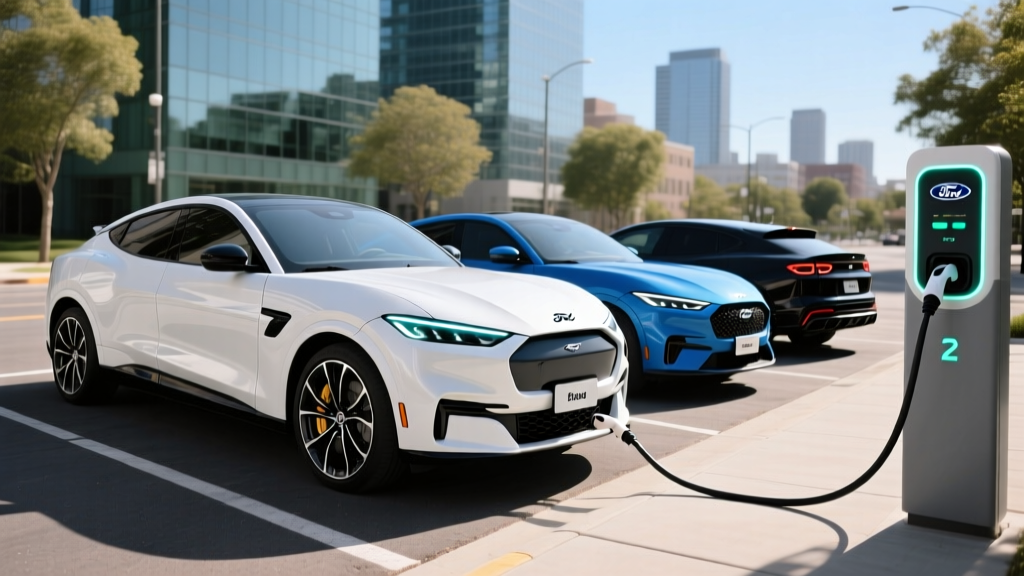
The Ford Mustang Mach-E enters the 2026 model year with a streamlined lineup that still spans four distinct trim levels, each with its own battery, drivetrain, and range profile. For buyers trying to decode which configuration actually fits their commute, road-trip habits, and budget, the differences between trims matter far more than the badge on the back. This guide breaks down every 2026 Mach-E trim level with exact EPA range figures, charging speeds, performance data, and current federal tax credit eligibility so you can choose with confidence.
2026 Mach-E Lineup at a Glance
Ford offers the 2026 Mach-E in four trims: Select, Premium, California Route 1 (RWD only), and GT. Battery options include the Standard Range (75.7 kWh usable, NMC chemistry) and the Extended Range (91 kWh usable, NMC). The California Route 1 is the efficiency play with rear-wheel drive, the GT is the performance flagship, and Select and Premium split the difference with AWD availability.
| Trim | Battery (kWh usable) | Drivetrain | EPA Range (mi) | 0-60 mph | Horsepower | Base MSRP |
|---|---|---|---|---|---|---|
| Select SR | 75.7 (NMC) | AWD | 250 | 6.3 sec | 266 hp | $39,995 |
| Premium ER | 91 (NMC) | AWD | 300 | 5.8 sec | 346 hp | $46,995 |
| Calif. Route 1 ER | 91 (NMC) | RWD | 320 | 6.5 sec | 290 hp | $45,495 |
| GT ER | 91 (NMC) | AWD | 280 | 3.5 sec | 480 hp | $59,995 |
Real-World Range: What to Actually Expect
The EPA estimates for the 2026 Mach-E assume a mix of city and highway driving at moderate temperatures. In real-world testing:
- Highway-heavy trips (70-80 mph): Expect 10-15% below EPA. The Premium ER AWD rated at 300 miles will deliver roughly 255-270 miles at sustained interstate speeds.
- Cold weather (below 30°F): Range loss of 20-30% is typical for NMC packs without preconditioning. The Route 1's 320-mile rating can drop to ~225-250 miles in freezing conditions.
- City/regenerative driving: You may match or slightly exceed EPA figures thanks to regen braking recovery, particularly in the Select SR with its lighter curb weight.
All trims use Ford's liquid-cooled thermal management system, which helps mitigate extreme degradation but does not eliminate cold-weather range loss.
The California Route 1 RWD remains the range champion in the lineup. Its single rear motor and lack of front-axle drivetrain losses give it a meaningful edge over AWD trims with the same 91 kWh pack. According to fueleconomy.gov, the Route 1 achieves 101 MPGe combined (33 kWh/100mi), while the GT drops to 84 MPGe combined (40 kWh/100mi) due to its performance-tuned motors and higher weight.
Charging Speed and Connector Details
The 2026 Mach-E uses the CCS1 connector for DC fast charging and J1772 for Level 2 AC. Ford has not adopted NACS natively for this model year, though Tesla Supercharger access is available via Ford's adapter program for existing owners.
| Charging Level | Standard Range (75.7 kWh) | Extended Range (91 kWh) | Miles Added per Hour |
|---|---|---|---|
| Level 1 (120V, 12A) | 1.4 kW | 1.4 kW | ~3 mi/hr |
| Level 2 (240V, 48A) | 11.5 kW | 11.5 kW | ~28-32 mi/hr |
| DC Fast Charge (peak) | 115 kW | 150 kW | ~59 mi in 10 min (ER) |
| 10-80% DCFC Time | ~38 min | ~45 min | — |
A critical detail for road-trippers: the Mach-E's charge curve tapers significantly above 80% SoC. The Extended Range pack peaks at 150 kW but typically sustains that rate only between 20-55% SoC. From 80-100%, the rate drops below 40 kW. For practical trip planning, plan your DC fast-charging stops around the 10-80% window and avoid charging to full unless you're at your destination overnight.
For home charging, a 48-amp Level 2 station on a 60-amp circuit will fully replenish the Extended Range pack in approximately 9.5 hours. The Ford Mobile Power Cord is included and can deliver up to 30 amps (7.2 kW) on a 240V NEMA 14-50 outlet, adding roughly 20 miles of range per hour — adequate for most daily commutes but slower than a hardwired wall connector.
Performance and Driving Dynamics by Trim
The Mach-E's powertrain configurations vary substantially across trims, and the driving experience shifts accordingly:
- Select SR AWD (266 hp, 317 lb-ft): Adequate for daily commuting with confident highway merging. The 6.3-second 0-60 time won't win drag races but feels responsive in traffic. Regenerative braking is strong enough for near one-pedal driving in the "Whisper" drive mode.
- Premium ER AWD (346 hp, 428 lb-ft): The sweet spot for enthusiasts who also want range. The extra torque from the extended-range pack's higher discharge rate makes this noticeably quicker than the Select, with a 5.8-second 0-60.
- California Route 1 RWD (290 hp, 317 lb-ft): The lightest and most efficient configuration. Rear-wheel drive gives it a more traditional, tail-happy feel in corners, though it sacrifices all-weather traction. Not ideal for snow-belt buyers without dedicated winter tires.
- GT ER AWD (480 hp, 634 lb-ft): Ford's performance flagship. The 3.5-second 0-60 time rivals a Porsche Macan GTS, and the GT's MagneRide adaptive dampers (standard on this trim) provide genuinely composed handling for a 4,900-lb crossover. The trade-off is range: 280 miles EPA, and closer to 230-240 at highway speeds.
All trims feature Ford Co-Pilot360 Assist 2.0 as standard, including adaptive cruise control with stop-and-go, lane centering, and evasive steering assist. This is an SAE Level 2 driver-assistance system — the driver must remain fully engaged with hands on the wheel and eyes on the road. Ford's BlueCruise hands-free highway driving is available as a subscription on Premium and GT trims for mapped divided highways.
Pricing, Tax Credits, and Ownership Costs
| Trim | Base MSRP | Est. Tax Credit (§30D) | Effective Price | MSRP Cap Compliant? |
|---|---|---|---|---|
| Select SR AWD | $39,995 | Up to $7,500 | ~$32,495 | Yes (SUV cap: $80,000) |
| Premium ER AWD | $46,995 | Up to $7,500 | ~$39,495 | Yes |
| Calif. Route 1 ER RWD | $45,495 | Up to $7,500 | ~$37,995 | Yes |
| GT ER AWD | $59,995 | Up to $7,500 | ~$52,495 | Yes |
The IRS §30D clean vehicle credit provides up to $7,500, but eligibility depends on several factors:
- Buyer income caps: Modified AGI must not exceed $150,000 (single), $225,000 (head of household), or $300,000 (joint).
- MSRP cap: The Mach-E qualifies as an SUV under IRS classification, so the cap is $80,000. All trims fall well under this.
- Battery sourcing: The $7,500 credit splits into two halves — $3,750 for critical minerals sourcing and $3,750 for battery component manufacturing. Sourcing requirements tighten annually. Verify current-year compliance on the IRS qualified vehicles list before purchase.
- Point-of-sale transfer: As of 2024, buyers can transfer the credit to the dealer at purchase, reducing the out-of-pocket cost immediately rather than waiting for a tax refund.
Consult a tax professional to confirm your personal eligibility. State incentives (such as California's CVRP or Colorado's innovative motor vehicle credit) may stack on top of the federal credit.
On the ownership-cost side, the Mach-E's efficiency translates to meaningful fuel savings. At the national average electricity rate of $0.17/kWh and 33 kWh/100mi (Premium ER), charging costs roughly $5.61 per 100 miles. A comparable gas-powered SUV at 25 MPG and $3.50/gallon costs $14.00 per 100 miles — a $8.39 savings every 100 miles driven.
Cargo, Passenger Space, and Daily Practicality
The Mach-E is classified as a midsize crossover, and interior space reflects that positioning:
- Cargo behind rear seats: 29.7 cu ft (all trims)
- Cargo with rear seats folded: 59.7 cu ft
- Front trunk (frunk): 4.7 cu ft — drainable, useful for wet gear or charging cables
- Rear legroom: 38.9 inches — competitive with the Hyundai Ioniq 5 and slightly more than the Tesla Model Y's 37.4 inches
- Front headroom: 40.4 inches (panoramic glass roof slightly reduces this on Premium and GT)
The frunk is a genuine differentiator vs. competitors like the Volkswagen ID.4 (which has no frunk) and provides a dedicated space for the mobile charge cord and tire-inflation kit. The cabin materials are solid on Premium and GT (ActiveX synthetic leather, aluminum accents), while the Select uses cloth upholstery to hit its price point.
The 15.5-inch vertical touchscreen running SYNC 4A is standard across all trims, with wireless Apple CarPlay and Android Auto. The GT adds a performance-oriented digital cluster with track-mode telemetry. One criticism: the Mach-E still lacks a native trip-planning feature that automatically routes through DC fast chargers on long trips — Ford relies on third-party apps like A Better Route Planner for that functionality.
Warranty Coverage and Battery Longevity
Ford backs the 2026 Mach-E with the following warranty structure:
- Bumper-to-bumper: 3 years / 36,000 miles
- Powertrain: 5 years / 60,000 miles
- Battery (high-voltage): 8 years / 100,000 miles — covers capacity loss below 70% of original state of health
- Corrosion perforation: 5 years / unlimited miles
The 70% capacity retention threshold is industry-standard and matches competitors like Hyundai and Volkswagen. Tesla's battery warranty uses the same 70% threshold but extends to 120,000 miles on the Model Y. In practice, NMC packs like those in the Mach-E typically degrade 10-15% over the first 100,000 miles based on fleet data from earlier model years, meaning most owners will retain 85-90% capacity well within the warranty period.
Pros, Cons, and Who Should Buy
✅ Pros
- Class-leading handling, especially GT with MagneRide
- Spacious rear seat and generous frunk
- Competitive DC fast-charge speed (150 kW peak on ER)
- All trims under the $80K MSRP cap for full tax credit
- BlueCruise hands-free driving available on mapped highways
❌ Cons
- No native trip planner with integrated DCFC routing
- CCS1 only — no native NACS; requires adapter for Tesla Superchargers
- Real-world highway range falls 10-15% below EPA on AWD trims
- RWD-only Route 1 is a poor fit for snow-belt climates
- Base Select cloth interior feels budget for a $40K vehicle
- Choose the Select SR AWD if: You want the lowest entry price, primarily commute under 50 miles daily, and need AWD for rain/snow.
- Choose the Premium ER AWD if: You want the best balance of range (300 mi), features (panoramic roof, BlueCruise eligibility), and daily-drivable performance.
- Choose the California Route 1 RWD if: Maximum range is your top priority, you live in a mild climate, and you don't need all-wheel drive.
- Choose the GT ER AWD if: Performance is non-negotiable, you want sub-4-second acceleration, and you're willing to sacrifice ~40 miles of range for it.
How the Mach-E Stacks Up Against Competitors
The Mach-E's closest rivals in the midsize electric crossover segment include the Hyundai Ioniq 5, Tesla Model Y, and Volkswagen ID.4. The Ioniq 5 charges significantly faster (up to 240 kW on 800V architecture, 10-80% in ~18 minutes) and offers a more distinctive design, but has less rear legroom. The Model Y offers more cargo volume (30.2 cu ft rear, 76 cu ft total folded) and access to the Supercharger network natively, but its ride quality is firmer and its interior is sparser. The ID.4 is the value play with a lower starting price but trails in both range and performance.
The Mach-E occupies a middle ground: better driving dynamics than the ID.4, more traditional crossover styling than the Ioniq 5, and a more premium interior than the Model Y. Its biggest competitive disadvantage in 2026 remains charging infrastructure access — while Ford provides a Tesla Supercharger adapter, the experience is less seamless than Tesla's native NACS integration.
Frequently Asked Questions
What is the real-world highway range of the Mach-E Premium?
The Premium ER AWD is EPA-rated at 300 miles. On sustained highway driving at 70-80 mph, expect approximately 255-270 miles before needing to charge. In cold weather (below 30°F), that figure can drop to 225-240 miles without battery preconditioning.
How fast does the Mach-E charge at a DC fast charger?
Extended Range trims peak at 150 kW and can add roughly 59 miles of range in 10 minutes at a compatible station. The 10-80% charge takes approximately 45 minutes. Standard Range trims peak at 115 kW with a 10-80% time of about 38 minutes.
Does the 2026 Mach-E qualify for the full $7,500 federal tax credit?
All trims fall under the $80,000 MSRP cap for SUVs and are expected to qualify, but the full $7,500 depends on battery critical-mineral and component sourcing requirements that tighten annually. Check the IRS qualified vehicle list before purchasing. Buyer income caps also apply ($150K single / $300K joint).
Is the Mach-E GT worth the price premium over the Premium?
If performance is your priority, the GT's 3.5-second 0-60 time, MagneRide suspension, and 480 hp are genuinely thrilling. But you sacrifice 20 miles of EPA range (280 vs. 300) and pay $13,000 more. For most buyers, the Premium ER AWD delivers a better balance of daily usability and value.
Can I charge the Mach-E at Tesla Superchargers?
Yes, but only with Ford's CCS-to-NACS adapter, which Ford provides to qualifying owners. The charging experience requires using the Tesla app or Ford's adapter handshake process. It's functional but not as seamless as a native NACS-equipped vehicle like the Tesla Model Y or Ford F-150 Lightning (2025+).
What's the best Mach-E trim for cold-weather states?
The Premium ER AWD or Select SR AWD. Both provide all-wheel drive for snow traction, and the Extended Range battery on the Premium gives you enough buffer to absorb the 20-30% cold-weather range loss while still covering a 200+ mile daily route comfortably. Avoid the RWD-only California Route 1 if you regularly drive in snow.