2026 Ford Mustang Mach-E: Colors, Trims, and the Full EV Breakdown
The 2026 Ford Mustang Mach-E enters its sixth model year with a refreshed palette, continued NACS adoption, and a lineup that now firmly straddles the mainstream electric-SUV segment. If you've been searching for 2026 Mach-E colors and wondering whether this year's exterior options align with meaningful mechanical updates, this profile covers the paint choices alongside every spec that matters for real-world ownership — from EPA range and DC fast-charging curves to federal tax-credit eligibility under IRS §30D.
2026 Mach-E Color Palette: What's New and What Carries Over
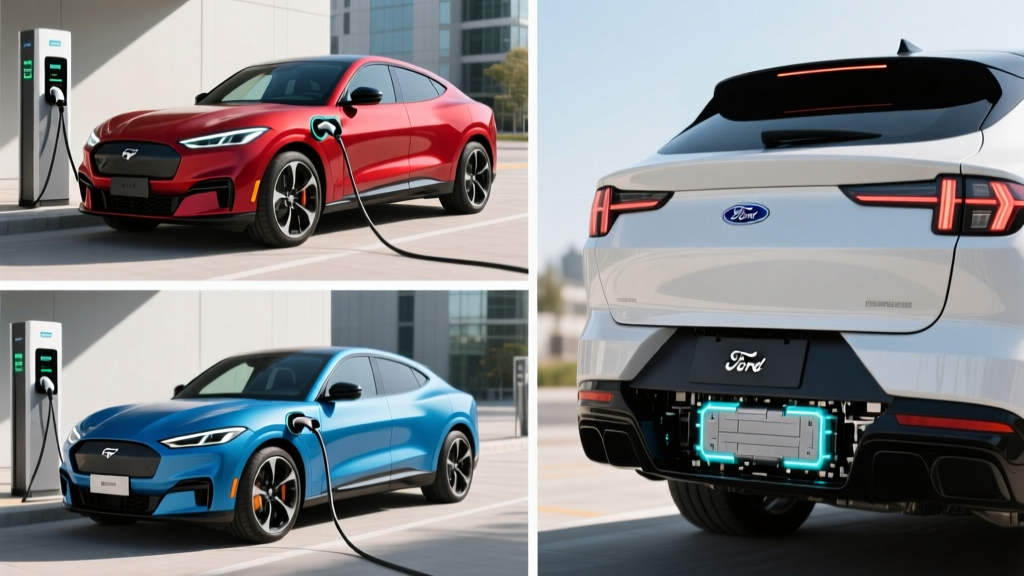
Ford has streamlined the 2026 exterior color lineup while introducing two new shades. The full roster of 2026 Mach-E colors includes:
- Glacier Gray Metallic TriCoat — replaces Iconic Silver with a cooler, more premium tone
- Desert Sand Bronze Metallic — new warm-toned option, exclusive to Premium and GT trims
- Star White Metallic TriCoat — carryover, $395 premium
- Rapid Red Metallic Tinted Clearcoat — carryover, $395 premium
- Eruption Green Metallic — carryover from 2025, popular on GT
- Shadow Black — standard, no upcharge
- Molten Magenta Metallic Tinted Clearcoat — limited availability, GT-exclusive
Interior colorways remain tied to trim level: ActiveX seating in Light Space Gray (Select/Premium), Black Onyx with red contrast stitching (GT), and a new optional Copper Accent package on Premium trims. Ford has dropped the Cyber Orange exterior option that was available on early model years.
Specs at a Glance: Range, Battery, Performance, and Pricing
| Attribute | Select RWD | Premium Ext. Range AWD | GT |
|---|---|---|---|
| EPA Range | 250 mi | 320 mi | 290 mi |
| Battery (usable) | 72 kWh (NMC) | 91 kWh (NMC) | 91 kWh (NMC) |
| Horsepower | 266 hp | 346 hp | 480 hp |
| 0–60 mph | 6.3 sec | 5.1 sec | 3.5 sec |
| Drivetrain | RWD | Dual-motor AWD | Dual-motor AWD |
| Max DC Charge | 150 kW | 150 kW | 150 kW |
| 10–80% DC Time | ~33 min | ~41 min | ~41 min |
| Efficiency | 100 MPGe / 34 kWh/100mi | 98 MPGe / 34 kWh/100mi | 84 MPGe / 40 kWh/100mi |
| Base MSRP | $39,995 | $49,495 | $57,995 |
Source: fueleconomy.gov and Ford Motor Company. MSRP excludes $1,395 destination. Specs reflect 2026 model-year data.
Charging Speed: DC Fast, Level 2, and the NACS Transition
The 2026 Mach-E ships with the Tesla NACS charge port as standard equipment, a change Ford began implementing for the 2025 model year. This gives Mach-E owners native access to Tesla Supercharger stalls (now numbering over 20,000 in North America) without an adapter — a significant practical advantage for road-trip charging.
| Charge Level | Power | Speed (mi/hr) | Notes |
|---|---|---|---|
| Level 1 (120V) | 1.4 kW | ~3–4 mi/hr | Emergency/top-up only |
| Level 2 (240V, 48A) | 11.5 kW | ~27–30 mi/hr | Full charge in ~8–9 hrs (91 kWh) |
| DC Fast (peak) | 150 kW | ~190 mi/hr (peak) | 10–80% in ~33–41 min; tapers above 80% |
A critical ownership note: the Mach-E's 150 kW peak charge rate is competitive but not class-leading. Rivals like the Hyundai Ioniq 5 peak at 240 kW on 800V architecture, completing 10–80% in roughly 18 minutes. The Mach-E's charge curve holds near peak from approximately 15% to 55% state of charge, then tapers progressively. If you routinely charge past 80% on road trips, the taper from 80–100% can add 25+ minutes — plan your stops accordingly.
For home Level 2 charging, Ford recommends a 48-amp hardwired wall connector on a 60-amp circuit. The onboard charger accepts up to 11.5 kW (48A × 240V), which adds roughly 28 miles of range per hour of charging. Expect a professional installation to cost between $800 and $2,200 depending on panel proximity and whether your home needs a 200-amp service upgrade.
Interior Space, Cargo, and Daily Practicality
The Mach-E remains a midsize crossover with strong cargo utility for its footprint:
- Cargo behind rear seats: 29.7 cu ft
- Cargo with rear seats folded: 59.7 cu ft
- Front trunk (frunk): 4.7 cu ft — useful for charging cables or a small bag, though the drain plug makes it suitable for ice and tailgating
- Rear legroom: 38.9 inches
- Front headroom: 40.4 inches
Compared to the Tesla Model Y (30.2 cu ft behind the second row, 76.2 cu ft folded), the Mach-E concedes some maximum cargo volume, but the difference is marginal for most family use cases. The Mach-E's rear seat comfort — bolstered by a more traditional cushion shape — tends to win praise on longer drives.
Tax Credit Eligibility and Real Purchase Cost
Federal EV tax-credit eligibility for the 2026 Mach-E depends on three IRS §30D requirements that buyers must verify at the point of sale:
- MSRP cap: SUVs/vans/pickups must be ≤ $80,000. All Mach-E trims qualify (highest GT at ~$65,000 loaded).
- Buyer income cap: AGI ≤ $150,000 (single) / $225,000 (head of household) / $300,000 (joint). Check your modified AGI against IRS thresholds.
- Battery sourcing: Critical-mineral and battery-component requirements phase in annually. Ford sources NMC cells from SK On (Georgia-built Battery Lab). As of early 2026, qualifying trims may receive up to $7,500, but confirm the specific VIN's eligibility via the dealer and the IRS portal at irs.gov.
- Point-of-sale transfer: You can transfer the credit to the dealer for an immediate price reduction at purchase — no need to wait until tax filing.
| Trim | MSRP (incl. dest.) | After Max $7,500 Credit | Eligible? |
|---|---|---|---|
| Select RWD | $41,390 | ~$33,890 | Yes (verify VIN) |
| Premium Ext. Range AWD | $50,890 | ~$43,390 | Yes (verify VIN) |
| GT | $59,390 | ~$51,890 | Yes (verify VIN) |
Eligibility subject to IRS §30D sourcing and income rules. Consult a tax professional and confirm at irs.gov.
Technology, Driver Assists, and Standout Features
The 2026 Mach-E carries Ford's latest SYNC 4A infotainment on a 15.5-inch portrait touchscreen with wireless Apple CarPlay and Android Auto. The digital cluster is a 10.2-inch display. Over-the-air updates continue to refine navigation, charging-route planning, and BlueCruise functionality.
Ford BlueCruise 1.5 is the Mach-E's hands-free highway driving assistant — a SAE Level 2 system, meaning the driver must remain attentive and eyes on the road (monitored via an infrared driver-facing camera). BlueCruise operates on over 130,000 miles of pre-mapped divided highways. It handles steering, acceleration, and braking competently but does not navigate interchanges, stoplights, or unmapped roads. It is not autonomous driving.
Other notable tech:
- Phone-as-a-key (Bluetooth LE) with backup keycard
- Intelligent Range prediction that factors in terrain, weather, and driving habits
- Available BlueCruise Lane Change Assist (hands-free lane changes on mapped highways)
- B&O 10-speaker sound system (Premium/GT)
- Pro Power Onboard is not available on the Mach-E (unlike the F-150 Lightning); no V2L capability
Pros, Cons, and Who Should Buy the 2026 Mach-E
Pros
- Native NACS port — Supercharger access without adapter
- Composed ride quality; more refined suspension than early model years
- Spacious, comfortable rear seat for a sporty crossover
- BlueCruise is among the best Level 2 systems available
- Strong tax-credit eligibility across the lineup
- Fresh 2026 color options including Glacier Gray and Desert Sand Bronze
Cons
- 150 kW peak DC charge rate trails Hyundai/Kia 800V rivals
- No vehicle-to-load (V2L) or frunk power outlet
- Real-world highway range falls 10–15% below EPA sticker
- GT trim is quick but priced near luxury competitors
- Touchscreen-heavy interior lacks physical climate controls
Look elsewhere if: You prioritize the fastest possible DC charging (consider the Ioniq 5 or EV6 with 800V), need V2L for camping or job-site use, or want maximum cargo volume (Model Y leads here).
Warranty Coverage
Ford backs the 2026 Mach-E with:
- Bumper-to-bumper: 3 years / 36,000 miles
- Powertrain: 5 years / 60,000 miles
- High-voltage battery: 8 years / 100,000 miles (retains ≥70% capacity)
The 70% capacity-retention threshold is standard for the segment. Ford's NMC cells from SK On have shown moderate degradation in field data — most owners report 4–6% loss over the first 50,000 miles, which is within expected NMC behavior. Avoid routinely charging to 100% and storing the vehicle at high state of charge in hot climates to maximize longevity.
Frequently Asked Questions
What is the real-world range of the 2026 Mach-E?
The Extended Range AWD is EPA-rated at 320 miles, but expect roughly 265–285 miles in real highway driving and 220–245 miles in cold weather. The Select RWD (250 EPA) delivers about 210–225 miles on the highway.
How fast does the 2026 Mach-E charge?
On a DC fast charger, it peaks at 150 kW and reaches 10–80% in approximately 33 minutes (standard battery) or 41 minutes (extended range). At home on a 48-amp Level 2 charger, it adds about 28 miles per hour and fills the extended battery in roughly 8–9 hours.
Does the 2026 Mach-E qualify for the federal EV tax credit?
Most trims are expected to qualify for up to $7,500 under §30D, but eligibility depends on your income, the vehicle's battery sourcing for that production batch, and the MSRP cap (which all trims clear). Always verify the specific VIN at irs.gov before purchasing.
Is the 2026 Mach-E worth buying over a Tesla Model Y or Hyundai Ioniq 5?
The Mach-E wins on ride comfort, BlueCruise quality, and traditional dealership service access. The Model Y offers more cargo space and slightly better efficiency. The Ioniq 5 charges significantly faster (240 kW peak) but has less Supercharger convenience. Your priority — charging speed, comfort, or cargo — should drive the decision.
What are the new 2026 Mach-E colors?
Glacier Gray Metallic TriCoat (replacing Iconic Silver) and Desert Sand Bronze Metallic (Premium/GT exclusive) are the two new additions for 2026. Molten Magenta remains a GT-exclusive limited option.
Does the 2026 Mach-E have a NACS or CCS charge port?
All 2026 Mach-E models ship with the Tesla NACS charge port as standard, providing native access to the Supercharger network. CCS adapters are no longer needed for non-Tesla DC chargers — Ford includes a NACS-to-CCS adapter for Electrify America and other legacy CCS stations.