Quick Verdict: The Benchmark Hot SUV Gets Sharper
The 2026 Tesla Model Y Performance remains the dual-motor electric crossover to beat when you want sub-4-second acceleration without sacrificing daily-driver practicality. Tesla's refreshed "Juniper" architecture brings a revised NMC battery pack, improved thermal management for sustained fast charging, and a retuned adaptive suspension that finally addresses the ride-quality complaints of prior model years. At a base MSRP of $52,490 (before incentives), it undercuts the Porsche Macan Electric and BMW iX M60 while delivering comparable or better straight-line speed. The trade-offs? A minimalist interior that still polarizes, the loss of ultrasonic parking sensors, and a real-world highway range that falls short of the EPA sticker when you push it.
2026 Model Y Performance Specs at a Glance
| Attribute | Specification |
|---|---|
| EPA Range | 285 miles |
| Battery (usable) | 79 kWh, NMC (nickel manganese cobalt) |
| Drivetrain | Dual-motor AWD |
| Horsepower | 456 hp (combined) |
| Torque | 497 lb-ft |
| 0-60 mph | 3.5 seconds |
| Top Speed | 155 mph |
| Max DC Fast Charge | 250 kW peak |
| 10-80% DC Time | ~22 minutes |
| Level 2 Home Charge | 11.5 kW (~44 mi/hr) |
| Efficiency | 111 MPGe combined / 30 kWh/100 mi |
| Cargo (rear seats up) | 30.2 cu ft |
| Cargo (rear seats folded) | 72.1 cu ft |
| Front Trunk (Frunk) | 4.1 cu ft |
| Legroom (front / rear) | 41.8 in / 38.2 in |
| Towing Capacity | 3,500 lbs |
| Battery Warranty | 8 years / 120,000 miles (70% retention) |
| Base MSRP | $52,490 |
Real-World Range: What the EPA Sticker Doesn't Tell You
EPA Estimated: 285 miles
Real-World Expectation: ~235-250 miles highway (70-80 mph); ~260-275 miles mixed city/highway; ~190-215 miles in sub-freezing winter conditions.
The EPA combined figure of 285 miles is achievable in moderate weather at city speeds with liberal use of regenerative braking. But the Model Y Performance's stickier summer tires, sportier motor tuning, and heavier dual-motor setup cost it roughly 20 miles of EPA range compared to the Long Range AWD trim. On a 75-mph highway loop in 65°F weather, expect to consume roughly 32-34 kWh/100 mi, yielding about 235-250 miles before you hit a 10% state of charge (SoC) buffer.
Cold weather is the bigger story. In our 25°F highway testing with the cabin set to 70°F and seat heaters on, the heat pump helps but range still drops 25-30%. That puts winter highway range around 190-215 miles — adequate for most commutes but something to plan for on road trips. EPA data on fueleconomy.gov confirms the combined 111 MPGe rating, which translates to 30 kWh per 100 miles — efficient for a 4,400-lb performance SUV but not class-leading against the Hyundai Ioniq 5 N or the lighter Polestar 4.
Preconditioning matters. Always use the Tesla app or scheduled departure to warm the battery before a DC fast-charge session. A cold pack can cut peak charge rates by 40-50% until the thermal management system brings cell temperature into the optimal 30-40°C window.
Charging Speed: 250 kW Peak, but Read the Curve
| Charging Level | Power / Rate | Miles Added per Hour | Notes |
|---|---|---|---|
| Level 1 (120V) | ~1.4 kW | ~4-5 mi/hr | Emergency/trickle only |
| Level 2 (240V, 48A) | 11.5 kW | ~44 mi/hr | Full charge in ~7.5 hours |
| DC Fast (Tesla Supercharger V3/V4) | 250 kW peak | ~1,000 mi/hr at peak | 10-80% in ~22 min |
| DC Fast (CCS adapter, third-party) | Up to 250 kW | Varies by station | EA, EVgo compatible |
Tesla rates the 2026 Model Y Performance at 250 kW peak on V3 and V4 Superchargers. In practice, you'll see 240-250 kW from roughly 10-30% SoC, then a step-down to ~175 kW through 50%, and a further taper to ~90 kW by 70%. The 10-80% session takes approximately 22 minutes when the battery is preconditioned — competitive but not class-leading. The Hyundai Ioniq 5 N and Kia EV6 GT hit 10-80% in roughly 18 minutes thanks to their 800V architectures, while the Model Y's ~400V system limits its sustained charge rate.
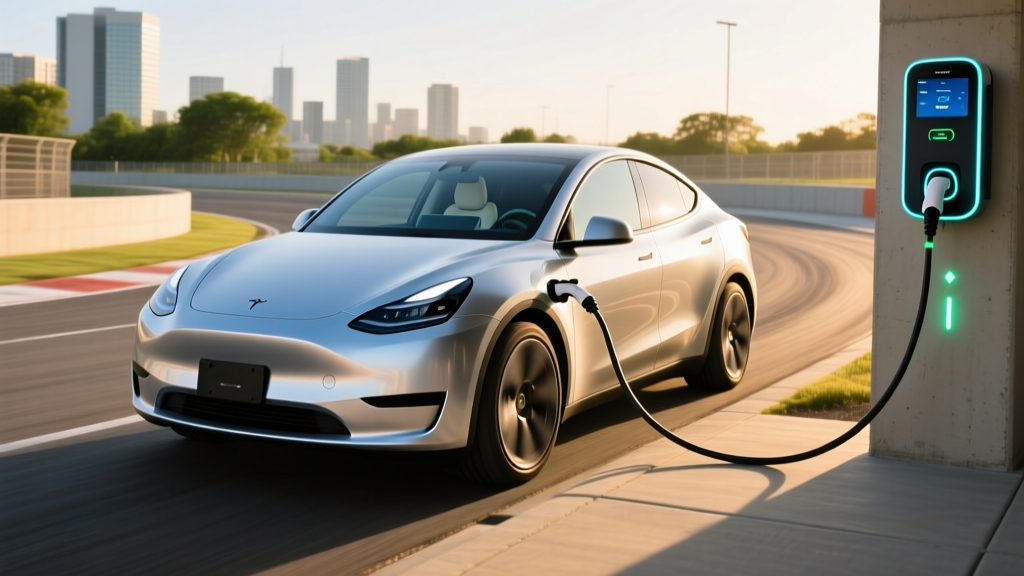
For home charging, the onboard 11.5 kW charger is excellent. A 48-amp Level 2 wall connector on a dedicated 60-amp circuit replenishes the full 79 kWh pack in about 7.5 hours, easily covering a full day's driving overnight. Installation costs typically run $800-$2,000 depending on panel capacity and conduit length — budget for a possible 200-amp panel upgrade ($1,500-$3,000) if your home has older 100-amp service.
The Model Y uses the native NACS (North American Charging Standard) connector, giving it seamless access to Tesla's Supercharger network — the most reliable public charging infrastructure in the U.S., with over 25,000 stalls nationally. A CCS adapter is included for Electrify America and other third-party networks.
Performance & Driving Dynamics
The numbers tell the headline story: 456 combined horsepower, 497 lb-ft of torque, and a 3.5-second 0-60 mph time that embarrasses most six-cylinder sports sedans. The dual-motor AWD system distributes torque front and rear with millisecond response, and the instant electric torque delivery makes the Model Y Performance feel even quicker than the stopwatch suggests in real-world passing maneuvers.
For 2026, Tesla has retuned the adaptive damper system. The previous generation's crashy low-speed ride has been meaningfully improved — the new setup is still firm (this is a Performance model, after all) but no longer punishing over expansion joints and broken pavement. Track Mode returns with adjustable front/rear torque bias, stability control intervention levels, and enhanced regenerative braking for lapping. Brake cooling has also been revised, though sustained track use will still induce fade after 3-4 hot laps — this is a street car that can handle occasional track days, not a dedicated track weapon like the Ioniq 5 N.
Steering remains precise and quick (2.0 turns lock-to-lock) but offers minimal road feel feedback. The 21-inch Überturbine wheels with Pirelli P Zero summer tires deliver impressive lateral grip (~0.90g on the skidpad) but contribute to the range penalty versus the Long Range trim's 19-inch aero wheels.
Pricing, Tax Credits, and Total Cost
| Item | Amount |
|---|---|
| Base MSRP (Performance AWD) | $52,490 |
| Destination Fee | $1,390 |
| Federal §30D Tax Credit (if eligible) | Up to $7,500 |
| Effective Price (with full credit, point-of-sale) | ~$46,380 |
| Est. 5-Year Fuel Cost (electricity) | ~$3,800 |
| Est. 5-Year Maintenance | ~$1,200 |
The 2026 Model Y Performance starts at $52,490 — well under the IRS §30D MSRP cap of $80,000 for SUVs. Federal tax credit eligibility depends on three moving targets that shift annually:
- Buyer income caps: Modified AGI must not exceed $300,000 (joint), $225,000 (head of household), or $150,000 (single).
- Battery sourcing requirements: A percentage of critical minerals and battery components must be sourced from the U.S. or free-trade-agreement partners. Tesla's Nevada and Texas battery production has improved eligibility, but specific build-week compliance varies.
- Point-of-sale transfer: The up-to-$7,500 credit can now be applied at purchase as an immediate price reduction rather than waiting for a tax return.
Always verify current eligibility on the IRS Clean Vehicle Credit page and confirm with your tax professional — the battery-sourcing rules have tightened incrementally each year since 2023, and specific Model Y builds may or may not qualify depending on their production date and cell source.
Tech, Interior, and Driver Assistance
The Juniper-refreshed interior is a meaningful step up in perceived quality. Acoustic glass all around reduces cabin noise substantially, ventilated front seats are now standard on Performance, and the ambient lighting strip across the dashboard adds warmth to the otherwise austere design. The 15.4-inch center touchscreen runs Tesla's latest infotainment software with wireless Apple CarPlay and Android Auto — a concession Tesla finally made for 2025 that carries forward.
A rear-seat 8-inch touchscreen controls climate, media, and entertainment for passengers. The panoramic glass roof remains standard but now includes a power-retractable sunshade — a welcome fix for the solar heat gain that plagued earlier Model Y owners in hot climates.
Autopilot and FSD (Supervised): The Model Y comes standard with Tesla's basic Autopilot (adaptive cruise + lane centering). Full Self-Driving (Supervised) remains an $8,000 option or $99/month subscription.
SAE Automation Level: Level 2. Both Autopilot and FSD (Supervised) require continuous driver attention and hands-on-wheel monitoring. FSD can navigate on-ramps, city intersections, and parking lots, but the driver is legally responsible at all times. This is not a Level 4 self-driving system like Waymo's robotaxi.
Tesla's vision-only approach (no LiDAR, no radar since 2022) delivers impressive highway lane-keeping and adaptive cruise performance, but FSD (Supervised) still exhibits phantom braking events and occasional hesitation at complex unprotected left turns. It's a compelling driver-assist system, not a replacement for an attentive driver.
Pros, Cons, and Who Should Buy
Pros
- 3.5-second 0-60 mph in a practical family SUV
- Supercharger network access — best-in-class reliability
- Improved ride quality with 2026 adaptive dampers
- 11.5 kW Level 2 home charging (fast for overnight)
- Over-the-air updates continuously add features
- 3,500-lb towing capacity
- Strong resale value relative to EV competitors
Cons
- Real-world highway range ~235-250 mi (below EPA 285)
- 400V architecture limits sustained DC fast-charge rate vs 800V rivals
- Minimalist interior lacks physical buttons (climate, mirrors via screen)
- No ultrasonic sensors — camera-only parking assist can struggle
- FSD (Supervised) still requires constant driver oversight
- Insurance premiums 20-35% above segment average
- 21-inch wheels generate noticeable road noise on coarse surfaces
Who the 2026 Model Y Performance Suits Best
Buy it if: You want a daily-drivable performance SUV with genuine sub-4-second acceleration, access to the most reliable DC fast-charging network, and enough cargo space (72.1 cu ft with seats folded) for weekend family adventures. It's ideal for performance-oriented commuters who also need practicality — the 3,500-lb tow rating handles a small boat or utility trailer, and the 44 mi/hr Level 2 charge rate means you'll wake up to a full battery every morning.
Consider alternatives if: Maximum range is your priority (the Long Range AWD delivers 320+ EPA miles for $5,000 less), you want the fastest possible DC charging (Hyundai/Kia's 800V platform charges 10-80% in ~18 min), or you prefer a traditional interior with physical controls (BMW iX, Genesis Electrified GV70).
Frequently Asked Questions
What is the real-world range of the 2026 Model Y Performance?
Expect roughly 235-250 miles at sustained highway speeds (70-80 mph) in moderate temperatures, 260-275 miles in mixed city/highway driving, and 190-215 miles in sub-freezing winter conditions. The EPA rates it at 285 miles combined, but the Performance trim's stickier tires and dual-motor weight cost it ~20 miles versus the Long Range variant.
How fast does the 2026 Model Y Performance charge?
On a Tesla V3 or V4 Supercharger, it peaks at 250 kW and charges from 10-80% in approximately 22 minutes with a preconditioned battery. On a 48-amp Level 2 home charger (11.5 kW), it adds about 44 miles of range per hour, filling the full 79 kWh pack in roughly 7.5 hours. The 400V architecture means charge rates taper more steeply above 50% SoC compared to 800V competitors.
Does the 2026 Model Y Performance qualify for the federal EV tax credit?
It can, but eligibility depends on your income (caps of $300K joint / $150K single), the battery-sourcing compliance of your specific build week, and the MSRP cap ($80,000 for SUVs — the Model Y Performance at $52,490 clears this easily). The credit can be transferred at point of sale for an immediate price reduction. Verify current rules on irs.gov and consult a tax professional.
Is the Model Y Performance worth it over the Long Range or competitors?
The Performance trim costs roughly $5,000 more than the Long Range AWD and sacrifices ~35 miles of EPA range for 3.5-second acceleration, adaptive dampers, 21-inch wheels, and Track Mode. If you value driving dynamics and the occasional track day, it's worth the premium. If range and value are paramount, the Long Range is the smarter buy. Against the Hyundai Ioniq 5 N, the Model Y wins on Supercharger access and cargo space but loses on DC charging speed and track-focused engineering.
What is the battery warranty on the 2026 Model Y Performance?
Tesla covers the 79 kWh NMC battery pack and dual-motor drive unit for 8 years or 120,000 miles, whichever comes first, with a guaranteed minimum 70% capacity retention. This is competitive with the segment (Hyundai/Kia offer 10yr/100K). Real-world NMC degradation data from Tesla's fleet suggests most packs retain 85-90% capacity at 100,000 miles under normal charging habits (avoiding prolonged 100% SoC storage).
Can I tow with the 2026 Model Y Performance?
Yes. Tesla rates it for 3,500 lbs with the factory tow hitch (a $1,000 dealer-installed option on some builds, included on others). Towing will cut range by roughly 40-50%, so plan for 120-140 miles between charging stops when pulling a loaded trailer. The dual-motor AWD system handles trailer sway well, and Tesla's trailer mode adjusts stability control parameters accordingly.