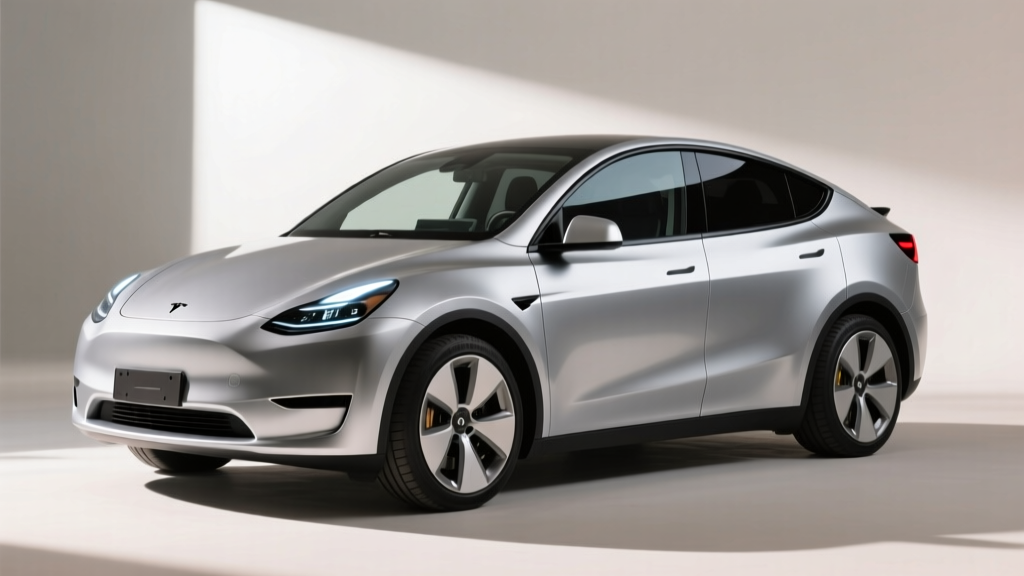
The Tesla Model Y remains the best-selling electric vehicle in the United States for good reason: it threads the needle between crossover practicality, charging infrastructure access, and price. For the 2026 model year, Tesla has introduced the refreshed "Juniper" generation — bringing updated styling, a revised interior, and tweaked battery chemistry. But for buyers researching garage fitment, parking-space compatibility, and real-world livability, the physical dimensions matter just as much as the range sticker.
This review covers the 2026 Tesla Model Y with a specific focus on its exterior length and dimensions, alongside the full spec sheet buyers need: real-world range, charging speed, pricing after federal tax credits, and how it stacks up against the Hyundai Ioniq 5, Ford Mustang Mach-E, and Chevrolet Equinox EV.
2026 Model Y Length and Exterior Dimensions
The 2026 Tesla Model Y measures 188.0 inches (4,775 mm) in overall length, making it a compact-to-midsize electric crossover. That's roughly 1.5 inches longer than the pre-refresh Model Y, owing to revised front and rear fascias introduced with the Juniper update. Here's the full dimensional breakdown:
| Dimension | Measurement |
|---|---|
| Overall Length | 188.0 in (4,775 mm) |
| Wheelbase | 113.8 in (2,890 mm) |
| Width (excl. mirrors) | 75.6 in (1,921 mm) |
| Width (incl. mirrors) | 83.8 in (2,129 mm) |
| Height | 63.9 in (1,624 mm) |
| Ground Clearance | 6.6 in (167 mm) |
| Curb Weight (Long Range AWD) | 4,398 lbs (1,995 kg) |
For garage planning, the 188.0-inch length means the Model Y fits comfortably in a standard single-car garage bay (typically 20–24 feet deep). Allow at least 24 inches of clearance fore and aft for walking space and Level 2 charging cable routing. The 83.8-inch mirror-inclusive width is worth noting for tight parking structures — fold the mirrors via the touchscreen if you're squeezing into a narrow space.
Range, Battery, and Real-World Efficiency
The 2026 Model Y is offered in three powertrain configurations, each with distinct range and battery characteristics:
| Trim | EPA Range | Battery (usable) | Chemistry | MPGe (combined) | kWh/100 mi |
|---|---|---|---|---|---|
| RWD (Standard Range) | 302 mi | ~60 kWh | LFP | 123 MPGe | 27 |
| Long Range AWD | 320 mi | ~75 kWh | NMC | 117 MPGe | 29 |
| Performance AWD | 298 mi | ~75 kWh | NMC | 111 MPGe | 30 |
The EPA estimates are measured under controlled conditions. In real-world highway driving at 70–75 mph, expect the Long Range AWD to deliver 270–290 miles before needing a charge. In cold weather (below 32°F), range drops 15–25% depending on cabin heating demand — a Long Range AWD may see 240–260 miles in winter highway conditions. City driving with regenerative braking recovers energy and typically matches or exceeds EPA estimates. The LFP-equipped RWD model can be charged to 100% daily without degradation concerns, effectively giving you the full 302 miles every day.
The LFP (lithium iron phosphate) battery in the RWD trim trades some energy density for longevity and lower cost. LFP cells tolerate frequent 100% charges and exhibit slower long-term degradation — ideal for daily commuters who charge at home every night. The NMC (nickel manganese cobalt) packs in the Long Range and Performance trims offer higher energy density (more range in the same physical space) but Tesla recommends charging to 80% for daily use, reserving 100% for road trips.
Charging Speed: DC Fast, Level 2, and Level 1
Charging speed is where the 2026 Model Y's Juniper refresh shows incremental improvement. The Long Range and Performance trims now support up to 250 kW peak DC fast charging on V3 and V4 Tesla Superchargers, while the RWD (LFP) peaks at approximately 170 kW.
| Charging Level | Power | Long Range / Performance | RWD (LFP) |
|---|---|---|---|
| DC Fast Charge (peak) | 250 kW / 170 kW | 10–80% in ~25 min | 10–80% in ~30 min |
| DC Fast (sustained avg.) | ~150 kW / ~110 kW | ~180 mi added in 15 min | ~130 mi added in 15 min |
| Level 2 (home, 48A) | 11.5 kW | ~44 mi/hr | ~36 mi/hr |
| Level 2 (home, 32A) | 7.7 kW | ~29 mi/hr | ~24 mi/hr |
| Level 1 (120V outlet) | ~1.4 kW | ~3–4 mi/hr | ~3–4 mi/hr |
Charging-curve reality check: The 250 kW peak on Long Range models is sustained only between roughly 10–30% State of Charge (SoC). Above 50%, the rate tapers to ~120 kW, and above 80% it drops below 50 kW to protect battery health. This is why Tesla (and all automakers) quote 10–80% times rather than 0–100%. On a road trip, plan your Supercharger stops around the 15–20 minute mark for optimal throughput — staying longer to push past 90% yields diminishing returns.
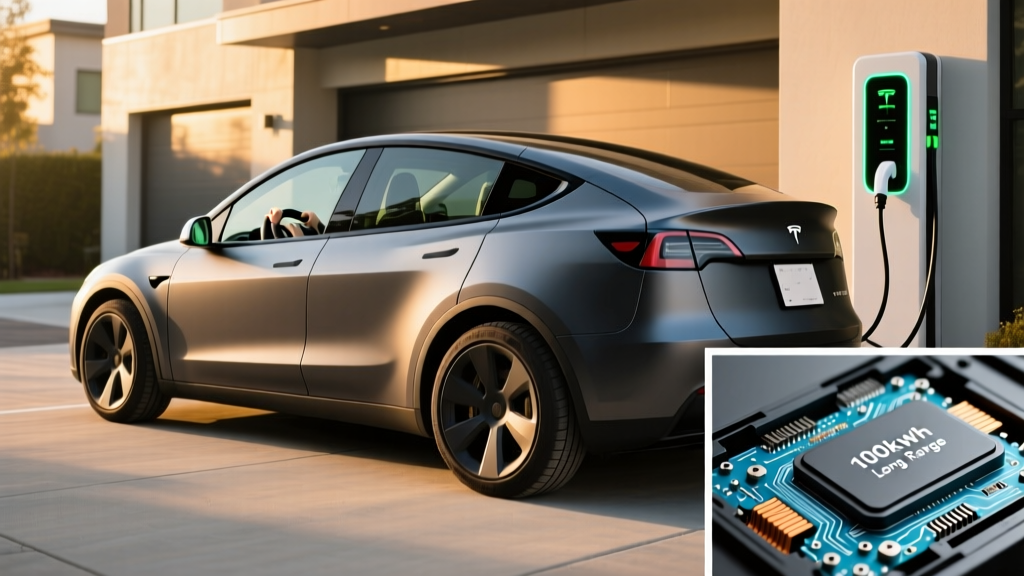
At home, a Tesla Wall Connector on a 60-amp circuit delivers 48 amps (11.5 kW), adding roughly 44 miles of range per hour on the Long Range. An overnight 8-hour charge replenishes ~350 miles — more than a full battery. Installation typically runs $800–$2,000 depending on panel proximity and whether a 200-amp service upgrade is needed.
Performance and Drivetrain
| Spec | RWD | Long Range AWD | Performance AWD |
|---|---|---|---|
| Horsepower | 315 hp | 384 hp | 456 hp |
| Torque | 317 lb-ft | 376 lb-ft | 410 lb-ft |
| 0–60 mph | 5.8 sec | 4.8 sec | 3.5 sec |
| Drivetrain | Rear-Wheel Drive | Dual-Motor AWD | Dual-Motor AWD |
| Top Speed | 135 mph | 135 mph | 155 mph |
| Towing Capacity | 3,500 lbs | 3,500 lbs | 3,500 lbs |
Even the base RWD Model Y hits 60 mph in under six seconds — brisk by any compact-crossover standard. The dual-motor AWD models provide genuine all-weather traction, with independent torque control front and rear. The Performance trim's 3.5-second sprint places it in sports-sedan territory, though the firmer suspension tuning and 21-inch wheels trade some ride comfort for cornering grip.
All trims come standard with Tesla's heat pump, which significantly reduces cold-weather range loss compared to resistive cabin heating. The thermal management system also preconditions the battery when you navigate to a Supercharger — warming the pack to optimal temperature so you hit peak charge rates immediately upon plugging in.
Interior Space, Cargo, and Technology
The 2026 Juniper refresh brought a notably quieter cabin (acoustic glass front and rear), ventilated front seats, a rear-seat touchscreen, and ambient lighting. The minimalist interior still centers on a single 15.4-inch touchscreen, but material quality has improved with soft-touch surfaces replacing some of the harder plastics found in pre-2025 models.
| Dimension | Measurement |
|---|---|
| Front Headroom | 41.0 in |
| Rear Headroom | 37.7 in |
| Front Legroom | 41.8 in |
| Rear Legroom | 38.4 in |
| Cargo (rear seats up) | 30.2 cu ft |
| Cargo (rear seats folded) | 72.1 cu ft |
| Front Trunk (frunk) | 4.1 cu ft |
Rear legroom at 38.4 inches is competitive with the segment — adequate for adults on longer trips, though the Hyundai Ioniq 5 offers slightly more at 39.4 inches. The 72.1 cu ft maximum cargo volume with seats folded beats most competitors and accommodates full-size luggage for a family of four on a week-long road trip.
Notable technology:
- 15.4-inch center touchscreen with integrated navigation, streaming, and vehicle controls
- Rear-seat 8-inch touchscreen for climate and entertainment
- Tesla Autopilot (Level 2 driver assistance) standard — includes Traffic-Aware Cruise Control and Autosteer
- Full Self-Driving (Supervised) available as a $8,000 option — still Level 2, requiring active driver supervision
- Over-the-air software updates adding features post-purchase
- Sentry Mode dashcam surveillance when parked
- Dog Mode and Camp Mode for climate control while stationary
Tesla Autopilot and FSD (Supervised) are SAE Level 2 driver-assistance systems. The driver must keep hands on the wheel (or demonstrate attentiveness via cabin camera) and eyes on the road at all times. These are not self-driving systems. Only Level 4 services like Waymo One operate without a human driver — and those are limited to geofenced urban areas.
Pricing, Trims, and Federal Tax Credit
| Trim | Base MSRP | §30D Credit Eligibility | Effective Price (if eligible) |
|---|---|---|---|
| RWD (Standard Range) | $44,990 | Up to $7,500 | ~$37,490 |
| Long Range AWD | $48,990 | Up to $7,500 | ~$41,490 |
| Performance AWD | $52,990 | Up to $7,500 | ~$45,490 |
All three trims fall under the IRS §30D MSRP cap of $80,000 for SUVs/crossovers. However, eligibility for the full $7,500 credit depends on several factors that change periodically:
- Buyer income caps: Modified AGI must not exceed $150,000 (single), $225,000 (head of household), or $300,000 (joint filing)
- Battery sourcing: A percentage of critical minerals and battery components must be sourced from the US or free-trade-agreement countries — this threshold increases annually
- Point-of-sale transfer: As of 2024+, you can transfer the credit to the dealer at purchase, reducing your out-of-pocket cost immediately rather than waiting for tax filing
- Foreign Entity of Concern (FEOC) restriction: Vehicles with battery components from certain foreign entities may be ineligible — verify current status on the IRS clean vehicle credit page
Tesla's US-built battery cells and North American assembly generally position the Model Y favorably for credit eligibility, but the specific credit amount (full $7,500, partial $3,750, or $0) depends on the battery sourcing rules in effect at the time of purchase. Consult a tax professional and check fueleconomy.gov for the most current eligibility data before purchasing.
Pros, Cons, and Who Should Buy
- Access to Tesla Supercharger network — the most reliable and extensive DC fast-charging network in North America
- Class-leading efficiency (27–30 kWh/100 mi)
- Strong real-world range across all trims (270+ mi highway)
- Over-the-air updates continuously improve the vehicle
- Excellent cargo volume (72.1 cu ft) with a usable frunk
- Heat pump standard — better cold-weather range retention
- Quieter cabin with Juniper refresh
- No physical buttons — all controls via touchscreen (climate, mirrors, glovebox)
- Rear visibility is limited; relies heavily on backup camera
- FSD (Supervised) is expensive ($8,000) and remains Level 2
- Firm ride on Performance trim with 21-inch wheels
- No Apple CarPlay or Android Auto
- Insurance premiums tend to be higher than segment average
- Turn-signal stalk removed in Juniper — steering-wheel buttons instead
- Daily commuters: The RWD trim at ~$37,490 (after credit) with LFP battery is ideal for 40–80 mile round trips with nightly home charging
- Families needing cargo space: 72.1 cu ft with seats folded, 3,500-lb towing, and five-seat comfort make it a practical family hauler
- Road trippers: Supercharger network access and 250 kW peak charging mean less downtime on long drives
- Tech-forward buyers: OTA updates, integrated navigation, and Tesla's app ecosystem appeal to software-savvy owners
- Cold-climate drivers: Standard heat pump and AWD availability make it viable in northern states
How the 2026 Model Y Compares to Key Rivals
| Spec | Tesla Model Y LR | Hyundai Ioniq 5 LR | Ford Mustang Mach-E ER | Chevy Equinox EV RS |
|---|---|---|---|---|
| EPA Range | 320 mi | 310 mi | 312 mi | 319 mi |
| Length | 188.0 in | 182.7 in | 186.7 in | 190.1 in |
| DC Fast Charge (peak) | 250 kW | 235 kW | 150 kW | 150 kW |
| 10–80% Time | ~25 min | ~20 min | ~36 min | ~35 min |
| Starting MSRP | $48,990 | $49,850 | $48,995 | $43,900 |
| Cargo (max) | 72.1 cu ft | 59.3 cu ft | 59.7 cu ft | 63.5 cu ft |
| Charging Network | Tesla Supercharger | NACS (Supercharger access) | NACS (Supercharger access) | NACS (Supercharger access) |
The Model Y's key advantages remain cargo volume, Supercharger network reliability, and efficiency. The Ioniq 5 charges faster on a percentage basis (its 800V architecture enables a quicker 10–80% time despite slightly lower peak kW) and offers a more conventional interior with physical climate controls. The Mach-E and Equinox EV now have NACS ports and Supercharger access, narrowing Tesla's charging-network moat — but Tesla's integrated navigation-to-charger preconditioning still delivers a more seamless road-trip experience.
Warranty and Long-Term Ownership
| Component | Coverage |
|---|---|
| Basic Vehicle | 4 years / 50,000 miles |
| Battery & Drive Unit | 8 years / 120,000 miles (Long Range/Performance) |
| Battery & Drive Unit (RWD) | 8 years / 100,000 miles |
| Battery Capacity Retention | Minimum 70% over warranty period |
Tesla guarantees the battery will retain at least 70% of its original capacity during the warranty period. Real-world data from high-mileage Tesla owners suggests NMC packs typically retain 85–90% after 100,000 miles, while LFP packs show even slower degradation due to their chemistry's inherent cycle-life advantage. A full battery replacement outside warranty currently runs $12,000–$16,000 depending on the pack — though this is rarely needed within the first decade of ownership.
Frequently Asked Questions
What is the exact length of the 2026 Tesla Model Y?
The 2026 Model Y is 188.0 inches (4,775 mm) long overall. This is approximately 1.5 inches longer than the pre-refresh model due to updated front and rear bumper designs. It fits standard garage bays with room to spare for charging equipment.
What is the real-world range of the 2026 Model Y?
The Long Range AWD achieves 320 miles EPA, but expect 270–290 miles in real-world highway driving at 70–75 mph. In cold weather below freezing, plan for 240–260 miles. The RWD (LFP) model's 302-mile EPA rating translates to roughly 260–280 highway miles. City driving with regenerative braking often meets or exceeds EPA figures.
How fast does the 2026 Model Y charge?
On a Tesla V3/V4 Supercharger, the Long Range and Performance trims peak at 250 kW and charge from 10–80% in approximately 25 minutes. The RWD (LFP) peaks at 170 kW with a 10–80% time of ~30 minutes. At home on a 48-amp Level 2 Wall Connector, expect ~44 miles of range added per hour (Long Range).
Does the 2026 Model Y qualify for the $7,500 federal tax credit?
The Model Y is manufactured in the US and falls under the $80,000 MSRP cap for SUVs. However, the full $7,500 credit under IRS §30D depends on battery-sourcing requirements, critical-mineral thresholds, and the buyer's income (caps of $150K single / $300K joint). Eligibility can change as sourcing rules tighten annually. Verify current status on irs.gov and consult a tax professional before purchasing.
Is the 2026 Model Y worth buying over the Ioniq 5 or Mach-E?
Choose the Model Y if cargo space (72.1 cu ft), Supercharger integration, and maximum efficiency are priorities. Choose the Ioniq 5 if you prefer faster 10–80% charging, physical buttons, and a more distinctive design. Choose the Mach-E if driving dynamics and a traditional dealer service network matter. All three now have access to the Supercharger network via NACS, so the charging moat is narrowing.
What are the biggest drawbacks of the 2026 Model Y?
The touchscreen-only interface (no physical climate knobs or speedometer), limited rear visibility, absence of Apple CarPlay/Android Auto, and the removal of the turn-signal stalk in the Juniper refresh are the most common complaints. Insurance costs also run 15–25% higher than comparable gas crossovers.