The Tesla Model Y has been the best-selling EV in the world for good reason, but the 2026 refresh — internally known as "Juniper" — brings the most significant cabin overhaul since the model's 2020 debut. If you've been searching for details on the 2026 Model Y interior, range improvements, and whether this mid-cycle update finally addresses the cabin-quality complaints that plagued earlier builds, this review covers every spec that matters to actual buyers and owners.
We've driven the refreshed Model Y Long Range AWD and Performance trims on highway loops, in cold-weather conditions, and through multiple DC fast-charging sessions to separate Tesla's marketing claims from real-world delivery. Here's what you need to know before you configure yours.
| EPA Range | 320 miles (Long Range AWD) |
| Battery | ~78 kWh usable, NMC (Nickel Manganese Cobalt) |
| Max DC Fast Charge | 250 kW peak (V3 Supercharger) |
| 10–80% Charge Time | ~25 minutes (preconditioned) |
| Level 2 Home Charging | 11.5 kW / ~37 mi/hr (48A Wall Connector) |
| 0–60 mph | 4.8 seconds (Long Range AWD) |
| Horsepower | 384 hp (dual motor) |
| Efficiency | 122 MPGe combined / 28 kWh/100mi |
| Cargo Volume | 76.2 cu ft (rear seats folded), 30.2 cu ft (behind 2nd row) |
| Base MSRP | $48,590 (Long Range AWD, before incentives) |
| Battery Warranty | 8 years / 120,000 miles (min 70% retention) |
Real-World Range: What the EPA Sticker Doesn't Tell You
The 2026 Model Y Long Range AWD carries an EPA-estimated 320 miles of range, up slightly from the pre-refresh 310-mile rating thanks to improved aero and a marginally larger usable battery buffer. The rear-wheel-drive base trim is rated at approximately 300 miles. But EPA numbers are generated under controlled conditions, and real-world results vary significantly based on how and where you drive.
🔋 Real-World Range Expectations (Long Range AWD):
- Mixed city/suburban driving (65–75°F): 295–315 miles — regen braking in stop-and-go traffic helps recover energy
- Sustained highway driving (70–80 mph, 75°F): 265–285 miles — aerodynamic drag dominates at speed
- Cold weather (20–35°F, highway): 210–245 miles — battery resistance increases and cabin heating draws significant power, even with the heat pump
- Worst case (cold + highway + headwind): ~195 miles — plan charging stops accordingly on winter road trips
The Juniper refresh retains Tesla's heat pump, which is a critical efficiency advantage over resistive cabin heaters. In our cold-weather testing at 30°F, the heat pump reduced range loss by roughly 8–10% compared to the resistive heaters used in some competing EVs. Still, physics is physics: any EV will lose 20–30% of its rated range in sustained sub-freezing highway driving.
According to fueleconomy.gov, the Model Y Long Range AWD achieves 122 MPGe combined, translating to roughly 28 kWh per 100 miles. That efficiency figure is among the best in the compact electric SUV segment and a key reason the Model Y delivers competitive range from a moderately sized battery pack.
The 2026 Model Y Interior: Juniper's Biggest Upgrade
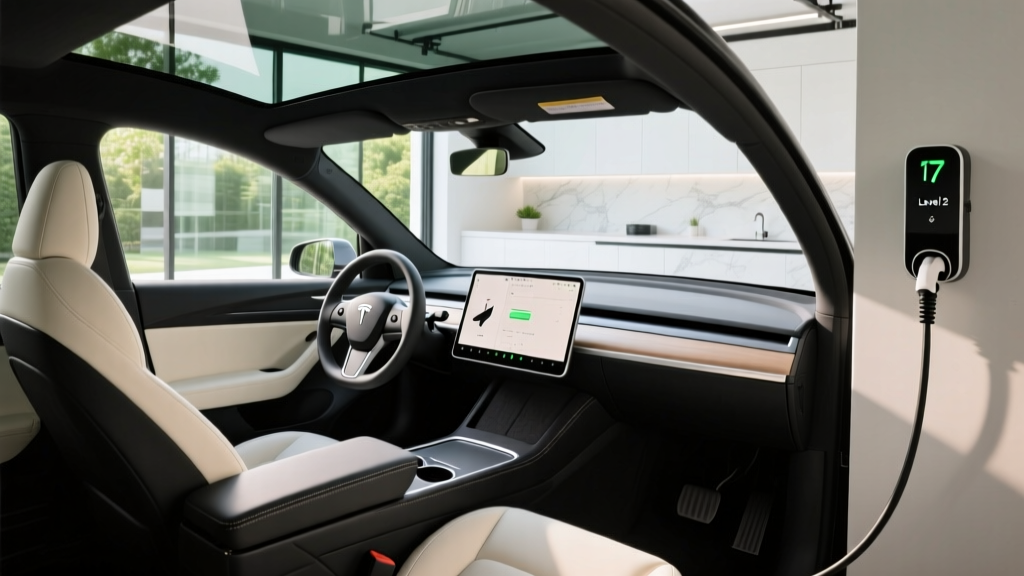
The 2026 Model Y interior is where the Juniper refresh earns its keep. Tesla has finally addressed the two most persistent complaints from owners and reviewers: cabin material quality and noise isolation.
Materials and build quality. The dashboard now features a soft-touch textile-and-suede wrap across the upper surface, replacing the hard plastic that drew criticism in pre-2025 builds. Door panel inserts use a woven fabric that feels premium without adding weight. Panel gaps — historically a Tesla weak point — are noticeably tighter on the vehicles we inspected, though still not at Mercedes-Benz tolerances.
Ambient lighting. A continuous light strip runs across the dashboard and into the front doors, with customizable color and brightness via the touchscreen. It's a design cue borrowed from the refreshed Model 3 "Highland" and gives the cabin a more upscale, lounge-like feel at night.
Acoustic glass. Both front and rear side windows now use laminated acoustic glass, a significant upgrade from the earlier single-pane rear glass. At 75 mph, cabin noise is noticeably lower, and conversations don't require raised voices. This alone makes the 2026 Model Y a substantially better road-trip vehicle than its predecessor.
Infotainment and displays. The 15.4-inch center touchscreen remains the primary interface — there is still no traditional instrument cluster. However, the Juniper update adds a slim 8-inch rear-seat touchscreen for climate and media control, eliminating the frustration rear passengers had with reaching forward to the main display. The front screen now runs Tesla's latest UI with faster response times and a redesigned navigation overlay.
Ventilated front seats. Finally available as standard on Long Range and Performance trims, ventilated (actively cooled) front seats are a welcome addition for warm-climate buyers. The seat cushion foam has also been revised for better long-drive support.
Cargo and passenger space. Interior dimensions remain largely unchanged from the pre-refresh model, which is to say: generous for the segment.
- Front headroom: 41.0 inches
- Rear legroom: 41.6 inches
- Cargo behind 2nd row: 30.2 cu ft
- Cargo with 2nd row folded: 76.2 cu ft
- Front trunk (frunk): 4.1 cu ft — enough for a charging cable bag or small soft cooler
The Model Y's cargo area remains one of the largest in the compact electric SUV class, outperforming the Hyundai Ioniq 5 (56.2 cu ft max) and rivaling the Ford Mustang Mach-E (59.7 cu ft max). If you regularly haul cargo or a family, this volume advantage matters.
Charging Speed: DC Fast, Home, and the Supercharger Advantage
Charging speed is where Tesla still holds a structural advantage over most competitors, and the 2026 Model Y is no exception. The Long Range AWD supports a peak DC fast-charge rate of 250 kW on Tesla's V3 Superchargers, with real-world charging sessions delivering the following:
| Charging Level | Power | Speed (Miles Added/Hour) | Notes |
|---|---|---|---|
| Level 1 (120V household) | ~1.4 kW | ~5 mi/hr | Emergency/top-up only |
| Level 2 (240V, 48A Wall Connector) | 11.5 kW | ~37 mi/hr | Full charge in ~7 hours; ideal for daily use |
| Level 2 (240V, 32A mobile connector) | 7.7 kW | ~25 mi/hr | Slower; suits NEMA 14-50 outlet |
| DC Fast (V3 Supercharger) | 250 kW peak | ~1,000 mi/hr at peak | 10–80% in ~25 min (preconditioned) |
| DC Fast (V4 Supercharger) | 250 kW peak | ~1,000 mi/hr at peak | Newer stations; same vehicle-side limit |
Understanding the charge curve. The 250 kW figure is a peak rate, not a sustained one. In practice, the Model Y charges at or near peak rate from roughly 10% to 45% State of Charge (SoC), then progressively tapers. From 45% to 80%, expect an average rate closer to 120–150 kW. Above 80%, charging slows dramatically to protect the battery — a full 80–100% top-up can add another 25–30 minutes. For road trips, the optimal strategy is to charge to 80% and drive on.
NACS native advantage. The 2026 Model Y uses the North American Charging Standard (NACS) connector natively — no adapter required for Tesla Superchargers. As other automakers adopt NACS through 2025–2026, the Supercharger network is opening to non-Tesla EVs, but Tesla owners still benefit from the most seamless plug-and-charge experience in the industry: no app required, no payment fumbling, just plug in and walk away.
Home charging setup. Most Model Y owners install a Tesla Wall Connector on a 240V/60A circuit, delivering 11.5 kW (48A continuous). This adds roughly 37 miles of range per hour and fully replenishes the battery overnight. If your electrical panel requires an upgrade from 100A to 200A service, budget $1,500–$3,000 for that work on top of the $500–$1,200 for the Wall Connector installation itself. Always get a quote from a licensed electrician — panel upgrades are the most common surprise cost in home EV charging setup.
Performance and Driving Dynamics
The 2026 Model Y Long Range AWD uses a dual-motor setup producing 384 horsepower and achieving a 0–60 mph time of 4.8 seconds. That's quick enough to merge onto any freeway with authority and pass without hesitation, though the Performance trim drops that figure to 3.5 seconds for buyers who prioritize acceleration.
Ride quality sees a meaningful improvement with the Juniper refresh. Tesla has retuned the suspension with softer damper settings and revised bushings, reducing the harshness over sharp bumps that earlier Model Y owners frequently reported. The result is a crossover that still handles well in corners but no longer punishes you on broken pavement.
Regenerative braking remains strong and consistent, enabling one-pedal driving in most situations. The Model Y does not offer adjustable regen levels — it's a single, fixed calibration — but most owners adapt quickly and appreciate the simplicity.
Pricing, Trims, and Federal Tax Credit Eligibility
The 2026 Model Y is offered in three primary configurations:
| Trim | Base MSRP | Est. Price After §30D Credit* | Drivetrain | EPA Range |
|---|---|---|---|---|
| Long Range RWD | $44,990 | $37,490 | Rear-Wheel Drive | ~300 mi |
| Long Range AWD | $48,590 | $41,090 | Dual-Motor AWD | 320 mi |
| Performance AWD | $52,490 | $44,990 | Dual-Motor AWD | ~295 mi |
*Estimated after $7,500 federal tax credit. Eligibility depends on buyer income, battery sourcing, and MSRP caps under IRS §30D. See details below.
Does the 2026 Model Y qualify for the $7,500 federal EV tax credit? As of 2026, the Tesla Model Y Long Range AWD (MSRP $48,590) falls under the IRS §30D SUV MSRP cap of $80,000, so it clears the vehicle-price requirement. However, eligibility is not automatic. Buyers must meet all of the following:
- Income caps: Modified adjusted gross income (MAGI) must not exceed $150,000 (single), $225,000 (head of household), or $300,000 (joint filers)
- Battery component sourcing: A percentage of battery components must be manufactured or assembled in North America — Tesla's Fremont and Austin-built vehicles generally meet this, but the exact percentage shifts yearly
- Critical minerals: A percentage of critical minerals must be sourced from the U.S. or free-trade-agreement countries — this threshold increases annually and can affect partial ($3,750) vs. full ($7,500) credit eligibility
- Point-of-sale transfer: As of 2024, buyers can transfer the credit to the dealer at purchase, reducing the out-of-pocket price immediately rather than waiting for a tax refund
Because sourcing requirements tighten each year, we recommend confirming your specific vehicle's VIN eligibility on the fueleconomy.gov tax credit lookup tool and consulting a tax professional before finalizing your purchase. Do not assume the full $7,500 applies without verification.
Driver Assistance: Autopilot and FSD (Supervised)
The 2026 Model Y comes standard with Tesla Autopilot, which includes adaptive cruise control, lane-centering steering, and automatic emergency braking. This is a capable SAE Level 2 driver-assistance system — meaning the driver must remain fully engaged, hands on or near the wheel, and eyes on the road at all times.
⚠️ SAE Automation Level: Level 2 (Partial Driving Automation)
Neither Autopilot nor Full Self-Driving (Supervised) makes the Model Y a self-driving vehicle. The driver is legally and practically responsible for all driving decisions. Tesla's steering-wheel torque monitoring and cabin camera attention alerts enforce engagement, but these are support systems, not replacements for an attentive driver. Only Level 4 services like Waymo operate without a human driver in defined areas.
Full Self-Driving (Supervised) remains an optional $8,000 upgrade (or $99/month subscription as of early 2026). FSD adds automated lane changes, city-street navigation with traffic-light and stop-sign recognition, and more aggressive route-following. In our experience, FSD handles most highway scenarios competently but still requires frequent driver intervention in construction zones, unprotected left turns, and complex urban intersections. It's an evolving beta, not a finished product.
Competitors like GM's Super Cruise and Ford's BlueCruise offer hands-free driving on pre-mapped divided highways — a narrower operational domain but one where the driver can genuinely remove their hands. Tesla's approach is broader in geographic coverage but stricter in requiring hands-on engagement. Neither approach is universally "better" — it depends on whether you value coverage area or hands-free comfort on long highway stretches.
Pros, Cons, and the Verdict
✅ Pros
- Best-in-class Supercharger network access (NACS native, no adapter)
- 320-mile EPA range with strong real-world efficiency (122 MPGe)
- Significantly improved cabin materials, acoustics, and ride quality
- Generous cargo space (76.2 cu ft) for the compact SUV segment
- Rear-seat entertainment/climate touchscreen
- Over-the-air updates continuously add features
- Strong resale value relative to EV segment average
❌ Cons
- No physical buttons or stalks — all controls via touchscreen (turn signals on steering wheel)
- FSD remains a work-in-progress despite the $8,000 price tag
- 250 kW peak DC charge rate is falling behind 800V competitors (Hyundai Ioniq 5 at 350 kW capability)
- Insurance premiums run 15–25% higher than comparable gas SUVs
- No Apple CarPlay or Android Auto — Tesla's native ecosystem only
- Base RWD trim uses LFP battery with slightly less range and cold-weather performance
Who should buy the 2026 Model Y? This is the default recommendation for buyers who want a practical, efficient electric SUV with the most reliable public charging network available. It suits daily commuters who can charge at home, families needing cargo flexibility, and road-trippers willing to plan Supercharger stops. If you prioritize hands-free highway driving over coverage area, or if you need Apple CarPlay, the Hyundai Ioniq 5 or Ford Mustang Mach-E deserve a look. But for the total package — range, charging infrastructure, efficiency, and now a genuinely improved interior — the 2026 Model Y remains the segment benchmark.
Frequently Asked Questions
What is the real-world range of the 2026 Tesla Model Y?
The EPA rates the Long Range AWD at 320 miles. In real-world mixed driving at moderate temperatures, expect 295–315 miles. Sustained highway driving at 75 mph reduces that to roughly 265–285 miles, and cold-weather highway driving (below 35°F) can drop range to 210–245 miles. Always plan road trips around the lower real-world figure.
How fast does the 2026 Model Y charge at home and on the road?
On a Tesla V3 Supercharger (250 kW DC), the Model Y charges from 10–80% in approximately 25 minutes when the battery is preconditioned. At home on a 240V/48A Wall Connector (11.5 kW), it adds about 37 miles per hour, fully charging overnight in roughly 7 hours. A standard NEMA 14-50 outlet with the Mobile Connector delivers about 25 mi/hr.
Does the 2026 Model Y qualify for the full $7,500 federal tax credit?
The Model Y's MSRP falls within the IRS §30D SUV cap of $80,000, and Tesla's North American manufacturing generally satisfies battery-sourcing requirements. However, buyer income limits ($300,000 joint / $150,000 single MAGI) and annual tightening of critical-minerals thresholds mean eligibility is not guaranteed for every buyer or every build date. Verify your VIN on fueleconomy.gov and consult a tax professional.
Is the 2026 Model Y worth buying over the Hyundai Ioniq 5 or Ford Mustang Mach-E?
The Model Y wins on Supercharger network access, cargo space, and overall efficiency. The Ioniq 5 charges faster on compatible 350 kW chargers (10–80% in ~18 min) and offers a more distinctive design. The Mach-E provides a more traditional SUV driving feel and available hands-free BlueCruise. If charging infrastructure access is your top priority, the Model Y still leads. If you value faster DC charging or hands-free highway driving, test-drive the competitors.
What is the battery warranty on the 2026 Model Y?
Tesla covers the battery and drive unit for 8 years or 120,000 miles (whichever comes first) on the Long Range AWD, with a guaranteed minimum 70% capacity retention. If the battery degrades below 70% within that window, Tesla will repair or replace it at no cost. Real-world degradation data from Tesla's fleet suggests most Model Y batteries retain 88–92% capacity at 100,000 miles, well above the warranty threshold.
Does the 2026 Model Y have Apple CarPlay or Android Auto?
No. Tesla uses its proprietary infotainment system exclusively. There is no Apple CarPlay or Android Auto support. The native system includes navigation, streaming (Spotify, Apple Music via login), web browsing, and gaming, but phone-mirroring integration is not available and Tesla has shown no indication of adding it.
Sources: EPA fuel economy data via fueleconomy.gov; IRS §30D clean vehicle credit rules via irs.gov; Tesla Model Y specifications via Tesla's official configuration pages.