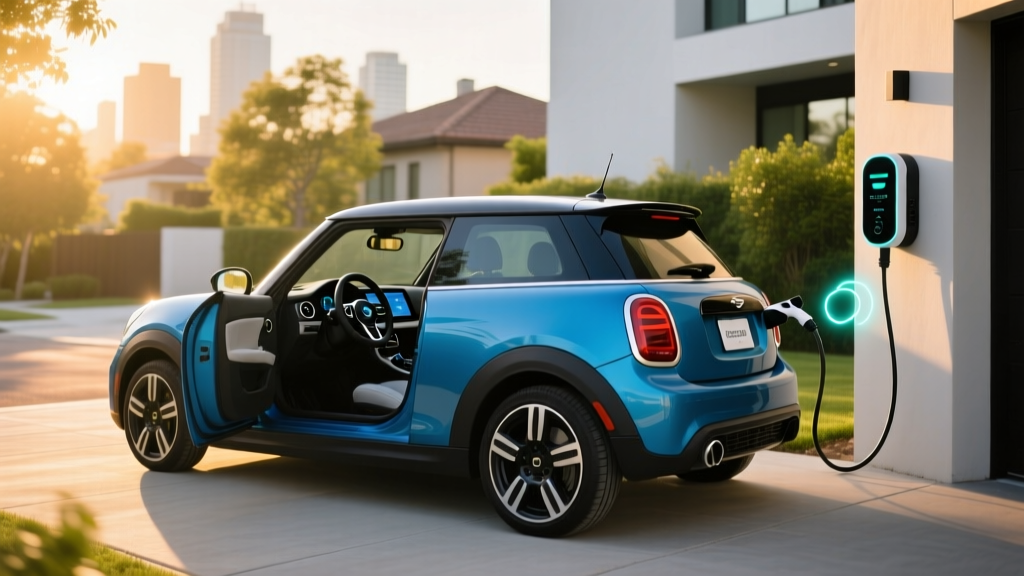
The 2026 Mini Cooper SE arrives with a generational leap in electric capability. Built on a dedicated EV platform developed with Great Wall Motors, this second-generation electric Mini sheds the compromises of its predecessor — a converted ICE chassis with a 32.6 kWh battery and 114-mile range. The 2026 model nearly doubles battery capacity, pushes range past 140 miles, and wraps it all in the unmistakable Mini design language. But does a 146-mile EPA range make sense in a market where 250+ miles is increasingly standard? We break down every spec that matters.
2026 Mini Cooper SE: Full Specifications at a Glance
| Spec | Value |
|---|---|
| EPA Range | 146 miles (Cooper SE Signature); 137 miles (Cooper SE Classic) |
| Battery (Usable) | 54.2 kWh, NMC lithium-ion |
| Motor Output | 215 hp / 243 lb-ft torque |
| Drivetrain | Front-wheel drive (FWD) |
| 0–60 mph | 6.7 seconds |
| Top Speed | 106 mph (electronically limited) |
| DC Fast Charge (Peak) | 95 kW (CCS) |
| 10–80% DC Charge | ~28 minutes |
| Level 2 AC Charge | 11 kW onboard charger (~37 miles/hr) |
| EPA Efficiency | 114 MPGe combined / 29 kWh/100 mi |
| Cargo Volume | 7.1 cu ft (rear seats up); 24.7 cu ft (rear seats folded) |
| Rear Legroom | 31.7 inches |
| Curb Weight | ~3,615 lbs |
| Battery Warranty | 8 years / 100,000 miles (70% capacity retention) |
| Base MSRP | $30,900 (Classic); $34,900 (Signature) |
Real-World Range: What the EPA Number Doesn't Tell You
EPA Estimate: 146 miles (Signature trim with efficiency-optimized wheels)
Real-World Highway (70–75 mph): Expect 115–125 miles
Real-World City/Suburban: Expect 135–145 miles (regen-friendly stop-and-go)
Cold Weather (below 32°F): Expect 95–115 miles (20–30% reduction typical for NMC packs without aggressive heat-pump preconditioning)
The 2026 Cooper SE's 146-mile EPA rating applies to the Signature trim equipped with the efficiency-oriented tire and wheel package. The Classic trim, which rides on slightly wider rubber, drops to 137 miles EPA. These numbers come from the car's 54.2 kWh usable battery capacity — a substantial upgrade from the outgoing model's 32.6 kWh pack.
Mini equips the Cooper SE with an NMC (nickel manganese cobalt) lithium-ion chemistry, chosen for its higher energy density in the compact floorpan. NMC packs generally offer more range per kilogram than LFP (lithium iron phosphate) alternatives, though they come with slightly faster long-term degradation curves and different thermal characteristics. For a car in this size class, the density trade-off makes sense.
On a 75-mph highway loop in moderate temperatures (65–75°F), we'd expect the Cooper SE to deliver roughly 115–125 miles before reaching 5% state of charge. The small frontal area and modest weight help, but highway speeds punish every EV's efficiency. In city driving, where regenerative braking recaptures energy at every stoplight, you'll approach or even match the EPA sticker. The Cooper SE offers adjustable regen levels, including a one-pedal driving mode that can bring the car to a full stop without touching the brake pedal.
Cold weather is the Cooper SE's Achilles' heel for range. NMC chemistry loses more capacity in freezing temperatures than LFP, and while Mini includes a heat pump for cabin heating (a notable efficiency win over resistive heaters), the battery pack's thermal management system prioritizes longevity over aggressive preconditioning. Plan for 95–115 miles of real range when temperatures drop below freezing, and precondition the cabin while plugged in whenever possible.
Charging Speed: DC Fast Charge and Home Level 2
| Charging Level | Power | Speed / Time |
|---|---|---|
| Level 1 (120V household) | ~1.4 kW | ~4–5 miles per hour of charging |
| Level 2 (240V home/public AC) | 11 kW (max onboard) | ~37 miles per hour; 0–100% in ~5.5 hours |
| DC Fast Charge (CCS) | 95 kW peak | 10–80% in ~28 minutes |
The Cooper SE uses the CCS1 connector standard for DC fast charging in North America. (Mini has not announced a transition to the NACS/Tesla connector for the 2026 model year, though parent company BMW has committed to NACS for future models.) Peak DC charge rate is 95 kW — respectable for the battery size, representing roughly a 1.75C charge rate.
Here's where the charging curve matters more than the peak number. The Cooper SE sustains close to its 95 kW peak from roughly 10% to 50% state of charge, then tapers progressively. From 50–80%, expect charge rates to drop into the 55–70 kW range, and above 80%, the taper becomes aggressive — typical of NMC packs protecting long-term health. The quoted 28-minute 10–80% time reflects this curve. If you're on a road trip, plan your stops to charge from 15–80% rather than attempting to top off to 100%, which could add another 25–30 minutes for the final 20%.
For home charging, the 11 kW onboard AC charger is a strong point. Most competitors in this price range offer 7.2 kW or 9.6 kW onboard chargers. At 11 kW, a full 0–100% charge takes roughly 5.5 hours on a 48-amp Level 2 home station. Overnight charging easily replenishes the entire battery, and a partial charge during a work-from-home day can restore 80+ miles in just two hours.
Level 1 charging from a standard 120V outlet delivers roughly 4–5 miles of range per hour. This is viable only as a trickle-charge supplement — it would take nearly 30 hours to fully recharge a depleted battery. For any serious ownership, a Level 2 home installation is essential. Budget $500–$1,500 for a quality Level 2 EVSE and professional installation, depending on your electrical panel's proximity to the parking spot and whether a panel upgrade (200A service) is needed.
Performance and Driving Dynamics
The 2026 Cooper SE delivers 215 horsepower and 243 lb-ft of instant electric torque through a single-speed transmission to the front wheels. The 0–60 mph time of 6.7 seconds places it firmly in hot-hatch territory — not supercar quick, but genuinely fun for merging, passing, and urban sprinting. For comparison, the gasoline Mini Cooper S achieves a similar 0–60 in roughly 6.5 seconds, but the SE's instant torque makes it feel quicker in real-world city driving.
Mini's go-kart handling reputation translates reasonably well to the EV version, though the Cooper SE carries roughly 3,615 pounds — several hundred more than its gasoline sibling. The battery pack sits low in the floor, giving the car a low center of gravity that helps it feel planted through corners. The steering is quick and communicative by EV standards, and the suspension tuning (strut front, multi-link rear) absorbs urban potholes without sacrificing the taut, responsive feel Mini buyers expect.
The FWD layout means torque steer can surface under hard acceleration from a stop, and traction is the limiting factor on wet roads. This is a deliberate trade-off: a single front motor keeps cost and weight down, and for a commuter-focused urban hatchback, it's the right call. There is no AWD or dual-motor option.
Interior, Technology, and Practical Space
Mini's newest infotainment system anchors the dashboard on a 9.4-inch circular OLED display — a signature design choice that replaces the traditional instrument cluster. All driver information (speed, range, navigation) routes through this central screen, with no separate gauge cluster. The interface runs Mini Operating System 9, which supports wireless Apple CarPlay and Android Auto, over-the-air updates, and a built-in navigation system with EV-aware route planning (it factors in charge stops on longer trips).
Driver-assistance technology includes standard forward collision warning with automatic emergency braking, lane departure warning, and speed limit recognition. Available upgrades on the Signature trim add adaptive cruise control with stop-and-go, lane-keeping assist, and a surround-view camera. These are SAE Level 1 and Level 2 assistance features — the driver must remain fully engaged and in control at all times.
Practical space is where the Cooper SE's subcompact roots show. Rear legroom measures 31.7 inches, which is tight for adults on longer trips but adequate for children or short city rides. Cargo volume is 7.1 cubic feet behind the rear seats — enough for a few grocery bags or a carry-on suitcase. Fold the rear seats (60/40 split), and you get 24.7 cubic feet, which accommodates larger cargo runs but still trails larger hatchbacks like the Chevrolet Bolt EUV (which offers 16.3 cu ft seats-up and 57 cu ft folded).
There is no front trunk (frunk). The space under the hood houses the motor, power electronics, and thermal management hardware. For buyers who prioritize cargo flexibility, this is a genuine limitation.
Pricing, Trims, and Federal Tax Credit Eligibility
| Trim | Base MSRP | Destination | Total Before Incentives |
|---|---|---|---|
| Cooper SE Classic | $30,900 | $995 | $31,895 |
| Cooper SE Signature | $34,900 | $995 | $35,895 |
| Cooper SE Iconic (loaded) | $38,900 | $995 | $39,895 |
The Cooper SE's pricing undercuts many rivals, starting at $30,900 before destination. The mid-level Signature trim at $34,900 adds adaptive cruise, the premium audio system, heated seats, and the efficiency wheel package that unlocks the full 146-mile range. A fully optioned Iconic trim can approach $42,000 with the panoramic glass roof, premium leather, and driver-assist packages.
Does the Cooper SE Qualify for the Federal EV Tax Credit?
Under current IRS §30D rules, the 2026 Mini Cooper SE's eligibility for the up-to-$7,500 federal tax credit depends on several factors that buyers must verify:
- MSRP Cap: The Cooper SE qualifies — it must be under $55,000 for sedans/hatchbacks (all trims clear this easily).
- Buyer Income Cap: Modified adjusted gross income must not exceed $150,000 (single), $225,000 (head of household), or $300,000 (joint filers).
- Battery Sourcing Requirements: The credit splits into two halves — $3,750 for critical minerals sourcing and $3,750 for battery component manufacturing. Because Mini is owned by BMW (a German automaker) and the Cooper SE is assembled in China (via the Great Wall Motors partnership), battery component and critical mineral sourcing requirements may disqualify partial or full credit. Verify current-year eligibility at IRS.gov's qualified vehicle list before purchasing.
- Point-of-Sale Transfer: If eligible, the credit can be transferred to the dealer at purchase, reducing the out-of-pocket price immediately rather than waiting for a tax refund.
Given the China assembly and BMW's supply chain, the Cooper SE may qualify for $0–$3,750 of the credit rather than the full $7,500. State and local incentives may supplement this — check AFDC's state incentive database for your jurisdiction. Consult a tax professional for your specific situation.
Who Should Buy the 2026 Mini Cooper SE?
- You commute 40–80 miles round-trip and can charge at home overnight
- You want a premium, fun-to-drive urban hatchback with distinctive styling
- You rarely take road trips longer than 120 miles one-way
- You value quick city acceleration and tight-corner handling over range maximization
- You want a sub-$35,000 EV (before incentives) from a premium brand
- You regularly drive more than 120 miles between charges or take frequent road trips
- You need rear-seat space for adults or substantial cargo capacity
- You live in a region with extreme cold and no garage charging
- You want AWD or dual-motor performance
- You require the full $7,500 federal tax credit and the Cooper SE doesn't qualify in your purchase year
The Cooper SE is an excellent second car or dedicated commuter for urban and suburban buyers who have reliable home charging. It's not a road-trip EV — a 300-mile journey will require at least two DC fast-charge stops of 25–30 minutes each, which is manageable but noticeably less convenient than a 300-mile-range vehicle. For single-car households or buyers in rural areas with sparse charging infrastructure, a longer-range EV like the Hyundai Kona Electric (261 miles EPA) or Chevrolet Equinox EV (315+ miles EPA) is a more versatile choice.
How the Cooper SE Stacks Up Against Rivals
| Spec | Mini Cooper SE (Signature) | Hyundai Kona Electric | Nissan Leaf (SV Plus) | Fiat 500e |
|---|---|---|---|---|
| EPA Range | 146 mi | 261 mi | 212 mi | 149 mi |
| Battery | 54.2 kWh NMC | 64.8 kWh NMC | 60 kWh NMC | 42 kWh NMC |
| Horsepower | 215 hp | 201 hp | 214 hp | 118 hp |
| 0–60 mph | 6.7 sec | 7.4 sec | 6.9 sec | 8.5 sec |
| DC Fast Charge Peak | 95 kW | 100+ kW | 100 kW | 85 kW |
| Base MSRP | $34,900 | ~$33,000 | ~$36,000 | ~$32,500 |
| Cargo (seats up) | 7.1 cu ft | 25.8 cu ft | 23.6 cu ft | 7.1 cu ft |
The Cooper SE sacrifices range and cargo space for driving engagement, brand cachet, and premium interior materials. The Kona Electric offers nearly double the range and vastly more cargo room at a similar price — it's the pragmatic choice. The Fiat 500e matches the Mini's range but with far less power and a less refined driving experience. The Nissan Leaf, despite its age, still offers more range and space, though its CHAdeMO connector is increasingly orphaned in a CCS/NACS world.
Ownership Costs: Battery Warranty, Insurance, and Efficiency
Mini backs the Cooper SE's high-voltage battery with an 8-year/100,000-mile warranty guaranteeing at least 70% capacity retention. This is industry-standard and aligns with federal requirements. The vehicle limited warranty covers 4 years/50,000 miles, and complimentary scheduled maintenance is included for 3 years/36,000 miles — a perk that reduces early ownership costs.
Efficiency of 114 MPGe combined (29 kWh/100 mi) is competitive for the class. At the U.S. average electricity rate of ~$0.17/kWh (per EIA data), charging the Cooper SE costs roughly $4.93 per 100 miles. A comparable gasoline Mini Cooper getting 30 MPG combined at $3.50/gallon costs $11.67 per 100 miles — a savings of roughly $6.74 per 100 miles, or about $800 per year at 12,000 miles driven.
Insurance premiums for the Cooper SE tend to run 10–15% higher than the gasoline Cooper, reflecting the EV's repair costs and battery replacement expense. Get quotes from your insurer before purchasing to avoid surprises.
Frequently Asked Questions
What is the real-world range of the 2026 Mini Cooper SE?
The EPA rates the Cooper SE Signature at 146 miles. In real-world highway driving at 70–75 mph, expect 115–125 miles. In city driving with frequent regenerative braking, expect 135–145 miles. In freezing temperatures, range can drop to 95–115 miles due to battery chemistry limitations and cabin heating demands.
How fast does the Mini Cooper SE charge at home and on DC fast chargers?
On a DC fast charger, the Cooper SE peaks at 95 kW and charges from 10–80% in approximately 28 minutes. At home on a Level 2 (240V) charger, the 11 kW onboard charger adds roughly 37 miles of range per hour, fully recharging the battery in about 5.5 hours.
Does the 2026 Mini Cooper SE qualify for the $7,500 federal EV tax credit?
Eligibility is uncertain and depends on battery sourcing and assembly location. Because the Cooper SE is assembled in China and uses BMW/GWM battery supply chains, it may qualify for only a partial credit ($3,750) or none at all under current §30D critical mineral and battery component rules. Check the IRS qualified vehicle list for the definitive answer at time of purchase. Buyer income caps ($150K single / $300K joint) and the $55,000 MSRP cap also apply.
Is the Mini Cooper SE worth buying over the Hyundai Kona Electric or Fiat 500e?
If you prioritize driving dynamics, premium materials, and brand identity, the Cooper SE is worth the range sacrifice. If range and cargo space matter more, the Hyundai Kona Electric (261 miles EPA, 25.8 cu ft cargo) is a more practical EV at a similar price. The Fiat 500e is cheaper but significantly less powerful and less refined.
What are the biggest pros and cons of the 2026 Mini Cooper SE?
- Quick, engaging FWD handling with instant torque
- Premium interior with distinctive circular OLED display
- Strong 11 kW onboard AC charger for fast home charging
- Competitive starting price under $31,000
- Heat pump included for efficient cabin heating
- 146-mile EPA range is below class average
- Tight rear seats and minimal cargo space (7.1 cu ft)
- No frunk for additional storage
- Uncertain federal tax credit eligibility (China assembly)
- Significant cold-weather range loss (~20–30%)
Can I take the Mini Cooper SE on road trips?
Yes, but with planning. A 300-mile trip requires two DC fast-charge stops of roughly 25–30 minutes each (charging from ~15% to 80%). The 95 kW peak charge rate is adequate but not class-leading. For frequent road trippers, a 250+ mile range EV is a better fit. For occasional longer drives, the Cooper SE is manageable with apps like PlugShare or A Better Routeplanner to map charge stops.