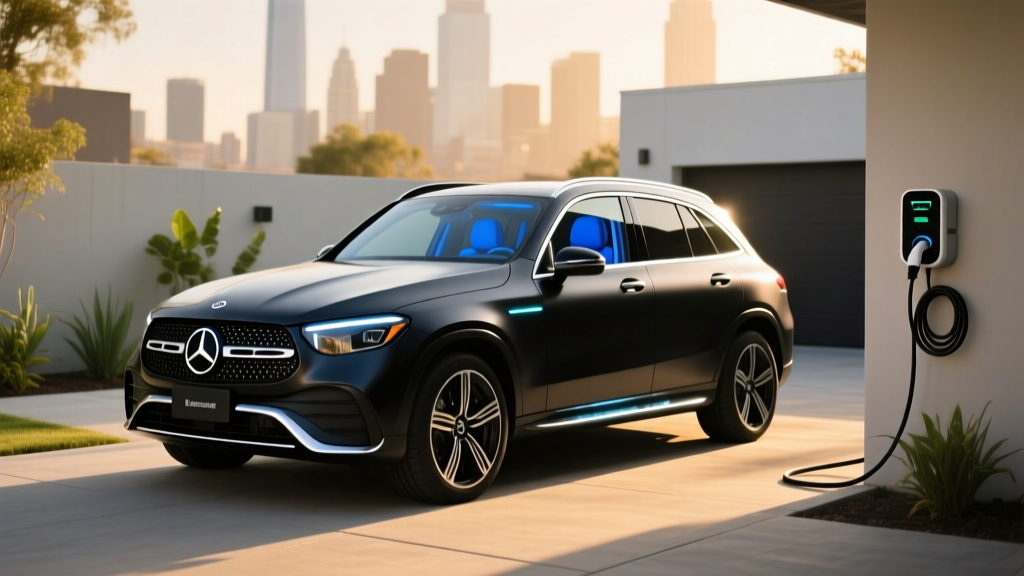
Quick Answer: The 2026 Mercedes-Benz GLC EV (internationally known as the GLC 350e all-electric variant on the MMA platform) is expected to start around $59,950, deliver an estimated 310–330 miles of EPA range with an ~84 kWh NMC battery, and support peak DC fast charging near 250 kW via its 800-volt architecture. It will qualify as a luxury SUV under current IRS §30D rules — meaning the MSRP cap for SUVs is $80,000, but buyer income limits and battery-sourcing requirements may restrict the full $7,500 federal credit. Real-world highway range will likely land closer to 260–280 miles, and cold-weather driving can reduce that further by 20–30%.
The compact luxury EV SUV segment has become fiercely competitive, and Mercedes-Benz is answering with the 2026 GLC EV — the all-electric successor built on the brand's new Mercedes Modular Architecture (MMA). If you've been watching the GLC lineup and wondering whether the electric version makes financial and practical sense versus the gas-powered GLC 300 or a plug-in hybrid alternative, this guide breaks down every number that matters.
Range, Battery, and Real-World Efficiency
The 2026 GLC EV is built on an 800-volt electrical architecture, a significant upgrade from the 400V systems still found in many competitors. This enables both faster charging and improved efficiency. Mercedes has targeted an energy-dense NMC (nickel-manganese-cobalt) battery pack with approximately 84 kWh of usable capacity.
The EPA has not yet published official range figures at the time of writing, but based on Mercedes' WLTP claims and comparable MMA-platform vehicles like the CLA EV, we project the following:
| Spec | GLC EV 350 (Est.) | GLC EV 400 (Est.) |
|---|---|---|
| Battery (usable) | 84 kWh NMC | 84 kWh NMC |
| EPA Range (projected) | ~330 mi | ~310 mi |
| Real-World Highway | ~270–280 mi | ~250–260 mi |
| Cold-Weather (20°F) | ~210–240 mi | ~195–220 mi |
| Efficiency (est.) | ~3.3 mi/kWh (100 MPGe+) | ~3.1 mi/kWh |
| Drivetrain | RWD | AWD (4MATIC) |
| Horsepower | ~268 hp | ~402 hp |
| 0–60 mph | ~6.5 sec | ~4.7 sec |
Real-World Range Reality: The EPA sticker may say 330 miles, but plan your road trips around 260–280 miles at highway speeds (70–80 mph). In winter conditions below freezing, expect a 20–30% reduction, bringing effective range to 210–240 miles. The GLC EV's heat pump (standard on MMA vehicles) helps mitigate this, but physics still wins in extreme cold.
For context, the gas-powered 2026 GLC 300 with its turbocharged four-cylinder achieves roughly 25 MPG combined, yielding about 370 miles from its ~14.8-gallon tank. The EV closes the gap substantially on efficiency while eliminating tailpipe emissions — but the gas model still holds an edge in total single-fill range and refueling speed.
Charging Speed and Infrastructure
This is where the 800V architecture earns its keep. The 2026 GLC EV supports:
| Charging Level | Power | Miles Added/Hour | Typical Use |
|---|---|---|---|
| Level 1 (120V) | ~1.4 kW | ~4–5 mi/hr | Emergency / trickle |
| Level 2 (240V, 48A) | ~11.5 kW | ~35–38 mi/hr | Home overnight |
| DC Fast (peak) | ~250 kW | ~180+ mi in 15 min | Road trips |
| 10–80% DCFC | — | — | ~18–22 minutes |
The charge curve matters more than the peak number. Expect the GLC EV to sustain above 200 kW up to roughly 50% state of charge, then taper progressively. By 80% SoC, charging slows to around 50–70 kW. This is why the 10–80% metric is the one that counts for road trips — and ~20 minutes is competitive with the best in the segment, including the Hyundai Ioniq 5 and BMW iX3.
The GLC EV will ship with a NACS (North American Charging Standard) port, granting native access to Tesla's Supercharger network — now the largest and most reliable DC fast-charging network in the US. A CCS adapter may also be included for Electrify America and other legacy networks.
Pricing, Trims, and Tax Credit Eligibility
Here's what we expect for the 2026 GLC EV lineup at launch:
| Trim | Est. Base MSRP | Drivetrain | Federal Credit Eligibility |
|---|---|---|---|
| GLC EV 350 | $59,950 | RWD | Partial to full (§30D) |
| GLC EV 350 4MATIC | $63,500 | AWD | Partial to full (§30D) |
| GLC EV 400 4MATIC | $71,900 | AWD | Partial (§30D, sourcing TBD) |
IRS §30D Federal Tax Credit — 2026 Rules:
- MSRP Cap: SUVs must be ≤$80,000 — all GLC EV trims clear this
- Buyer Income Cap: AGI ≤$150K single / ≤$300K married filing jointly
- Battery Sourcing: Critical minerals and battery components must meet phased-in domestic/free-trade-area thresholds — Mercedes has been shifting supply chains, but exact 2026 compliance per trim is unconfirmed
- Point-of-Sale Transfer: Eligible buyers can apply the credit as an instant dealer discount
- Source: IRS Clean Vehicle Credits
Always consult a tax professional before banking on the credit. Battery-sourcing requirements have disqualified several luxury EVs in prior model years, and the rules tighten annually through 2032.
GLC EV vs. Gas GLC 300: 5-Year Cost Comparison
Numbers beat narratives. Here's a realistic 5-year/75,000-mile ownership comparison assuming national averages:
| Category | GLC EV 350 (est.) | GLC 300 Gas (2026) |
|---|---|---|
| Purchase Price | $59,950 | $49,500 |
| Federal Tax Credit | –$3,750 to –$7,500 | $0 |
| Effective Purchase | $52,450–$56,200 | $49,500 |
| Fuel / Energy (75K mi) | $3,900 (home L2 avg.) | $9,400 (25 MPG, $3.50/gal) |
| Maintenance (5 yr) | ~$1,800 | ~$4,200 |
| Insurance (5 yr avg.) | ~$12,500 | ~$10,200 |
| Depreciation (est.) | ~$22,000 | ~$18,500 |
| Total 5-Yr Cost | ~$92,650–$96,400 | ~$91,800 |
The EV and gas versions land remarkably close over five years. The EV's fuel and maintenance savings (~$7,900 combined) nearly offset its higher purchase price and insurance premiums. If you qualify for the full $7,500 credit and charge primarily at home on off-peak rates, the EV pulls ahead. If you rely heavily on public DC fast charging (at $0.35–$0.55/kWh in many markets), the energy cost gap narrows significantly.
Sources: fueleconomy.gov for efficiency baselines; insurance estimates via industry averages for luxury compact SUVs.
Home Charging and Ownership Logistics
The single biggest variable in EV satisfaction is home charging access. Here's the honest breakdown:
If you have a garage or dedicated parking spot with a 240V outlet or the ability to install one: A Level 2 home charger (48A hardwired) will replenish the GLC EV's 84 kWh battery from 10% to 100% in roughly 8–9 hours — perfect for overnight charging. Installation costs typically run $800–$2,500 depending on panel proximity and local permitting. If your electrical panel needs upgrading from 100A to 200A service, add $1,500–$3,000.
If you live in an apartment or lack dedicated parking: Public charging becomes your primary fuel source. At current national averages, DC fast charging costs roughly $0.35–$0.55/kWh, making the GLC EV's per-mile energy cost comparable to a 30–35 MPG gas car. This erodes the EV's operating-cost advantage substantially. Before buying, map the Level 2 and DC fast chargers within 2 miles of your home and workplace.
Climate considerations: If you live where winters routinely drop below 30°F, preconditioning (warming the battery while still plugged in) is essential for preserving range and enabling fast charging. The GLC EV's thermal management system handles this automatically when you set a departure time in the Mercedes me app.
Common Misconceptions — Fact-Checked
| Myth | Fact |
|---|---|
| "The battery will need replacing in 5 years" | Mercedes warranties the battery for 8 years / 100,000 miles at ≥70% capacity retention. NMC packs on 800V systems with active thermal management typically degrade 10–15% over 150K+ miles. |
| "It qualifies for the full $7,500 tax credit" | Eligibility depends on your AGI, the battery's critical-mineral sourcing, and component manufacturing. The MSRP cap is satisfied, but sourcing compliance varies by build date and trim. |
| "Charging takes too long for road trips" | At 250 kW peak, 10–80% takes ~20 minutes — comparable to a gas station stop with food and restroom break. Plan around 2–3 stops per 800-mile trip. |
| "EV insurance is unreasonably expensive" | The GLC EV will cost roughly 15–25% more to insure than the gas GLC 300 due to higher repair costs and purchase price. Shop quotes from 3+ carriers before purchasing. |
| "The GLC EV is self-driving" | Mercedes' DRIVE PILOT is a SAE Level 2 driver-assist system on most US roads (Level 3 only on limited pre-approved highway sections under 40 mph in select states). You must remain engaged and ready to take over at all times. |
SAE Automation Level: Mercedes DRIVE PILOT operates as Level 2 (partial automation, driver must supervise) on the vast majority of US roads. Conditional Level 3 capability (eyes-off in heavy highway traffic under 40 mph) is approved only on specific mapped highway sections in Nevada and California. This is not a robotaxi — it's an advanced cruise-and-lane-keep system that demands your attention.
Decision Framework: Is the 2026 GLC EV Right for You?
Choose the 2026 GLC EV if:
- You have home Level 2 charging or can install it
- Your daily commute is under 80 miles round-trip
- You qualify for at least a partial §30D tax credit (AGI under limits)
- You take 3+ road trips per year under 600 miles each
- You value silent, instant-torque acceleration and lower maintenance
- You want native Tesla Supercharger access via NACS
Stick with the gas GLC 300 or consider the GLC PHEV if:
- You lack reliable home or workplace charging
- You regularly tow (the gas GLC handles 3,500 lbs; EV towing is more limited and range-destroying)
- You live in a charging desert with sparse DC fast infrastructure
- You drive 400+ miles in a single day frequently and can't tolerate 20-minute stops
- Your AGI exceeds §30D income caps, making the EV's price premium harder to justify
Frequently Asked Questions
What is the expected EPA range of the 2026 Mercedes-Benz GLC EV?
We project approximately 310–330 miles for the RWD GLC EV 350 and 300–310 miles for the AWD 4MATIC variant. Real-world highway driving at 75+ mph will reduce this to roughly 260–280 miles. Cold weather below freezing can reduce range an additional 20–30%.
How fast does the GLC EV charge?
On a DC fast charger, the 800V system supports up to ~250 kW peak, enabling a 10–80% charge in approximately 18–22 minutes. On a home Level 2 charger (11.5 kW), a full charge takes about 8–9 hours. The 800V architecture also means faster charging at lower-power public stations compared to 400V competitors.
Does the 2026 GLC EV qualify for the $7,500 federal tax credit?
It may, partially or fully. The MSRP is under the $80,000 SUV cap. However, buyer income limits (≤$150K single, ≤$300K joint) and battery-sourcing requirements (critical minerals and component manufacturing thresholds) determine actual eligibility. Check IRS §30D guidelines and consult a tax professional.
How does the GLC EV compare to the BMW iX3 or Audi Q6 e-tron?
The GLC EV's 800V architecture gives it a charging-speed edge over the 400V BMW iX3. The Audi Q6 e-tron also uses an 800V PPE platform and is a closer rival, offering similar range and charging but at a slightly higher starting price. The GLC EV differentiates with Mercedes' MBUX infotainment, available Level 3 DRIVE PILOT in limited areas, and the brand's luxury positioning.
What does maintenance cost on the GLC EV?
Expect roughly $1,800 over 5 years — mostly cabin air filters, brake fluid checks, tire rotations, and wiper blades. There are no oil changes, spark plugs, or transmission fluid services. Regenerative braking significantly extends brake pad life; many EV owners replace pads only after 80,000+ miles.
What is the battery warranty?
Mercedes provides an 8-year / 100,000-mile high-voltage battery warranty covering capacity retention below 70%. This is standard across the luxury EV segment and consistent with BMW, Audi, and Tesla coverage terms.