Quick Verdict: The Efficiency King of Electric Luxury Sedans
The 2026 Mercedes-Benz EQS remains the benchmark for aerodynamic efficiency in the luxury EV sedan segment. With a drag coefficient of just 0.20 and EPA range stretching to 390 miles in the EQS 450+, it solves the road-trip anxiety problem that plagues many electric luxury cars. But at a base price above $104,000, buyers need to weigh its exceptional cruising comfort against stiff competition from the BMW i7, Tesla Model S, and Lucid Air — and a federal tax credit situation that's far from guaranteed.
After a significant refresh for the 2025 model year that added a standalone hood ornament, revised grille, and increased battery capacity, the 2026 EQS carries forward with the same 118 kWh (usable) battery pack and improved interior materials. Here's everything you need to know before signing a lease or purchase agreement.
Range and Efficiency: EPA Numbers vs. Real-World Driving
| Trim | Drivetrain | EPA Range | MPGe (Combined) | kWh/100 mi |
|---|---|---|---|---|
| EQS 450+ Sedan | RWD | 390 mi | 97 MPGe | 35 |
| EQS 450 4MATIC | AWD (Dual Motor) | 365 mi | 92 MPGe | 37 |
| EQS 580 4MATIC | AWD (Dual Motor) | 358 mi | 90 MPGe | 38 |
| AMG EQS Sedan | AWD (Dual Motor) | 315 mi | 79 MPGe | 43 |
According to fueleconomy.gov, the EQS 450+ posts a combined 97 MPGe — a remarkable figure for a 5,700-pound luxury sedan. The secret is the car's teardrop silhouette and underbody paneling, which cut drag more effectively than any other production sedan currently on sale.
Battery Chemistry, Capacity, and Longevity
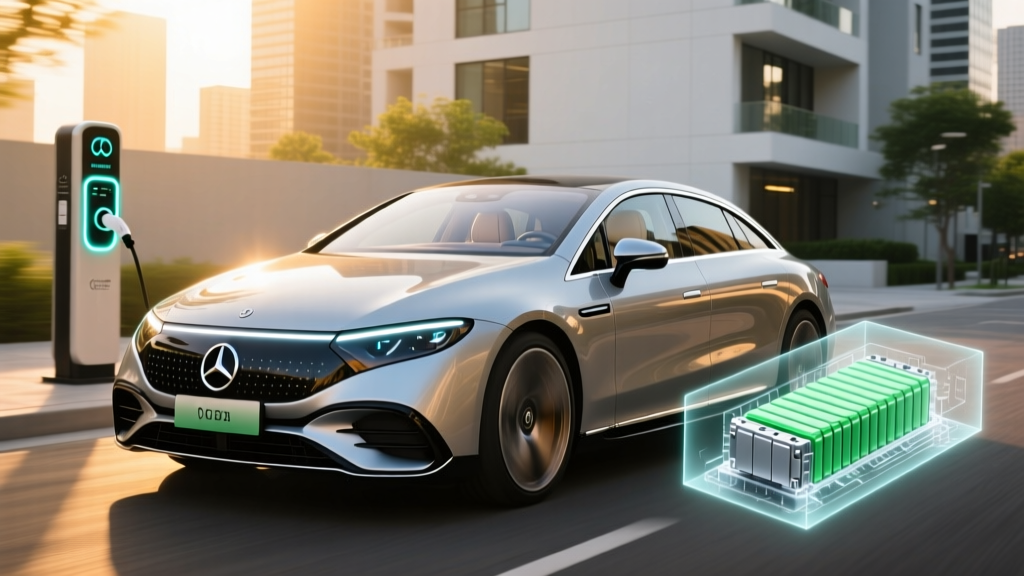
The 2026 EQS uses a 118 kWh usable (120 kWh gross) lithium-ion battery pack with NMC (nickel manganese cobalt) cell chemistry. NMC delivers higher energy density than LFP (lithium iron phosphate), which is essential for fitting this much capacity into a sedan floor while keeping weight manageable. The trade-off: NMC cells degrade slightly faster than LFP over thousands of charge cycles, and they carry a higher thermal runaway risk — though Mercedes's liquid thermal management system keeps cells in their optimal temperature window.
Mercedes-Benz backs the EQS battery with an 8-year/100,000-mile warranty that guarantees at least 70% state of health (SoH) retention. In practice, independent fleet data from comparable NMC packs suggests most owners will see roughly 8–12% degradation over the first 100,000 miles — meaning your 390-mile EQS 450+ might deliver 340–355 miles of EPA range at that milestone. Battery replacement cost, should it be needed out of warranty, is estimated at $25,000–$35,000 including labor, based on current Mercedes parts pricing.
Mercedes recommends charging to 80% for daily use and 100% only for long trips. The car's onboard navigation will automatically precondition the battery when you route to a DC fast charger — warming the cells to roughly 95°F to accept maximum charge rate.
Charging Speed: DC Fast Charging and Home Level 2
| Charge Level | Power / Voltage | Miles of Range per Hour | 10–80% Time |
|---|---|---|---|
| Level 1 (120V household) | ~1.4 kW | ~3–4 mi/hr | Not practical (60+ hrs) |
| Level 2 (240V home/public) | 9.6 kW (40A) / 11.5 kW (48A) | ~25–30 mi/hr | ~10–12 hrs (full charge) |
| DC Fast Charge (CCS/NACS*) | 200 kW peak | ~180 mi in 15 min | ~31 minutes (10–80%) |
*For 2026, Mercedes-Benz has transitioned new EQS vehicles to the NACS (Tesla-style) charge port in North America. CCS adapters are available for legacy Electrify America and third-party stations.
The EQS's 200 kW peak DC fast-charge rate is competitive but not class-leading — the Lucid Air peaks at roughly 250 kW, and the Porsche Taycan at 270 kW (on 800V architecture). The EQS runs on a 400V system, which limits peak power but simplifies the powertrain design.
Charging curve reality: The EQS holds near-peak power (180–200 kW) from roughly 10% to 40% SoC, then tapers progressively. From 60% to 80%, expect roughly 100–120 kW. That taper is why the 10–80% time stretches to 31 minutes rather than the theoretical ~22 minutes a sustained 200 kW would deliver. On a road trip, plan your stops around 25–35 minute sessions and you'll keep moving efficiently.
At home on a 48-amp Level 2 charger (like the ChargePoint Home Flex or Tesla Wall Connector with J1772/NACS adapter), the EQS adds roughly 30 miles of range per hour. A full overnight charge from 20% to 100% takes about 10 hours — easily manageable if you plug in when you arrive home.
Performance: 0–60 Times and Powertrain Options
| Trim | Horsepower | Torque (lb-ft) | 0–60 mph | Top Speed |
|---|---|---|---|---|
| EQS 450+ | 355 hp | 419 | 5.9 sec | 130 mph |
| EQS 450 4MATIC | 355 hp | 590 | 5.3 sec | 130 mph |
| EQS 580 4MATIC | 536 hp | 631 | 4.1 sec | 130 mph |
| AMG EQS | 649 hp (751 w/ Race Start) | 700 (752 w/ Race Start) | 3.4 sec | 155 mph |
The rear-wheel-drive EQS 450+ is the efficiency play — it's the lightest, longest-range variant, and its 355 hp is more than adequate for confident highway merging. The 580 4MATIC's 4.1-second 0–60 time puts it firmly in sports-sedan territory despite the weight. And the AMG variant, with its launch-control-enabled 751 hp, is brutally quick — though at the cost of roughly 75 miles of EPA range versus the 450+.
All trims feature adaptive air suspension as standard. The ride quality is genuinely excellent — the EQS absorbs highway expansion joints and potholes with the composure expected of a six-figure Mercedes. Rear-axle steering (standard on 580 and AMG, optional on 450 trims) shrinks the turning circle to 35.8 feet, making this large sedan surprisingly manageable in parking structures.
Interior, Cargo, and Technology
The EQS rides on a dedicated EV platform (not a converted gas car), which gives it a flat floor and generous interior volume. Passenger space includes 41.7 inches of front legroom and 38.5 inches of rear legroom — enough for adults to sit comfortably behind tall front occupants. The cabin seats five, though the rear middle position is best for short trips due to the center-console intrusion.
Cargo capacity: 22.0 cubic feet behind the rear seats (hatchback-style liftgate), expanding to 63.0 cubic feet with the rear seats folded. That hatchback design makes the EQS more practical than a traditional trunk sedan, though it still can't match an SUV-format EV like the EQS SUV or Tesla Model X for vertical cargo space.
The Hyperscreen: The EQS's signature interior feature is the optional MBUX Hyperscreen — a 56-inch curved glass panel spanning the full dashboard width, combining a 12.3-inch instrument cluster, 17.7-inch central OLED touchscreen, and 12.3-inch passenger display. It's visually striking and the OLED contrast is superb, though some drivers find the touch-capacitive climate controls less intuitive than physical buttons. The base 450+ comes with a more conventional 12.8-inch central screen.
Driver assistance: The EQS includes Mercedes's Driver Assistance Package with adaptive cruise control, lane-centering, automatic emergency braking, and evasive steering assist. This is a SAE Level 2 system — meaning you must keep hands on the wheel and eyes on the road at all times. It's not self-driving. Mercedes's Drive Pilot (Level 3 conditional automation, available in limited markets like Nevada and California) allows hands-off, eyes-off driving at speeds up to 40 mph on approved highways in heavy traffic — a genuine differentiator, but with extremely narrow operational boundaries.
Pricing, Trims, and Federal Tax Credit Eligibility
| Trim | Base MSRP | As-Tested (Typical) | §30D Credit Eligible? |
|---|---|---|---|
| EQS 450+ Sedan | $104,350 | $112,000–$118,000 | Exceeds MSRP cap* |
| EQS 450 4MATIC | $107,350 | $115,000–$122,000 | Exceeds MSRP cap* |
| EQS 580 4MATIC | $125,950 | $135,000–$148,000 | Exceeds MSRP cap* |
| AMG EQS Sedan | $149,550 | $158,000–$170,000 | Exceeds MSRP cap* |
*IRS §30D MSRP cap for sedans: $55,000. Under current IRS rules, new electric sedans must have an MSRP at or below $55,000 to qualify for the up-to-$7,500 federal clean vehicle credit. Every EQS trim exceeds this threshold substantially — meaning no 2026 EQS variant qualifies for the federal purchase tax credit.
Additionally, §30D imposes buyer income caps ($150,000 single / $300,000 joint AGI), critical mineral sourcing requirements, and battery component manufacturing rules that further restrict credit eligibility across the luxury EV market. Even if Mercedes restructured the EQS pricing (which it hasn't), the sedan MSRP cap alone disqualifies it.
Leasing loophole: Under the commercial clean vehicle credit (§45W), vehicles leased through a qualifying lessor may pass through a $7,500 credit as a capitalized cost reduction — regardless of MSRP caps or buyer income. Many Mercedes-Benz Financial Services leases include this benefit, but it's structured by the leasing company, not guaranteed. Ask your dealer specifically whether the lease includes the pass-through credit before signing.
There is no used-EV credit (§25E) pathway for a 2026 model year vehicle, as that credit applies only to vehicles at least two model years old with a sale price under $25,000.
Competitor Comparison: EQS vs. i7, Lucid Air, and Model S
| Spec | Mercedes EQS 450+ | BMW i7 xDrive60 | Lucid Air Pure | Tesla Model S LR |
|---|---|---|---|---|
| EPA Range | 390 mi | 318 mi | 419 mi | 402 mi |
| Base MSRP | $104,350 | $106,695 | $69,900 | $74,990 |
| Peak DC Charge | 200 kW | 195 kW | 250 kW | 250 kW |
| 0–60 mph | 5.9 sec | 4.5 sec | 6.2 sec | 3.1 sec |
| Cargo (cu ft) | 22.0 | 17.7 | 22.1 | 28.0 |
| Battery Warranty | 8 yr / 100k mi | 8 yr / 100k mi | 8 yr / 100k mi | 8 yr / 150k mi |
Choose the BMW i7 if: You want a more traditional luxury sedan feel with sharper handling dynamics, a more intuitive iDrive interface, and don't mind sacrificing ~70 miles of range for a more engaging drive.
Choose the Lucid Air if: You want the best range-per-dollar in the segment (419 mi at $69,900), a more compact exterior footprint, and don't need the Mercedes three-pointed star on the hood.
Choose the Tesla Model S if: You need Supercharger network access, the quickest acceleration, the longest battery warranty mileage (150k), and are comfortable with Tesla's minimalist interior and panel-gap variability.
Pros, Cons, and Who Should Buy
- Class-leading aerodynamic efficiency and EPA range (390 mi, 450+)
- Exceptionally quiet, compliant air-suspension ride quality
- Hyperscreen offers stunning visual impact and OLED clarity
- Hatchback cargo versatility (22 cu ft) rare in luxury sedans
- Drive Pilot Level 3 available in limited conditions (NV/CA)
- Rear-axle steering makes a large car feel manageable
- No federal §30D tax credit — MSRP far exceeds $55K sedan cap
- 200 kW DC peak is slower than Lucid Air and Tesla Model S
- Touch-capacitive controls and Hyperscreen learning curve
- Brake pedal feel is vague due to blended regen system
- Depreciation historically steep for six-figure Mercedes EVs
- AMG variant trades significant range for performance
Who this EV suits best: The 2026 EQS is ideal for luxury-sedan loyalists who cover long highway miles, value isolation and comfort over sportiness, and have reliable home Level 2 charging. It's a strong executive commuter and cross-state road-tripper. It's less ideal for buyers who want maximum charging speed, federal tax credit eligibility, or the sharpest handling dynamics — those buyers should cross-shop the Lucid Air, Tesla Model S, or BMW i7 respectively.
Frequently Asked Questions
What is the real-world range of the 2026 Mercedes-Benz EQS?
The EPA rates the EQS 450+ at 390 miles, but real-world highway driving at 75 mph in moderate temperatures yields approximately 320–340 miles. In cold weather (below 30°F), expect 260–290 miles. The AWD 450 4MATIC and 580 trims deliver 10–15% less in all conditions. The AMG variant sees roughly 250–270 miles on the highway.
How fast does the EQS charge at home and on the road?
On DC fast charging, the EQS peaks at 200 kW and charges from 10–80% in approximately 31 minutes — adding roughly 180 miles of range in 15 minutes under ideal conditions. At home on a 48-amp Level 2 charger (11.5 kW), expect about 30 miles of range per hour, or a full overnight charge in roughly 10 hours. The EQS uses the NACS connector for 2026 in North America.
Does the 2026 EQS qualify for the $7,500 federal EV tax credit?
No. Under IRS §30D rules, new electric sedans must have an MSRP at or below $55,000 to qualify. Every 2026 EQS trim starts above $104,000, far exceeding the cap. However, leasing through Mercedes-Benz Financial Services may pass through a $7,500 credit via the commercial vehicle credit (§45W) as a capitalized cost reduction — confirm with your dealer before signing.
Is the EQS worth buying versus the BMW i7 or Lucid Air?
The EQS wins on ride comfort, cabin quietness, and aerodynamic efficiency. The BMW i7 is more engaging to drive and has a more intuitive infotainment system, but 72 fewer miles of EPA range. The Lucid Air Pure offers more range (419 mi) at a significantly lower price ($69,900), though with a smaller dealer/service network. Your choice depends on whether you prioritize comfort (EQS), driving dynamics (i7), or value/range (Air).
What is the EQS battery warranty and expected degradation?
Mercedes-Benz covers the EQS battery for 8 years or 100,000 miles, whichever comes first, guaranteeing at least 70% state of health. Real-world NMC pack data suggests 8–12% degradation over 100,000 miles is typical. Out-of-warranty battery replacement is estimated at $25,000–$35,000. Following the 80% daily charge limit recommendation will help maximize longevity.
How much cargo and passenger space does the EQS offer?
The EQS provides 22.0 cubic feet of cargo space behind the rear seats (hatchback style) and 63.0 cubic feet with seats folded. Front legroom is 41.7 inches; rear legroom is 38.5 inches. It seats five, though the rear center seat is best for shorter trips.
Sources: EPA fueleconomy.gov, Mercedes-Benz USA, IRS §30D Clean Vehicle Credit. Pricing and specifications reflect 2026 model year data available at time of publication. Tax credit rules are subject to change; consult a tax professional for personal eligibility.