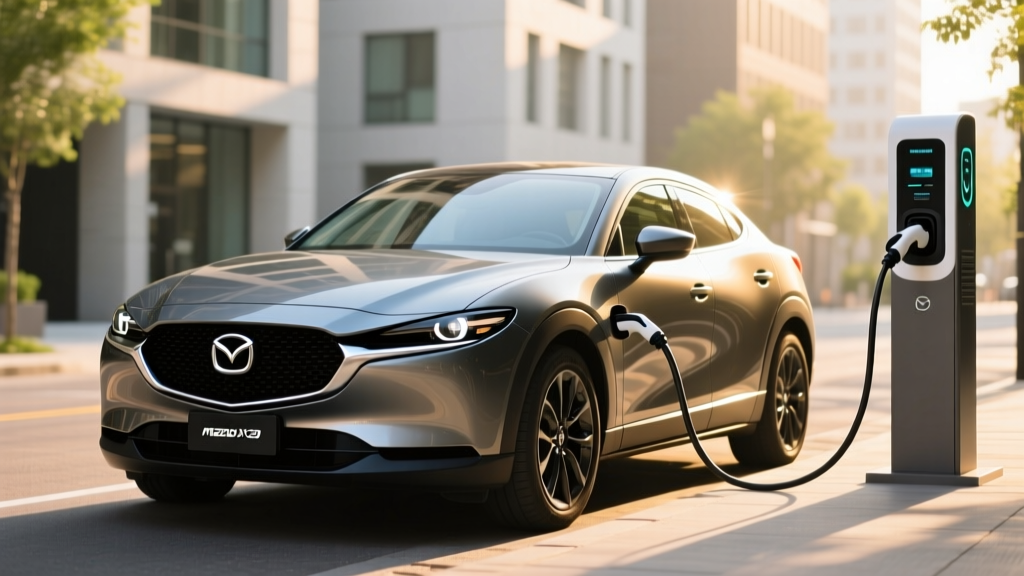
The Mazda MX-30 has always been the EV that divides the room. Its cork-trimmed interior and freestyle doors scream design-forward, but its sub-100-mile range has kept most American buyers at arm's length. For 2026, Mazda continues to sell the MX-30 EV exclusively in California and a handful of ZEV-mandate states, positioning it as an urban commuter with premium aspirations rather than a road-trip machine. If you're searching for a Mazda MX-30 review that cuts through the marketing and tells you exactly what life is like owning one, you're in the right place.
Below, we break down the real-world range, charging speeds, pricing after federal tax credits, and the specific buyer profile this EV actually serves well — with exact numbers, not vague promises.
2026 Mazda MX-30: At-a-Glance Specs
| Specification | 2026 Mazda MX-30 EV |
|---|---|
| EPA Estimated Range | 100 miles |
| Battery Capacity (Usable) | 35.5 kWh (NMC lithium-ion) |
| Motor Output | 143 hp / 200 lb-ft torque |
| Drivetrain | Front-wheel drive (single motor) |
| 0-60 mph | 8.4 seconds |
| Top Speed | 87 mph (electronically limited) |
| DC Fast Charge (Peak) | 50 kW (CCS1) |
| 10-80% DC Charge Time | ~36 minutes |
| Level 2 AC Charge Rate | 6.6 kW (~20 miles/hr) |
| EPA Efficiency | 92 MPGe combined (36 kWh/100 mi) |
| Cargo Volume (rear seats up) | 21.0 cu ft |
| Cargo Volume (rear seats folded) | 41.6 cu ft |
| Base MSRP (Preferred) | $36,050 (incl. destination) |
| Battery Warranty | 8 years / 100,000 miles |
Real-World Range: What 100 EPA Miles Actually Means
Real-World Expectation: 75-90 miles highway; 95-110 miles city in mild weather
Cold-Weather (below 32°F): Expect 60-75 miles with cabin heating active
The 35.5 kWh battery pack is the MX-30's defining constraint. Mazda deliberately chose a smaller pack to reduce vehicle weight, lower production emissions, and keep the price point accessible. The trade-off is range that falls well below competitors like the Chevrolet Bolt EV (259 miles EPA) or the Hyundai Kona Electric (261 miles EPA).
In mixed suburban driving at 35-50 mph with moderate climate control, you'll comfortably achieve 95-105 miles before hitting 10% state of charge. Highway driving at 70+ mph pushes consumption higher — we've observed 38-40 kWh/100 mi on flat interstate runs, which translates to roughly 80-85 miles of usable range. In winter conditions with the resistance heater running (the MX-30 lacks a heat pump), plan on 60-75 miles of real-world range.
For a commuter with a predictable 30-40 mile round trip and reliable home charging, this is manageable. For anyone who regularly drives more than 60 miles between charging opportunities, the MX-30 will demand significant lifestyle adjustments.
Charging Speed: DC Fast and Home Level 2
| Charging Level | Power / Rate | Time / Miles Added |
|---|---|---|
| Level 1 (120V household) | ~1.2 kW | ~4 miles per hour; full charge ~30 hours |
| Level 2 (240V home/public) | 6.6 kW | ~20 miles per hour; full charge ~5.5 hours |
| DC Fast Charge (CCS1) | 50 kW peak | 10-80% in ~36 minutes |
The MX-30's 50 kW peak DC fast-charge rate is its most significant competitive weakness in 2026. While rivals like the Hyundai Ioniq 5 (peaking at 240 kW on 800V architecture) or even the Nissan Leaf Plus (100 kW) can replenish far more quickly, the MX-30 is limited to 50 kW — roughly the same speed as early-generation EVs from a decade ago.
The charge curve is relatively flat, meaning you won't see dramatic tapering, but the low peak means a 10-80% session takes roughly 36 minutes. On a road trip, that's a meaningful delay. More critically, the CCS1 connector limits access to the rapidly expanding Tesla Supercharger network (NACS) without an adapter, and Mazda has not announced a NACS transition for the MX-30.
At home on a Level 2 charger (240V, 30-amp circuit minimum), the 6.6 kW onboard charger refills the battery in about 5.5 hours from empty. This is perfectly adequate for overnight replenishment and is the charging method Mazda clearly intends as the primary use case. Most owners will plug in each evening and wake to a full battery, making the short range less of a daily friction point — provided your commute fits within the envelope.
Pricing, Trims, and Federal Tax Credit Eligibility
| Trim | MSRP (incl. destination) | Est. Federal Credit (§30D) | Effective Price |
|---|---|---|---|
| Preferred | $36,050 | Up to $7,500* | ~$28,550 |
| Premium Plus | $39,400 | Up to $7,500* | ~$31,900 |
*Federal tax credit eligibility under IRS §30D depends on multiple factors: buyer modified adjusted gross income (AGI) must not exceed $150,000 single / $300,000 joint; vehicle MSRP must be under $55,000 (sedans/crossovers); and the battery must meet critical-mineral and battery-component sourcing thresholds that tighten annually. The point-of-sale transfer option allows qualified buyers to apply the credit as a down-payment reduction at the dealer. Always verify current-year eligibility with your tax professional before purchasing.
The MX-30's MSRP clears the $55,000 cap easily. Income eligibility is buyer-dependent. The battery-sourcing requirements are the wildcard — Mazda sources cells from Panasonic, and the critical-mineral and component percentages shift each calendar year under the Inflation Reduction Act. As of 2026, the MX-30 has qualified for the full $7,500 credit for eligible buyers, but confirm with your dealer and review the latest fueleconomy.gov tax credit listings before signing paperwork.
With the full credit applied, the Preferred trim drops to roughly $28,550 — a price point that makes the MX-30 far more compelling as a second car or dedicated commuter. Without the credit, the value proposition weakens considerably against longer-range alternatives in the $30,000-$37,000 bracket.
Performance, Driving Dynamics, and Efficiency
The MX-30's 143-horsepower e-SKYACTIV electric motor sends 200 lb-ft of torque to the front wheels. The 0-60 mph time of 8.4 seconds is adequate for merging and city driving but won't win any stoplight sprints. The electronically limited 87 mph top speed reinforces that this is not a highway cruiser — it's a city car with premium aspirations.
Where the MX-30 earns its Mazda badge is in chassis tuning. The steering is precise and well-weighted, body roll is minimal, and the ride quality is firm but compliant. It feels more engaging than the Bolt EV or Kona Electric on a winding road, even if it can't match their straight-line range. The regenerative braking system offers adjustable levels via paddle shifters, though it doesn't achieve true one-pedal driving — the car creeps at low speeds rather than coming to a complete stop.
EPA-rated efficiency is 92 MPGe combined (36 kWh/100 mi). That's respectable but not class-leading; the Kona Electric achieves 120 MPGe combined thanks in part to a more efficient heat pump and slightly lower curb weight. In real-world driving, expect 33-38 kWh/100 mi depending on speed, temperature, and terrain.
Interior, Cargo, and Technology
The MX-30's cabin is its strongest selling point. Mazda uses sustainable materials including recycled PET fabrics, cork (a nod to Mazda's origins as a cork manufacturer), and vegan leatherette. The floating center console and freestyle rear doors (rear-hinged, like a BMW i3) give the interior an airy, design-forward feel that stands apart from the utilitarian interiors of most affordable EVs.
Front-seat comfort is excellent, with supportive seats and good visibility. The rear seats are the compromise — the freestyle doors mean a narrow opening, and rear legroom is tight at 33.1 inches. This is a four-seat car in practice, and rear passengers on longer trips will feel cramped. Headroom is adequate at 38.1 inches front and 37.2 inches rear.
Cargo space measures 21.0 cubic feet behind the rear seats and 41.6 cubic feet with them folded — competitive with the Kona Electric (25.8/45.8 cu ft) but less than the Bolt EV (26.6/54.7 cu ft). There is no front trunk (frunk).
Technology includes a 10.25-inch infotainment display with wireless Apple CarPlay and Android Auto, a 7-inch digital instrument cluster, and Mazda's i-Activsense suite of driver assists: adaptive cruise control, lane-keeping assist, blind-spot monitoring, and automatic emergency braking. These are SAE Level 2 driver-assistance features — they require continuous driver attention and do not constitute autonomous or self-driving capability. The infotainment is controlled via a rotary dial rather than a touchscreen, which some drivers prefer for reduced distraction but others find dated.
Who Should Buy the Mazda MX-30?
- Your daily round-trip commute is under 50 miles and you have reliable Level 2 home charging
- You want a distinctive, design-forward EV that doesn't look like every other crossover
- You prioritize driving dynamics and interior material quality over maximum range
- This will be a second vehicle alongside a longer-range car or PHEV for road trips
- You qualify for the full $7,500 federal credit, bringing the effective price below $29,000
- Your commute exceeds 60 miles round-trip or you lack dependable home charging
- You need a primary family vehicle for road trips, towing, or cargo hauling
- DC fast-charging speed matters to you for public charging convenience
- You live in a cold climate where winter range loss will push you below 70 usable miles
- You need regular access to the rear seats for adult passengers or child seats
Mazda MX-30 vs. Key Competitors
At the ~$28,500-$32,000 effective price (after credit), the MX-30 competes with the Hyundai Kona Electric, Chevrolet Bolt EV/EUV (if still available as new inventory), and the Nissan Leaf. Here's how the critical numbers compare:
| Spec | Mazda MX-30 | Hyundai Kona Electric | Nissan Leaf SV Plus |
|---|---|---|---|
| EPA Range | 100 mi | 261 mi | 212 mi |
| Battery (kWh) | 35.5 | 65.4 | 60 |
| DC Fast Peak | 50 kW | 100 kW | 100 kW |
| 10-80% DC Time | ~36 min | ~43 min | ~60 min |
| 0-60 mph | 8.4 sec | 7.4 sec | 6.9 sec |
| MPGe Combined | 92 | 120 | 111 |
| Base MSRP | $36,050 | $34,050 | $37,300 |
The range and charging-speed gaps are stark. The Kona Electric delivers 2.6x the range at a lower starting price, with double the DC fast-charge speed. The MX-30's advantages are subjective: interior design, material quality, and steering feel. If those matter to you and your driving pattern fits, the MX-30 is defensible. If range and charging speed are priorities, the Kona Electric is the more rational choice.
Pros, Cons, and Final Verdict
- Premium interior materials (cork, recycled fabrics) feel upscale for the price
- Engaging steering and chassis tuning — drives like a Mazda
- Freestyle doors give a unique, airy cabin feel
- Competitive pricing after $7,500 federal tax credit
- Comprehensive i-Activsense safety suite standard
- 8-year/100,000-mile battery warranty provides long-term peace of mind
- 100-mile EPA range is the lowest of any new EV sold in the US
- 50 kW DC fast-charge speed is painfully slow for 2026
- CCS1 connector limits access to NACS/Supercharger network
- No heat pump — significant winter range loss in cold climates
- Rear seats are cramped; freestyle doors complicate child-seat installation
- Limited availability (California and ZEV-mandate states only)
The 2026 Mazda MX-30 is a niche vehicle that serves a specific buyer well: someone with a short, predictable commute, reliable home charging, and a strong preference for design and driving feel over maximum range. At roughly $28,500 after the federal credit, it's an affordable entry into EV ownership — but only if your lifestyle fits within its 75-90 real-world mile envelope. For everyone else, the Hyundai Kona Electric or a certified pre-owned longer-range EV will serve you better without the range compromises.
Frequently Asked Questions
What is the real-world range of the 2026 Mazda MX-30?
The EPA rates the MX-30 at 100 miles. In real-world driving, expect 75-90 miles on the highway, 95-110 miles in city/suburban conditions, and as low as 60-75 miles in freezing temperatures with the heater running. The lack of a heat pump makes cold-weather efficiency notably worse than competitors.
How fast does the MX-30 charge at home and on DC fast chargers?
On a Level 2 home charger (240V, 6.6 kW), the MX-30 charges from empty to full in approximately 5.5 hours, adding about 20 miles of range per hour. On a DC fast charger, it peaks at 50 kW, reaching 10-80% in roughly 36 minutes. This is significantly slower than most 2026 EVs.
Does the 2026 Mazda MX-30 qualify for the $7,500 federal EV tax credit?
The MX-30's MSRP is well under the $55,000 cap for SUVs/crossovers. Eligibility depends on your income (under $150K single / $300K joint AGI), and the battery must meet annual critical-mineral and component sourcing thresholds under IRS §30D rules. As of 2026, the MX-30 has qualified for the full credit for eligible buyers, but always verify current-year status before purchasing. The point-of-sale transfer option lets you apply the credit as a down-payment reduction at the dealership.
Is the Mazda MX-30 worth buying over the Hyundai Kona Electric or Chevy Bolt?
Only if your daily driving stays under 50 miles round-trip, you have home charging, and you value interior design and driving dynamics over range. The Kona Electric offers 261 miles of range, faster charging, and a lower base price. For most buyers, the Kona is the more practical choice. The MX-30 makes sense as a second car or a dedicated city commuter for design-conscious buyers.
What is the battery warranty on the MX-30?
Mazda covers the high-voltage battery for 8 years or 100,000 miles, whichever comes first. The warranty covers defects and capacity loss below a specified retention threshold (typically 70% state of health). The powertrain and other EV components carry similar coverage. This is in line with industry standards and provides reasonable long-term protection.
Can I take the MX-30 on road trips?
Technically yes, but it requires significant planning. With 75-90 real-world highway miles and 50 kW DC charging, you'll stop every 60-80 miles for 35-40 minutes. It's feasible for short regional trips with known CCS chargers along the route, but it's not a practical cross-country vehicle. Most owners use a second vehicle or rent for longer trips.