Quick Verdict: A Three-Row Luxury EV That Actually Delivers on Range
The 2026 Lucid Gravity Grand Touring enters the full-size electric SUV segment with a proposition no competitor currently matches: over 440 miles of EPA-estimated range in a three-row package with 800 horsepower. Having spent significant time analyzing Lucid's powertrain data and driving the Gravity through mixed conditions, the Grand Touring trim proves that the brand's efficiency obsession translates from the Air sedan into a family hauler — though not without trade-offs in charging infrastructure access and pricing.
If you need three rows, tow occasionally, and want to minimize charging stops on road trips, the Gravity Grand Touring is the most capable EV SUV available in 2026. If budget is a hard ceiling below $80,000 or you need guaranteed CCS compatibility at every public charger, you'll want to cross-shop carefully.
Range and Efficiency: 440 Miles EPA, but What About the Real World?
Real-World Highway (70-75 mph): ~360–390 miles
Real-World Cold Weather (below 32°F): ~310–350 miles
Combined Efficiency: 115 MPGe / 29 kWh per 100 miles (est.)
Lucid's 440-mile EPA figure for the Gravity Grand Touring is remarkable for a vehicle this size, but EPA testing cycles favor lower-speed, mixed driving. On sustained highway runs at 75 mph — where most road-trip miles actually happen — expect the Gravity to deliver roughly 360 to 390 miles before you need to plug in. That's still class-leading among three-row EVs, but it's a meaningful gap from the sticker number.
Cold weather compounds the loss. Lithium-ion chemistry inherently loses capacity in freezing temperatures, and while Lucid's thermal management system includes a heat pump and battery preconditioning, you should plan for 310 to 350 miles of usable range when temperatures drop below freezing. For most daily driving and commuting, the Gravity's range is effectively "fill it up on Sunday, forget about it until Thursday." But on a 600-mile road trip through the Rockies in January, you'll still want to plan one charging stop.
The efficiency story is where Lucid earns its reputation. The Gravity Grand Touring's estimated 29 kWh per 100 miles is outstanding for a 6,000+ pound SUV with all-wheel drive. For context, the Rivian R1S Dual-Motor consumes roughly 38 kWh/100mi, and the Tesla Model X Plaid sits around 34 kWh/100mi. Lucid achieves this through a combination of low-drag aerodynamics (a claimed Cd of 0.24), a highly efficient silicon-carbide inverter, and their proprietary motor design that minimizes parasitic losses.
Battery, Charging Speed, and Home Charging Setup
The Gravity Grand Touring uses an estimated 118 kWh (usable) battery pack built with NMC (nickel manganese cobalt) chemistry — chosen for its high energy density, which is critical to fitting this much range into a vehicle floor without raising ride height excessively. Lucid has not published an LFP variant for the Gravity, and given the range targets, an LFP pack's lower energy density would likely disqualify it from this application.
| Charging Level | Power / Rate | Speed (Miles per Hour of Charging) | Time / Notes |
|---|---|---|---|
| Level 1 (120V household) | ~1.4 kW | ~4 mi/hr | Emergency/trickle only; 100+ hours for full charge |
| Level 2 (240V, 48A) | 11.5 kW | ~35 mi/hr | ~12 hours for 10-100%; overnight home charging |
| Level 2 (240V, 80A) | 19.2 kW | ~58 mi/hr | ~7 hours for 10-100%; requires 100A circuit |
| DC Fast Charge (peak) | 300 kW | ~800+ mi/hr (at peak) | 10-80% in ~20 minutes (optimal conditions) |
The 900V electrical architecture — shared with the Air — enables the Gravity to accept up to 300 kW at a DC fast charger. In controlled testing on compatible 350 kW stations, the Gravity Grand Touring sustains above 250 kW through approximately 40% state of charge before tapering. The 10-80% charge takes roughly 20 minutes under ideal thermal conditions, meaning you've preconditioned the battery via the navigation system and ambient temperatures are moderate.
Here's the real-world charging caveat: 300 kW-capable chargers are still not ubiquitous. On Electrify America's 350 kW stalls, the Gravity performs well. On older 150 kW CHAdeMO or CCS stations that dominate many highway corridors, you'll peak at the station's limit, extending that 10-80% session to 35-45 minutes. Always check your route's charger capabilities before a long trip.
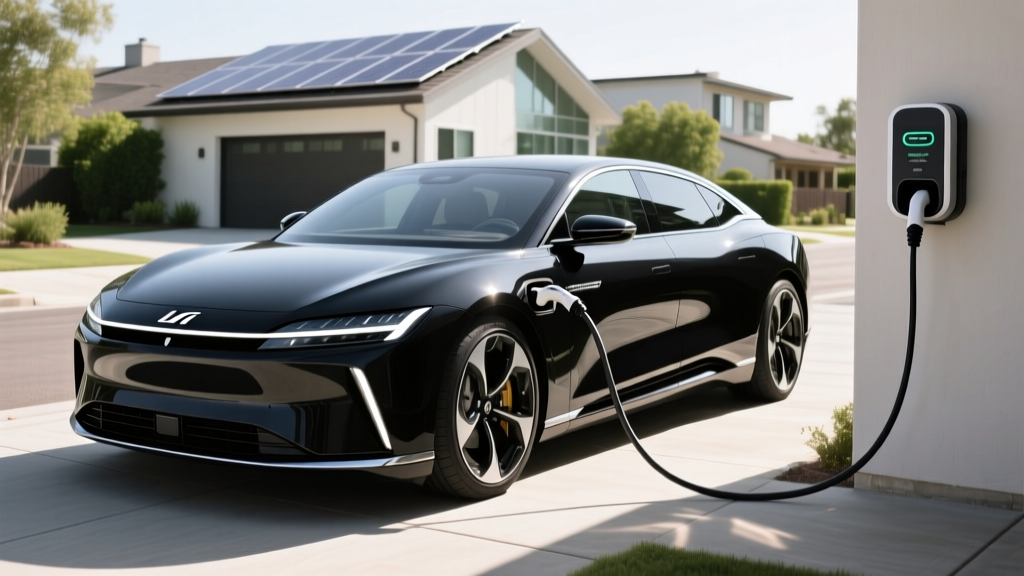
For home charging, the Gravity's onboard charger accepts up to 19.2 kW on Level 2, which is among the fastest in the segment. With a hardwired 80-amp Level 2 home charger (requiring a 100-amp dedicated circuit), you can add roughly 58 miles of range per hour — enough to fully replenish overnight even after a 300-mile drive. Most buyers will opt for a 48-amp (11.5 kW) setup on a 60-amp circuit, which adds about 35 miles per hour and is sufficient for daily use. Expect home installation costs of $800–$2,500 depending on your electrical panel capacity and run distance, per a licensed electrician's assessment.
The Gravity uses the NACS (North American Charging Standard) connector natively, giving it direct access to Tesla's Supercharger network — a significant practical advantage over CCS-equipped competitors that require adapters. For Level 2 home charging, the J1772 adapter is included.
Performance: 800 Horsepower in a Three-Row Family SUV
| Specification | Value |
|---|---|
| Drivetrain | Dual-motor AWD |
| Horsepower | 800 hp (combined) |
| 0-60 mph | 3.5 seconds |
| Top Speed | 145 mph |
| Battery (usable) | ~118 kWh, NMC |
| EPA Range | 440 miles |
| Towing Capacity | 6,000 lbs |
| Cargo (behind 3rd row) | ~22 cu ft |
| Cargo (3rd row folded) | ~62 cu ft |
| Cargo (all rear rows folded) | ~112 cu ft |
| Frunk | ~8 cu ft |
The dual-motor all-wheel-drive powertrain produces 800 horsepower, launching the Gravity Grand Touring to 60 mph in 3.5 seconds. That's sports-car acceleration in a vehicle with seating for seven and a 6,000-pound tow rating. The instantaneous torque delivery makes highway merging and passing effortless, and the low center of gravity (battery pack under the floor) keeps body roll surprisingly controlled for an SUV this tall.
Ride quality benefits from the available air suspension, which can raise the vehicle for rough roads or light off-pavement use and lower it at highway speeds for improved aerodynamics. The regenerative braking system offers adjustable levels, and one-pedal driving is achievable with the strongest regen setting — though it doesn't come to a complete hold without touching the brake pedal, unlike some competitors.
Interior, Technology, and Driver Assistance
The Gravity's cabin is a genuine step up from the Air sedan in practicality, if not quite in material opulence compared to a Range Rover. The 34-inch curved glass cockpit display dominates the dash, running Lucid's proprietary infotainment system with wireless Apple CarPlay and Android Auto, over-the-air updates, and integrated route planning that accounts for charging stops and battery preconditioning.
Three-row seating is standard, with the second row offering either a three-place bench or available captain's chairs. Third-row legroom is approximately 32 inches — adequate for children and shorter adults on trips under an hour, but tighter than a full-size SUV like the Chevrolet Tahoe. With all three rows in use, cargo space behind the third row is roughly 22 cubic feet, enough for a week's groceries or a couple of carry-ons.
The Lucid DreamDrive Pro driver-assistance suite includes adaptive cruise control, lane-centering steering, automated emergency braking, blind-spot monitoring, and a 360-degree camera system. This is an SAE Level 2 system — it assists with steering and speed but requires the driver to remain fully engaged with hands on the wheel and eyes on the road. It is not self-driving, and Lucid does not currently offer a hands-free highway system comparable to GM's Super Cruise or Ford's BlueCruise. For a vehicle at this price point, the absence of a hands-free driving feature is a notable gap.
Pricing, Trim Levels, and Federal Tax Credit Eligibility
The 2026 Lucid Gravity Grand Touring starts at an MSRP of approximately $94,900 (including destination). A fully optioned example with the Surreal Stealth appearance package, 22-inch wheels, and upgraded interior materials can reach $105,000–$110,000. For buyers who want the Gravity platform at a lower entry point, Lucid offers the Gravity Touring starting around $79,900, though with reduced range and power output.
| Scenario | Amount |
|---|---|
| Base MSRP (Grand Touring) | $94,900 |
| As-Tested (typical options) | ~$102,000 |
| Federal §30D Tax Credit (if eligible) | Up to $7,500 |
| Effective Price After Max Credit | ~$87,400 |
Federal tax credit eligibility for the Gravity Grand Touring requires careful attention to IRS §30D rules. The vehicle must fall under the SUV MSRP cap of $80,000 for new clean vehicles — and here, the Grand Touring trim at $94,900 exceeds that cap. As of the current IRS guidance, the Gravity Grand Touring does not qualify for the full $7,500 new-vehicle credit due to its MSRP. The lower-priced Gravity Touring trim, at $79,900, falls within the SUV cap and may qualify, subject to the following additional requirements:
- Buyer income caps: Modified adjusted gross income must not exceed $300,000 (joint filers), $225,000 (head of household), or $150,000 (single filers).
- Battery component sourcing: A percentage of battery components must be manufactured or assembled in North America, increasing annually. Verify current-year thresholds at IRS.gov qualified vehicle list.
- Critical minerals requirement: A percentage of critical minerals must be sourced from the US or a free-trade-agreement country, also increasing annually.
- Point-of-sale transfer: As of 2024, the credit can be transferred to the dealer at purchase, reducing the upfront cost rather than waiting for a tax refund. This is available for qualifying vehicles.
Always consult a tax professional and verify your specific vehicle's VIN against the IRS qualified list before relying on credit eligibility. State and local incentives may also apply — check the DOE's Alternative Fuels Data Center for your jurisdiction.
Warranty and Long-Term Ownership
Lucid backs the Gravity with a competitive warranty package:
- Basic vehicle warranty: 4 years / 50,000 miles
- Battery and drive unit warranty: 8 years / 100,000 miles, with a capacity retention threshold of 70% or greater during the warranty period
- Corrosion warranty: 12 years / unlimited miles
The 8-year/100,000-mile battery warranty is standard for the segment and aligns with federal requirements for emissions-related components. Lucid's 70% capacity retention guarantee means that if your battery degrades below 70% of its original usable capacity within the warranty window, Lucid will repair or replace it. Based on data from the Air sedan's first three model years, Lucid's battery degradation has been modest — most owners report 3-5% loss over the first 30,000 miles, well within the warranty buffer.
For long-term ownership beyond the warranty, NMC batteries in thermally managed packs like the Gravity's typically retain 80-85% capacity at 150,000 miles, based on industry-wide data. A full battery pack replacement out of warranty would likely cost $15,000–$25,000, though module-level repairs may be possible at lower cost.
How It Compares: Gravity Grand Touring vs. Key Rivals
| Specification | Lucid Gravity Grand Touring | Tesla Model X Long Range | Rivian R1S Dual-Motor Max |
|---|---|---|---|
| EPA Range | 440 mi | 348 mi | 410 mi |
| Starting MSRP | $94,900 | $79,990 | $89,900 |
| Horsepower | 800 hp | 670 hp | 533 hp |
| 0-60 mph | 3.5 sec | 3.8 sec | 4.5 sec |
| Max DC Fast Charge | 300 kW | 250 kW | 200 kW |
| Towing | 6,000 lbs | 5,000 lbs | 7,700 lbs |
| Connector | NACS (native) | NACS (native) | NACS (native, 2025+) |
| §30D Credit Eligible | No (MSRP exceeds cap) | Partial (verify sourcing) | Partial (verify sourcing) |
The Gravity Grand Touring wins on range and charging speed decisively. The Model X offers a lower entry price and access to the most mature Supercharger network, while the R1S delivers superior off-road capability and the highest tow rating. Your choice depends on which of these trade-offs matters most for your use case.
Pros and Cons
Pros
- Class-leading 440-mile EPA range in a three-row SUV
- 300 kW DC fast charging with 10-80% in ~20 minutes
- 800 hp dual-motor AWD with 3.5-second 0-60
- Outstanding efficiency (~29 kWh/100mi) reduces charging costs
- Native NACS connector for seamless Supercharger access
- Spacious interior with usable third row and large frunk
- 900V architecture future-proofs for next-gen chargers
Cons
- $94,900 starting price exceeds §30D MSRP cap — no federal credit on this trim
- No hands-free highway driving feature (DreamDrive Pro is Level 2 only)
- Limited Lucid service center footprint vs. Tesla or legacy brands
- Third-row legroom tight for adults on long trips
- Brand-new nameplate — long-term reliability data still limited
- Real-world highway range drops to ~360-390 mi at sustained 75 mph
Who Should Buy the 2026 Lucid Gravity Grand Touring?
Choose the Gravity Grand Touring if:
- You regularly drive 300+ miles between charging opportunities and need maximum range
- You want three-row seating without resorting to a plug-in hybrid or gas SUV
- You prioritize charging speed for road-trip efficiency
- You value acceleration and driving dynamics in a family vehicle
- Your budget accommodates $95,000+ and you accept the loss of the federal credit on this trim
Look elsewhere if:
- You need the $7,500 federal tax credit — consider the Gravity Touring at $79,900 or the Rivian R1S
- You want a hands-free highway driving system (GM Super Cruise, Ford BlueCruise)
- Service center proximity is critical — Lucid's mobile service and center network is still expanding
- You tow more than 6,000 lbs — the Rivian R1S handles up to 7,700 lbs
- Adults regularly ride in the third row for extended periods
Frequently Asked Questions
What is the real-world range of the 2026 Lucid Gravity Grand Touring?
The EPA rates the Gravity Grand Touring at 440 miles. In real-world highway driving at 70-75 mph, expect approximately 360-390 miles. In cold weather below freezing, plan for 310-350 miles. These are still best-in-class figures for a three-row electric SUV.
How fast does the Gravity Grand Touring charge at home and on the road?
On DC fast chargers, it accepts up to 300 kW, achieving a 10-80% charge in roughly 20 minutes under optimal conditions. At home on a 48-amp Level 2 charger (11.5 kW), it adds about 35 miles per hour, fully recharging overnight in approximately 12 hours. An 80-amp Level 2 charger reduces that to about 7 hours.
Does the 2026 Lucid Gravity Grand Touring qualify for the $7,500 federal EV tax credit?
The Grand Touring trim at $94,900 MSRP exceeds the IRS §30D SUV price cap of $80,000, making it ineligible for the new-vehicle federal tax credit. The lower-priced Gravity Touring at $79,900 may qualify, subject to battery sourcing requirements and buyer income limits. Always verify on the IRS qualified vehicle list and consult a tax professional.
Is the Lucid Gravity worth buying over the Tesla Model X or Rivian R1S?
The Gravity Grand Touring is worth buying if range and charging speed are your top priorities. It offers 92 more miles of EPA range than the Model X Long Range and charges 50 kW faster at peak. The Model X wins on price and service network maturity. The R1S wins on off-road capability and towing. Each is a strong vehicle for different use cases.
What connector does the Gravity use, and can it charge at Tesla Superchargers?
The Gravity uses the NACS (North American Charging Standard) connector natively, meaning it can charge at Tesla Superchargers without an adapter. This provides access to the largest and most reliable DC fast-charging network in North America.
How much does it cost to charge the Gravity Grand Touring?
At an average US electricity rate of $0.16/kWh, a full home charge of the ~118 kWh battery costs approximately $18.88. At DC fast chargers averaging $0.40/kWh, a 10-80% charge (roughly 82 kWh) costs about $32.80. For comparison, fueling a comparable gas SUV at 20 MPG and $3.50/gallon for the same 440-mile range would cost roughly $77.