Is the 2026 Lexus RZ EV Worth Buying?
The 2026 Lexus RZ 450e delivers an EPA-estimated 220 miles of range (RZ 450e Premium AWD) or up to 266 miles (RZ 300e FWD), with DC fast charging peaking at 150 kW and a 10–80% time of approximately 30 minutes. Starting at roughly $55,000 (RZ 450e) and $44,000 (RZ 300e), it occupies the luxury compact EV SUV segment. The RZ is best suited for buyers who prioritize Lexus-grade refinement, a quiet cabin, and strong build quality over maximum range or cutting-edge charging speeds. If you regularly drive more than 250 highway miles between charges or live in a region with sparse DC fast-charging infrastructure, the RZ's range and 150 kW peak charge rate may feel limiting compared to rivals like the Genesis GV60 or Hyundai Ioniq 5.
2026 Lexus RZ EV: Core Specs at a Glance
| Specification | RZ 300e (FWD) | RZ 450e (AWD) |
|---|---|---|
| EPA Range | 266 mi | 220 mi (Premium) / 196 mi (Luxury w/ 20" wheels) |
| Battery (usable) | 71.4 kWh, NMC lithium-ion | |
| Horsepower | 201 hp | 308 hp |
| 0–60 mph | ~7.8 sec | ~5.0 sec |
| Peak DC Fast Charge | 150 kW | |
| 10–80% DC Charge Time | ~30 minutes | |
| Level 2 Charge Rate | ~11 kW (approx. 7.5 hrs 0–100%) | |
| Connector | CCS1 (NACS adapter available for Tesla Supercharger access) | |
| Efficiency (MPGe combined) | ~120 MPGe | ~102 MPGe |
| Starting MSRP (est.) | $44,000 | $55,000 |
| Battery/Powertrain Warranty | 8 years / 100,000 miles | |
Real-World Range vs. EPA Sticker
The EPA numbers above assume moderate temperatures and mixed driving. In real-world conditions, expect the following:
- Highway driving at 75 mph: Plan for roughly 180–200 miles (RZ 450e) or 220–240 miles (RZ 300e) before needing a charge.
- Cold weather (below 32°F): Expect a 15–25% range reduction. The RZ 450e may deliver as little as 165 miles in freezing conditions. The RZ uses a resistive PTC heater rather than a heat pump, which draws more energy from the battery in winter — a meaningful disadvantage compared to Hyundai/Kia EVs equipped with heat pumps.
- DC fast-charging taper: The 150 kW peak rate holds only briefly between roughly 10–40% State of Charge (SoC). Above 60%, charging slows considerably, which is why the 10–80% time stretches to ~30 minutes. If you frequently road-trip, this taper adds real time at charging stops versus competitors peaking at 230–350 kW.
Lexus RZ EV vs. Gas Lexus RX: The Cost Comparison
Many RZ shoppers cross-shop the gasoline Lexus RX 350, so the comparison matters. Here's how a 5-year ownership period stacks up at 15,000 miles per year (75,000 total miles):
| Cost Factor | 2026 RZ 450e (est.) | 2026 RX 350 AWD (est.) |
|---|---|---|
| Purchase Price (base MSRP) | $55,000 | $50,000 |
| Federal Tax Credit (§30D) | $0–$7,500 (see eligibility below) | $0 |
| Fuel / Charging (75k mi) | $3,000–$4,500 (home + public mix) | $9,400 (24 MPG combined, $3.00/gal) |
| Maintenance (5 yr) | ~$1,200 (no oil changes, fewer wear items) | ~$3,500 (oil, filters, belts, transmission fluid) |
| Insurance (avg annual) | ~$2,400/yr ($12,000 total) | ~$1,900/yr ($9,500 total) |
| Estimated 5-Year Total Cost | $58,700–$67,700 | $72,400 |
Key takeaway: The RZ can break even or come out ahead over five years primarily through fuel and maintenance savings — but only if you qualify for at least a partial federal tax credit and charge mostly at home. Insurance premiums for EVs tend to run 15–30% higher than gas equivalents, which eats into savings. If you rely entirely on public DC fast charging at $0.35–$0.50/kWh, your "fuel" cost climbs to $6,500–$8,500, narrowing the gap substantially.
Federal Tax Credit: Does the 2026 RZ Qualify?
Under IRS §30D rules, the Lexus RZ's eligibility for the full $7,500 federal tax credit depends on several factors that shift annually. As of the 2026 model year, here is what determines eligibility:
- MSRP cap: SUVs must be under $80,000. All RZ trims clear this threshold.
- Buyer income cap: Modified adjusted gross income must not exceed $150,000 (single), $225,000 (head of household), or $300,000 (joint filers).
- Battery sourcing requirements: A percentage of critical minerals and battery components must be sourced from the U.S. or free-trade-agreement partners. Toyota's supply chain has been progressively meeting these thresholds, but eligibility can change mid-year. Always verify current status on the IRS qualified vehicles list before purchasing.
- Point-of-sale transfer: If eligible, you can transfer the credit to the dealer at purchase to reduce the upfront price rather than waiting to claim it on your tax return.
Bottom line: Do not assume the RZ qualifies for $7,500. Check the IRS list for the specific model year and trim, and consult a tax professional if your income is near the cap or your tax situation is complex.
Charging the RZ: Home, Public, and What You Need to Know
| Charging Level | Power | Miles Added Per Hour | Typical Use Case |
|---|---|---|---|
| Level 1 (120V household outlet) | ~1.4 kW | ~4–5 miles | Overnight top-up; too slow for daily full recharges |
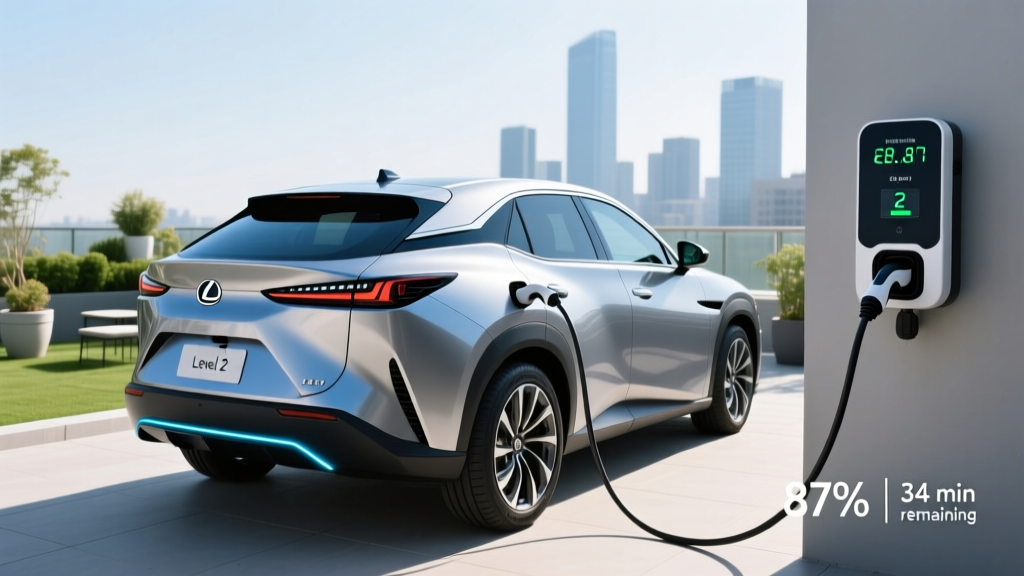
| Level 2 (240V home charger) | ~11 kW | ~35–40 miles | Ideal daily charging; 0–100% in ~7.5 hours |
| DC Fast Charging | Up to 150 kW | ~150+ miles in 15 min (peak) | Road trips; 10–80% in ~30 min |
Home Charging Setup
Most RZ owners will install a Level 2 home charger (such as a ChargePoint Home Flex or Tesla Wall Connector with CCS adapter). Expect the following costs:
| Item | Estimated Cost |
|---|---|
| Level 2 charger hardware | $500–$800 |
| Electrician (240V/50A circuit, standard install) | $800–$2,000 |
| Panel upgrade (if needed for 200A service) | $1,500–$3,500 |
| Permits | $50–$200 |
| Total (typical) | $1,350–$3,000 (without panel upgrade) |
Always have a licensed electrician assess your panel capacity before purchasing equipment. A 50-amp circuit requires a panel with adequate headroom; older homes with 100-amp service may need an upgrade.
Connector and Network Access
The RZ ships with a CCS1 port. For Tesla Supercharger access, Lexus offers a NACS adapter. Public charging reliability varies widely by network — Electrify America, EVgo, and ChargePoint are the primary non-Tesla networks. According to fueleconomy.gov, preconditioning your battery (if the RZ supports navigation-based preconditioning) before arriving at a DC fast charger can improve initial charge speeds in cold weather.
Common Misconceptions About the Lexus RZ
| Myth | Fact |
|---|---|
| "The RZ can go 300 miles on a charge." | The highest EPA rating is 266 miles (RZ 300e FWD). Real-world highway range is closer to 220–240 miles. The AWD RZ 450e with 20-inch wheels drops to 196 miles EPA. |
| "It charges as fast as a Tesla or Ioniq 5." | The RZ peaks at 150 kW, which is modest for 2026. The Ioniq 5 peaks at ~240 kW (10–80% in ~18 min), and Tesla's latest architecture charges at 250 kW. The RZ takes ~30 minutes for the same session. |
| "EVs need no maintenance at all." | EVs eliminate oil changes and have fewer moving parts, but you still need tire rotations (EVs wear tires faster due to weight and instant torque), cabin air filter replacements, brake fluid checks, and wiper fluid. Budget ~$200–$300/year. |
| "The battery will need replacing in 5 years." | Lexus warranties the RZ battery for 8 years/100,000 miles against defects and excessive capacity loss (typically below 70% State of Health). NMC batteries in modern EVs routinely last 150,000–200,000+ miles before significant degradation. Replacement, if ever needed, currently costs $12,000–$18,000 out of warranty. |
| "I can't drive an EV if I don't have a garage." | It's harder but not impossible. Solutions include workplace charging, public Level 2 chargers near your routine, and curbside charging infrastructure expanding in many cities. However, relying solely on public charging significantly increases your per-mile energy cost. |
Decision Framework: Is the 2026 Lexus RZ Right for You?
Choose the RZ 300e (FWD) if:
- You want the lowest entry price (~$44,000) and longest range (266 mi EPA).
- Your commute is under 80 miles round-trip and you can charge at home nightly.
- You don't need AWD for snow or mountain driving.
- You value efficiency (120 MPGe combined) over acceleration.
Choose the RZ 450e (AWD) if:
- You need all-wheel drive for weather or terrain.
- You want the 308 hp / 5.0-second 0–60 performance and Lexus Luxury trim amenities.
- Your daily driving stays under 160 miles and you road-trip infrequently (or plan charging stops carefully).
Look elsewhere if:
- You regularly drive 300+ miles between charges — consider the Tesla Model Y Long Range (320+ mi) or Hyundai Ioniq 5 (300+ mi).
- Fast DC charging is a priority — the RZ's 150 kW peak is behind the class. The Kia EV6 and Genesis GV60 charge at ~240 kW on 800V architecture.
- You live in a very cold climate and need maximum winter range — the RZ's lack of a heat pump means more energy spent on cabin heating vs. competitors that use heat pump systems.
Ownership Considerations First-Time EV Buyers Should Know
Transitioning from a gas Lexus to the RZ involves practical adjustments:
- Plan charging around your routine, not the other way around. If you can plug in at home every night, the RZ becomes a "start every morning with a full tank" experience. If you can't, map your weekly mileage against the real-world range and identify reliable public chargers.
- Understand the charge curve. The 150 kW peak only applies at low SoC. Above 80%, charging slows dramatically to protect the battery. On road trips, it's faster to charge from 10–80% and get back on the road than to wait for a full charge.
- Tire costs are real. The RZ 450e weighs approximately 4,600 lbs. Combined with instant electric torque, expect to replace tires every 25,000–35,000 miles rather than the 40,000–50,000 typical of lighter gas vehicles. Budget $1,000–$1,600 for a set of premium all-season or EV-specific tires.
- Insurance is higher. EV insurance premiums reflect higher repair costs and battery replacement risk. Get quotes from your insurer before purchasing — the difference can be $400–$800/year over a comparable gas SUV.
- Depreciation is a wildcard. EV resale values have been volatile. Lexus brand strength helps, but early RZ models saw steep first-year depreciation. Leasing can mitigate this risk if you're concerned about long-term value retention.
Frequently Asked Questions
Does the 2026 Lexus RZ have a heat pump?
No. The RZ uses a PTC (positive temperature coefficient) resistive heater for cabin warmth. This is less efficient than a heat pump, particularly in temperatures below freezing, where a heat pump can be 2–3x more efficient at extracting heat. This contributes to the RZ's steeper cold-weather range loss compared to EVs equipped with heat pumps.
Can I charge the Lexus RZ at Tesla Superchargers?
Yes, with a NACS adapter. Lexus provides or offers a CCS-to-NACS adapter that enables access to Tesla's Supercharger network. Confirm adapter availability and compatibility with your specific model year at your dealer. The Supercharger network remains the most reliable DC fast-charging option in the U.S. for road trips.
How does the RZ compare to the Toyota bZ4X?
The RZ shares the e-TNGA platform and 71.4 kWh battery with the Toyota bZ4X but features a more premium interior, refined suspension tuning, and Lexus-specific styling. The bZ4X starts roughly $10,000–$12,000 lower and offers similar range. If luxury branding and cabin refinement aren't priorities, the bZ4X delivers nearly identical EV fundamentals at a lower price.
What happens if the RZ battery fails out of warranty?
Full battery replacement currently costs $12,000–$18,000 depending on the service center. However, module-level repair (replacing individual degraded cells or modules) may be possible for less. Battery failures before 150,000 miles are statistically rare based on data from similar NMC packs. According to IIHS and long-term fleet data, most modern EV batteries retain 85–90% capacity at 100,000 miles.
Is the RZ a good first EV?
It depends on your situation. If you have home charging, a commute under 100 miles, and value a quiet, well-built luxury cabin, the RZ is a strong choice. If you apartment-dwell, road-trip frequently, or live in a cold climate without garage parking, the RZ's range limitations, lack of a heat pump, and moderate charging speed make it less ideal as a first EV. Consider a longer-range, faster-charging alternative or a plug-in hybrid like the Lexus NX 450h+ as a bridge vehicle.
What is the RZ's towing capacity?
The RZ is not rated for towing. If you need an electric SUV that can tow, look at the Rivian R1S, Tesla Model Y (up to 3,500 lbs), or the Hyundai Ioniq 5 (up to 2,300 lbs with the tow package).
Sources: fueleconomy.gov (EPA range and MPGe data), IRS §30D qualified vehicle list, Lexus manufacturer specifications. Prices and tax credit eligibility are estimates for the 2026 model year and subject to change. Always verify with your dealer and a tax professional.