Quick Verdict: The 3-Row EV Benchmark Gets a Mid-Cycle Refresh
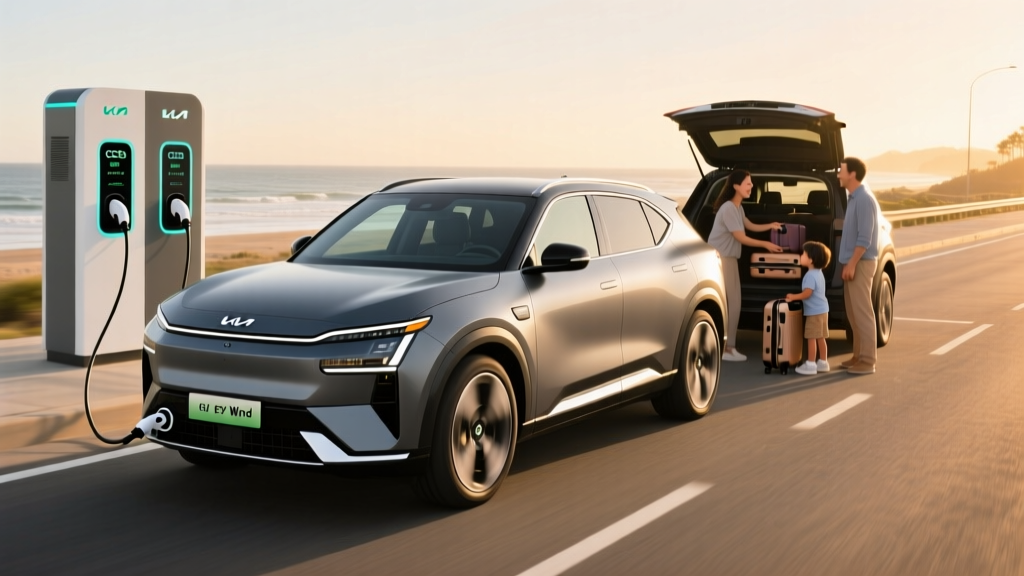
The 2026 Kia EV9 Wind occupies a rare position in the electric-vehicle market: it's one of the few mainstream three-row battery-electric SUVs that doesn't cost north of $70,000. Built on Hyundai Motor Group's E-GMP platform with an 800-volt architecture, the EV9 Wind delivers 280 miles of EPA-estimated range, 210 kW peak DC fast-charging, and genuine third-row usability — all at a base MSRP of $56,900 before incentives. For families who need six or seven seats but aren't ready to spend Rivian R1S or Tesla Model X money, the EV9 Wind remains the default recommendation in this segment for 2026.
But the EV9 Wind isn't without compromises. Highway range falls noticeably short of its EPA sticker, the infotainment system still relies heavily on touch controls, and federal tax-credit eligibility depends on battery-sourcing rules that shift year to year. This review breaks down every number that matters — range, charging curves, real-world efficiency, interior dimensions, and total cost — so you can decide whether the Wind trim hits the sweet spot.
Range, Battery & Real-World Efficiency
EPA-estimated range: 280 miles (Wind RWD, 19-inch wheels).
Real-world highway (70-75 mph, moderate climate): expect 235–255 miles.
Cold-weather highway (below 30°F): expect 200–225 miles without preconditioning; ~225–240 with battery preconditioning active.
City/stop-and-go driving with regen: closely matches or slightly exceeds the 280-mile sticker.
The 2026 EV9 Wind RWD uses a 100.0 kWh gross / ~96.0 kWh usable lithium-ion battery pack with NMC (nickel-manganese-cobalt) chemistry. Kia does not offer an LFP option on the EV9 lineup. The large pack is necessary to move a vehicle with a curb weight approaching 5,700 pounds, and it's the same battery used across the EV9 range (Light, Wind, Land, GT-Line).
Efficiency on the EPA cycle comes in at 88 MPGe combined, which translates to roughly 38 kWh per 100 miles. That's competitive for a three-row SUV but noticeably thirstier than a two-row midsize EV like the Hyundai Ioniq 5 or Tesla Model Y. On a 300-mile road trip at sustained highway speeds, plan for at least one DC fast-charging stop — the math simply doesn't allow a full trip on a single charge unless you're driving conservatively in mild weather.
| Spec | Wind RWD | Wind AWD (if available) |
|---|---|---|
| EPA Range | 280 mi | ~270 mi (est.) |
| Battery (gross / usable) | 100.0 kWh / ~96.0 kWh | 100.0 kWh / ~96.0 kWh |
| Battery Chemistry | NMC | NMC |
| Motor / Drivetrain | Single rear motor, RWD | Dual motor, AWD |
| Horsepower | 215 hp | 379 hp |
| 0–60 mph | 7.8 sec | 5.0 sec |
| MPGe (combined) | 88 MPGe | ~83 MPGe (est.) |
| Efficiency | 38 kWh/100 mi | ~40 kWh/100 mi |
| Max DC Fast Charge | 210 kW | 210 kW |
| 10–80% DC Charge Time | ~24 min | ~24 min |
| Level 2 Charge Rate | 10.9 kW (~29 mi/hr) | 10.9 kW |
| Base MSRP | $56,900 | $60,900 (est.) |
| Battery Warranty | 10 yr / 100,000 mi | 10 yr / 100,000 mi |
Source: fueleconomy.gov and Kia.com official specifications.
Charging Speed: 800V Architecture Pays Off
The EV9's 800-volt electrical architecture remains one of its strongest technical advantages. While many competitors in this price range still use 400V systems limited to 150 kW or less, the EV9 Wind can accept up to 210 kW at a DC fast charger — provided you find a station capable of delivering it (Electrify America, EVgo, and Tesla Superchargers with a NACS adapter are your best bets in 2026).
| Charging Level | Power | Speed / Time | Typical Use Case |
|---|---|---|---|
| Level 1 (120V household) | ~1.4 kW | ~4 mi/hr | Emergency / overnight trickle |
| Level 2 (240V home, 48A) | 10.9 kW | ~29 mi/hr; 0–100% in ~9.5 hr | Daily home charging |
| DC Fast Charge (peak) | 210 kW | 10–80% in ~24 min | Road-trip stops |
| DC Fast Charge (sustained avg.) | ~150–170 kW avg. | 10–80% realistic: ~27–30 min | Average real-world session |
Charging-curve reality check: The 210 kW figure is a peak, not a sustained rate. In real-world testing, the EV9 hits peak power between roughly 15% and 40% state of charge, then tapers progressively. From 10% to 80%, expect an average rate closer to 150–170 kW, yielding a realistic session time of about 27 to 30 minutes at a 350 kW-capable station. At a 150 kW charger, plan for 35–40 minutes for the same 10–80% session.
For home charging, a Level 2 wall connector on a 60-amp circuit (48 amps continuous) replenishes about 29 miles of range per hour. A full 0–100% charge takes roughly 9.5 hours — easily accomplished overnight. Home installation costs typically range from $800 to $2,500 depending on whether your electrical panel needs an upgrade; consult a licensed electrician for your specific situation.
Connector note for 2026: Kia has adopted the NACS (Tesla-style) charge port on new EV9 models for the U.S. market, giving direct access to Tesla Supercharger stations. CCS adapters are available for older CCS-only stations. Verify your local charging network's connector availability before purchase.
Performance & Driving Dynamics
The Wind RWD makes do with a single rear-mounted motor producing 215 horsepower and 258 lb-ft of torque. The 0–60 mph time of 7.8 seconds is perfectly adequate for a family hauler — merging onto highways and passing are confident — but it's not going to win drag races. If you want more punch, the dual-motor AWD variant bumps output to 379 hp and drops the 0–60 time to roughly 5.0 seconds, though it sacrifices about 10 miles of EPA range and adds approximately $4,000 to the price.
Ride quality is a highlight. The EV9's long wheelbase (122.0 inches) and well-tuned suspension absorb highway imperfections effectively, and the cabin remains quiet even at 80 mph. The steering is light and precise, though it lacks the feedback enthusiasts might want. Regenerative braking offers multiple levels adjustable via steering-wheel paddles, and a true one-pedal driving mode (i-Pedal) brings the SUV to a complete stop without touching the brake pedal.
Towing capacity is rated at 2,000 pounds for the RWD Wind — enough for a small utility trailer or a pair of dirt bikes, but not suitable for a boat or camper. The AWD Land and GT-Line trims with the tow package bump capacity to 5,000 pounds, but that's not available on the Wind.
Interior Space, Cargo & Technology
The EV9's three-row layout is genuinely usable for adults in all three rows — a claim few competitors can make. Here are the critical dimensions:
- Front legroom: 41.3 inches
- Second-row legroom: 42.8 inches (bench) / 39.1 inches (captain's chairs, where available)
- Third-row legroom: 32.0 inches — tight for tall adults on long trips, but fine for children or short commutes
- Cargo behind third row: 20.2 cu ft
- Cargo behind second row (third row folded): 43.5 cu ft
- Maximum cargo (all rear seats folded): 81.7 cu ft
- Front trunk (frunk): 1.8 cu ft (RWD) — enough for a charging cable and small bag
The Wind trim comes standard with a dual-screen setup: a 12.3-inch digital instrument cluster and a 12.3-inch infotainment touchscreen running Kia's latest Connect system with wireless Apple CarPlay and Android Auto. Navigation-based preconditioning for the battery is included, which is critical for optimizing DC fast-charge speeds on road trips. The system also supports over-the-air (OTA) updates.
Driver assistance: The EV9 Wind includes Kia's Highway Driving Assist 2 (HDA2), which provides adaptive cruise control with stop-and-go, lane-centering, and lane-change assistance. This is an SAE Level 2 system — meaning the driver must remain fully attentive with hands on the wheel. It is not autonomous or "self-driving." The system works well on interstates but can be overly cautious in merging situations and requires clear lane markings to function properly.
Other standard tech on the Wind: heated and ventilated front seats, heated steering wheel, power liftgate, 6 USB-C ports across all three rows, and a 12-speaker Harman Kardon audio system. Notable omissions compared to the Land and GT-Line trims: no heads-up display, no premium Nappa leather, no digital side mirrors, and no Highway Driving Assist with lane-change-on-command.
Pricing, Tax Credit & Total Cost
| Item | Amount |
|---|---|
| Base MSRP (Wind RWD) | $56,900 |
| Destination charge | $1,495 |
| As-tested (with popular options) | $59,000–$61,500 |
| Federal §30D tax credit (if eligible) | Up to $7,500 |
| Effective price after max credit | ~$49,400–$54,000 |
Federal tax credit eligibility (IRS §30D) — critical details: The EV9 Wind's MSRP of $56,900 falls under the $80,000 SUV cap, so it passes the MSRP test. However, the full $7,500 credit depends on two components: $3,750 tied to critical-mineral sourcing and $3,750 tied to battery-component manufacturing, both of which must meet U.S. or free-trade-agreement partner requirements as defined by current-year IRS guidance. These sourcing rules tighten annually. Additionally, buyer income must not exceed $300,000 (married filing jointly), $225,000 (head of household), or $150,000 (single).
As of 2026, Kia has moved some battery component sourcing to comply with §30D requirements, but the exact credit amount available for the EV9 can range from $0 to $7,500 depending on the specific battery pack's supply chain in a given production batch. Always verify current eligibility on IRS.gov or through the point-of-sale transfer process at the dealership before committing.
The point-of-sale transfer option, available since 2024, lets you apply the credit as an immediate price reduction at the dealer rather than waiting to claim it on your tax return. This is the preferred method for most buyers.
Warranty & Long-Term Ownership
Kia backs the EV9's battery and electric powertrain with a 10-year / 100,000-mile warranty — one of the best in the industry. The warranty guarantees that the battery will retain at least 70% of its original capacity over that period. Based on data from earlier Hyundai Motor Group E-GMP vehicles (Ioniq 5, EV6), NMC packs in this family have shown degradation of approximately 5–8% over the first 100,000 miles under normal use, suggesting the 70% threshold is a conservative floor rather than an expected outcome.
The basic vehicle warranty is 5 years / 60,000 miles. Kia also includes 3 years / 36,000 miles of complimentary scheduled maintenance (software checks, tire rotations, cabin-filter replacements) and 5 years of roadside assistance.
Battery replacement cost (out of warranty): A full pack replacement for the EV9's 100 kWh battery currently ranges from $15,000 to $22,000 including labor. Module-level repairs are less expensive but not always available. This figure is worth noting for second owners or those planning to keep the vehicle well past the warranty period.
Pros, Cons & Competition
- Genuine three-row usability with adult-capable third row
- 800V architecture enables 210 kW DC fast charging
- 280-mile EPA range is strong for the segment
- 10-year/100,000-mile battery warranty
- Competitive pricing vs. Rivian R1S, Tesla Model X
- NACS charge port for Supercharger access (2026)
- Spacious cargo area with 81.7 cu ft max
- Real-world highway range falls ~10–15% below EPA
- RWD Wind is limited to 2,000-lb towing
- Touch-heavy infotainment with limited physical buttons
- No heads-up display on Wind trim
- Federal tax credit is not guaranteed — depends on sourcing
- AWD upgrade costs ~$4,000 and reduces range
Key competitors: The Tesla Model X offers more range (330+ mi) and faster acceleration but starts around $80,000 and has panel-gap quality concerns. The Rivian R1S is more capable off-road and tows 7,700 lb but starts above $75,000. The Hyundai Ioniq 9 (EV9's platform sibling) offers a similar package with slightly different styling and feature distribution at comparable pricing. The Volkswagen ID. Buzz offers three rows and charm but significantly less range (~230 mi EPA).
Against these alternatives, the EV9 Wind's value proposition is straightforward: it delivers 90% of what families need at 70% of the price of luxury alternatives.
Who Should Buy the 2026 Kia EV9 Wind?
Buy the EV9 Wind if: You need three rows for children or occasional adult passengers, you have access to home Level 2 charging, your daily commute is under 80 miles round-trip, and you want a mainstream brand with strong warranty coverage and dealer support. The Wind RWD at ~$56,900 before credits is the value sweet spot in the EV9 lineup.
Look elsewhere if: You regularly tow more than 2,000 pounds (step up to the AWD Land with tow package), you need 300+ miles of real-world highway range without stopping (consider the Tesla Model X or wait for next-gen platforms), or you demand a fully autonomous-capable driving system (no Level 3+ system is available on the EV9).
Frequently Asked Questions
What is the real-world range of the 2026 Kia EV9 Wind?
The EPA rates the EV9 Wind RWD at 280 miles. In real-world highway driving at 70–75 mph, expect 235–255 miles. In cold weather below 30°F without preconditioning, range can drop to 200–225 miles. City driving with regenerative braking closely matches the EPA estimate.
How fast does the EV9 Wind charge at home and on the road?
At home on Level 2 (240V, 48A), the EV9 Wind charges at 10.9 kW, adding about 29 miles of range per hour and fully charging overnight in ~9.5 hours. On a DC fast charger, it peaks at 210 kW and charges from 10–80% in approximately 24–30 minutes depending on charger capability and battery temperature.
Does the 2026 Kia EV9 Wind qualify for the federal EV tax credit?
The EV9 Wind passes the $80,000 MSRP cap for SUVs. Whether you receive the full $7,500, a partial credit, or no credit depends on your income (capped at $150K single / $300K joint), the battery's critical-mineral and component sourcing for that production batch, and current-year IRS rules. Verify on IRS.gov before purchasing.
How much does the EV9 Wind cost after incentives?
Base MSRP is $56,900 plus $1,495 destination. With the maximum $7,500 federal credit applied at point of sale, the effective price drops to approximately $50,895. State and local incentives may reduce this further — check your state's energy office for current programs.
Is the Kia EV9 Wind worth buying over the Tesla Model X or Rivian R1S?
For most families prioritizing value, warranty coverage, and practicality over performance or brand cachet, the EV9 Wind offers the best cost-to-utility ratio in the three-row EV segment. The Model X offers more range and acceleration; the R1S offers more off-road capability and towing. But at $57K vs. $80K+, the EV9 Wind is the pragmatic choice.
Can adults fit in the third row of the EV9?
Yes, for shorter trips. Third-row legroom is 32.0 inches — tight for adults over 5'10" on long drives but acceptable for children, teenagers, or adults on commutes under an hour. For regular full-capacity adult hauling, a minivan remains more comfortable.
What is the EV9 Wind's towing capacity?
The RWD Wind is rated for 2,000 pounds. If you need more, the AWD trims with the factory tow package can handle up to 5,000 pounds, but that option is not available on the Wind trim level.
Sources: EPA fueleconomy.gov, Kia.com EV9 specifications, IRS.gov §30D clean vehicle credits, IIHS.org safety ratings.