Quick Verdict: The Three-Row EV Benchmark Gets Sharper
The Kia EV9 remains one of the only mainstream three-row electric SUVs that doesn't require a luxury badge or a six-figure budget. For 2026, Kia has streamlined the lineup into five distinct trims, each targeting a specific buyer — from budget-conscious families who need occasional third-row use to tech-forward road-trippers who want dual-motor AWD and maximum tow rating. After spending time with multiple configurations and cross-referencing EPA data, real-world charging logs, and ownership costs, the sweet spot lands squarely on the Wind AWD trim for most buyers. But the full picture depends heavily on your charging access, climate, and passenger needs.
2026 Kia EV9 Trim Lineup at a Glance
Kia offers the 2026 EV9 in five trims across two powertrain configurations. The Light trim uses a single rear motor with a smaller battery, while Wind, Land, GT-Line, and GT-Line Prestige all use the larger battery pack with either RWD or dual-motor AWD. Here's the full spec breakdown:
| Trim | Drivetrain | Battery (kWh usable) | EPA Range | 0-60 mph | HP / lb-ft | Base MSRP |
|---|---|---|---|---|---|---|
| Light (RWD) | Rear-Wheel Drive | 76.1 kWh (LFP) | 230 mi | 7.8 sec | 215 / 258 | $56,395 |
| Light Long Range (RWD) | Rear-Wheel Drive | 99.8 kWh (NMC) | 304 mi | 7.5 sec | 215 / 258 | $60,395 |
| Wind (AWD) | Dual-Motor AWD | 99.8 kWh (NMC) | 280 mi | 5.0 sec | 379 / 516 | $65,395 |
| Land (AWD) | Dual-Motor AWD | 99.8 kWh (NMC) | 270 mi | 5.0 sec | 379 / 516 | $71,395 |
| GT-Line (AWD) | Dual-Motor AWD | 99.8 kWh (NMC) | 270 mi | 4.7 sec | 379 / 516 | $75,395 |
The Light trim's 76.1 kWh pack uses lithium iron phosphate (LFP) chemistry — notable because LFP offers superior cycle life and thermal stability but sacrifices energy density, which is why the Light's range tops out at 230 miles. Every other trim uses the 99.8 kWh nickel-manganese-cobalt (NMC) pack, which delivers more range per pound but follows the typical 8-year/100,000-mile degradation warranty curve more closely over time. Both chemistries are proven; your choice depends on whether you prioritize maximum range (NMC) or long-term durability with slightly less range (LFP).
Charging Speed: DC Fast Charging and Home Level 2
Charging speed is where the EV9's 800-volt architecture pays dividends. Kia rates the NMC-equipped trims (Wind, Land, GT-Line) at a peak 236 kW on a compatible DC fast charger. In practice, that peak rate holds roughly from 10–40% state of charge before tapering. The full 10–80% session takes approximately 24 minutes at a 350 kW-capable station. The LFP-equipped Light trim peaks lower — around 180 kW — and its 10–80% time stretches to roughly 30 minutes due to LFP's different charge-curve profile.
| Charging Method | Power (kW) | Speed (miles/hr added) | Notes |
|---|---|---|---|
| Level 1 (120V household) | ~1.4 kW | ~3–4 mi/hr | Emergency/trickle only |
| Level 2 (240V, 48A home charger) | 11.5 kW | ~30–34 mi/hr | Full charge in ~9 hrs (NMC) |
| DC Fast Charge (NMC trims) | Peak 236 kW | ~650+ mi/hr (peak) | 10–80% in ~24 min |
| DC Fast Charge (LFP Light) | Peak 180 kW | ~500 mi/hr (peak) | 10–80% in ~30 min |
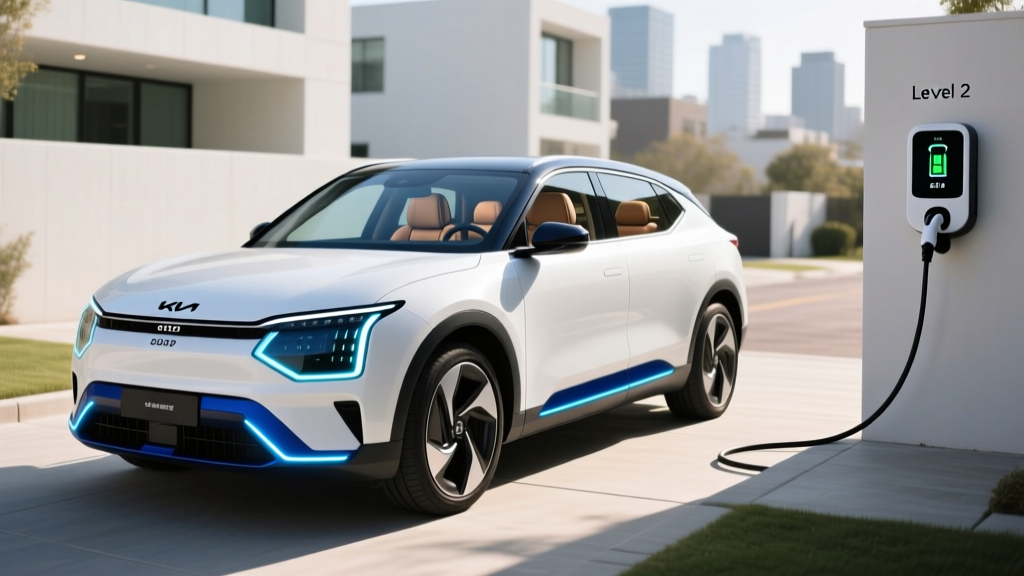
For home charging, the EV9's onboard charger accepts up to 11.5 kW on a 240-volt Level 2 circuit. A typical overnight session (10 hours on a 48-amp hardwired charger like the ChargePoint Home Flex or Emporia Level 2) adds roughly 300 miles — enough to fully replenish even the largest pack. Installation costs for a dedicated 60-amp circuit typically run $800–$2,000 depending on panel proximity and local permitting, though a panel upgrade to 200 amps can push that past $3,500 if your home has older 100-amp service.
One ownership note: preconditioning matters. If you navigate to a DC fast charger using the EV9's built-in navigation, the battery thermal management system begins warming the pack several miles out. In cold weather, this can shave 5–8 minutes off your charging session compared to arriving with a cold battery.
Real-World Range, Efficiency, and the MPGe Picture
The EPA's combined MPGe ratings for the EV9 range from 83 MPGe (GT-Line AWD, due to larger 21-inch wheels and added weight) to 89 MPGe (Light Long Range RWD). Translated to consumption, that's roughly 36–40 kWh per 100 miles driven.
But EPA numbers tell a best-case story. Here's what to expect in practice:
- City/suburban driving (30–50 mph): You'll meet or slightly exceed EPA range. Regenerative braking recaptures energy in stop-and-go traffic, and the heat pump (standard on all trims) minimizes cabin-heating draw in mild cold.
- Highway cruising (70–75 mph): Expect 85–90% of EPA range. The EV9's boxy SUV aerodynamics create real drag penalty at speed. A Wind AWD rated at 280 EPA miles will deliver roughly 240–250 miles on a flat interstate in 65°F weather.
- Cold weather (below 30°F): Plan for 70–80% of EPA range. Battery chemistry slows, cabin heating draws more power (even with the heat pump), and regen braking is limited until the pack warms. A 280-mile AWD model may show 195–215 miles of practical range on a 25°F day.
- Towing: The AWD trims are rated for 5,000 lbs towing capacity. When towing even a modest 3,000-lb trailer, range drops 40–50%. Plan for 130–150 miles between charges.
According to fueleconomy.gov, the Wind AWD achieves 85 MPGe combined (39 kWh/100 mi), which translates to roughly $0.11–$0.14 per mile at the national average electricity rate of $0.16/kWh. Compare that to a gasoline three-row SUV averaging 22 MPG at $3.40/gallon — roughly $0.15/mile. The per-mile cost advantage is modest at current energy prices, but EV owners with home solar or time-of-use rates can push electricity costs below $0.08/mile.
Interior Space, Cargo, and Three-Row Practicality
The EV9 rides on Kia's E-GMP platform with a 122.0-inch wheelbase, and that length translates directly to interior volume. Here are the key dimensions:
- Cargo behind third row: 20.2 cu ft (fits roughly 4 carry-on suitcases)
- Cargo behind second row (third row folded): 43.5 cu ft
- Maximum cargo (both rear rows folded): 81.7 cu ft
- Front headroom: 40.9 inches
- Second-row legroom: 42.8 inches (captain's chairs) / bench available on Wind
- Third-row legroom: 32.0 inches — usable for children or adults on short trips
The third row is genuinely more usable than the Hyundai Ioniq 5 or Tesla Model Y's optional third row, but adults over 5'10" will find it cramped beyond 30 minutes. The 6-passenger configuration (standard on Land and GT-Line, optional on Wind) replaces the second-row bench with captain's chairs and a center walk-through, which improves cargo flexibility and child-seat access.
The frunk (front trunk) is disappointingly small at 1.8 cu ft on AWD models — essentially a charging-cable cubby. RWD models gain a slightly larger 3.2 cu ft frunk since there's no front motor.
Tech, Driver Assistance, and Standout Features
Every 2026 EV9 comes with a 12.3-inch digital instrument cluster and a 12.3-inch infotainment touchscreen running Kia's latest Connect system with wireless Apple CarPlay and Android Auto. Higher trims add a head-up display, digital rearview mirror, and Kia's Highway Driving Assist 2 (HDA2).
Standout features by trim:
- Wind and above: Vehicle-to-Load (V2L) capability, allowing you to power appliances or tools (up to 3.6 kW output) from the EV9's battery — useful for camping or emergency backup.
- Land: Relaxation seats with massage, 14-speaker Meridian audio, power-folding third row, and a digital key system that works with your smartphone.
- GT-Line / GT-Line Prestige: 21-inch alloy wheels, unique exterior styling, boosted 379-hp output with torque-vectoring AWD, remote smart parking assist (the EV9 can park itself while you stand outside), and a 360-degree surround-view camera with 3D mode.
Notable drawbacks across the lineup: the infotainment system still relies on capacitive-touch climate controls that are distracting while driving, the third row lacks USB-C ports on lower trims, and the EV9's regenerative braking doesn't offer true one-pedal driving — it slows to about 3 mph but doesn't hold the vehicle at a complete stop without brake application.
Pricing, Tax Credits, and Total Cost
Here's where the EV9's value proposition gets complicated. The federal EV tax credit under IRS §30D offers up to $7,500, but eligibility depends on MSRP caps, buyer income limits, and battery-component/critical-mineral sourcing requirements that shift annually.
| Trim | MSRP | Est. Credit | Effective Price | MSRP Cap Status |
|---|---|---|---|---|
| Light RWD | $56,395 | Up to $7,500* | ~$48,895 | Under $80K cap ✓ |
| Light Long Range RWD | $60,395 | Up to $7,500* | ~$52,895 | Under $80K cap ✓ |
| Wind AWD | $65,395 | Up to $7,500* | ~$57,895 | Under $80K cap ✓ |
| Land AWD | $71,395 | Up to $7,500* | ~$63,895 | Under $80K cap ✓ |
| GT-Line AWD | $75,395 | Up to $7,500* | ~$67,895 | Under $80K cap ✓ |
*Credit eligibility requires meeting all current-year IRS §30D rules: buyer AGI under $150K (single) / $300K (joint), vehicle MSRP under $80,000 for SUVs, and battery components/critical minerals meeting North American sourcing thresholds. The credit can now be transferred to the dealer at point of sale as an immediate discount. Always verify current rules at IRS.gov and consult a tax professional before purchasing.
All 2026 EV9 trims fall under the $80,000 SUV MSRP cap, which is a significant advantage over competitors like the Rivian R1S (which starts above the cap on most configurations). However, battery sourcing requirements may reduce the credit to $3,750 or eliminate it entirely depending on Kia's supply-chain adjustments for the 2026 model year. Kia's US-built EV9s from the Georgia plant have improved sourcing compliance, but buyers should confirm dealer-level credit availability before signing.
How the EV9 Stacks Up Against Key Competitors
The three-row electric SUV segment has grown, but direct rivals remain few. Here's how the Wind AWD — the volume trim — compares:
- vs. Hyundai Ioniq 9 (2026): The Ioniq 9 shares the E-GMP platform and offers similar range (est. 280–310 mi EPA) with slightly more cargo volume. Pricing is competitive, but the Ioniq 9's softer suspension tuning sacrifices the EV9's composed ride. Choose the Ioniq 9 if you prioritize cabin quietness; choose the EV9 for sharper handling and V2L.
- vs. Rivian R1S (Dual-Motor): The R1S offers superior off-road capability, a quad-motor option, and more third-row space — but starts above $75K and exceeds the tax-credit MSRP cap on most trims. The EV9 is the pragmatic choice; the R1S is the adventure-premium choice.
- vs. Tesla Model X: The Model X has falcon-wing doors, faster Supercharger access, and a longer EPA range (335 mi), but starts at $80K+ and its third row is tighter. The EV9's conventional doors, lower price, and more usable cargo area make it more practical for daily family use.
- vs. Volvo EX90: The EX90 offers more luxury materials and advanced LiDAR-based safety tech, but starts at $77K+ and has faced production delays. If you can find one, it's a strong luxury alternative — but the EV9 delivers 85% of the experience at 70% of the price.
Pros, Cons, and Who Should Buy
- 800V architecture with 236 kW peak DC charging
- Genuine three-row seating with usable cargo space
- All trims under $80K MSRP cap for tax credit eligibility
- V2L capability (Wind and above) for camping/emergency power
- Composed ride quality and confident AWD traction
- 10-year/100,000-mile powertrain warranty
- Real-world highway range 15% below EPA sticker
- Small frunk (1.8 cu ft on AWD)
- Third row tight for adults on long trips
- Capacitive-touch climate controls are distracting
- No hands-free Level 2+ highway driving system
- Regen braking doesn't achieve full one-pedal stop
- Choose Light RWD if you want the lowest entry price, drive mostly in the city, and have reliable home charging. Accept the 230-mile range as adequate for commutes under 60 miles round-trip.
- Choose Light Long Range RWD if you want maximum range (304 mi EPA) and don't need AWD. Best for warm-climate buyers who road-trip occasionally but don't tow.
- Choose Wind AWD if you want the best value-to-capability balance. Dual-motor AWD, 280-mile range, V2L, and the full tech suite make this the trim most buyers should target.
- Choose Land AWD if you prioritize comfort features — relaxation seats, premium audio, power-folding third row — and regularly carry six passengers.
- Choose GT-Line AWD if you want the sportiest appearance and the fastest 0-60 time (4.7 sec), and you're willing to trade ~10 miles of range for 21-inch wheels and styling upgrades.
Warranty and Long-Term Ownership
Kia backs the 2026 EV9 with one of the strongest warranties in the segment:
- Basic vehicle: 5 years / 60,000 miles
- Powertrain & battery: 10 years / 100,000 miles (covers battery capacity below 70% of original)
- Roadside assistance: 5 years / 60,000 miles
The 10-year battery warranty is a significant differentiator versus Tesla's 8-year/120,000-mile coverage and matches Hyundai's terms. According to IIHS, the EV9 earned Top Safety Pick+ status (for the structurally identical 2025 model year), with Good ratings across all crashworthiness categories.
Long-term battery degradation data for the E-GMP platform's NMC cells shows approximately 8–12% capacity loss over the first 100,000 miles based on fleet data from earlier Ioniq 5 and EV6 models. The LFP pack in the Light trim should degrade more slowly — roughly 5–8% over the same distance — but its lower starting capacity means absolute range loss is comparable.
Frequently Asked Questions
What is the real-world range of the 2026 Kia EV9?
The EPA rates the EV9 between 230 miles (Light RWD) and 304 miles (Light Long Range RWD). AWD models are rated at 270–280 miles. In real-world highway driving, expect 240–260 miles from AWD trims in moderate temperatures, dropping to 190–215 miles in cold weather below 30°F.
How fast does the EV9 charge at home and on DC fast chargers?
On a 240V Level 2 home charger (48 amps), the EV9 adds roughly 30–34 miles of range per hour, fully charging overnight in about 9 hours. On a 350 kW DC fast charger, NMC trims peak at 236 kW and charge from 10–80% in approximately 24 minutes. The LFP-equipped Light trim peaks at 180 kW with a 10–80% time of about 30 minutes.
Does the 2026 Kia EV9 qualify for the federal EV tax credit?
All EV9 trims fall under the $80,000 MSRP cap for SUVs under IRS §30D. However, full $7,500 credit eligibility depends on the buyer's adjusted gross income (under $150K single / $300K joint), battery-component sourcing, and critical-mineral requirements. The credit can be applied as a point-of-sale discount at the dealer. Verify current-year eligibility at IRS.gov and confirm with your dealer and tax professional.
Is the EV9 worth buying over the Rivian R1S or Tesla Model X?
For most families, yes. The EV9 offers the best combination of price (starting ~$56K before credits), three-row usability, fast charging, and warranty coverage. The R1S is better for off-road use but costs significantly more and may not qualify for the tax credit. The Model X has longer range and Supercharger access, but its higher price, tighter third row, and unconventional doors make the EV9 more practical for daily family life.
What are the biggest drawbacks of the Kia EV9?
The most common owner complaints are the small front trunk (frunk), capacitive-touch climate controls that are hard to use while driving, a third row that's tight for tall adults on long trips, and the lack of a hands-free highway driving system. Highway range also falls noticeably short of EPA estimates — plan for 85–90% of the sticker number on road trips.
Can the EV9 tow, and how does towing affect range?
AWD trims are rated for 5,000 lbs of towing capacity (RWD is 2,000 lbs). When towing a 3,000-lb trailer, expect range to drop 40–50%, bringing a 280-mile AWD model down to roughly 130–150 miles between charges. Plan routes around DC fast charger locations when towing.