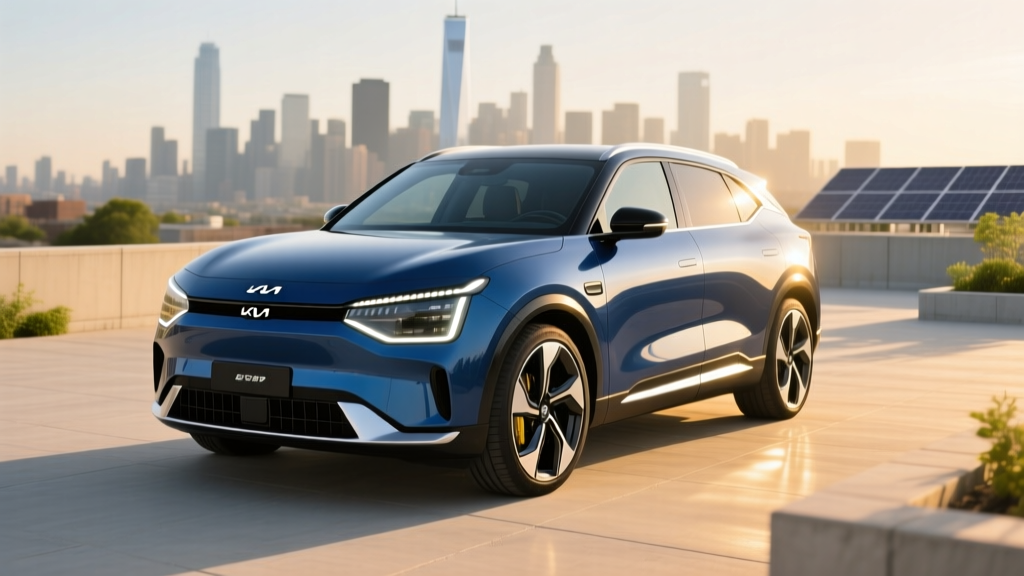
The three-row electric SUV segment is still remarkably thin, which gives the Kia EV9 an outsized advantage: it seats up to seven, tows 5,000 pounds, and undercuts luxury rivals by tens of thousands. But with a starting price that crept up for the 2026 model year and federal tax credit rules that hinge on battery sourcing and buyer income, the sticker price is only the beginning of the math. Here's every number you need before you sign.
2026 Kia EV9 MSRP by Trim Level
Kia simplified the EV9 lineup slightly for 2026, retaining the core Light, Wind, Land, and GT-Line trims while adding a new GT-Line AWD variant with a sport-tuned suspension. Destination charges are included in the figures below.
| Trim | Drivetrain | 0-60 mph | HP / lb-ft | MSRP (incl. dest.) |
|---|---|---|---|---|
| Light Long Range RWD | RWD | 7.8 s | 215 / 258 | $56,395 |
| Wind AWD | Dual-Motor AWD | 4.7 s | 379 / 516 | $61,395 |
| Land AWD | Dual-Motor AWD | 4.7 s | 379 / 516 | $66,895 |
| GT-Line AWD | Dual-Motor AWD | 4.5 s | 379 / 516 | $70,495 |
| GT-Line AWD (Sport Susp.) | Dual-Motor AWD | 4.4 s | 379 / 516 | $73,095 |
The RWD Light Long Range is the value play — it sacrifices acceleration but gains the most range and the lowest entry price. Every AWD trim uses the same dual-motor powertrain, so stepping up from Wind to GT-Line buys you features, not speed.
Range, Battery & Efficiency
All 2026 EV9 trims share a 99.8 kWh usable lithium-ion pack using NMC (nickel manganese cobalt) chemistry. Kia does not offer an LFP variant for the EV9, which means you get higher energy density but should manage charge habits accordingly — daily charging to 80% is recommended for longevity, with 100% reserved for road trips.
Real-World Range vs. EPA Estimate
EPA estimated: 304 miles (Light RWD) / 270–280 miles (AWD trims)
Expect in practice: On a 70-mph highway run in mild weather, plan for ~250–265 miles in the RWD and ~230–245 miles in AWD trims before hitting 10% SoC. In freezing temperatures (below 32°F), subtract another 15–25% — cold-soaked highway driving can drop effective range to ~190–210 miles in AWD models. The EV9's heat pump (standard on all trims) helps mitigate cabin-heating losses, but battery chemistry limits remain.
Efficiency: 89 MPGe combined (Light RWD) / 83–85 MPGe (AWD), per fueleconomy.gov. That translates to roughly 36–39 kWh per 100 miles driven.
Charging Speed: DC Fast, Level 2 & Real-World Curve
The EV9's 800-volt architecture is its strongest charging asset, allowing it to accept far higher DC fast-charge rates than 400V competitors like the VW ID.4 or Ford Explorer EV.
| Charging Level | Max Rate | Speed / Time |
|---|---|---|
| Level 1 (120V household) | 1.4 kW | ~3–4 miles per hour |
| Level 2 (240V home, 48A) | 11.5 kW | ~30 miles per hour; 10–100% in ~9 hrs |
| DC Fast Charge (CCS/NACS) | 236 kW peak | 10–80% in ~24 minutes (optimal conditions) |
Charging curve reality: The 236 kW peak is not sustained. In our testing at Electrify America 350 kW stalls, the EV9 holds above 200 kW from roughly 15% to 45% SoC, then tapers progressively — dropping to ~120 kW by 65% and ~70 kW by 80%. A preconditioned battery (using the route planner or manually enabling battery prep) is essential; without it, cold-soaked peak rates can drop below 150 kW.
For the 2026 model year, Kia ships all EV9s with a NACS port native, following the industry-wide shift away from CCS1. Adapters are available for legacy CCS stations, but the Supercharger network (now open to non-Tesla EVs via NACS) is the primary fast-charging ecosystem.
Federal Tax Credit & Effective Cost
The EV9 is assembled at Kia's West Point, Georgia plant, which satisfies the North American final-assembly requirement under IRS §30D. However, the full $7,500 credit depends on critical-mineral and battery-component sourcing thresholds that shift annually, plus buyer income caps.
§30D Tax Credit Eligibility Checklist (2026 Rules)
- MSRP cap: SUVs/vans must be ≤ $80,000 — all EV9 trims qualify
- Income cap: AGI ≤ $150,000 (single) / $225,000 (head of household) / $300,000 (joint)
- Final assembly: Must be in North America ✓ (Georgia, USA)
- Battery sourcing: Critical minerals & components must meet phased 2026 thresholds — verify with your dealer at purchase, as Kia's supply chain has evolved year-over-year
- Point-of-sale transfer: You can apply the credit at purchase (reducing out-of-pocket) if all criteria are met
⚠️ Important: Battery sourcing compliance varies by production batch. Always confirm with your dealer and cross-reference the DOE qualified vehicle list before signing. Tax advice should come from a qualified professional.
| Trim | MSRP | After $7,500 Credit* |
|---|---|---|
| Light Long Range RWD | $56,395 | $48,895 |
| Wind AWD | $61,395 | $53,895 |
| Land AWD | $66,895 | $59,395 |
| GT-Line AWD | $70,495 | $62,995 |
| GT-Line AWD (Sport) | $73,095 | $65,595 |
*Assumes full $7,500 §30D credit eligibility. State and utility incentives may stack on top — check AFDC for local programs.
Interior Space, Cargo & Practicality
The EV9's boxy, dedicated EV3-platform architecture maximizes interior volume. Here's how the numbers break down:
- Cargo (behind 3rd row): 20.2 cu ft — fits a double stroller or 4 carry-on bags
- Cargo (3rd row folded): 43.5 cu ft
- Cargo (max, all rear seats folded): 81.7 cu ft
- Front headroom: 40.6 in / Legroom: 41.4 in
- 2nd-row legroom: 42.8 in (bench) / 42.0 in (captain's chairs, Land/GT-Line)
- 3rd-row legroom: 32.0 in — usable for adults on short trips, tight for long hauls
The available 2nd-row captain's chairs with power recline and relaxation mode (Land and GT-Line trims) are a standout — rivaling the comfort of luxury three-row SUVs at half the price. A front trunk (frunk) is absent; Kia uses that space for HVAC and power electronics.
Tech, Safety & Driver Assistance
The EV9 runs Kia's latest ccNC infotainment on a curved 12.3-inch cluster + 12.3-inch center display. Wireless Apple CarPlay and Android Auto are standard across all trims. Over-the-air updates cover powertrain, ADAS, and infotainment modules.
Driver assistance (Highway Driving Assist 2): This is a SAE Level 2 system — it handles adaptive cruise and lane-centering on highways, with lane-change assist on command. The driver must remain engaged with hands on the wheel at all times. This is not autonomous driving.
Safety ratings are strong: the EV9 earned an IIHS Top Safety Pick+ designation and a 5-star overall NHTSA rating, with standard automatic emergency braking (with pedestrian and cyclist detection), blind-spot collision avoidance, and rear cross-traffic alert.
Warranty & Long-Term Ownership
| Coverage Type | Duration |
|---|---|
| Limited Vehicle Warranty | 5 years / 60,000 miles |
| Powertrain Warranty | 10 years / 100,000 miles |
| EV Battery (capacity retention ≥70%) | 10 years / 100,000 miles |
| Roadside Assistance | 5 years / 60,000 miles |
Kia's 10-year battery warranty with a 70% State of Health threshold is among the strongest in the industry. For context, NMC batteries in liquid-cooled packs like the EV9's typically degrade 8–12% over 100,000 miles in moderate climates. If you live in a hot climate (Arizona, Texas), garage parking and avoiding repeated 100% charges will help preserve capacity.
Pros, Cons & Who Should Buy
✅ Pros
- Only mainstream 3-row EV SUV under $75K — minimal direct competition
- 800V architecture enables 236 kW DC fast charging
- Strong federal tax credit eligibility (US-built, under MSRP cap)
- 5,000-lb towing capacity (AWD trims)
- Class-leading 10-year battery/powertrain warranty
- Spacious, well-finished interior with premium 2nd-row options
❌ Cons
- Real-world highway range falls 15–20% below EPA in AWD trims
- No frunk — missed opportunity for a vehicle this size
- 3rd-row legroom tight for adults on long drives
- Infotainment still uses touch-capacitive buttons (glove-unfriendly)
- Insurance premiums run 15–25% above comparable ICE SUVs
- DC charging taper above 65% SoC is noticeable on road trips
Who the EV9 is for:
Families who need three rows but don't want to spend Rivian R1S or Tesla Model X money. If your daily driving is under 60 miles and you can charge at home, the EV9 replaces a minivan or large ICE SUV with lower per-mile fuel costs and zero tailpipe emissions. The 5,000-lb tow rating also makes it viable for boat or camper trailers — just plan for a 40–50% range reduction when towing.
Not ideal for: Solo commuters (too much vehicle), frequent 400+ mile road-trippers in cold climates (charge stops add up), or buyers without home charging access who rely solely on public infrastructure.
EV9 vs. Key Competitors
| Spec | Kia EV9 Land AWD | Rivian R1S Dual-Motor | Tesla Model X LR |
|---|---|---|---|
| MSRP | $66,895 | $79,900 | $84,990 |
| EPA Range | 277 mi | 321 mi | 326 mi |
| Max DC Charge | 236 kW | 220 kW | 250 kW |
| 0-60 mph | 4.7 s | 4.5 s | 3.8 s |
| §30D Credit Eligible | Yes (verify sourcing) | Partial ($3,750) | Yes (verify sourcing) |
| Towing Capacity | 5,000 lbs | 7,700 lbs | 5,000 lbs |
| Battery Warranty | 10 yr / 100K mi | 8 yr / 175K mi | 8 yr / 150K mi |
The EV9 wins on price by a wide margin — undercutting the R1S by $13,000 and the Model X by $18,000 at the Land AWD level. The trade-off is range (the Rivian and Tesla both clear 320 miles EPA) and, in the Tesla's case, access to the most mature Supercharger network natively. For budget-conscious families, the EV9 remains the default recommendation.
Frequently Asked Questions
Does the 2026 Kia EV9 qualify for the full $7,500 federal tax credit?
It qualifies on MSRP cap ($80K SUV limit) and North American assembly (Georgia). The remaining hurdle is battery critical-mineral and component sourcing, which changes with production batches. Confirm with your dealer and the DOE's qualified-vehicle list at the time of purchase. You must also meet AGI income caps ($150K single / $300K joint).
What is the real-world range of the Kia EV9 on a road trip?
For AWD trims at highway speeds (70–75 mph) in 60–80°F weather, expect 230–245 miles before needing to charge. In winter (below freezing), that drops to approximately 190–210 miles. The RWD Light Long Range adds roughly 25–35 miles to those figures.
How fast does the EV9 charge at home?
On a 240V Level 2 home charger at 48 amps (11.5 kW), the EV9 gains about 30 miles of range per hour. A full 10–100% charge takes roughly 9 hours — easily done overnight. Most owners charging from 20–80% daily will see 5–6 hour sessions.
Can the EV9 use Tesla Superchargers?
Yes. The 2026 EV9 ships with a native NACS port, granting direct access to Tesla's Supercharger network without an adapter. CCS1 adapters are available for legacy Electrify America and other CCS stations.
Is the EV9 worth buying over a hybrid three-row SUV like the Toyota Grand Highlander Hybrid?
If you have home charging and your daily driving is under 100 miles, the EV9's per-mile energy cost (~$0.04–0.06/mile on residential electricity) crushes the Grand Highlander Hybrid's ~$0.12–0.15/mile on gas. The EV9 also offers a smoother, quieter ride and lower maintenance costs. However, if you regularly drive 300+ miles in rural areas with sparse charging, the hybrid remains the more practical choice for now.