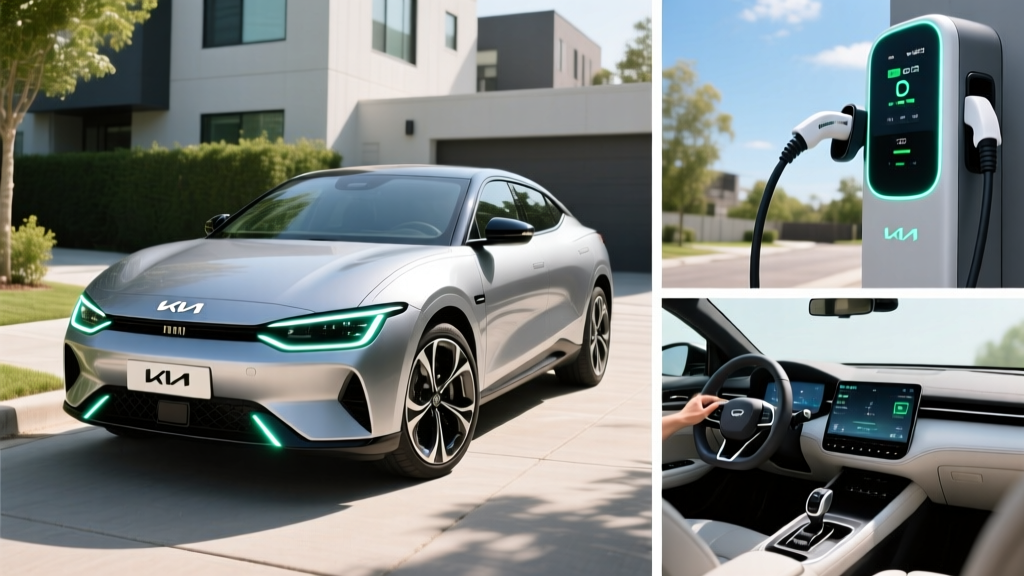
The Kia EV6 has been one of the most compelling electric crossovers since its debut, and the 2026 Kia EV6 arrives with meaningful updates that sharpen its position against rivals like the Tesla Model Y, Ford Mustang Mach-E, and Hyundai Ioniq 5. Built on Hyundai Motor Group's E-GMP 800-volt architecture, the EV6 continues to offer some of the fastest DC fast-charging speeds in its class, a comfortable and well-appointed interior, and a real-world range that holds up well on highway road trips. This review breaks down every number that matters — from EPA range and charging curves to total cost after federal tax credits — so you can decide if the 2026 EV6 fits your next purchase.
Quick Verdict: Who Should Buy the 2026 Kia EV6?
The 2026 EV6 is best suited for tech-forward commuters and small families who prioritize ultra-fast public charging and a premium cabin over maximum cargo space. If your routine includes regular DC fast-charging on road trips and you value an 800V platform that most competitors still lack, the EV6 remains a top-tier pick. It's less ideal for buyers who need three-row seating, maximum towing capability, or the lowest possible entry price in the segment.
Range, Battery, and Efficiency
The 2026 Kia EV6 carries over a 77.4 kWh usable battery pack (84.0 kWh gross) using NMC (nickel-manganese-cobalt) chemistry, which provides higher energy density than LFP at the cost of slightly more sensitivity to repeated 100% charging. Kia pairs this pack with a heat pump across all trims, which is critical for preserving range in cold climates.
| Trim | Drivetrain | EPA Range | MPGe (City/Hwy/Combined) | kWh/100 mi |
|---|---|---|---|---|
| Light / Wind RWD | Rear-Wheel Drive | 310 miles | 134 / 115 / 125 MPGe | 27 |
| Wind AWD | Dual-Motor AWD | 282 miles | 117 / 101 / 109 MPGe | 31 |
| GT-Line AWD | Dual-Motor AWD | 274 miles | 113 / 97 / 105 MPGe | 32 |
| GT | Dual-Motor AWD (Performance) | 232 miles | 85 / 74 / 80 MPGe | 42 |
Charging Speed: DC Fast and Home Level 2
The EV6's 800-volt architecture is its defining technical advantage. While most rivals in this price range use 400V systems that peak around 150 kW, the EV6 can accept up to 240 kW on a compatible DC fast charger — meaning you'll see real charging speeds that sustain well above what competitors manage through the middle of the charge curve.
| Charging Level | Power (kW) | Speed / Time | Connector |
|---|---|---|---|
| Level 1 (120V household) | ~1.4 kW | ~4 miles per hour | J1772 / NACS |
| Level 2 (240V home) | 10.9 kW | ~36 miles per hour (full charge ~7.5 hrs) | J1772 / NACS |
| DC Fast Charge | Up to 240 kW peak | 10–80% in ~18 minutes | CCS1 (2026 model year); NACS adapter available |
Charging curve reality check: The 240 kW peak is achieved at low states of charge (roughly 10–35% SoC). Expect the rate to taper to ~150 kW around 50% SoC and further to ~80 kW above 70%. The 10–80% time of approximately 18 minutes is achievable at Electrify America, Tesla Supercharger (with adapter), or other 350 kW-rated stations — but not at older 50–150 kW chargers, where your session will take 30–45 minutes. Always precondition the battery via the navigation system before arriving at a DC fast charger to hit these numbers.
For the 2026 model year, Kia has adopted the NACS (North American Charging Standard) port on new EV6 models, granting native access to Tesla's Supercharger network. CCS1-equipped 2024–2025 EV6 owners can use a Kia-provided adapter. This shift significantly expands the EV6's public charging footprint, particularly in rural corridors where Superchargers often outnumber CCS stations.
Performance and Drivetrain
The standard RWD EV6 uses a single rear-mounted motor producing 225 horsepower and 258 lb-ft of torque — adequate for daily driving with a 0–60 mph time of approximately 7.2 seconds. The dual-motor AWD models bump output to 320 hp and 446 lb-ft, cutting the 0–60 to about 5.1 seconds.
The performance-oriented EV6 GT remains the flagship, with 576 hp and 545 lb-ft from its dual-motor setup, hitting 0–60 in a blistering 3.4 seconds. However, that performance comes at the cost of range (232 miles EPA) and a firmer ride. For most buyers, the Wind AWD strikes the best balance between acceleration, range, and comfort.
All trims feature regenerative braking with multiple levels, adjustable via steering-wheel paddles. The highest setting enables near one-pedal driving in city traffic, though it doesn't bring the car to a complete hold without brake application — unlike some competitors' full one-pedal modes.
Interior, Cargo, and Technology
The EV6's cabin has aged well thanks to its minimalist design and high-quality materials. A panoramic curved display houses a 12.3-inch digital cluster and a 12.3-inch infotainment touchscreen running Kia's latest Connect system with wireless Apple CarPlay and Android Auto. Physical climate controls return for 2026, addressing one of the most common complaints about the prior touch-capacitive panel.
| Measurement | Specification |
|---|---|
| Front Headroom | 39.2 inches |
| Rear Headroom | 38.0 inches |
| Front Legroom | 41.7 inches |
| Rear Legroom | 39.5 inches |
| Cargo Volume (behind 2nd row) | 24.4 cu ft |
| Cargo Volume (seats folded) | 50.2 cu ft |
| Front Trunk (Frunk) | 0.7 cu ft (AWD) / 1.8 cu ft (RWD) |
The rear seat is genuinely comfortable for adults on longer trips, with ample legroom rivaling midsize sedans. However, the sloping roofline cuts into cargo height, and the 50.2 cu ft maximum cargo volume trails the Tesla Model Y (76 cu ft) and Hyundai Ioniq 5 (56 cu ft) noticeably. The frunk on AWD models is essentially a small cubby — useful for charging cables but not much else.
Driver assistance: The EV6 comes standard with Kia's Highway Driving Assist 2 (HDA2), a SAE Level 2 system offering adaptive cruise control with stop-and-go, lane centering, and lane-change assist. It's competent on interstates but requires the driver to maintain hands-on-wheel awareness. It is not a self-driving system and does not approach Level 3 or Level 4 autonomy. GT-Line and GT trims add Remote Smart Parking Assist, which can move the car in and out of tight spaces via the key fob.
Pricing, Trims, and Federal Tax Credit Eligibility
The 2026 Kia EV6 starts at $42,900 MSRP for the Light RWD trim and climbs to approximately $61,600 for the GT. Destination charges add roughly $1,375. Here's the trim-by-trim breakdown with federal tax credit implications:
| Trim | MSRP (incl. destination) | Est. §30D Credit | Effective Price |
|---|---|---|---|
| Light RWD | $44,275 | Up to $7,500* | ~$36,775 |
| Wind RWD | $48,675 | Up to $7,500* | ~$41,175 |
| Wind AWD | $52,575 | Up to $7,500* | ~$45,075 |
| GT-Line AWD | $57,975 | Up to $7,500* | ~$50,475 |
| GT AWD | $62,975 | Up to $7,500* | ~$55,475 |
*Critical tax credit caveats: The IRS §30D Clean Vehicle Credit has several eligibility requirements that can reduce or eliminate the credit:
- MSRP cap: SUVs/crossovers must be under $80,000 MSRP — all EV6 trims qualify.
- Buyer income limits: Modified AGI cannot exceed $150,000 (single), $225,000 (head of household), or $300,000 (joint). Check your tax situation before assuming eligibility.
- Battery sourcing: The credit is split into two halves ($3,750 each) — one for critical minerals and one for battery components. Kia has been working to shift EV6 battery sourcing to North America through its Georgia plant, but specific mineral-sourcing percentages change annually. Verify current-year compliance on fueleconomy.gov before purchasing.
- Point-of-sale transfer: Eligible buyers can transfer the credit to the dealer at purchase, reducing the upfront price rather than waiting for a tax refund.
Always consult a tax professional and verify your specific eligibility — rules shift and individual circumstances vary.
Warranty and Long-Term Ownership
Kia backs the 2026 EV6 with one of the strongest warranty packages in the EV segment:
- Battery & Drive Unit: 10 years / 100,000 miles (whichever comes first)
- Battery Capacity Retention: Warranty covers degradation below 70% of original capacity within the warranty period
- Basic Vehicle: 5 years / 60,000 miles
- Powertrain: 10 years / 100,000 miles
- Roadside Assistance: 5 years / 60,000 miles
The 10-year/100,000-mile battery warranty is a standout and significantly outlasts Tesla's 8-year/120,000-mile coverage on the Model Y. The 70% capacity retention threshold is industry-standard. Real-world NMC degradation data from early EV6 owners suggests roughly 5–8% capacity loss over the first 3 years with normal charging habits (avoiding frequent 100% charges and DC fast-charging exclusively). Kia's battery management system includes active thermal management to further protect long-term health.
Pros and Cons
Pros
- Ultra-fast 240 kW DC charging (10–80% in ~18 min)
- 800V architecture rare at this price point
- Strong 10-year/100,000-mile battery warranty
- NACS port for native Tesla Supercharger access
- Comfortable, well-built interior with physical climate controls
- Competitive real-world highway range with heat pump
- HDA2 driver assist is smooth and reliable
Cons
- Cargo volume (50.2 cu ft) trails Model Y and Ioniq 5
- Frunk is very small, especially on AWD trims
- GT trim sacrifices significant range for performance
- Rear visibility is limited by thick C-pillars
- No third-row option for larger families
- Infotainment can be slow to respond on startup
- Towing capacity limited to 2,700 lbs (braked)
2026 EV6 vs. Key Competitors
| Spec | Kia EV6 Wind AWD | Tesla Model Y LR AWD | Hyundai Ioniq 5 Limited AWD | Ford Mach-E Premium AWD |
|---|---|---|---|---|
| EPA Range | 282 mi | 320 mi | 266 mi | 290 mi |
| Battery (usable kWh) | 77.4 | 75.0 | 77.4 | 75.7 |
| Peak DC Charge (kW) | 240 | 250 | 240 | 150 |
| 10–80% DC Time | ~18 min | ~20 min | ~18 min | ~38 min |
| 0–60 mph | 5.1 sec | 4.8 sec | 5.1 sec | 5.5 sec |
| Cargo (max cu ft) | 50.2 | 76.0 | 56.2 | 59.7 |
| Base MSRP (AWD) | ~$52,575 | ~$48,990 | ~$54,600 | ~$48,995 |
| Battery Warranty | 10 yr / 100k mi | 8 yr / 120k mi | 10 yr / 100k mi | 8 yr / 100k mi |
The EV6's edge is charging infrastructure flexibility (NACS + 800V) and warranty length. The Model Y wins on range and cargo space. The Ioniq 5 is its platform sibling with a slightly boxier design and more cargo room. The Mach-E lags in charging speed but offers competitive range and pricing.
Frequently Asked Questions
What is the real-world range of the 2026 Kia EV6?
The RWD model's EPA estimate is 310 miles. In real-world highway driving at 70 mph, expect 255–275 miles. Cold weather (below freezing) reduces this to roughly 215–250 miles. The AWD Wind model delivers approximately 235–250 miles on the highway in moderate temperatures.
How fast does the 2026 EV6 charge at home and on the road?
On a Level 2 home charger (240V, 48A), the EV6 charges at 10.9 kW, adding roughly 36 miles of range per hour — a full charge takes about 7.5 hours. On a 350 kW-capable DC fast charger, it peaks at 240 kW and reaches 10–80% in approximately 18 minutes. On older 50–150 kW chargers, plan for 30–45 minutes.
Does the 2026 Kia EV6 qualify for the $7,500 federal tax credit?
It can, but eligibility depends on your income (AGI caps apply), the specific battery-sourcing compliance for the current production batch, and MSRP limits. All EV6 trims fall under the $80,000 SUV MSRP cap. Verify current sourcing compliance on fueleconomy.gov and consult a tax professional before relying on the credit.
Is the 2026 EV6 worth buying over the Tesla Model Y?
Choose the EV6 if you prioritize faster DC charging on non-Tesla networks, a longer battery warranty (10 vs. 8 years), and a quieter, more traditionally styled interior. Choose the Model Y if maximum cargo space, slightly longer EPA range, and Tesla's software ecosystem are more important to you. Both are strong picks — the decision comes down to which trade-offs matter more for your lifestyle.
What connector does the 2026 EV6 use?
The 2026 model year EV6 comes equipped with the NACS (Tesla-style) charging port, providing native access to the Tesla Supercharger network. CCS1 adapters are available for use with Electrify America and other CCS-based public chargers that haven't yet transitioned to NACS.
How long will the EV6 battery last?
Kia warranties the battery for 10 years or 100,000 miles against degradation below 70% capacity. Real-world data from early E-GMP platform owners (EV6, Ioniq 5) suggests 5–8% degradation over 3 years with mixed charging habits. With proper care (charging to 80% daily, limiting DC fast-charging frequency), the battery should remain well above 80% capacity at the 10-year mark.