Quick Verdict: Is the 2026 Kia EV6 Worth Leasing?
The 2026 Kia EV6 remains one of the most well-rounded electric crossovers on the market, combining 800-volt ultra-fast charging, sharp styling, and practical interior space. For buyers weighing Kia EV6 leasing versus purchasing outright, the math often favors a lease: you sidestep long-term battery depreciation concerns, lock in a predictable monthly payment, and can upgrade when solid-state or next-gen models arrive later this decade. The EV6 earns a strong recommendation for commuters and small families who want rapid DC charging and a premium cabin without crossing into luxury-brand pricing.
However, the EV6 is not without trade-offs. The standard-range battery delivers underwhelming real-world range, the rear visibility is compromised by the sloping roofline, and Kia's infotainment — while feature-rich — can feel cluttered compared to Tesla or Hyundai's Ioniq 5 interface. Let's break down every number that matters.
Range, Battery, and Real-World Efficiency
| Specification | Wind (RWD Std Range) | Wind/Light (RWD Long Range) | GT-Line (AWD Long Range) | GT (AWD Performance) |
|---|---|---|---|---|
| EPA Range | 232 mi | 310 mi | 282 mi | 206 mi |
| Battery (Usable) | 58.0 kWh | 77.4 kWh | 77.4 kWh | 77.4 kWh |
| Chemistry | NMC | NMC | NMC | NMC |
| Combined MPGe | 117 MPGe | 134 MPGe | 106 MPGe | 85 MPGe |
| Efficiency (kWh/100 mi) | 29 | 25 | 32 | 40 |
| Drivetrain | RWD | RWD | AWD Dual-Motor | AWD Dual-Motor |
| Horsepower | 167 hp | 225 hp | 320 hp | 576 hp |
| 0-60 mph | 7.7 sec | 6.2 sec | 4.5 sec | 3.4 sec |
All 2026 EV6 models use NMC (nickel manganese cobalt) lithium-ion cells, not LFP. NMC offers higher energy density — enabling that 310-mile Long Range figure in a relatively compact pack — but it is more sensitive to sustained high state-of-charge storage. For longevity, Kia recommends keeping daily charging between 20-80% and only charging to 100% before long trips. Source: fueleconomy.gov.
Charging Speed: 800-Volt Architecture Pays Off
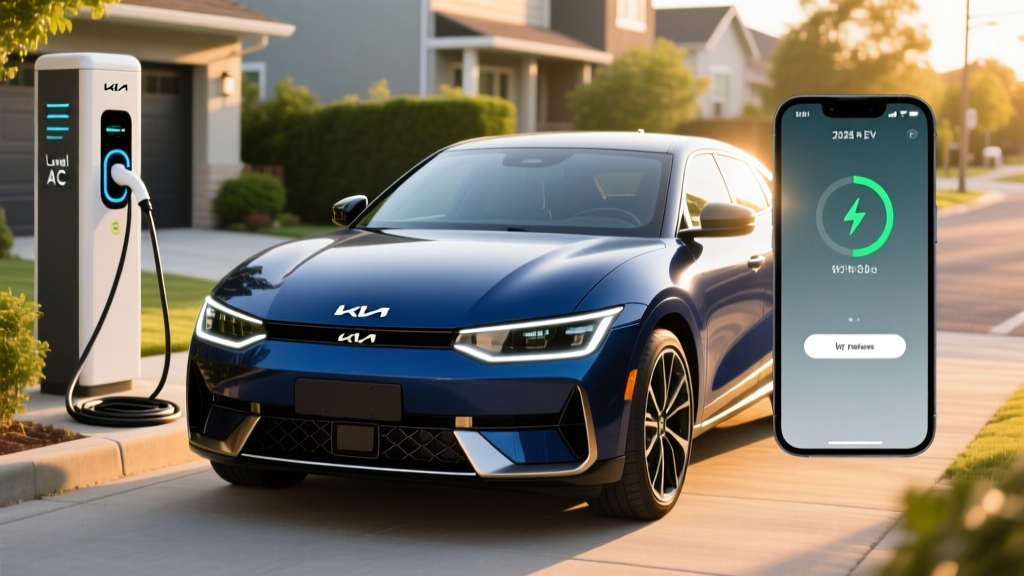
The EV6's E-GMP platform supports 800-volt DC fast charging, one of the key advantages it holds over competitors still on 400-volt systems. Here is what that translates to in practice:
| Charging Level | Power / Rate | Time / Miles Added |
|---|---|---|
| Level 1 (120V household) | ~1.4 kW | ~4-5 miles per hour |
| Level 2 (240V home, 48A) | 10.9 kW | ~36 miles per hour; 0-100% in ~7.5 hrs (77.4 kWh) |
| DC Fast Charge (350 kW station) | Peak 240 kW | 10-80% in ~18 minutes (Long Range) |
| DC Fast Charge (150 kW station) | Peak ~135 kW | 10-80% in ~28 minutes |
Charging curve reality: The EV6 peaks near 240 kW between roughly 10-55% state of charge, then tapers progressively. From 80-100%, charging slows dramatically to protect the NMC cells — expect the final 20% to take nearly as long as the 10-80% sprint. For road trips, adopt the 10-80% strategy: charge for 18 minutes, drive ~200 miles, repeat.
One important note for home charging: the EV6 ships with a NACS (Tesla-style) charge port for the 2026 model year in North America, giving you native access to Tesla Superchargers with V3 (150 kW) and V4 stalls without an adapter. This dramatically expands your public charging network compared to the CCS1 port on pre-2025 models. For home Level 2 installation, budget $600-$1,500 for a quality 48-amp charger (e.g., ChargePoint Home Flex or Emporia Level 2) plus $500-$2,000 for electrician labor, depending on panel proximity and whether a 200-amp service upgrade is needed.
Pricing, Trims, and the Tax Credit Question
| Trim | Base MSRP | Federal §30D Credit | Effective Price (if eligible) |
|---|---|---|---|
| Wind (RWD Std Range) | $41,900 | Up to $7,500 | ~$34,400 |
| Wind (RWD Long Range) | $45,900 | Up to $7,500 | ~$38,400 |
| GT-Line (AWD Long Range) | $52,400 | Up to $7,500 | ~$44,900 |
| GT (AWD Performance) | $61,400 | Up to $7,500 | ~$53,900 |
Does the 2026 Kia EV6 qualify for the federal EV tax credit? The answer depends on three IRS §30D requirements that change periodically. As of the 2026 tax year:
- MSRP cap: SUVs must be under $80,000. All EV6 trims clear this threshold.
- Buyer income cap: Modified adjusted gross income must not exceed $150,000 (single), $225,000 (head of household), or $300,000 (joint filers).
- Battery sourcing: A percentage of critical minerals and battery components must be sourced from the U.S. or free-trade-agreement countries. Kia has progressively shifted supply chains, but the exact credit amount ($3,750 or $7,500) depends on current-year sourcing compliance. Check the IRS clean vehicle credit page for the latest approved vehicle list.
- Point-of-sale transfer: Eligible buyers can transfer the credit to the dealer at purchase, reducing the drive-off price immediately — a significant advantage when negotiating a lease or purchase.
Leasing-specific note: When you lease an EV, the §30D credit technically goes to the lessor (the finance company), not to you. However, most manufacturers — Kia included — typically pass this savings through as a lease cash incentive or capitalized cost reduction. Confirm with your dealer that the $7,500 is being applied to reduce your lease cost. Under current IRS guidance, leased vehicles may also qualify under the separate commercial clean vehicle credit (§45W), which has fewer sourcing restrictions — meaning leased EVs often have an easier path to the full incentive than purchased ones.
Interior Space, Tech, and Daily Livability
The EV6's cabin blends futuristic design with genuine practicality. Here are the dimensions that matter for families and cargo haulers:
- Cargo volume: 24.4 cu ft behind the rear seats; 50.2 cu ft with the 60/40 rear seats folded
- Frunk (front trunk):strong> 0.7 cu ft (Long Range AWD) — enough for the charge cable and a small bag; RWD models offer a slightly larger 1.8 cu ft
- Rear legroom: 39.4 inches — competitive with the Hyundai Ioniq 5 and significantly better than the Ford Mustang Mach-E
- Front headroom: 40.9 inches (without panoramic roof); the glass roof reduces this by roughly 0.5 inches
Tech highlights:
- Dual 12.3-inch curved displays (instrument cluster + infotainment) running Kia's latest Connect system
- Wireless Apple CarPlay and Android Auto (now standard across all trims for 2026)
- Augmented-reality head-up display (GT-Line and above)
- Vehicle-to-load (V2L) capability — the EV6 can power external devices up to 3.6 kW via an interior outlet and an external adapter, useful for camping or emergency backup
- Digital Key 2.0 using UWB (Ultra-Wideband), allowing your phone to unlock and start the car
Driver assistance (SAE Level 2): The EV6 comes with Kia's Highway Driving Assist 2 (HDA2), which combines adaptive cruise control with lane-centering and automatic lane-change assist on divided highways. This is a Level 2 system — you must keep your hands on or near the wheel and remain fully engaged. It is not self-driving. HDA2 performs well on interstates but will disengage on faded lane markings or sharp curves. For the 2026 model year, Kia has improved the lane-centering smoothness and reduced the frequency of unnecessary hands-on-wheel alerts.
Warranty and Long-Term Ownership
Kia backs the EV6 with one of the strongest warranty packages in the segment:
- Battery & drive unit: 10 years / 100,000 miles (whichever comes first), covering defects and capacity loss below approximately 70% state of health
- Limited vehicle warranty: 5 years / 60,000 miles
- Powertrain: 10 years / 100,000 miles
- Roadside assistance: 5 years / 60,000 miles
The 10-year battery warranty is a significant lease advantage — virtually any 36- or 48-month lease will be fully covered under warranty for the entire term, eliminating battery-degradation risk for the lessee. If you plan to buy and hold for 8+ years, the warranty provides meaningful peace of mind. NMC batteries in the EV6 have shown approximately 10-15% degradation over the first 100,000 miles based on fleet data from earlier model years, which is within industry norms.
How the EV6 Stacks Up Against Key Rivals
| Spec | 2026 Kia EV6 (LR RWD) | 2026 Hyundai Ioniq 5 (LR RWD) | 2026 Tesla Model Y (LR AWD) | 2026 Ford Mustang Mach-E (ER RWD) |
|---|---|---|---|---|
| EPA Range | 310 mi | 303 mi | 320 mi | 300 mi |
| Battery | 77.4 kWh NMC | 77.4 kWh NMC | ~78 kWh NMC | 91 kWh NMC |
| Peak DC Charge | 240 kW | 240 kW | ~250 kW | ~150 kW |
| 10-80% Time | ~18 min | ~18 min | ~22 min | ~38 min |
| 0-60 mph | 6.2 sec | 6.3 sec | 4.8 sec | 5.1 sec |
| Base MSRP | $45,900 | $46,500 | $47,990 | $45,995 |
| NACS Port (native) | Yes (2026) | Yes (2026) | Yes | Yes (2026) |
| Battery Warranty | 10 yr / 100k mi | 10 yr / 100k mi | 8 yr / 120k mi | 8 yr / 100k mi |
The EV6's closest sibling, the Hyundai Ioniq 5, shares the E-GMP platform and nearly identical powertrain specs. The Ioniq 5 offers a slightly roomier rear seat and more retro styling; the EV6 counters with a sportier driving feel and a marginally larger EPA range figure. Against the Tesla Model Y, the EV6 trails in range, Supercharger network maturity (though NACS adoption narrows this gap), and software polish — but wins on interior material quality, ride comfort, and warranty length. The Mach-E offers strong range and a sporty drive but charges considerably slower on DC, which matters on road trips.
Pros
- Ultra-fast 240 kW DC charging (10-80% in ~18 min)
- Native NACS port for Tesla Supercharger access
- Industry-leading 10-year/100,000-mile battery warranty
- V2L capability for off-grid and emergency power
- Sporty handling for a crossover; GT model is genuinely quick
- Generous rear legroom (39.4 in)
Cons
- Standard Range (232 mi EPA) is hard to recommend for most buyers
- Rear visibility compromised by thick C-pillars and sloping roofline
- Small frunk (especially on AWD models)
- Infotainment can feel overloaded; touch-capacitive climate controls are finicky
- GT-Line and GT trims push into luxury-EV pricing territory
- NMC chemistry requires more careful SoC management than LFP
Who Should Lease the 2026 Kia EV6?
Lease the EV6 if:
- You commute 30-60 miles daily and want ultra-fast public charging for weekend road trips
- You value a premium interior and sporty driving dynamics without luxury-brand pricing
- You want to test EV ownership for 36-48 months without committing to long-term battery risk
- You can install a Level 2 home charger (the EV6 rewards home charging with low per-mile costs)
- You want access to Tesla Superchargers natively without carrying adapters
Look elsewhere if:
- You need maximum cargo space — the Ioniq 5 or Model Y offer more cubic feet
- You frequently tow — the EV6 is not rated for towing in the U.S. market
- You want LFP chemistry for worry-free 100% daily charging — consider the Tesla Model Y RWD
- You drive 200+ highway miles daily without access to fast charging
For most lessees, the Wind RWD Long Range at $45,900 MSRP hits the sweet spot: 310 miles EPA, 225 hp, and the full 240 kW charging capability without paying for AWD or performance trims you may not need. Apply the lease cash incentive (typically reflecting the $7,500 federal credit), negotiate the capitalized cost, and target a 36-month/36,000-mile lease for the best residual value protection.
Frequently Asked Questions
What is the real-world range of the 2026 Kia EV6?
The Long Range RWD model is EPA-rated at 310 miles. In real-world highway driving at 70-75 mph, expect 260-275 miles. In cold weather (below 30°F), plan for 215-230 miles. The Standard Range model delivers roughly 190-210 miles real-world highway.
How fast does the Kia EV6 charge at home and on the road?
At home on a 240V Level 2 charger (48 amps / 10.9 kW), the Long Range EV6 adds about 36 miles per hour and charges fully in ~7.5 hours. On a 350 kW DC fast charger, it peaks at 240 kW and charges 10-80% in approximately 18 minutes. On a 150 kW station, expect 10-80% in about 28 minutes.
Does the 2026 Kia EV6 qualify for the $7,500 federal tax credit?
All EV6 trims fall under the $80,000 MSRP cap. Eligibility depends on your income (≤$150K single / ≤$300K joint), and the vehicle's battery sourcing compliance with current IRS §30D rules. When leasing, the credit typically flows through as a lease incentive from Kia. Always verify current eligibility on irs.gov before signing.
Is the Kia EV6 better than the Hyundai Ioniq 5?
They share the same E-GMP platform, battery, and charging hardware. The EV6 is slightly more efficient (310 vs 303 mi EPA), has a sportier driving character, and a more driver-focused cockpit. The Ioniq 5 offers a roomier rear seat and more cargo versatility. Neither is objectively better — choose based on styling preference and which dealer offers the better lease deal.
Can the Kia EV6 use Tesla Superchargers?
Yes. The 2026 EV6 comes with a native NACS charge port, giving you direct access to Tesla's Supercharger network (V3 and V4 stalls) without an adapter. This is one of the strongest practical advantages for 2026 model-year Kia and Hyundai EVs.
What is the battery warranty on the EV6?
Kia covers the high-voltage battery and drive unit for 10 years or 100,000 miles, whichever comes first. This warranty covers defects and capacity loss below approximately 70% of original capacity. For a typical 36-month lease, you will never approach the warranty limits.
Is leasing an EV6 better than buying?
Leasing makes sense if you want to avoid battery depreciation risk, prefer a lower monthly payment, and plan to upgrade in 3-4 years. Buying makes sense if you drive high annual mileage (over 15,000 miles/year, where lease penalties apply), want to claim the §30D credit directly on your tax return, and plan to keep the vehicle 6+ years. Run both scenarios with your dealer's specific money factor and residual to compare.