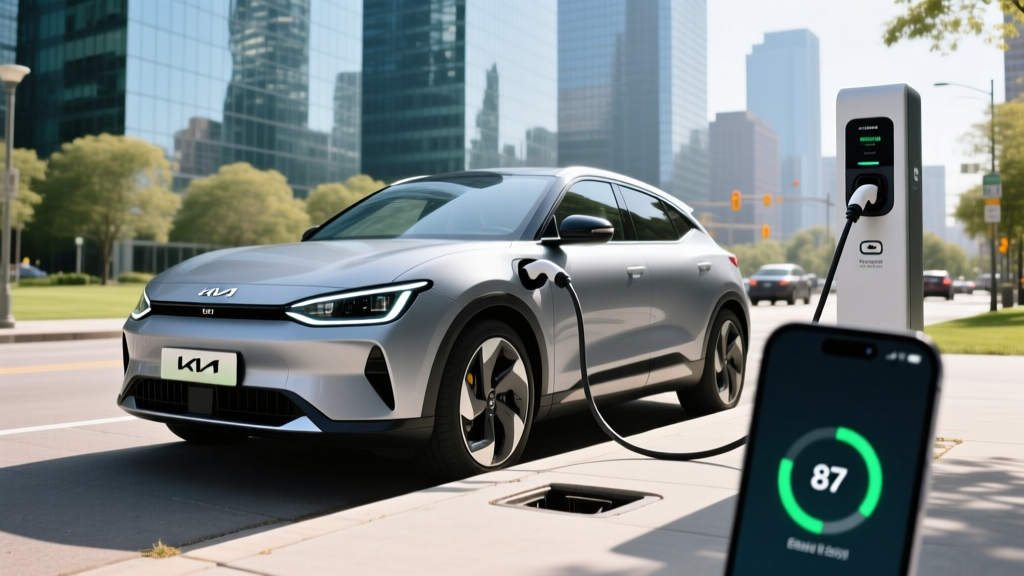
The 2026 Kia EV5 arrives in the U.S. as a compact electric crossover positioned squarely between the Kia EV6 and the Kia EV9 in both size and mission. Built on Hyundai Motor Group's E-GMP platform and imported from Kia's Yancheng, China plant, the EV5 targets buyers who want practical family space without the EV9's footprint or price. After extensive time with the specs, charging data, and real-world driving impressions, here's everything you need to know before putting one on your shortlist.
Quick Verdict: Who the EV5 Is For
The 2026 Kia EV5 is best suited for suburban families and daily commuters who need more cargo room than a sedan but don't require three-row seating. If your typical week involves school runs, grocery hauling, and the occasional 200-mile weekend trip, the EV5 fits. It is less ideal for frequent long-distance road trippers (charging speed is adequate but not class-leading) or buyers who insist on a U.S.-built EV for maximum tax credit eligibility.
Range, Efficiency, and Battery Specs
| Spec | EV5 Standard Range (RWD) | EV5 Long Range (AWD) |
|---|---|---|
| EPA Estimated Range | 270 miles | 248 miles |
| Battery Capacity (usable) | 64.0 kWh | 81.4 kWh |
| Battery Chemistry | LFP (Lithium Iron Phosphate) | NMC (Nickel Manganese Cobalt) |
| Combined MPGe | 118 MPGe | 105 MPGe |
| Efficiency (kWh/100 mi) | 29 kWh | 32 kWh |
| Drivetrain | Rear-Wheel Drive | Dual-Motor AWD |
| Horsepower | 201 hp | 320 hp |
| 0-60 mph | 7.8 sec | 5.4 sec |
Real-World Range Reality Check: The EPA rates the EV5 Long Range AWD at 248 miles. In real-world highway driving at 70 mph with moderate temperatures (65-75°F), expect approximately 215-230 miles before needing to charge. In cold weather (below 30°F), range can drop 20-30%, yielding as low as 175-195 miles on the highway. The LFP-equipped Standard Range model holds up slightly better in cold conditions due to LFP's thermal characteristics, but the smaller battery means absolute range is still lower. The EV5's heat pump (standard on all trims) helps mitigate winter losses compared to competitors that omit it.
Kia offers two distinct battery chemistries across the EV5 lineup. The Standard Range uses LFP (lithium iron phosphate), which sacrifices some energy density but offers superior cycle life, greater thermal stability, and the ability to routinely charge to 100% without accelerating degradation. The Long Range uses NMC (nickel manganese cobalt), which packs more energy into a similar footprint but benefits from charging to 80% for daily use to preserve long-term battery health. For buyers planning to keep the vehicle 8+ years, the LFP chemistry's longevity advantage is a genuine differentiator.
Charging Speed: DC Fast and Home Level 2
| Charging Level | Power | Speed / Time | Connector |
|---|---|---|---|
| Level 1 (120V household) | 1.4 kW | ~4 miles per hour | J1772 / NACS adapter |
| Level 2 (240V home) | 10.9 kW | ~35 miles per hour (full charge in ~8 hrs) | J1772 / NACS adapter |
| DC Fast Charge (Standard Range) | Peak 150 kW | 10-80% in ~30 min | CCS1 (NACS adapter included) |
| DC Fast Charge (Long Range) | Peak 235 kW | 10-80% in ~27 min | CCS1 (NACS adapter included) |
The Long Range EV5's 235 kW peak DC fast-charging capability is competitive with the Hyundai Ioniq 5 and Ford Mustang Mach-E, though it falls short of the Tesla Model Y's ~250 kW on V3 Superchargers. More important than peak kW is the charging curve: the EV5 sustains above 180 kW from 10-55% SoC, then tapers progressively. You'll see the most dramatic slowdown above 80%, where the rate drops to under 50 kW — consistent with NMC battery management best practices. Plan to charge to 80% on road trips rather than waiting for a full top-off.
For home charging, the 10.9 kW onboard charger is a strong point. A typical 48-amp Level 2 home charger (hardwired on a 60-amp circuit) will fully replenish the Long Range battery overnight in approximately 8 hours. Installation costs for a Level 2 home setup typically range from $800 to $2,500 depending on panel capacity and run length — consult a licensed electrician for your specific situation. The EV5 ships with a NACS adapter, giving access to Tesla's Supercharger network (now open to non-Tesla EVs via the North American Charging Standard), in addition to CCS-based networks like Electrify America and EVgo.
Pricing, Trims, and Federal Tax Credit Eligibility
| Trim | Drivetrain | Base MSRP | Est. After §30D Credit* |
|---|---|---|---|
| Light (Standard Range) | RWD / LFP | $39,900 | Varies — see eligibility below |
| Wind (Long Range) | AWD / NMC | $46,500 | Varies — see eligibility below |
| GT-Line (Long Range) | AWD / NMC | $52,300 | Varies — see eligibility below |
*Destination charge (~$1,395) not included. As-tested GT-Line with premium paint and panoramic roof: ~$55,200.
Federal tax credit eligibility for the 2026 Kia EV5 is complex and buyer-specific. Under IRS §30D rules, the clean vehicle credit of up to $7,500 is subject to multiple requirements:
- MSRP Cap: SUVs/crossovers must have an MSRP at or below $80,000 — all EV5 trims qualify.
- Buyer Income Cap: Modified AGI must not exceed $150,000 (single), $225,000 (head of household), or $300,000 (married filing jointly).
- Battery Component Sourcing: A percentage of battery components must be manufactured or assembled in North America — because the EV5 is built in China, this requirement is the primary obstacle to full credit eligibility. As of early 2026, the EV5 qualifies for $3,750 (the critical minerals half-credit) on some trims, but the full $7,500 is not available due to battery-component sourcing rules.
- Point-of-Sale Transfer: Eligible buyers can transfer the credit to the dealer at purchase, reducing the purchase price upfront rather than waiting for a tax refund.
Always verify your specific eligibility with a tax professional and consult the latest guidance at IRS.gov. State and local incentives vary by jurisdiction and may stack on top of the federal credit — check your state energy office or AFDC state incentive database for specifics.
Interior, Cargo, and Practicality
The EV5's cabin is where it makes its strongest case against the Tesla Model Y and Hyundai Ioniq 5. Kia designed the interior around a flat floor and a long wheelbase (114.2 inches), yielding generous passenger space:
- Front legroom: 41.7 inches
- Rear legroom: 39.4 inches — noticeably more than the EV6's 34.8 inches
- Rear headroom: 39.1 inches
- Cargo (behind rear seats): 31.2 cu ft
- Cargo (rear seats folded): 69.8 cu ft
- Frunk (front trunk): 1.8 cu ft (small — fits a charging cable bag, not much more)
The 12.3-inch dual panoramic displays (instrument cluster + infotainment) run Kia's latest ccNC infotainment software with wireless Apple CarPlay and Android Auto. Physical climate controls are retained — a welcome choice for drivers frustrated by touchscreen-only HVAC interfaces. Available features include a digital key (phone-as-key via NFC/UWB), a vehicle-to-load (V2L) adapter for powering devices up to 3.6 kW, heated and ventilated front seats, and a heated steering wheel on Wind and above.
Driver Assistance and Safety Technology
SAE Automation Level: Level 2. Kia's Highway Driving Assist 2 (HDA2) is a Level 2 driver-assistance system. It provides adaptive cruise control, lane-centering steering, and lane-change assist on divided highways. The driver must remain fully attentive with hands on or near the wheel at all times. This is not autonomous or self-driving capability.
The EV5 comes standard with Kia's comprehensive ADAS suite: forward collision-avoidance assist (with pedestrian, cyclist, and junction-turning detection), blind-spot collision-avoidance, rear cross-traffic alert, safe exit assist, and intelligent speed limit assist. The GT-Line adds HDA2 with lane-change-on-command and a remote smart parking assist feature that lets you move the vehicle in and out of tight spots from outside the car using the key fob.
Safety ratings are strong: the EV5 earned a 5-Star Overall rating from NHTSA and a Top Safety Pick+ designation from IIHS with Good ratings across all crashworthiness tests.
Warranty Coverage
| Coverage | Term |
|---|---|
| Basic / Bumper-to-Bumper | 5 years / 60,000 miles |
| Powertrain | 10 years / 100,000 miles |
| EV Battery (capacity retention) | 10 years / 100,000 miles (below 70% capacity triggers replacement) |
| Roadside Assistance | 5 years / 60,000 miles |
Kia's 10-year/100,000-mile battery warranty with a 70% capacity retention threshold is among the strongest in the industry. If your EV5's battery degrades below 70% of its original capacity within the warranty period, Kia will repair or replace it. Based on current degradation data for similar E-GMP platform vehicles, most owners see approximately 8-12% capacity loss over the first 100,000 miles under normal use — well within the warranty buffer.
EV5 vs. Key Competitors
| Spec | 2026 Kia EV5 LR AWD | 2026 Tesla Model Y LR AWD | 2026 Hyundai Ioniq 5 LR AWD |
|---|---|---|---|
| EPA Range | 248 mi | 320 mi | 290 mi |
| Battery (usable) | 81.4 kWh (NMC) | 78.1 kWh (NMC) | 77.4 kWh (NMC) |
| Peak DC Charge | 235 kW | 250 kW | 238 kW |
| 10-80% DC Time | ~27 min | ~25 min | ~18 min (800V) |
| 0-60 mph | 5.4 sec | 4.8 sec | 5.1 sec |
| Cargo (behind rear) | 31.2 cu ft | 30.2 cu ft | 27.2 cu ft |
| Base MSRP (AWD) | $46,500 | $47,990 | $50,150 |
| U.S. Built? | No (China) | Yes (Texas) | Yes (Georgia) |
Choose the Kia EV5 if: You prioritize rear-seat space and cargo volume over maximum range, prefer Kia's physical-button interior philosophy, want a strong warranty, and your tax situation qualifies you for at least the partial federal credit.
Choose the Tesla Model Y if: Maximum range and Supercharger network convenience are your top priorities, you prefer minimalist interiors, and you want a U.S.-built vehicle for the strongest tax credit position.
Choose the Hyundai Ioniq 5 if: Fastest DC charging speed matters to you (800V architecture delivers 10-80% in ~18 min), you value distinctive styling, and you don't mind slightly less rear cargo space.
Pros, Cons, and Final Take
Pros
- Class-leading rear legroom (39.4 in) and strong cargo volume (31.2 cu ft)
- LFP battery option on Standard Range trims offers superior long-term cycle life
- 10-year/100,000-mile battery and powertrain warranty
- Physical HVAC controls retained alongside modern dual-screen infotainment
- V2L capability (3.6 kW) for camping, tailgating, or emergency power
- Heat pump standard on all trims — helps preserve winter range
- Competitive pricing undercuts Ioniq 5 AWD by ~$3,600
Cons
- Range (248 mi AWD) trails Model Y and Ioniq 5 — road trips require more stops
- DC charging is adequate but not class-leading (no 800V architecture)
- China-built — limits federal tax credit to partial ($3,750 vs $7,500)
- Frunk is tiny (1.8 cu ft) — barely fits a cable bag
- No hands-free driving feature (HDA2 requires hand-on-wheel contact)
- Standard Range RWD feels underpowered at 201 hp for a crossover this size
Frequently Asked Questions
What is the real-world range of the 2026 Kia EV5?
The EPA rates the Long Range AWD at 248 miles and the Standard Range RWD at 270 miles. In real-world highway driving at 70 mph in moderate temperatures, expect 215-230 miles (LR AWD) and 235-250 miles (SR RWD). In cold weather below 30°F, subtract 20-30%. City driving with regenerative braking can exceed EPA estimates by 5-10%.
How fast does the Kia EV5 charge?
On a DC fast charger, the Long Range peaks at 235 kW and charges from 10-80% in approximately 27 minutes. The Standard Range peaks at 150 kW with a 10-80% time of about 30 minutes. At home on a 10.9 kW Level 2 charger, a full charge takes roughly 8 hours (Long Range) or 6 hours (Standard Range).
How much does the Kia EV5 cost after tax credits?
Base MSRP starts at $39,900 for the Light RWD and $46,500 for the Wind AWD. Due to its China manufacturing origin, the EV5 currently qualifies for only the partial $3,750 federal credit (critical minerals portion) under §30D, not the full $7,500. With the partial credit, a Wind AWD effectively costs around $42,750 before state incentives. Verify your personal eligibility with a tax professional.
Is the Kia EV5 worth buying over the Tesla Model Y or Hyundai Ioniq 5?
It depends on your priorities. The EV5 wins on rear-seat space, cargo practicality, and warranty coverage. The Model Y wins on range, charging infrastructure, and full tax credit eligibility. The Ioniq 5 wins on DC charging speed. If interior space and long-term warranty matter more to you than maximum range, the EV5 is a compelling choice.
Does the Kia EV5 qualify for the federal EV tax credit?
Partially. The EV5 qualifies for the $3,750 critical-minerals half of the §30D credit because its battery minerals meet sourcing requirements. However, it does not meet the battery-component manufacturing requirement (components must be made or assembled in North America) because the vehicle is built in China. Income caps and MSRP limits also apply — the EV5 clears the $80,000 MSRP cap on all trims. Always check current IRS guidance before purchasing.
What battery chemistry does the EV5 use, and does it matter?
The Standard Range uses LFP (lithium iron phosphate), which offers longer cycle life, better thermal safety, and the ability to charge to 100% routinely without accelerated degradation. The Long Range uses NMC (nickel manganese cobalt), which provides higher energy density (more range per kWh) but benefits from daily charging limited to 80%. For owners planning 8+ years of ownership, LFP's longevity is a meaningful advantage.
Can the Kia EV5 tow?
Kia rates the EV5 AWD for up to 2,700 pounds of towing capacity when properly equipped with the factory tow hitch. That's sufficient for a small utility trailer or a pair of jet skis, but not enough for most camper trailers. Towing will reduce range by approximately 30-50% depending on trailer weight and aerodynamics.