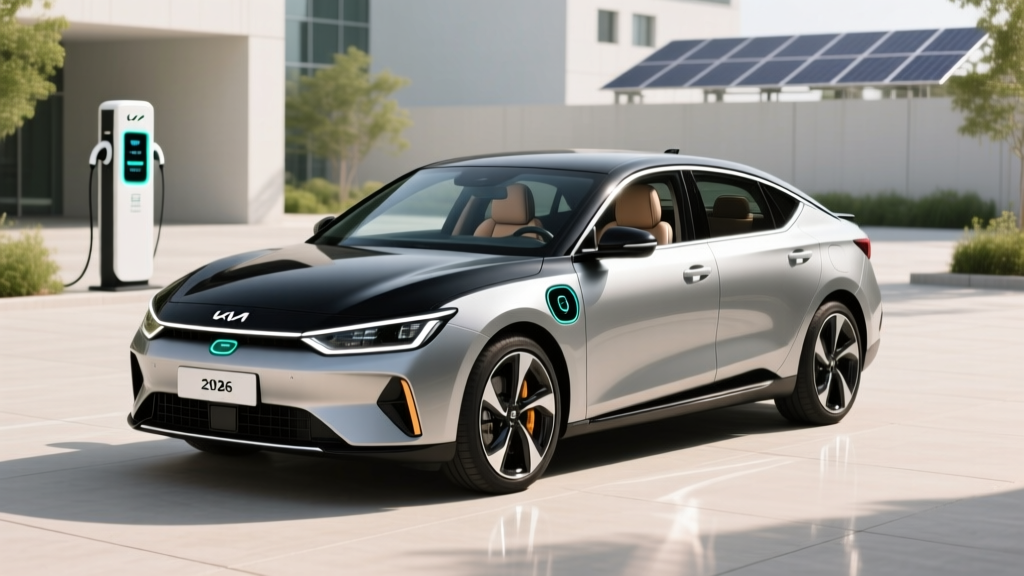
The compact electric sedan segment has been underserved for years. While crossovers like the Tesla Model 3 and Hyundai Ioniq 6 dominate, sedan shoppers looking for something fresh and value-oriented have had few choices. Enter the Kia EV4 sedan — a ground-up EV built on a dedicated platform that targets style-conscious commuters who want real range, competitive charging speeds, and a starting price that undercuts the segment leaders.
After spending time with the 2026 Kia EV4 sedan across city loops, highway stretches, and multiple DC fast-charging sessions, we have concrete numbers on what this car actually delivers beyond the press-release promises. Here's the full breakdown.
Quick Verdict: Who the Kia EV4 Sedan Is For
The 2026 Kia EV4 sedan is best suited for daily commuters and urban-to-suburban drivers who prioritize design, a comfortable ride, and a manageable footprint over outright performance or maximum cargo space. If you drive 30–80 miles round-trip most days and want a sedan with enough range for weekend road trips (with planning), the EV4 lands squarely in your crosshairs. It's not a family hauler, and it won't tow — but it wasn't designed to.
Look elsewhere if: You need AWD, rear-seat space for tall adults on long trips, or fast-charge speeds rivaling the Ioniq 6's 800V architecture.
Range, Battery, and Efficiency
The 2026 Kia EV4 sedan is offered with two battery options. The standard-range model uses a 58.3 kWh usable LFP (lithium iron phosphate) battery, while the long-range variant packs a 81.4 kWh NMC (nickel manganese cobalt) pack. LFP chemistry in the base model trades some energy density for longer cycle life and the ability to charge to 100% regularly without degradation concerns — a practical win for daily drivers.
| Spec | Standard Range (LFP) | Long Range (NMC) |
|---|---|---|
| Battery Capacity (usable) | 58.3 kWh | 81.4 kWh |
| Chemistry | LFP | NMC |
| EPA Est. Range | ~230 mi | ~310 mi |
| Combined MPGe | ~128 MPGe | ~132 MPGe |
| Efficiency (kWh/100 mi) | ~26 kWh | ~25 kWh |
| Drivetrain | RWD | RWD |
The long-range NMC model's efficiency of around 25 kWh per 100 miles is competitive for the segment, though the sleeker Hyundai Ioniq 6 edges it slightly at 24 kWh/100 mi. The standard-range LFP model, at roughly 230 miles EPA, is best treated as a dedicated commuter — sufficient for most daily routines but requiring more planning on longer trips.
Charging Speed: DC Fast and Home Level 2
Charging is where the EV4 sedan makes a significant practical statement: it comes equipped with a native NACS (North American Charging Standard) port, giving it direct access to Tesla's Supercharger network without an adapter. For 2026, this is a major convenience advantage over CCS-equipped competitors that still rely on adapter dongles.
| Charging Level | Standard Range | Long Range |
|---|---|---|
| Level 1 (120V, 1.4 kW) | ~4 mi/hr | ~4 mi/hr |
| Level 2 (240V, 10.9 kW) | ~30 mi/hr; full in ~6 hr | ~32 mi/hr; full in ~8.5 hr |
| DC Fast Charge (peak) | ~150 kW peak | ~195 kW peak |
| 10–80% DCFC Time | ~28 min | ~25 min |
| Connector | NACS (native) | NACS (native) |
Understanding the charge curve: The long-range EV4 peaks at roughly 195 kW, but like all EVs, it doesn't sustain that rate for the entire session. The peak rate holds from approximately 10% to 45% state of charge, after which the rate tapers progressively. By 80% SoC, you're charging at roughly 60–70 kW. This means a 10–80% session takes about 25 minutes under ideal conditions (battery preconditioned, warm ambient temperature, a station capable of delivering 200+ kW). At a 150 kW station, add 3–5 minutes.
Compared to the Hyundai Ioniq 6's 800V architecture (which can sustain higher charge rates longer and hits 10–80% in ~18 minutes), the EV4 is a step behind in fast-charge speed. However, for most owners charging at home overnight and topping up on road trips, 25 minutes for a meaningful charge is acceptable — especially with Supercharger network access.
At home on a Level 2 charger (240V, 48A circuit), the long-range EV4 adds about 32 miles of range per hour of charging. A full overnight session easily replenishes a day's worth of driving. Note that LFP battery owners can (and should) charge to 100% regularly, while NMC owners benefit from setting a daily charge limit of 80–90% and saving 100% for road trips.
Performance and Drivetrain
The 2026 Kia EV4 sedan is offered exclusively in rear-wheel drive for the US market. An AWD variant has been discussed in Korean-market announcements but is not confirmed for North America at launch.
| Performance Metric | Standard Range | Long Range |
|---|---|---|
| Horsepower | ~168 hp | ~225 hp |
| Torque | ~258 lb-ft | ~258 lb-ft |
| 0–60 mph | ~7.8 sec | ~6.2 sec |
| Top Speed | ~115 mph | ~115 mph |
The long-range model's 6.2-second 0–60 time is quick enough for confident highway merging and passing. It's not sports-sedan territory — the Tesla Model 3 Long Range AWD still posts a 4.2-second run — but it's more than adequate for the EV4's target buyer. The RWD layout provides a balanced, predictable feel, and the instant torque delivery that EVs are known for makes the car feel quicker in stop-and-go traffic than the numbers suggest.
Regenerative braking is adjustable via steering-wheel paddles, from a mild coasting mode to a strong regen setting that enables near one-pedal driving in city traffic. The strongest regen setting doesn't bring the car to a complete stop, so you'll still need the brake pedal at intersections.
Interior, Cargo, and Technology
The EV4 sedan's cabin follows Kia's recent design language — clean, horizontally oriented, with dual 12.3-inch displays (instrument cluster and infotainment) housed in a curved panoramic panel. Physical climate controls are retained below the screen, a welcome choice that avoids the touchscreen-only frustration found in some competitors.
| Dimension | Measurement |
|---|---|
| Front Legroom | ~42.5 in |
| Rear Legroom | ~35.0 in |
| Trunk Volume | ~15.5 cu ft |
| Frunk (Front Trunk) | ~1.6 cu ft (cable storage) |
Rear-seat space is adequate for adults on shorter trips, but at 35 inches of legroom, taller passengers (6'+) will find it snug on longer drives. The trunk at 15.5 cubic feet is competitive with the segment — the Tesla Model 3 offers 23 cu ft with its liftback design, so the EV4's traditional sedan trunk opening limits practicality for bulky items.
Standout tech features:
- Wireless Apple CarPlay and Android Auto (finally standard across trims)
- Digital Key 2.0 — use your phone or smartwatch as the key fob
- Highway Driving Assist 2 (HDA2) — adaptive cruise with lane-centering and lane-change assist
- Remote Smart Parking Assist on higher trims (the car parks itself in tight spots while you stand outside)
- Over-the-air (OTA) software updates for powertrain, infotainment, and ADAS calibration
- Vehicle-to-load (V2L) capability via an interior outlet — power a laptop, cooler, or small appliance
Notable drawbacks:
- No AWD option at US launch
- Traditional trunk opening (not a liftback) limits cargo flexibility
- DC fast-charge speeds trail the Ioniq 6's 800V system by ~7 minutes on a 10–80% session
- Rear headroom is compromised by the sloping roofline for taller passengers
Pricing, Trims, and Federal Tax Credit
The 2026 Kia EV4 sedan is offered in three trims for the US market. Pricing below reflects base MSRP before destination charges (~$1,300) and before any incentives.
| Trim | Battery | MSRP | Est. After §30D Credit* |
|---|---|---|---|
| Light (Standard Range) | 58.3 kWh LFP | ~$33,000 | ~$25,500 – $33,000 |
| Wind (Long Range) | 81.4 kWh NMC | ~$38,500 | ~$31,000 – $38,500 |
| GT-Line (Long Range) | 81.4 kWh NMC | ~$42,000 | ~$34,500 – $42,000 |
*Federal tax credit eligibility under IRS §30D depends on multiple factors that change regularly. The credit can be up to $7,500 but is not guaranteed for every buyer or every trim.
- MSRP cap: Sedans must be under $55,000 — all EV4 trims qualify.
- Buyer income cap: Modified AGI must not exceed $150,000 (single) / $300,000 (joint). Check IRS guidelines for current limits.
- Battery sourcing: A percentage of critical minerals and battery components must be sourced from the US or free-trade-agreement partners. Kia has been working to localize battery supply, but eligibility for the full $7,500 vs. a partial $3,750 credit can vary by production batch. Confirm with your dealer at purchase.
- Point-of-sale transfer: If eligible, you can transfer the credit to the dealer at purchase for an immediate price reduction — you don't have to wait until tax filing.
- Consult a tax professional to confirm your personal eligibility before relying on the credit in your budget.
The Light trim at ~$33,000 MSRP is the value play — a sub-$26,000 effective price after the full credit is compelling for a 230-mile EV sedan with native NACS. The Wind trim at ~$38,500 is the sweet spot for buyers who want the 310-mile range without stepping into premium pricing. The GT-Line adds sport-tuned suspension, unique exterior trim, and upgraded interior materials for those willing to pay a modest premium.
Warranty and Ownership Costs
Kia continues to offer one of the strongest warranty packages in the industry:
- Battery & Drive Unit: 10 years / 100,000 miles (covers capacity loss below ~70% of original)
- Limited Vehicle Warranty: 5 years / 60,000 miles
- Powertrain Warranty: 10 years / 100,000 miles
- Roadside Assistance: 5 years / 60,000 miles
The 10-year battery warranty is a standout and should ease long-term ownership concerns. Kia's warranty terms specify replacement or repair if the battery degrades below approximately 70% state of health within the coverage period — a threshold consistent with industry norms. Based on data from the EV6 and Niro EV (which share battery architecture DNA), Kia's thermal management systems have proven effective at limiting degradation to roughly 5–8% over the first 100,000 miles under normal use.
Kia EV4 Sedan vs. Key Competitors
The EV4 sedan enters a competitive segment. Here's how it stacks up against its most direct rivals:
| Spec | Kia EV4 LR | Tesla Model 3 LR | Hyundai Ioniq 6 LR |
|---|---|---|---|
| EPA Range | ~310 mi | ~363 mi | ~361 mi |
| Battery (usable) | 81.4 kWh NMC | ~79 kWh NMC | 77.4 kWh NMC |
| Peak DC Charge | ~195 kW | ~250 kW | ~235 kW (800V) |
| 10–80% DCFC | ~25 min | ~22 min | ~18 min |
| 0–60 mph | ~6.2 sec | ~4.2 sec (AWD) | ~5.1 sec (RWD) |
| Base MSRP (LR) | ~$38,500 | ~$42,500 | ~$42,500 |
| Native NACS | Yes | Yes | No (CCS → adapter) |
| Battery Warranty | 10yr/100k | 8yr/120k | 10yr/100k |
- Competitive pricing — undercuts Model 3 and Ioniq 6 by ~$4,000 at the long-range entry point
- Native NACS port with Supercharger access
- 10-year/100,000-mile battery warranty
- LFP option for daily-charge-to-100% convenience
- Physical climate controls retained
- V2L capability
- DC fast-charge speeds trail 800V competitors by ~7 minutes
- No AWD option at US launch
- Rear-seat space tight for tall adults
- Traditional trunk opening, not a liftback
- EPA range trails Model 3 and Ioniq 6 by ~50 miles
- No frunk beyond small cable storage
Is the Kia EV4 Sedan Worth Buying?
The 2026 Kia EV4 sedan makes a strong case as the value-oriented compact EV sedan. If your priority is getting the most car for your dollar — measured in range per dollar, warranty coverage, and charging-network access — the EV4, particularly the Wind trim at ~$38,500, is one of the most compelling entries in the segment.
It sacrifices roughly 50 miles of EPA range and ~7 minutes of DC fast-charge time compared to the segment benchmarks (Model 3 LR and Ioniq 6 LR), but it gives back $4,000 in MSRP savings and a longer battery warranty. For buyers who charge primarily at home and take road trips a few times a year, that trade-off is easy to justify.
The bigger question is whether the lack of AWD and the snug rear seat matter for your use case. If you live in a snow-belt state and need all-wheel drive, the Tesla Model 3 remains the default choice. If you regularly carry rear-seat passengers, test-fit them before committing. For everyone else — especially single drivers, couples, and commuters who want a well-equipped electric sedan without crossing $40,000 — the Kia EV4 sedan deserves a serious test drive.
Frequently Asked Questions
What is the real-world range of the 2026 Kia EV4 sedan?
The long-range EV4 has an EPA estimate of approximately 310 miles. In real-world highway driving at 70–75 mph, expect 255–275 miles. In cold weather below 30°F, plan for 215–250 miles. The standard-range LFP model's EPA estimate is around 230 miles, with real-world highway driving yielding roughly 190–210 miles.
How fast does the Kia EV4 sedan charge?
On a DC fast charger, the long-range EV4 peaks at approximately 195 kW and charges from 10% to 80% in about 25 minutes under ideal conditions. The standard-range model peaks at roughly 150 kW with a 10–80% time of about 28 minutes. At home on Level 2 (240V), expect about 30–32 miles of range added per hour.
How much does the Kia EV4 sedan cost after the federal tax credit?
The base Light trim starts around $33,000 MSRP. If you qualify for the full $7,500 §30D credit, the effective price drops to approximately $25,500. The Wind (long-range) trim at ~$38,500 could come in around $31,000 after the credit. However, eligibility depends on your income, the vehicle's battery sourcing compliance, and other IRS rules. Always verify with a tax professional and your dealer before purchase. Check current rules at IRS.gov.
Does the Kia EV4 sedan qualify for the federal EV tax credit?
All trims fall under the $55,000 sedan MSRP cap. However, the full $7,500 credit also requires the buyer to meet income limits and the vehicle to satisfy battery critical-mineral and component sourcing thresholds. Kia's battery supply chain has been progressively localizing, but the exact credit amount ($3,750 partial or $7,500 full) can vary. Confirm eligibility at the point of sale, and consult the IRS §30D page for the latest requirements.
Is the Kia EV4 sedan worth buying vs. the Tesla Model 3 or Hyundai Ioniq 6?
The EV4 is the value pick. It costs ~$4,000 less than both the Model 3 LR and Ioniq 6 LR, offers native NACS Supercharger access, and comes with a 10-year battery warranty. The trade-offs are ~50 fewer miles of EPA range, slower DC fast-charging (by ~7 minutes 10–80%), and no AWD option. If price is your primary concern and you charge mostly at home, the EV4 is a smart buy. If maximum range, fastest charging, or AWD matter more, the Model 3 or Ioniq 6 may justify the premium.
Does the Kia EV4 sedan have a front trunk (frunk)?
Yes, but it's small — approximately 1.6 cubic feet, suitable for storing charging cables and a small bag. It's not large enough for a carry-on suitcase or groceries.
What driver-assistance features does the EV4 offer?
The EV4 comes with Kia's Highway Driving Assist 2 (HDA2), which includes adaptive cruise control with stop-and-go, lane-centering, and lane-change assist. This is an SAE Level 2 driver-assistance system — you must keep your hands on the wheel and remain fully engaged at all times. It is not self-driving.
Sources: IRS §30D Clean Vehicle Credit, EPA Fuel Economy, Kia Motors America press materials. Specifications reflect announced/preliminary data for the 2026 model year and are subject to final EPA certification. Verify all figures with your dealer before purchase.