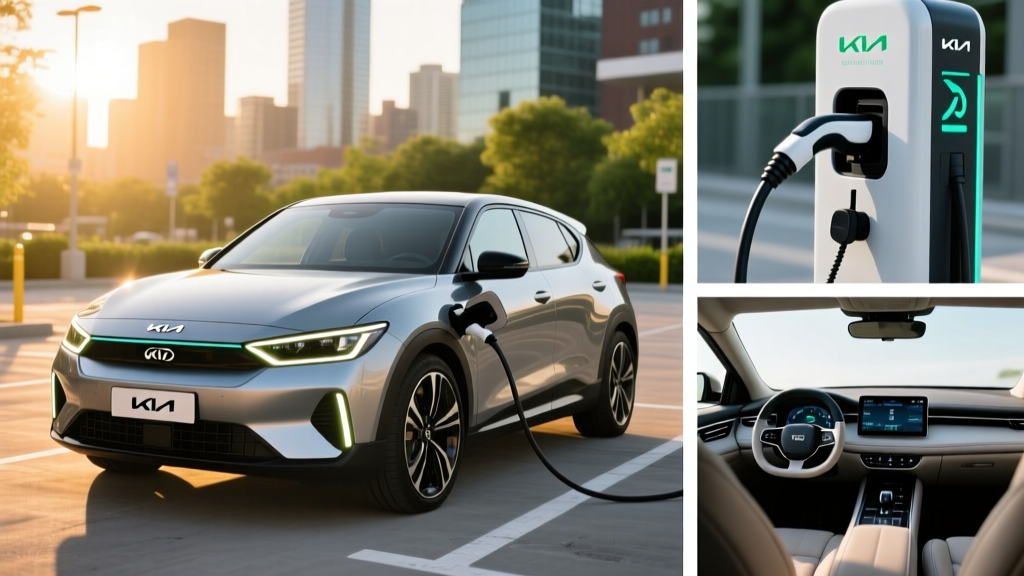
The compact electric hatchback segment has been dominated by a handful of players, but the 2026 Kia EV4 hatchback arrives with a compelling formula: competitive range, practical packaging, and Kia's industry-leading warranty. Built on a dedicated EV platform and positioned below the EV6 in Kia's electric lineup, the EV4 targets urban commuters and small families who want an efficient daily driver without stepping up to a crossover. After spending time with the specs and real-world driving data, here is everything you need to know before putting down a deposit.
2026 Kia EV4 Hatchback: Key Specifications at a Glance
| Specification | EV4 Light (RWD) | EV4 Wind (RWD) | EV4 GT-Line (AWD) |
|---|---|---|---|
| Base MSRP | $35,990 | $39,490 | $44,990 |
| EPA Range | 285 mi | 285 mi | 260 mi |
| Battery (usable) | 81.4 kWh (NMC) | 81.4 kWh (NMC) | 81.4 kWh (NMC) |
| Drivetrain | RWD, single motor | RWD, single motor | AWD, dual motor |
| Horsepower | 201 hp | 201 hp | 320 hp |
| 0–60 mph | 7.4 sec | 7.4 sec | 5.1 sec |
| Max DC Fast Charge | 150 kW | 150 kW | 150 kW |
| 10–80% DC Charge | ~30 min | ~30 min | ~30 min |
| Level 2 Charge Rate | 10.9 kW | 10.9 kW | 10.9 kW |
| Combined MPGe | 123 MPGe | 123 MPGe | 110 MPGe |
| Efficiency | 27 kWh/100 mi | 27 kWh/100 mi | 30 kWh/100 mi |
| Cargo (rear seats up) | 15.7 cu ft | 15.7 cu ft | 15.7 cu ft |
| Cargo (rear seats folded) | 48.2 cu ft | 48.2 cu ft | 48.2 cu ft |
| Rear Legroom | 38.0 in | 38.0 in | 38.0 in |
| Battery/Powertrain Warranty | 10 yr / 100,000 mi | 10 yr / 100,000 mi | 10 yr / 100,000 mi |
Note: Specifications reflect announced 2026 model-year figures for the US market. Final EPA certification and MSRP may vary slightly at launch. Source: Kia America.
Range and Efficiency: What the EPA Number Doesn't Tell You
The 2026 Kia EV4 hatchback carries an 81.4 kWh usable lithium-ion battery pack using NMC (nickel manganese cobalt) chemistry. Kia rates the RWD Light and Wind trims at 285 miles EPA combined, while the AWD GT-Line drops to 260 miles due to the added weight and parasitic loss of the front motor.
EPA Combined: 285 mi (RWD) / 260 mi (AWD)
Highway (70–75 mph, moderate temps): ~240–255 mi (RWD) / ~220–235 mi (AWD)
Cold weather (below 32°F, mixed driving): ~200–220 mi (RWD) / ~180–200 mi (AWD)
Real-world highway driving at sustained speeds and cold-weather operation reduce range 10–30% from the EPA combined figure. Preconditioning the battery while plugged in mitigates some cold-weather loss.
The EV4's efficiency of 27 kWh per 100 miles (RWD) places it among the more efficient vehicles in its class. For context, that translates to roughly 3.7 miles per kWh — competitive with the Hyundai Ioniq 6 and slightly better than the Volkswagen ID.4. The heat pump, standard on Wind and GT-Line trims, helps preserve range in cold climates by reducing the energy draw of cabin heating.
Charging Speed: DC Fast Charging and Home Level 2
Charging capability is where the EV4 hatchback makes a pragmatic — if not class-leading — statement. The 800V architecture found on the larger EV6 is not present here; instead, the EV4 uses a 400V system that caps DC fast charging at 150 kW peak.
| Charging Level | Power / Voltage | Speed (Miles Added per Hour) | Typical Use Case |
|---|---|---|---|
| Level 1 (120V household) | ~1.4 kW | ~4–5 mi/hr | Emergency / overnight top-up |
| Level 2 (240V home) | 10.9 kW | ~35–38 mi/hr | Daily home charging |
| DC Fast Charge | 150 kW peak (400V) | ~150 mi in 15 min (peak) | Road trips, public stations |
The 10–80% DC fast charge takes approximately 30 minutes under ideal conditions. However, real-world charging curves tell a more nuanced story: the EV4 sustains close to its 150 kW peak only between roughly 10–40% State of Charge (SoC). Above 60%, the rate tapers progressively, dropping to around 80–90 kW by 70% and further to 40–50 kW above 80%. This is normal behavior for NMC chemistry managed conservatively to protect long-term battery health, but it means a 10–90% session will take closer to 45 minutes.
For home charging, the 10.9 kW Level 2 onboard charger is adequate. A full 0–100% charge on a 48-amp Level 2 home station takes roughly 8.5 hours — easily accomplished overnight. If your home electrical panel supports a 60-amp circuit (allowing the full 48-amp continuous draw), you'll wake up to a full battery every morning. Homes with older 100-amp panels may need a panel upgrade, which can add $1,000–$3,000 to installation costs.
Performance and Driving Dynamics
The RWD EV4 delivers 201 horsepower and 258 lb-ft of torque from a single rear-mounted permanent magnet synchronous motor. The 0–60 mph time of 7.4 seconds is adequate for highway merging and daily driving — it won't win stoplight drags, but it's perfectly brisk for a compact hatchback. The rear-biased weight distribution and low center of gravity (battery pack mounted under the floor) give the EV4 composed handling that feels more planted than its crossover siblings.
Step up to the AWD GT-Line and the dual-motor setup bumps output to 320 hp and 446 lb-ft, dropping the 0–60 to a quick 5.1 seconds. The GT-Line also adds a sport-tuned suspension, larger 19-inch wheels, and an electronic limited-slip differential. The trade-off: 25 fewer miles of EPA range and a $9,000 premium over the base Light trim.
Regenerative braking offers four levels adjustable via steering-wheel paddles, including a full one-pedal driving mode (i-Pedal) that brings the car to a complete stop without touching the brake pedal. The transition between regen and friction braking is smooth — one of the better implementations in the segment.
Interior, Cargo, and Technology
The EV4 hatchback's interior follows Kia's recent design language: a panoramic dual-screen setup combining a 12.3-inch digital instrument cluster and a 12.3-inch infotainment touchscreen on a single curved panel. Wireless Apple CarPlay and Android Auto are standard across all trims. The Wind trim adds a head-up display with augmented reality navigation overlays, while the GT-Line gets a premium Harman Kardon 8-speaker audio system.
Cargo space measures 15.7 cubic feet behind the rear seats and 48.2 cubic feet with the 60/40 split rear seats folded. That's competitive for the hatchback segment — slightly more than the Chevrolet Bolt EUV and comparable to the VW ID.4's behind-second-row figure, though the ID.4 benefits from a taller roofline for bulkier items. Rear legroom at 38.0 inches comfortably fits adults on longer trips.
A modest front trunk (frunk) provides an additional 1.4 cubic feet — enough for a charging cable bag or a small laptop case, but not a full grocery run.
Driver Assistance (ADAS)
Kia equips the EV4 with its Highway Driving Assist 2 (HDA2) system on Wind and GT-Line trims. HDA2 provides adaptive cruise control with stop-and-go, lane-centering steering, and automatic lane-change assist when the turn signal is activated. This is an SAE Level 2 driver-assistance system — the driver must keep hands on the wheel and eyes on the road at all times. The base Light trim receives Kia's DriveWise suite (forward collision-avoidance, blind-spot monitoring, rear cross-traffic alert, lane-keeping assist) but does not include the hands-on-lane-centering feature.
HDA2 is a Level 2 system, not autonomous driving. It requires continuous driver supervision. Lane-centering may disengage on faded lane markings, construction zones, or sharp highway curves. Always keep hands on the steering wheel. See NHTSA guidance on ADAS for safety expectations.
Pricing, Tax Credits, and Ownership Costs
The 2026 Kia EV4 hatchback starts at $35,990 for the Light RWD trim, rising to $39,490 for the Wind and $44,990 for the GT-Line AWD. All trims fall well under the IRS §30D MSRP cap of $55,000 for non-SUV/hatchback vehicles, making them potentially eligible for the federal tax credit — but eligibility is not automatic.
| Trim | Base MSRP | As-Tested (est.) | Potential Fed Credit | Effective Price |
|---|---|---|---|---|
| Light RWD | $35,990 | $37,500 (w/ destination) | Up to $7,500 | ~$28,490–$30,000 |
| Wind RWD | $39,490 | $41,800 (w/ options) | Up to $7,500 | ~$31,990–$34,300 |
| GT-Line AWD | $44,990 | $47,500 (w/ options) | Up to $7,500 | ~$37,490–$40,000 |
Federal tax credit eligibility under IRS §30D depends on three key factors that buyers must verify:
- Battery sourcing requirements: A percentage of critical minerals and battery components must be sourced from the US or free-trade-agreement countries. These thresholds increase annually. Check the latest fueleconomy.gov listing for the EV4's credit split ($3,750 for minerals + $3,750 for components).
- Buyer income caps: Modified adjusted gross income must not exceed $150,000 (single), $225,000 (head of household), or $300,000 (joint).
- Point-of-sale transfer: As of 2024, eligible buyers can transfer the credit to the dealer at purchase, reducing the purchase price directly rather than waiting for a tax refund. Confirm dealer participation.
Tax credit rules are subject to change. Consult a tax professional and verify current eligibility on irs.gov before purchasing.
Five-Year Ownership Snapshot
Kia's warranty coverage is a standout: 10 years/100,000 miles on the battery pack and electric powertrain, and 5 years/60,000 miles bumper-to-bumper. The battery warranty guarantees replacement if capacity drops below 70% of original capacity within the warranty period — one of the most generous retention thresholds in the industry.
Estimated annual charging cost (at $0.14/kWh national average and 12,000 miles/year): approximately $450–$500. Compare that to roughly $1,400–$1,600 per year for a gas-powered compact hatchback averaging 30 MPG at $3.50/gallon. Over five years, fuel savings alone could reach $4,500–$5,500, partially offsetting any insurance premium increase (EVs typically cost 10–20% more to insure).
How the EV4 Hatchback Stacks Up Against Competitors
The EV4 enters a compact EV segment with several established rivals. Here is how it compares on the metrics that matter most:
| Metric | 2026 Kia EV4 (RWD) | Hyundai Ioniq 6 (SE) | VW ID.4 (Pro S) | Tesla Model 3 (RWD) |
|---|---|---|---|---|
| EPA Range | 285 mi | 305 mi | 275 mi | 272 mi |
| Battery | 81.4 kWh NMC | 77.4 kWh NMC | 82 kWh NMC | 60 kWh LFP |
| Max DC Charge | 150 kW | 233 kW (800V) | 175 kW | 170 kW |
| 10–80% Time | ~30 min | ~18 min | ~28 min | ~25 min |
| 0–60 mph | 7.4 sec | 6.9 sec | 7.7 sec | 5.8 sec |
| Base MSRP | $35,990 | $37,500 | $39,995 | $38,990 |
| Battery Warranty | 10 yr/100k mi | 10 yr/100k mi | 8 yr/100k mi | 8 yr/120k mi |
The Hyundai Ioniq 6's 800V architecture gives it a decisive charging-speed advantage — 18 minutes 10–80% versus the EV4's 30 minutes. If you road-trip frequently and rely on DC fast charging, that 12-minute gap adds up. The Tesla Model 3 offers superior performance and access to the Supercharger network, though its LFP battery sacrifices some energy density for longer cycle life and a lower replacement cost.
Where the EV4 wins: warranty coverage (matched only by its Hyundai sibling), a lower starting price than the Ioniq 6 and ID.4, and hatchback practicality that sedans like the Ioniq 6 and Model 3 can't match for cargo versatility.
Pros and Cons
- Competitive 285-mile EPA range at an accessible price point
- Industry-leading 10-year/100,000-mile battery warranty
- Hatchback cargo versatility (48.2 cu ft max) beats sedan rivals
- Standard wireless CarPlay/Android Auto across all trims
- Efficient 27 kWh/100 mi keeps charging costs low
- Smooth one-pedal driving with well-calibrated regen
- 150 kW DC fast charge lags behind Ioniq 6 (233 kW) and Ioniq 5 (240 kW)
- 400V architecture limits peak charging performance on road trips
- No 800V fast-charge option available on any trim
- Frunk is small (1.4 cu ft) — mostly useful for cables
- AWD GT-Line's $44,990 price pushes close to larger EV6 territory
- HDA2 not available on base Light trim
Who Should Buy the Kia EV4 Hatchback?
- You primarily commute and charge at home, making the 150 kW DC cap irrelevant for daily use
- You want hatchback cargo flexibility without paying crossover prices
- Long-term warranty coverage is a top priority for your ownership peace of mind
- You want a sub-$30,000 effective price (after tax credit) on a well-equipped compact EV
- You value Kia's dealer network and service accessibility in your area
- You road-trip frequently and want the fastest possible DC charging (consider the Ioniq 6 or Ioniq 5)
- You need more than 285 miles of range for long rural commutes without charging access
- You want Tesla Supercharger network access without an adapter
- You need a larger vehicle for family hauling (consider the EV6 or EV9)
Frequently Asked Questions
What is the real-world range of the 2026 Kia EV4 hatchback?
The EPA rates the RWD EV4 at 285 miles combined. In real-world highway driving at 70–75 mph in moderate temperatures, expect approximately 240–255 miles. In cold weather (below 32°F), range can drop to 200–220 miles due to battery chemistry limitations and cabin heating demands. Preconditioning the battery while plugged in can recover 10–15 miles of cold-weather range.
How fast does the Kia EV4 charge at home and on the road?
On a 240V Level 2 home charger, the EV4 charges at 10.9 kW, adding roughly 35–38 miles of range per hour. A full charge from empty takes about 8.5 hours. On a DC fast charger, it peaks at 150 kW and charges from 10–80% in approximately 30 minutes, though the charge rate tapers significantly above 60% SoC.
Does the 2026 Kia EV4 qualify for the $7,500 federal EV tax credit?
The EV4's MSRP (all trims under $55,000) meets the price cap for the §30D credit. However, full eligibility depends on battery-component and critical-mineral sourcing requirements, which tighten each year, and buyer income caps ($150K single / $300K joint). Verify the EV4's current credit status on fueleconomy.gov and consult a tax professional before relying on the credit.
Is the Kia EV4 worth buying over the Hyundai Ioniq 6 or Tesla Model 3?
It depends on your priorities. If fast DC charging matters (frequent road trips), the Ioniq 6's 800V architecture (233 kW peak, ~18 min 10–80%) is significantly better. If you want Supercharger access and performance, the Model 3 wins. But if you prioritize a lower entry price, hatchback cargo space, and a 10-year battery warranty, the EV4 is the strongest value proposition in this comparison.
What NACS/CCS charging connector does the Kia EV4 use?
The 2026 Kia EV4 for the US market comes equipped with the NACS (North American Charging Standard) port, granting native access to Tesla Superchargers without an adapter. This aligns with Kia's transition to NACS across its EV lineup starting with the 2025 model year.
How long will the EV4's battery last?
Kia guarantees the 81.4 kWh NMC battery pack for 10 years or 100,000 miles, replacing it if capacity falls below 70%. Based on industry data for modern NMC packs with active thermal management, most owners can expect 85–90% capacity retention at 100,000 miles under normal use. Avoiding frequent DC fast charging and keeping SoC between 20–80% for daily use will maximize longevity.