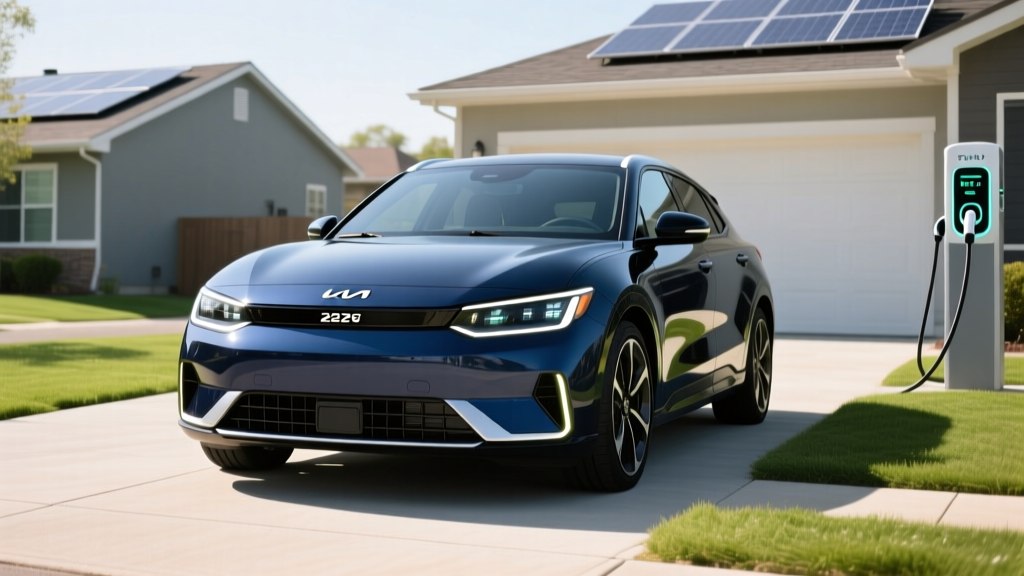
The subcompact electric SUV segment in the United States has been thin on options, but the 2026 Kia EV3 aims to change that. Already a sales success in Europe and South Korea since its 2024 debut, the EV3 is Kia's answer to buyers who want an affordable, practical electric crossover without stepping up to the larger EV6 or EV9. For American shoppers searching for the Kia EV3 USA availability, pricing, and real-world capability, here is everything confirmed and estimated as the model approaches its domestic launch.
Range, Battery, and Real-World Efficiency
The U.S.-market EV3 is expected to arrive exclusively with the Long Range battery pack — an 81.4 kWh usable lithium-ion unit using NMC (nickel-manganese-cobalt) cathode chemistry. Kia has not offered the smaller 58.3 kWh standard-range pack or the LFP (lithium iron phosphate) variant in the American market, likely because U.S. buyers prioritize maximum range in a single-charge package.
| Specification | Value |
|---|---|
| Battery Capacity (usable) | 81.4 kWh |
| Chemistry | NMC (Nickel-Manganese-Cobalt) |
| EPA Est. Range (FWD) | ~300 miles (preliminary) |
| Efficiency (est.) | ~115 MPGe / 29 kWh/100 mi |
| Drivetrain | Front-Wheel Drive (single motor) |
| Horsepower | 201 hp (150 kW) |
| Torque | 209 lb-ft |
| 0–60 mph (est.) | ~7.5 seconds |
| Max DC Fast Charge | ~150 kW peak |
| 10–80% DCFC Time | ~31 minutes |
| Level 2 Onboard Charger | 10.9 kW (est. ~35 mi/hr) |
| Cargo Volume (rear seats up) | ~16.1 cu ft |
| Cargo Volume (rear seats folded) | ~40.0 cu ft |
For context, the EV3's ~115 MPGe combined estimate places it near the Hyundai Kona Electric (120 MPGe combined per fueleconomy.gov) and slightly behind the most efficient compact crossovers. The 29 kWh/100 mi consumption figure means a full 81.4 kWh charge delivers roughly 280 miles in mixed conditions — a solid result for the vehicle's footprint.
Charging Speed: DC Fast and Home Level 2
Charging capability is where the EV3 makes practical compromises to hit its target price. The crossover is built on Kia's EV architecture but uses a 400-volt electrical system rather than the 800-volt platform found in the EV6 and EV9. That means slower peak DC fast-charging rates, though the numbers remain competitive for this class.
| Charging Level | Power (kW) | Miles Added per Hour | Notes |
|---|---|---|---|
| Level 1 (120V household) | ~1.4 kW | ~4–5 mi/hr | Emergency/trickle only; ~60+ hrs for full charge |
| Level 2 (240V home, 48A) | 10.9 kW | ~35 mi/hr | Overnight full charge in ~8 hours |
| DC Fast Charge (peak) | ~150 kW | N/A | 10–80% in ~31 min; tapers above 80% |
The 150 kW peak DC rate is respectable, but buyers should understand the charging curve. Like most NMC packs, the EV3 will sustain its peak rate only between roughly 10–50% state of charge, then progressively taper. Expect the 50–80% portion to take nearly as long as the first 40%. On a road trip, the practical strategy is to charge to 80% and go — pushing to 100% at a DC fast charger adds significant time for diminishing range gains.
At home on a 10.9 kW Level 2 charger (requiring a 240V/60A circuit with a hardwired EVSE or a NEMA 14-50 outlet on a 50A breaker), the EV3 replenishes roughly 35 miles of range per hour. A typical overnight session of 8 hours restores about 280 miles — more than enough for virtually any daily commute. Home charging installation costs typically range from $800 to $2,500 depending on panel capacity and conduit runs; budget more if your electrical panel needs a 200A upgrade.
The U.S.-market EV3 will use the NACS (North American Charging Standard) connector, aligning with Kia's commitment to adopt the Tesla-originated plug. This grants access to Tesla Supercharger stations via Kia's partnership, dramatically expanding the public fast-charging network available to EV3 owners compared to CCS-only vehicles.
Performance, Drivetrain, and Driving Dynamics
The EV3 is not a performance EV, and it doesn't pretend to be. The single front-mounted motor produces 201 horsepower and 209 lb-ft of torque, sending power exclusively to the front wheels. The estimated 0–60 mph time of roughly 7.5 seconds is adequate for merging and passing but won't thrill enthusiasts accustomed to the EV6 GT-Line's dual-motor punch.
An AWD dual-motor variant has not been confirmed for the U.S. market at launch. Kia may introduce one later, but the FWD-only strategy keeps the base price competitive and maximizes range. For buyers in snow-belt states, this is a consideration: FWD with quality winter tires handles moderate snow competently, but AWD provides a traction advantage in steep or icy conditions.
Driving dynamics should mirror the EV3's international reputation: composed, comfortable, and tuned for urban agility rather than canyon carving. The relatively light curb weight (estimated ~4,100 lbs) helps with efficiency and gives the EV3 a nimble feel around town. Kia's multi-link rear suspension (on higher trims) and well-damped ride have drawn praise in European reviews — expect a similar setup stateside.
Pricing, Trims, and Federal Tax Credit Eligibility
Kia has not published final U.S. MSRP figures, but based on international pricing conversions and Kia's competitive positioning against the Hyundai Kona Electric and Chevrolet Equinox EV, here are the estimated trim levels:
| Trim | Est. MSRP | Est. After §30D Credit* |
|---|---|---|
| Light (base) | ~$35,000 | ~$27,500 |
| Wind (mid) | ~$39,000 | ~$31,500 |
| GT-Line (top) | ~$43,500 | ~$36,000 |
*Tax credit estimates assume full $7,500 eligibility under IRS §30D. Actual credit depends on buyer income, vehicle MSRP, battery component sourcing, and critical mineral requirements. Consult a tax professional.
- MSRP Cap: SUVs/crossovers must have an MSRP ≤ $80,000 — the EV3 clears this easily.
- Buyer Income Cap: Modified AGI must not exceed $150,000 (single), $225,000 (head of household), or $300,000 (joint).
- Battery Sourcing: The $7,500 credit splits into two halves — $3,750 for battery components manufactured/assembled in North America, and $3,750 for critical minerals sourced from the U.S. or FTA partners. Kia's battery supply chain for the U.S.-market EV3 will determine how much of the credit applies. This is the biggest variable.
- Point-of-Sale Transfer: Eligible buyers can transfer the credit to the dealer at purchase, reducing the purchase price immediately rather than waiting for a tax refund.
- Final Assembly: Vehicle must undergo final assembly in North America. Kia's West Point, Georgia plant is a likely production site for the U.S.-bound EV3, though this is not yet confirmed.
The tax credit is the single biggest financial variable for EV3 buyers. If Kia sources its battery cells and critical minerals from qualifying supply chains (a significant effort the company has been undertaking with SK On), the full $7,500 credit could bring the base EV3 below $28,000 — an extraordinary value for a 300-mile electric crossover. However, if sourcing requirements are only partially met, the credit could drop to $3,750 or even $0, depending on the specific model year's compliance. Monitor Kia's announcements closely as launch approaches.
Interior, Cargo, and Technology
The EV3's cabin borrows design cues from the larger EV9, featuring a minimalist dashboard with a wide panoramic display cluster. Expect a 12.3-inch digital instrument panel paired with a 12.3-inch infotainment touchscreen on mid and upper trims, with a smaller 5-inch cluster on the base model. Wireless Apple CarPlay and Android Auto should be standard across all trims.
Passenger space is competitive for the subcompact class:
- Front legroom: ~41.7 inches
- Rear legroom: ~37.8 inches — adequate for adults on shorter trips, tight for tall passengers on long drives
- Headroom (front/rear): ~39.5 / 38.2 inches
Cargo capacity is one of the EV3's strengths relative to its footprint. The 16.1 cubic feet behind the rear seats swallows a week's groceries or two carry-on bags, and folding the 60/40 split rear seatbacks opens up approximately 40.0 cubic feet. There is no front trunk (frunk) on the FWD model, as the motor and electronics occupy that space.
On the technology front, the EV3 is expected to feature:
- Highway Driving Assist 2 (HDA-2): Kia's Level 2 driver-assistance suite combining adaptive cruise control with stop-and-go, lane-centering, and lane-change assist. Note: this is a driver-assist system (SAE Level 2), not autonomous driving — hands on the wheel and eyes on the road are required at all times.
- Remote Smart Parking Assist: Summon-style remote parking via key fob on upper trims.
- Digital Key 2: Use your smartphone as the vehicle key via NFC/UWB.
- Vehicle-to-Load (V2L): Power external devices (laptops, camping gear, small appliances) from the EV3's battery — a standout feature in this price class.
- Over-the-air (OTA) updates: Firmware and feature updates delivered wirelessly.
Pros, Cons, and Who Should Buy the EV3
Pros
- Projected ~300-mile EPA range at a sub-$40K starting price
- NACS connector = Tesla Supercharger access from day one
- Strong cargo capacity for the subcompact segment
- V2L capability rare at this price point
- Kia's 10-year/100,000-mile powertrain warranty
- Comfortable, composed ride quality
Cons
- 400V architecture limits DC fast-charge speed vs. 800V rivals
- FWD only at launch — no AWD option for snow-belt buyers
- Modest 201 hp — not a performance-oriented EV
- Rear seat legroom tight for taller adults on long trips
- No frunk
- Tax credit eligibility uncertain until battery sourcing confirmed
Best for: Budget-conscious commuters and small households who want maximum range per dollar, primarily drive in mild-to-moderate climates, and can charge at home. The EV3 excels as a daily driver with a 30–60 mile round-trip commute, occasional weekend road trips under 250 miles, and access to home Level 2 charging. It's also a strong candidate for a second household vehicle used primarily for errands and commuting.
Consider alternatives if: You need AWD for harsh winters, frequently tow (the EV3 is not rated for significant towing), regularly carry four adults on long trips, or prioritize rapid DC fast-charging for frequent 400+ mile road trips.
How the EV3 Compares to Key Rivals
The EV3 enters a segment with a handful of established players. Here's how it stacks up on the metrics that matter:
| Metric | Kia EV3 (est.) | Hyundai Kona Electric | Chevy Equinox EV |
|---|---|---|---|
| EPA Range | ~300 mi | 261 mi | 319 mi |
| Battery (kWh) | 81.4 | 64.8 | 85.0 |
| Peak DC Charge | ~150 kW | ~100 kW | ~150 kW |
| Base MSRP (est.) | ~$35,000 | $32,975 | ~$33,000 |
| Horsepower | 201 hp | 201 hp | 213 hp |
| Cargo (seats up) | ~16.1 cu ft | 25.5 cu ft | 26.4 cu ft |
The Equinox EV offers more range and cargo space but is physically larger and heavier. The Kona Electric is cheaper at the base but trails significantly in range and charging speed. The EV3 threads the needle: strong range, competitive charging, and a price that — with the tax credit — could undercut both.
Warranty Coverage
Kia's warranty is one of the strongest in the industry and should carry over to the EV3:
- Battery: 10 years / 100,000 miles (capacity retention threshold typically ≥70% of original capacity)
- Powertrain: 10 years / 100,000 miles
- Bumper-to-bumper: 5 years / 60,000 miles
- Roadside assistance: 5 years / 60,000 miles
The 10-year battery warranty is a significant ownership-cost advantage. Per IIHS and NHTSA databases, Kia's EV battery track record has been solid, though buyers should note that NMC batteries typically lose 8–12% capacity over the first 100,000 miles under normal use — well within the warranty threshold.
Frequently Asked Questions
What is the real-world range of the Kia EV3?
The preliminary EPA estimate is approximately 300 miles for the FWD Long Range model. In real-world conditions, expect 240–265 miles at sustained highway speeds (70–80 mph) and 210–230 miles in sub-freezing winter weather. City driving in mild conditions can approach or slightly exceed the EPA figure thanks to regenerative braking.
How fast does the EV3 charge at home and on the road?
On a DC fast charger, the EV3 peaks at approximately 150 kW, reaching 10–80% in about 31 minutes. At home on a Level 2 (240V) charger, it charges at up to 10.9 kW, adding roughly 35 miles of range per hour and achieving a full charge overnight in about 8 hours.
Does the Kia EV3 qualify for the $7,500 federal tax credit?
It likely will, but eligibility depends on final battery sourcing and assembly details. The MSRP is well under the $80,000 SUV cap, and most buyers will fall within income limits. The critical variable is whether Kia's battery components and critical minerals meet the IRS §30D sourcing requirements. This will be confirmed closer to launch.
Is the Kia EV3 worth buying over the Kona Electric or Equinox EV?
If you want the best range-to-price ratio and Tesla Supercharger access via NACS, the EV3 is compelling. If cargo space is your top priority, the Equinox EV and Kona Electric offer more cubic feet. If you need AWD, none of these currently offer it at this price — look at the larger Kia EV6 or Hyundai Ioniq 5 instead.
When will the Kia EV3 be available in the USA?
Kia has confirmed the EV3 for the U.S. market, with deliveries expected to begin in mid-to-late 2026 as a 2027 model-year vehicle. Exact timing may vary by region and trim level.