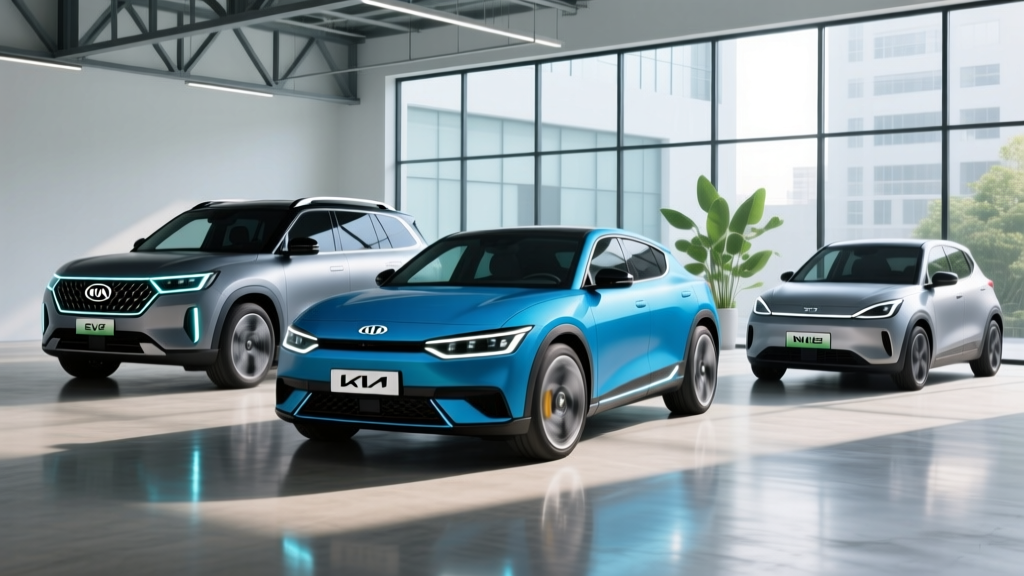
If you are researching a Kia EV in 2026, you are likely choosing among three distinct models: the redesigned EV6 midsize crossover, the three-row EV9 SUV, and the budget-friendly Niro EV. Each targets a different buyer, and their real-world usability depends heavily on how you plan to charge, drive, and use the vehicle day to day. This guide breaks down exact EPA range figures, charging curves, battery chemistry, federal tax credit eligibility under IRS §30D, and the ownership realities that spec sheets rarely reveal.
Quick Verdict: Which Kia EV Fits Your Life?
Choose the EV6 if you prioritize fast DC charging (peaks at 240+ kW), sporty handling, and a 310-mile EPA range for road trips.
Choose the EV9 if you need three rows, up to 304 miles of range, and V2L capability for family camping or emergency backup power.
Choose the Niro EV if your budget is under $42,000, you mostly drive in the city, and 239 miles of EPA range covers your commute with margin.
2026 Kia EV Spec Comparison Table
| Spec | EV6 (RWD Long Range) | EV9 (RWD) | Niro EV |
|---|---|---|---|
| EPA Range | 310 mi | 304 mi | 239 mi |
| Battery (usable) | 84.0 kWh, NMC | 100.0 kWh, NMC | 64.8 kWh, NMC |
| Peak DC Charge | 240 kW | 210 kW | 85 kW |
| 10-80% DC Time | ~18 min | ~24 min | ~43 min |
| Level 2 Rate | 10.9 kW (~36 mi/hr) | 10.9 kW (~30 mi/hr) | 7.2 kW (~24 mi/hr) |
| 0-60 mph | 7.2 sec (RWD) | 7.8 sec (RWD) | 7.8 sec |
| Horsepower | 225 hp (RWD) | 215 hp (RWD) | 201 hp |
| Drivetrain | RWD / AWD available | RWD / AWD available | FWD only |
| MPGe (combined) | 134 MPGe | 89 MPGe | 113 MPGe |
| Cargo (behind 2nd row) | 24.4 cu ft | 43.5 cu ft | 22.8 cu ft |
| Base MSRP | $44,200 | $56,300 | $40,900 |
Sources: EPA fueleconomy.gov, Kia America press materials. Figures reflect 2026 model-year RWD base trims; AWD and higher trims reduce range slightly.
Real-World Range: What the EPA Sticker Doesn't Tell You
EPA 310 miles (EV6 RWD) — Expect 260–280 miles in mixed highway driving at 70+ mph. In freezing temperatures (below 32°F), plan for 210–240 miles due to battery thermal losses and cabin heating demands. The EV6's heat pump (standard on most trims) mitigates some cold-weather loss compared to EVs without one.
EPA 304 miles (EV9 RWD) — Its larger frontal area and 5,000+ lb curb weight mean highway efficiency drops noticeably. Expect 250–270 miles real-world highway, and roughly 200–220 miles in winter conditions.
EPA 239 miles (Niro EV) — City-heavy commuters can approach or slightly exceed the EPA number thanks to regenerative braking. Highway-only trips at 75 mph yield closer to 195–210 miles. Winter drops this to approximately 165–180 miles.
The EV6 and EV9 both use an 800V-class battery architecture, which enables faster preconditioning and more consistent range delivery under load. The Niro EV uses a conventional 400V system — adequate for daily driving but less thermally robust on repeated fast-charge road trips.
Charging Speeds: DC Fast, Level 2, and the Curve Reality
Peak kW ratings are headline numbers, not sustained rates. The EV6's 240 kW peak holds roughly from 10% to 35% State of Charge (SoC), then tapers progressively. Here is what the full session looks like:
| Charging Level | EV6 | EV9 | Niro EV |
|---|---|---|---|
| Level 1 (120V, 1.4 kW) | ~4 mi/hr | ~3 mi/hr | ~5 mi/hr |
| Level 2 (240V, home) | 10.9 kW / ~36 mi/hr | 10.9 kW / ~30 mi/hr | 7.2 kW / ~24 mi/hr |
| DC Fast (peak) | 240 kW | 210 kW | 85 kW |
| 10-80% DC Time | ~18 min | ~24 min | ~43 min |
| 80-100% DC Time | ~25+ min (heavy taper) | ~30+ min | ~40+ min |
Critical insight: Charging from 80% to 100% on DC fast charging takes longer than 10% to 80% on all three models. The battery management system (BMS) restricts current to protect cell longevity. For road trips, plan stops at 10-80% and skip topping off unless you need the final miles to reach your destination.
All three models use the NACS (North American Charging Standard) connector as of the 2026 model year, granting native access to Tesla Supercharger stations alongside Electrify America, EVgo, and other networks. This eliminates the need for a CCS-to-NACS adapter that 2024 and earlier Kia EV owners must carry.
Pricing, Trims, and Federal Tax Credit Eligibility
| Model / Trim | MSRP | Est. §30D Credit | Effective Price |
|---|---|---|---|
| Niro EV Wind | $40,900 | $3,750–$7,500* | $33,400–$37,150 |
| EV6 Light RWD | $44,200 | $3,750–$7,500* | $36,700–$40,450 |
| EV6 GT-Line AWD | $56,500 | $3,750–$7,500* | $49,000–$52,750 |
| EV9 Light RWD | $56,300 | $3,750–$7,500* | $48,800–$52,550 |
| EV9 Land AWD | $66,400 | $0 (above MSRP cap) | $66,400 |
*Credit amount depends on battery component and critical mineral sourcing requirements per IRS §30D rules. The credit ranges from $3,750 (meeting one sourcing requirement) to $7,500 (meeting both). Point-of-sale transfer is available at participating dealers, reducing your out-of-pocket cost at purchase.
Tax Credit Eligibility Checklist
- Buyer income cap: AGI must not exceed $150,000 (single), $225,000 (head of household), or $300,000 (joint filers)
- MSRP cap: SUVs/vans/pickups (EV9) capped at $80,000; other vehicles (EV6, Niro EV) capped at $55,000
- Battery sourcing: $3,750 requires qualifying battery components; additional $3,750 requires qualifying critical minerals — percentages increase annually through 2029
- Final assembly: Must occur in North America (all three Kia EVs qualify)
- Transfer option: You may transfer the credit to the dealer at point of sale for an immediate price reduction, even if your tax liability is lower than the credit amount
Important caveat: The EV9 Land AWD at $66,400 remains under the $80,000 SUV cap, but the EV6 GT-Line AWD at $56,500 exceeds the $55,000 cap for non-SUV classified vehicles. Verify the IRS vehicle classification for the specific trim you are considering — the EV6 may be classified as an SUV by the IRS (allowing the $80,000 cap), but this determination should be confirmed with your dealer or tax professional before purchase. Consult IRS.gov for the latest eligible vehicle list.
Interior Space, Technology, and Daily Livability
The EV6's 24.4 cu ft of cargo space behind the rear seats is modest for a crossover but expands to 54.3 cu ft with the rear seats folded. The EV9 dominates in utility: 43.5 cu ft behind the second row and 81.7 cu ft with both rear rows folded, plus a usable third row that fits adults on shorter trips. The Niro EV offers 22.8 cu ft behind the rear seats and 53.0 cu ft folded — competitive with compact gas crossovers.
Standout Tech Features
- EV6 & EV9: Dual 12.3-inch panoramic displays, augmented-reality head-up display (GT-Line and above), Highway Driving Assist 2 (SAE Level 2 — requires driver supervision), remote smart parking assist, and vehicle-to-load (V2L) power output up to 3.6 kW — enough to run a laptop, mini-fridge, or power tools at a campsite.
- Niro EV: Single 10.25-inch display, Highway Driving Assist (Level 2), and a simpler but effective infotainment system. No V2L capability.
ADAS clarification: Kia's Highway Driving Assist and Highway Driving Assist 2 are SAE Level 2 driver-assistance systems. They provide lane centering and adaptive cruise control but require continuous driver attention and hands-on-wheel (or eyes-on-road) monitoring. They are NOT autonomous or self-driving systems.
Notable Drawbacks
- EV6 rear-seat headroom is tight for passengers over 6'2" due to the sloping roofline
- EV9's efficiency (89 MPGe combined) means higher electricity costs per mile than smaller EVs
- Niro EV's 85 kW DC fast-charge ceiling makes road trips slower — expect 45-minute stops where an EV6 would take 18 minutes
- All three models lack a front trunk (frunk); the EV9 has a small under-hood storage compartment but it is not sealed or large enough for a charging cable bag
Battery Warranty, Longevity, and Chemistry
All three Kia EVs use NMC (nickel-manganese-cobalt) lithium-ion battery packs, which offer higher energy density than LFP (lithium iron phosphate) chemistry but are more sensitive to sustained high-SoC storage. Kia's battery warranty covers 10 years / 100,000 miles with a capacity retention threshold of 70% — meaning if your battery degrades below 70% of original capacity within that period, Kia will repair or replace it.
Based on fleet data from earlier-generation NMC packs in the Kia EV6 (2022-2024), typical degradation at 60,000 miles is approximately 5–8%, assuming a mix of Level 2 home charging and occasional DC fast charging. Consistent daily DC fast charging and frequent 100% SoC storage will accelerate degradation. For maximum longevity, charge to 80% daily and use 100% only when needed for long trips.
Pros and Cons at a Glance
Pros
- EV6 and EV9 offer class-leading DC fast-charge speeds via 800V architecture
- NACS connector standard on all 2026 models — native Tesla Supercharger access
- 10-year/100,000-mile battery warranty (industry-leading duration)
- V2L on EV6 and EV9 adds practical off-grid power
- Niro EV remains one of the most affordable new EVs in the US market
- Competitive real-world range with heat pump standard on most trims
Cons
- EV6 rear headroom limited by coupe-like roofline
- EV9 efficiency suffers at highway speeds (89 MPGe combined)
- Niro EV's 85 kW DC charge rate is slow for road-trip use
- No frunk on any model
- EV6 GT-Line AWD may exceed §30D MSRP cap depending on IRS classification
- NMC chemistry requires more careful SoC management than LFP for longevity
Is a Kia EV Worth It vs. Competitors?
The EV6 competes most directly with the Hyundai Ioniq 5 (shared E-GMP platform), Tesla Model Y, and Ford Mustang Mach-E. Its 240 kW peak charge rate and 18-minute 10-80% time beat the Model Y's ~170 kW peak and roughly match the Ioniq 5. The EV9 has few direct three-row EV rivals at its price point — the closest competitor is the Tesla Model X at nearly $80,000, making the EV9 a value proposition in the large EV SUV segment.
The Niro EV faces competition from the Chevrolet Bolt EUV (discontinued after 2025 but available used), Hyundai Kona Electric (261 mi EPA, ~95 kW DC), and Volvo EX30 (275 mi EPA, 153 kW DC). The Niro's advantage is its lower starting price, but its slower charging and shorter range make it strictly a city-and-commute vehicle.
Frequently Asked Questions
What is the real-world range of the 2026 Kia EV6?
The EPA rates the EV6 RWD Long Range at 310 miles. In real-world highway driving at 70-75 mph, expect 260-280 miles. In cold weather (below 32°F), range drops to approximately 210-240 miles. The onboard heat pump helps reduce cabin-heating energy draw compared to resistive heaters.
How fast does the Kia EV9 charge at home and on DC fast chargers?
On a Level 2 home charger (240V, 48A), the EV9 charges at 10.9 kW, adding roughly 30 miles of range per hour — a full overnight charge from 10% to 90% takes about 9 hours. On a DC fast charger, it peaks at 210 kW and reaches 10-80% in approximately 24 minutes, with significant tapering above 80%.
Does the 2026 Kia Niro EV qualify for the federal tax credit?
The Niro EV qualifies for up to $7,500 under IRS §30D, depending on battery component and critical mineral sourcing thresholds. Its $40,900 MSRP falls well under the $55,000 vehicle cap. Buyer income limits apply: $150,000 single / $300,000 joint. Confirm the current credit amount on IRS.gov before purchasing, as sourcing requirements tighten annually.
Is the Kia EV6 better than the Tesla Model Y for road trips?
The EV6 charges faster (240 kW peak vs Model Y's ~170 kW), but the Tesla Supercharger network still has more reliable station uptime in many regions. With the EV6's native NACS connector, you can use both Superchargers and third-party networks. For pure road-trip charging convenience, the EV6's faster curve means shorter stops, but route planning on non-Tesla networks may require more effort.
What are the biggest pros and cons of the Kia EV lineup?
The biggest strengths are fast DC charging (EV6/EV9), competitive range, 10-year battery warranty, and native NACS compatibility. The biggest weaknesses are the Niro EV's slow charging, the EV6's tight rear headroom, the EV9's low highway efficiency, and the lack of a frunk across the lineup.
Can I tow with the Kia EV9?
Yes. The EV9 AWD is rated to tow up to 5,000 lbs when properly equipped. However, towing will reduce range by 40-55% depending on trailer weight and aerodynamics. Plan for 130-160 miles of range while towing at highway speeds, with more frequent charging stops.