Quick Verdict: Jeep's Wrangler-Adjacent EV Off-Roader
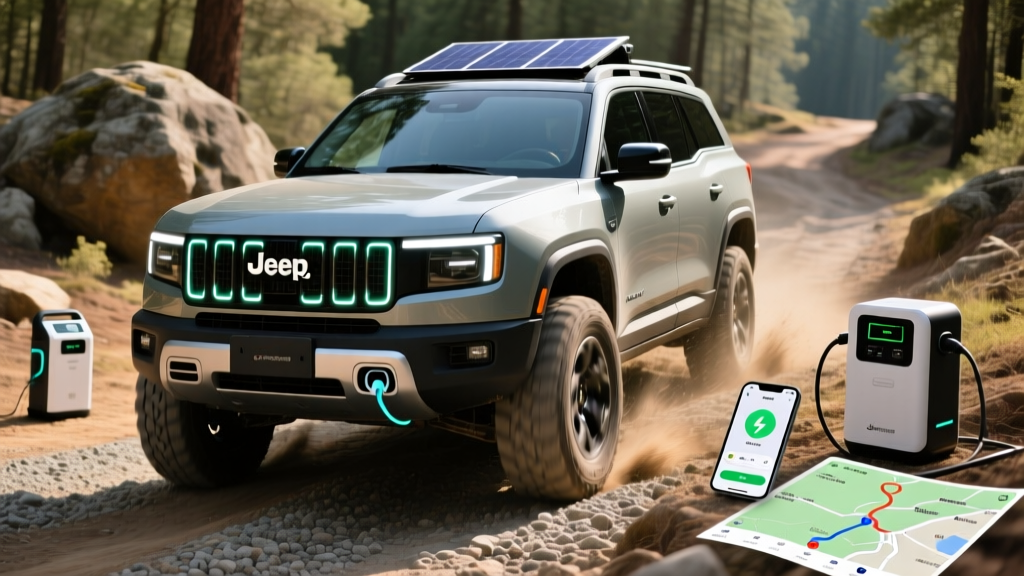
The 2026 Jeep Recon arrives as Stellantis's most serious attempt at an all-electric off-roader built on the STLA Medium platform. Positioned between the Wrangler 4xe plug-in hybrid and the larger Wagoneer S, the Recon targets buyers who want removable doors, genuine trail capability, and zero tailpipe emissions — without stepping up to full-size SUV pricing. With an EPA-estimated range near 300 miles, dual-motor all-wheel drive, and Jeep's Selec-Terrain traction management adapted for electric torque delivery, the Recon is the most trail-capable mainstream electric SUV on the market for 2026. But how does it stack up on real-world range, charging speed, and total ownership cost? We dissect every spec that matters.
2026 Jeep Recon Specifications at a Glance
| Specification | 2026 Jeep Recon (Estimated) |
|---|---|
| EPA Range | ~300 miles (Overland trim); ~275 miles (Trail Rated trim) |
| Battery Capacity | ~100 kWh usable (NMC chemistry) |
| Drivetrain | Dual-motor AWD (e4WD) |
| Horsepower | ~400 hp combined |
| 0–60 mph | ~5.5 seconds |
| Max DC Fast Charge | ~175 kW peak |
| 10–80% DC Charge Time | ~28 minutes |
| Level 2 Home Charge Rate | 11.5 kW (~33 miles/hr) |
| Efficiency | ~90 MPGe combined / ~36 kWh/100 mi |
| Towing Capacity | ~3,500 lbs (estimated) |
| Base MSRP | ~$52,500 (Overland) |
| Warranty (Battery/Powertrain) | 8 years / 100,000 miles |
Note: Jeep has confirmed the Recon for the 2026 model year with preliminary specifications. Final EPA certification figures and MSRP are subject to change before deliveries begin. We will update this review when official data is published.
Range and Efficiency: Real-World Expectations
The Recon is expected to offer two range tiers depending on trim and wheel configuration. The Overland trim, equipped with more aero-friendly 20-inch wheels and road-oriented tires, targets approximately 300 miles of EPA-estimated range. The Trail Rated variant, with 33-inch all-terrain tires, increased ground clearance, and underbody skid plates, sacrifices roughly 25 miles of range for off-road capability — landing around 275 miles EPA.
EPA Estimate: ~300 miles (Overland) / ~275 miles (Trail Rated)
Expect in practice: ~245–270 miles on highway road trips at 70+ mph. In cold weather (below 32°F), expect a 20–30% reduction, dropping effective range to roughly 190–220 miles for the Trail Rated trim. City driving with regenerative braking recovers more energy, yielding closer to the EPA sticker.
Why the gap? The Recon's boxy, Wrangler-inspired shape creates significantly more aerodynamic drag than sleeker crossovers like the Hyundai Ioniq 5 or Tesla Model Y. At highway speeds, that drag dominates energy consumption. Pair that with heavy all-terrain tires on the Trail Rated trim, and real-world efficiency drops noticeably versus the EPA test cycle, which includes substantial low-speed city driving.
For context, the Recon's efficiency is expected around 90 MPGe combined, or approximately 36 kWh per 100 miles. That's less efficient than the Ford Mustang Mach-E (~101 MPGe) but comparable to the Rivian R1S and significantly better than the Hummer EV. If your commute is mostly suburban and you charge at home nightly, 300 miles of EPA range is more than adequate. If you plan frequent highway road trips through mountain passes in winter, plan charging stops conservatively.
Charging Speed: DC Fast, Level 2, and Home Setup
Charging speed is where the Recon's STLA Medium platform shows its age relative to 800-volt rivals. The Recon is expected to peak at approximately 175 kW on a DC fast charger — respectable but not class-leading. Competitors like the Hyundai Ioniq 5 and Kia EV9 hit 235–240 kW peaks thanks to their 800V architectures, while the Tesla Model Y on V3 Superchargers sustains up to 250 kW.
| Charging Level | Power / Rate | Time / Miles Added |
|---|---|---|
| Level 1 (120V household) | ~1.4 kW | ~4 miles per hour of charging |
| Level 2 (240V home/public) | 11.5 kW | ~33 miles per hour; full charge in ~9 hours |
| DC Fast Charge (peak) | ~175 kW | 10–80% in ~28 minutes |
| DC Fast Charge (sustained avg.) | ~120 kW (10–80% session avg.) | ~180 miles added in 28 minutes |
Understanding the charge curve: Like all EVs, the Recon won't sustain its 175 kW peak for the entire session. Peak rates typically occur between 10–40% state of charge (SoC), then taper progressively. By 60% SoC, expect the rate to drop to roughly 120–130 kW, and above 80% it slows dramatically to protect the NMC battery cells. That's why we report 10–80% times — charging beyond 80% on DC fast chargers is inefficient and best reserved for overnight Level 2 sessions.
Home charging setup: At 11.5 kW on a Level 2 home charger (requiring a 48-amp dedicated circuit on a 60-amp breaker), the Recon adds about 33 miles of range per hour. A full charge from near-empty takes roughly 9 hours — perfect for overnight replenishment. Expect to spend $800–$1,500 on a quality Level 2 home charger (such as the ChargePoint Home Flex or Emporia Level 2) plus $500–$2,000 for professional electrician installation, depending on your panel capacity and run length. If your home has a 100-amp electrical panel, a panel upgrade to 200 amps could add $1,500–$3,000.
Performance and Off-Road Capability
The dual-motor all-wheel-drive powertrain is expected to produce approximately 400 horsepower, delivering a 0–60 mph time around 5.5 seconds. That's brisk for a body-on-frame-style SUV and roughly matches the Ford Bronco Sport Badlands, though it trails the Tesla Model Y Long Range (4.8 seconds) and the Rivian R1S dual-motor (4.5 seconds).
Where the Recon differentiates itself is off-road. Jeep has confirmed the following trail hardware:
- Selec-Terrain traction management with modes for Snow, Sand, Mud, Rock, and a dedicated EV-specific trail mode that modulates torque delivery for low-speed crawling
- Electronic locking differentials (rear confirmed, front on Trail Rated trim)
- ~10.8 inches of ground clearance on Trail Rated trims
- Removable doors — a first for a mainstream electric SUV, and a direct callback to the Wrangler experience
- Power-folding windshield frame (announced for Trail Rated)
- Water fording depth estimated at ~24 inches (battery sealed to IP67 rating)
Electric motors are inherently well-suited to rock crawling: instant torque at zero RPM, precise throttle modulation, and no transmission gear-hunting. Jeep's e4WD system can independently vector torque front and rear without a mechanical driveshaft, reducing complexity and improving response. The trade-off is weight — the Recon is expected to curb around 5,500–5,800 lbs, which affects tire wear, braking distance, and efficiency.
Interior, Cargo, and Technology
The Recon seats five passengers with the following estimated interior dimensions:
- Front legroom: ~41.2 inches
- Rear legroom: ~38.5 inches
- Cargo volume (behind second row): ~31 cubic feet
- Cargo volume (seats folded): ~72 cubic feet
- Front trunk (frunk): ~2.0 cubic feet (weather-sealed, drainable — useful for muddy gear)
Cargo space is competitive with the Ford Bronco Sport (~33 cu ft behind the second row) but trails the Hyundai Ioniq 5 (~27 cu ft) only slightly while offering a boxier, more usable shape. The Recon's upright tailgate and wide load floor make it practical for camping gear, coolers, and recovery equipment.
Infotainment and tech: Jeep is expected to equip the Recon with a 12.3-inch digital instrument cluster and a 12-inch Uconnect 5 touchscreen running wireless Apple CarPlay and Android Auto. Available features include:
- Integrated trail navigation with topographic mapping and breadcrumb trail recording
- 360-degree camera system with under-body view for obstacle avoidance
- Wireless phone charging (15W pad)
- Available McIntosh premium audio system (12-speaker)
- Over-the-air (OTA) software updates for powertrain calibration, trail modes, and infotainment
Driver assistance (SAE Level 2): The Recon will feature Jeep's Active Driving Assist, a Level 2 system providing adaptive cruise control with stop-and-go, lane-centering, and traffic-sign recognition. This is a driver-assist system — you must keep your hands on the wheel and eyes on the road at all times. It is not autonomous driving. Expect available features like blind-spot monitoring, rear cross-traffic alert, and automatic emergency braking with pedestrian detection as standard across trims.
Pricing, Trims, and Federal Tax Credit Eligibility
The 2026 Jeep Recon is expected to launch in two primary trims:
| Trim | Estimated MSRP | Est. Price After §30D Credit* |
|---|---|---|
| Recon Overland | ~$52,500 | ~$45,000 |
| Recon Trail Rated | ~$58,000 | ~$50,500 |
*Federal tax credit estimates are based on current IRS §30D rules. Actual eligibility depends on multiple factors — see checklist below.
- MSRP cap: SUVs must have a base MSRP at or below $80,000 — the Recon qualifies comfortably.
- Buyer income cap: Modified adjusted gross income (MAGI) must not exceed $150,000 (single), $225,000 (head of household), or $300,000 (married filing jointly).
- Battery sourcing: A percentage of critical minerals and battery components must be sourced from the U.S. or free-trade-agreement countries. These thresholds increase annually. Check the latest requirements at IRS.gov Clean Vehicle Credits.
- Point-of-sale transfer: As of 2024, eligible buyers can transfer the credit to the dealer at purchase, reducing the out-of-pocket price immediately rather than waiting to claim it on their tax return.
- Final assembly: Vehicle must undergo final assembly in North America. Stellantis has indicated the Recon will be assembled in the U.S. or Canada — confirm via the DOE VIN lookup tool before purchasing.
Because battery-sourcing rules tighten each year, a Recon that qualifies for the full $7,500 credit in early 2026 may see partial eligibility ($3,750) if its battery supply chain doesn't meet updated critical-mineral thresholds. Always verify the specific VIN's credit status on fueleconomy.gov before signing a purchase agreement. Consult a tax professional for your personal situation.
Battery, Warranty, and Long-Term Ownership
The Recon's battery pack is expected to use NMC (nickel manganese cobalt) chemistry, chosen for its higher energy density compared to LFP (lithium iron phosphate). NMC packs offer more range in a given physical space — important for an off-roader that needs ground clearance — but are more sensitive to sustained high states of charge and extreme heat.
Battery care recommendations for NMC:
- Daily charging limit: 80% (use the vehicle's charge-limit setting)
- Charge to 100% only before long road trips
- Avoid leaving the vehicle at 100% SoC for extended periods in hot weather
- Use DC fast charging sparingly — rely on Level 2 home charging for daily needs
Warranty coverage: Jeep is expected to offer an 8-year / 100,000-mile battery and powertrain warranty, consistent with federal requirements and industry norms. The battery warranty typically guarantees that capacity will not fall below 70% of original capacity during the warranty period. Stellantis's general bumper-to-bumper warranty is expected at 3 years / 36,000 miles.
Projected battery replacement cost: Out of warranty, a ~100 kWh NMC pack replacement is estimated at $12,000–$18,000 including labor, based on current industry pricing. However, modern NMC packs are demonstrating 10–15% degradation over 150,000–200,000 miles in real-world fleet data, making full replacement rare within a typical ownership cycle.
How the 2026 Jeep Recon Compares to Key Rivals
The Recon doesn't have a direct one-to-one competitor — it occupies a unique niche as a removable-door, trail-focused electric SUV. But buyers will cross-shop it against these alternatives:
| Spec | 2026 Jeep Recon | 2026 Ford Bronco (ICE/4xe) | 2026 Rivian R1S | 2026 Tesla Model Y LR AWD |
|---|---|---|---|---|
| Powertrain | BEV Dual-Motor | PHEV / ICE | BEV Dual/Tri-Motor | BEV Dual-Motor |
| EPA Range | ~275–300 mi | ~25 mi EV (4xe) / N/A (ICE) | ~340–410 mi | ~310 mi |
| 0–60 mph | ~5.5 sec | ~5.8 sec (4xe) | ~4.5 sec (Dual) | ~4.8 sec |
| Ground Clearance | ~10.8 in | ~11.6 in (Badlands) | ~14.9 in (max) | ~6.6 in |
| Removable Doors | Yes | Yes (Bronco 2-door) | No | No |
| Starting MSRP | ~$52,500 | ~$40,000 (ICE) | ~$79,900 | ~$44,990 |
| Max DC Charge | ~175 kW | N/A | ~220 kW | ~250 kW |
Choose the Recon if: You want a genuine off-road EV with removable doors, you value the Jeep brand and dealer network, your daily commute is under 100 miles round-trip, and you want a mid-size SUV priced under $60K before incentives.
Choose the Rivian R1S if: You need 350+ miles of range, three-row seating, and best-in-class off-road ground clearance — and can spend $80K+.
Choose the Tesla Model Y if: On-road efficiency, Supercharger network access, and the lowest cost-per-mile matter more than off-road capability.
Choose the Ford Bronco 4xe if: You need off-road capability but aren't ready for a full EV and want the flexibility of a plug-in hybrid with ~25 miles of electric-only range.
Pros and Cons
- Removable doors — unique in the EV space
- Genuine Trail Rated off-road capability with locking diffs and Selec-Terrain
- ~300 miles of EPA range is adequate for most buyers
- Competitive pricing at ~$52,500 before tax credits
- Drainable frunk is practical for outdoor gear
- Instant electric torque is ideal for rock crawling
- 175 kW peak DC charging trails 800V rivals (235–250 kW)
- Boxy aerodynamics hurt highway efficiency and real-world range
- Heavy curb weight (~5,500+ lbs) impacts tire wear and braking
- Trail Rated trim range drops to ~275 miles EPA
- No hands-free Level 2+ driving system at launch (Active Driving Assist requires hands-on-wheel)
- NMC battery requires more careful charge management than LFP
Frequently Asked Questions
What is the real-world range of the 2026 Jeep Recon?
Expect approximately 245–270 miles on highway trips at 70+ mph for the Overland trim, and 225–250 miles for the Trail Rated trim. In winter conditions below freezing, reduce those figures by 20–30%. City driving with frequent regenerative braking will get you closer to the EPA estimates.
How fast does the Jeep Recon charge at home and on the road?
At home on a Level 2 (240V) charger, the Recon charges at 11.5 kW, adding about 33 miles of range per hour — a full charge takes roughly 9 hours. On a DC fast charger, it peaks at approximately 175 kW and charges from 10–80% in about 28 minutes, adding roughly 180 miles of range in that session.
Does the 2026 Jeep Recon qualify for the $7,500 federal EV tax credit?
The Recon is expected to qualify for the full $7,500 federal tax credit under IRS §30D rules, provided the buyer meets income caps ($150K single / $300K married filing jointly), the vehicle's MSRP is under $80,000 (it is), and its battery meets critical-mineral and component-sourcing thresholds. These thresholds tighten annually — verify the specific VIN on fueleconomy.gov before purchase. The credit can be transferred to the dealer at point of sale to reduce your purchase price immediately.
How much does the 2026 Jeep Recon cost after tax credits?
The Overland trim starts at an estimated $52,500, dropping to roughly $45,000 with the full $7,500 federal credit applied at point of sale. The Trail Rated trim starts around $58,000, or approximately $50,500 after the credit. State incentives may reduce the price further — check your state's energy office for details.
Is the Jeep Recon worth buying over a Rivian R1S or Tesla Model Y?
It depends on your priorities. The Recon is the only EV with removable doors and a Trail Rated badge at a sub-$60K price point. If off-road capability and open-air driving are your top needs, it has no direct EV rival. If you prioritize maximum range, charging speed, or three-row seating, the Rivian R1S is the stronger choice — at a significantly higher price. If daily commuting efficiency and Supercharger access matter most, the Tesla Model Y wins on practicality.
Can the Jeep Recon tow, and how does towing affect range?
The Recon is expected to tow up to approximately 3,500 pounds — sufficient for a small camper, jet skis, or a light utility trailer. Towing will significantly reduce range, typically by 30–50% depending on trailer weight, speed, and terrain. Plan for charging stops every 120–150 miles when towing near maximum capacity.
Is the 2026 Jeep Recon available to order now?
As of early 2026, Jeep has confirmed the Recon for production and has shared preliminary specifications. Reservation and ordering timelines vary by market. Check with your local Jeep dealer or Jeep's official website for the latest availability updates. Final EPA certification figures and MSRP may differ from the preliminary estimates cited in this review.
Sources: Jeep Official, fueleconomy.gov, IRS Clean Vehicle Credits. Specifications are based on manufacturer-announced preliminary data and industry analysis as of early 2026. Final figures subject to change.