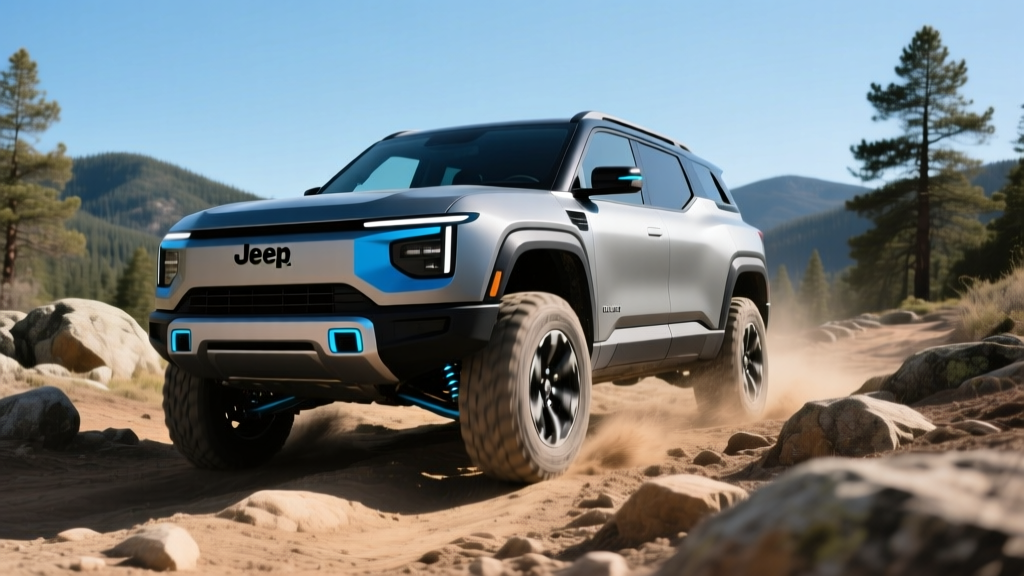
Jeep has spent decades building its reputation on four-wheel-drive capability, body-on-frame toughness, and the kind of trail cred that comes from crawling over rocks in a Wrangler. The 2026 Jeep Recon EV is the brand's boldest attempt to translate that DNA into a battery-electric package — a midsize SUV built on Stellantis' STLA Large platform that promises genuine off-road chops alongside daily-driver practicality. But can a 5,000-plus-pound electric SUV actually handle a trail, and more importantly for most buyers, does the range, charging speed, and pricing make sense for everyday ownership?
We've analyzed the preliminary specs, platform data, and Jeep's official disclosures to bring you a comprehensive profile of the Recon EV ahead of its retail rollout. Here's what you need to know before you configure one or cross-shop it against the Rivian R1S, Hyundai Ioniq 5, or Ford Bronco Sport hybrid.
Range, Battery, and Efficiency: What the Numbers Actually Mean
The 2026 Recon EV is expected to carry a usable battery capacity of approximately 115 kWh on the STLA Large platform, utilizing NMC (nickel-manganese-cobalt) chemistry optimized for energy density. Jeep has targeted an EPA-estimated range of around 300 miles for the most efficient configuration, though the off-road-oriented Overland and Mohawk trims with all-terrain tires and higher ride height will likely see that figure reduced.
Real-World Expectation: Expect approximately 250–270 miles in mixed highway driving at sustained speeds above 70 mph. In cold weather (below 32°F), plan for a 20–30% reduction, bringing effective range down to 210–240 miles. The boxy Wrangler-inspired aero profile and all-terrain tire options will penalize highway efficiency compared to sleeker crossover rivals. City and stop-and-go driving with regenerative braking will return closer to the EPA sticker.
Efficiency is projected in the range of 95–105 MPGe combined (roughly 32–36 kWh per 100 miles), though final EPA certification figures will depend on trim, wheel size, and drivetrain tuning. For context, the Rivian R1S with its larger dual-motor setup achieves around 85 MPGe combined, so the Recon should land in competitive territory for a body-on-frame-style electric SUV.
| Spec | Value |
|---|---|
| EPA Est. Range | ~300 miles (varies by trim) |
| Battery (Usable) | ~115 kWh, NMC chemistry |
| Max DC Fast Charge | ~175 kW peak |
| 10–80% DCFC Time | ~28–32 minutes (est.) |
| Level 2 Charge Rate | ~11.5 kW (onboard charger) |
| Level 2 Speed | ~25–28 miles per hour of charging |
| Drivetrain | Dual-motor AWD (standard) |
| Horsepower | ~400–450 hp (est., trim-dependent) |
| 0–60 mph | ~5.0–5.5 seconds (est.) |
| Efficiency | ~95–105 MPGe combined |
| Towing Capacity | ~4,000 lbs (est.) |
| Ground Clearance | ~9.0–10.5 inches (trim-dependent) |
Charging Speed: DC Fast Charging and Home Setup
Charging speed is where the Recon's STLA Large platform architecture matters most. The platform supports up to approximately 175 kW peak DC fast-charging capability. However, as with all EVs, peak kW is not sustained kW — the charge curve tapers significantly above 80% state of charge to protect battery health and manage thermal loads.
Expect a 10–80% charging session to take roughly 28–32 minutes at a capable DC fast charger (150 kW or higher). On a 350 kW Electrify America or Tesla Supercharger stall (with NACS adapter), the Recon won't pull its peak rate for the entire session. The sustained average between 10% and 80% will likely be closer to 120–130 kW, which is typical for a ~115 kWh battery pack in this weight class.
| Charging Level | Power | Speed / Time | Typical Use |
|---|---|---|---|
| Level 1 (120V) | ~1.4 kW | ~3–4 mi/hr | Emergency / overnight trickle |
| Level 2 (240V, 48A) | ~11.5 kW | ~25–28 mi/hr; full charge in ~10–12 hr | Home / workplace daily charging |
| DC Fast Charge | Up to ~175 kW peak | 10–80% in ~28–32 min | Road trips, highway corridors |
For home charging, the Recon's ~11.5 kW onboard charger means a 48-amp Level 2 wall connector on a 60-amp circuit will replenish the battery at roughly 25–28 miles of range per hour. A full overnight charge from near-empty to 100% will take approximately 10–12 hours. This is adequate for most owners who plug in nightly, but if your commute regularly depletes more than 150 miles, you'll want to ensure your home electrical panel can support a dedicated 60-amp circuit. Panel upgrades can add $1,500–$3,500 to your home charging installation — a cost many buyers overlook.
The Recon is expected to ship with a CCS1 connector in North America, though Stellantis has signaled a transition to NACS (Tesla's connector) across its lineup. Early 2026 models may still require a CCS-to-NACS adapter for Supercharger access. Confirm the connector type at time of purchase, as mid-year production changes are possible.
Performance, Drivetrain, and Trail Capability
The 2026 Recon EV comes standard with a dual-motor all-wheel-drive layout across all trims — there is no rear-wheel-drive base model. Estimated output sits between 400 and 450 horsepower depending on trim and drive-mode calibration, with a 0–60 mph time in the low 5-second range. That puts it firmly in the "quick but not a sports car" category — more comparable to a Ford Bronco Badlands than a Tesla Model Y Performance.
Where the Recon differentiates itself from most electric SUVs is in its off-road engineering. Jeep has confirmed the following trail-oriented features:
- Selec-Terrain traction management with modes for Sand, Mud, Snow, and Rock
- Electronic locking differentials (rear standard, front available on higher trims)
- Selec-Speed Control — essentially an off-road cruise control for low-speed crawling
- High ground clearance — approximately 9.0 inches on standard trims, up to ~10.5 inches on off-road packages
- Underbody protection — skid plates for the battery pack, motor, and transfer-case area
- Water fording — Jeep targets competitive wading depth, though official inches have not been published
The battery pack is mounted low in the chassis, which gives the Recon a lower center of gravity than a Wrangler, but also makes underbody protection critical. Jeep's skid-plate engineering will be a key selling point for serious trail use. The trade-off is weight: expect a curb weight in the 5,200–5,500 lb range, which affects tire wear, braking distances, and energy consumption under load.
One notable omission from the off-road spec sheet: there is no traditional two-speed transfer case. The dual-motor setup handles torque distribution electronically rather than through mechanical low-range gearing. For moderate trails and overlanding, this should be sufficient; for extreme rock crawling, a Wrangler 4xe may still hold an edge.
Interior, Cargo, and Technology
The Recon's cabin design draws clear inspiration from the Wrangler — upright dashboard, chunky physical controls, and an available removable roof panel system (Jeep has hinted at a modular open-air experience, though specifics on removable doors or full soft-top options remain unconfirmed for the EV variant).
Infotainment: The Recon is expected to feature Stellantis' Uconnect 5 system on a 12.3-inch touchscreen with wireless Apple CarPlay and Android Auto, native navigation with EV route planning (including charger preconditioning), and over-the-air update capability. A 10.25-inch digital instrument cluster and an available head-up display round out the driver-facing tech.
Driver Assistance: Standard ADAS features will include adaptive cruise control with stop-and-go, lane-keeping assist, automatic emergency braking with pedestrian detection, blind-spot monitoring, and rear cross-traffic alert. Higher trims are expected to offer a hands-on highway driving assist system (SAE Level 2 — the driver must remain engaged and keep hands on the wheel). This is not an autonomous driving system.
Cargo and Passenger Space (estimated):
- Rear legroom: ~38–40 inches
- Cargo behind rear seats: ~30–35 cu ft
- Cargo with rear seats folded: ~65–72 cu ft
- Front trunk (frunk): Small utility compartment, ~2–3 cu ft (limited by front motor packaging)
These figures position the Recon between a compact SUV and a full midsize in terms of interior volume. It will not match the three-row practicality of a Rivian R1S, but should comfortably seat four adults with gear for a weekend trip. The removable roof panel, if confirmed, would be a unique lifestyle feature with no direct electric rival.
Pricing, Trims, and Federal Tax Credit Eligibility
Jeep has indicated that the Recon EV will start in the low-to-mid $50,000 range before destination charges and options. Based on STLA Large platform pricing across Stellantis models and Jeep's brand positioning, here is the projected trim structure:
| Trim | Est. Base MSRP | Potential §30D Credit | Effective Price (if eligible) |
|---|---|---|---|
| Recon (Base) | ~$52,595 | Up to $7,500 | ~$45,095 |
| Recon Overland | ~$57,000 | Up to $7,500 | ~$49,500 |
| Recon Moab / Trail-Rated | ~$62,000 | Up to $7,500 | ~$54,500 |
Federal Tax Credit Eligibility (§30D): The Recon EV's eligibility for the full $7,500 federal tax credit depends on several factors that change annually and vary by buyer. Key requirements under current IRS §30D rules include:
- MSRP Cap: SUVs must have a base MSRP at or below $80,000 — the Recon should clear this threshold on all trims.
- Buyer Income Limits: Modified adjusted gross income must not exceed $150,000 (single), $225,000 (head of household), or $300,000 (joint filing).
- Battery Sourcing: Critical minerals and battery components must meet escalating domestic-sourcing thresholds that tighten each year. Stellantis has been working to secure North American battery supply, but final 2026 compliance depends on the specific battery cell supplier at time of manufacture.
- Point-of-Sale Transfer: Eligible buyers can transfer the credit to the dealer at purchase, reducing the purchase price directly rather than waiting for a tax refund.
- Final Assembly: Vehicle must undergo final assembly in North America. The Recon is expected to be assembled in the U.S. or Canada.
We strongly recommend consulting a tax professional and checking the latest IRS guidance at irs.gov before relying on credit eligibility for your purchase decision. Battery sourcing requirements in particular can change between model years and even between production batches.
Warranty and Ownership Costs
Jeep is expected to offer the following warranty coverage on the 2026 Recon EV:
- Basic Vehicle Warranty: 3 years / 36,000 miles
- Powertrain Warranty: 5 years / 60,000 miles
- Battery Pack Warranty: 8 years / 100,000 miles (minimum 70% capacity retention threshold, consistent with industry norms and EPA/California requirements)
The 8-year/100,000-mile battery warranty is standard across the EV industry and meets the minimum threshold required by the EPA for battery durability reporting. However, some competitors — notably Hyundai/Kia with their 10-year/100,000-mile powertrain coverage — offer more generous terms. Jeep's basic warranty at 3/36,000 is also on the shorter side compared to Hyundai's 5/60,000 bumper-to-bumper.
Insurance costs for the Recon EV are likely to be above average for the midsize SUV segment, driven by the vehicle's purchase price, weight, and the higher repair costs associated with EV battery proximity in collision events. Expect annual premiums 15–25% higher than a comparably priced gas SUV — get quotes before purchasing.
Who the 2026 Jeep Recon EV Is For — and Who Should Look Elsewhere
- You want genuine off-road capability in an electric SUV and don't want to compromise on trail features like locking diffs and skid plates
- You value the Wrangler-inspired open-air lifestyle and rugged design language
- Your daily commute is under 200 miles round-trip and you have reliable home Level 2 charging
- You need ~4,000 lb towing capacity for a small boat, utility trailer, or camper
- You prefer Jeep's brand identity and dealer network over startup brands
- Maximum range is your top priority — the Hyundai Ioniq 5 (340+ mi) or Tesla Model Y (330+ mi) will go farther per charge with better efficiency
- You need three rows of seating — the Rivian R1S or Kia EV9 are better family haulers
- You want the fastest DC charging — vehicles on 800V architectures (Hyundai Ioniq 5, Kia EV6, Porsche Macan EV) can charge 10–80% in under 20 minutes
- You're on a tighter budget — the base Equinox EV starts around $35,000 with comparable range
- You want a proven EV platform with years of real-world reliability data — the STLA Large platform is new, and long-term durability is untested
Pros and Cons at a Glance
- Legitimate off-road hardware (locking diffs, skid plates, Selec-Terrain) rare in the EV space
- ~300-mile EPA range is competitive for a body-on-frame-style SUV
- Open-air roof option is a unique lifestyle differentiator
- Dual-motor AWD standard across all trims — no stripped-down FWD model
- Strong Uconnect 5 infotainment with EV-native route planning
- Likely eligible for full $7,500 federal tax credit (pending sourcing confirmation)
- Boxy aerodynamics will hurt real-world highway and cold-weather range
- DC fast-charging at ~175 kW peak is slower than 800V competitors (Hyundai, Kia, Porsche)
- No three-row option limits family-hauler appeal
- Heavy curb weight (~5,300+ lbs) impacts tire wear and efficiency
- Short basic warranty (3 yr / 36,000 mi) compared to Hyundai/Kia
- STLA Large platform is unproven in long-term reliability
- Removable doors (if offered) may introduce wind noise and sealing concerns
How the Recon Stacks Up Against Key Competitors
The Recon occupies a niche that few electric SUVs currently target: genuine trail capability paired with daily-driver range. Here's how it compares to the most relevant alternatives:
| Spec | Jeep Recon EV | Rivian R1S (Dual-Motor) | Hyundai Ioniq 5 (AWD) | Ford Bronco (Gas, Badlands) |
|---|---|---|---|---|
| EPA Range | ~300 mi | ~340 mi (Max Pack) | ~290 mi | N/A (gas) |
| Battery | ~115 kWh NMC | 149 kWh (Max Pack) | 84 kWh NMC | N/A |
| DC Fast Charge (Peak) | ~175 kW | ~220 kW | ~240 kW (800V) | N/A |
| 0–60 mph | ~5.0–5.5 sec | ~4.5 sec | ~5.1 sec | ~6.5 sec |
| Off-Road Hardware | Locking diffs, skid plates | Air suspension, tank turns | None (crossover) | Locking diffs, sway-bar disconnect |
| Starting MSRP | ~$52,595 | ~$79,900 | ~$47,000 | ~$47,000 |
| 3rd Row | No | Yes | No | No (2-row) |
The Rivian R1S is the closest competitor in terms of off-road-meets-EV positioning, but it costs significantly more and skews toward tech-forward luxury rather than Jeep's rugged heritage. The Ioniq 5 is a better daily driver with faster charging and lower cost, but has no off-road pretensions. The gas Bronco remains the most direct analog for trail use, but lacks the instant torque and home-charging convenience of an EV.
Frequently Asked Questions
What is the real-world range of the 2026 Jeep Recon EV?
While the EPA estimate targets approximately 300 miles, real-world highway driving at 70+ mph will likely return 250–270 miles. In cold weather below freezing, expect 210–240 miles due to battery efficiency loss and cabin heating demands. The boxy shape and available all-terrain tires will further reduce highway efficiency compared to streamlined crossovers.
How fast does the Recon EV charge at home and on the road?
At home on a Level 2 (240V, 48-amp) charger, the Recon adds roughly 25–28 miles of range per hour, with a full charge taking 10–12 hours. On a DC fast charger, it peaks at approximately 175 kW, achieving a 10–80% charge in about 28–32 minutes. Sustained average charge rates will be lower than peak, as the battery management system tapers charging speed above 80% to protect cell health.
Does the 2026 Jeep Recon EV qualify for the $7,500 federal tax credit?
It is expected to qualify, but eligibility depends on your income (under $150K single / $300K joint), the MSRP of your chosen trim (must be ≤$80,000 for SUVs — all Recon trims should qualify), and whether the battery's critical minerals and components meet 2026 domestic-sourcing thresholds. The credit can be applied at point of sale as a purchase-price reduction. Always verify current rules at IRS.gov and consult a tax professional.
Is the Recon EV worth buying over a Rivian R1S or Hyundai Ioniq 5?
If your priority is off-road trail capability combined with Jeep brand identity and open-air driving, the Recon has no direct electric rival. If you need three rows, the Rivian R1S is the better choice despite the higher price. If you want maximum range, fastest charging, and lower cost for daily commuting, the Hyundai Ioniq 5 is the smarter buy. The Recon is a niche vehicle — excellent for its intended use case, but not the most efficient or practical EV in the segment.
Can the Recon EV actually handle serious off-road trails?
Jeep has engineered the Recon with locking differentials, Selec-Terrain modes, underbody skid plates, and high ground clearance — all genuine trail hardware. The dual-motor AWD system provides instant torque at each axle without the mechanical lag of a traditional transfer case. However, the 5,300+ lb curb weight and lack of a mechanical low-range gear mean it may not match a Wrangler Rubicon on extreme rock-crawling courses. For moderate to advanced trails, overlanding, and back-country roads, it should be highly capable.
What connector does the Recon EV use?
Early production is expected to use CCS1 for DC fast charging and J1772 for Level 2. Stellantis is transitioning to NACS (Tesla's connector) across its lineup, so later production runs may ship with NACS natively. If your Recon has CCS1, you will need a CCS-to-NACS adapter to access Tesla Superchargers. Confirm the connector with your dealer at time of purchase.
How long will the Recon EV's battery last?
Jeep covers the battery with an 8-year / 100,000-mile warranty guaranteeing at least 70% capacity retention. Industry data from similar NMC packs suggests 80–85% capacity retention at 100,000 miles under normal use is typical. To maximize longevity, avoid frequent charging above 90% for daily use, minimize DC fast-charging sessions when Level 2 is available, and use preconditioning in cold weather.
Note: The 2026 Jeep Recon EV specifications referenced in this article are based on Stellantis platform disclosures, preliminary manufacturer data, and industry analysis. Final EPA certification figures, MSRP, and feature availability may differ at time of retail launch. Always confirm specs with your dealer and official Jeep channels before purchasing. This article will be updated as final specifications become available.