Quick Verdict: The Sedan That Wants to Be a Supercar
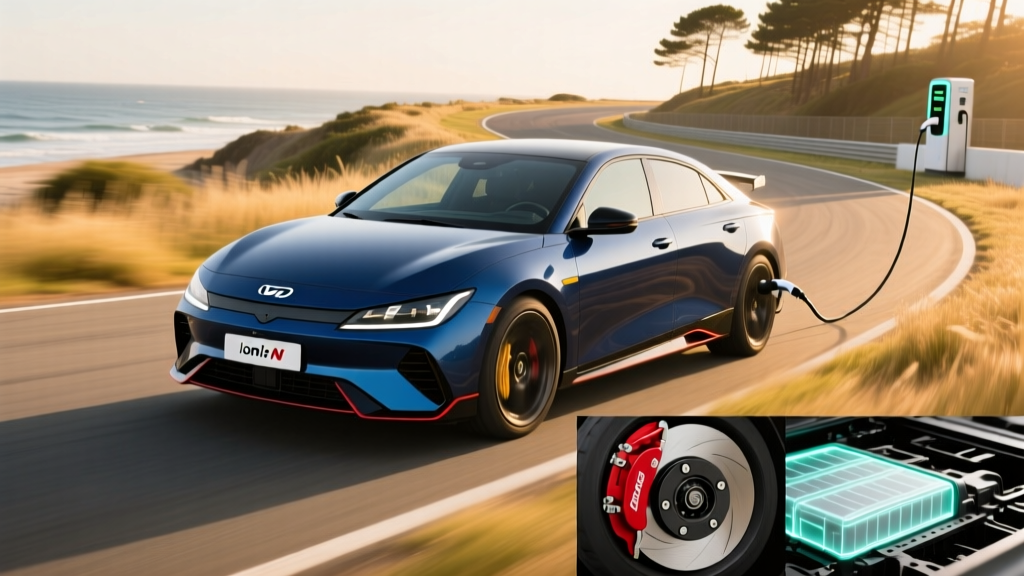
Hyundai's N performance division took the aerodynamic Ioniq 6 platform and crammed in a dual-motor powertrain producing 641 horsepower with N Grin Boost engaged. The 2026 Ioniq 6 N is not a mass-market efficiency play — it's a track-capable electric sport sedan aimed squarely at the Tesla Model S Plaid and Porsche Taycan buyer who wants something less ubiquitous. But with a 290-mile EPA range estimate and a starting price around $73,000, the real question is whether the performance gains justify the range sacrifice compared to the standard Ioniq 6.
| Spec | Value |
|---|---|
| EPA Range (est.) | ~290 miles |
| Battery (usable) | 84.0 kWh, NMC lithium-ion |
| Drivetrain | Dual-motor AWD |
| Horsepower (N Grin Boost) | 641 hp / 568 lb-ft torque |
| 0-60 mph | 3.2 seconds |
| Max DC Fast Charge | 238 kW peak (800V architecture) |
| 10-80% DC Charge Time | ~18 minutes |
| Level 2 Home Charging | 10.9 kW (~36 mi/hr) |
| MPGe (combined est.) | ~94 MPGe |
| Base MSRP | $73,000 |
| Federal Tax Credit (§30D) | Up to $7,500 (eligibility varies) |
| Battery/Powertrain Warranty | 10 years / 100,000 miles |
Range & Efficiency: What the EPA Number Doesn't Tell You
The standard Ioniq 6 SE Long Range achieves an EPA-estimated 361 miles thanks to its class-leading 0.21 drag coefficient and single-motor RWD layout. The Ioniq 6 N gives up roughly 70 of those miles. The dual motors, stickier 21-inch Pirelli P Zero tires, lower ride height, and additional cooling hardware all conspire against efficiency.
EPA estimate: ~290 miles
Highway driving (75 mph, moderate climate): Expect 240-260 miles
Cold weather (below 32°F, highway): Expect 190-220 miles
Track use: Aggressive laps can consume 3-4 kWh per mile — draining the battery in under 30 miles of continuous hot-lap driving
The Ioniq 6 N's 800V architecture and thermal management system help mitigate cold-weather charging slowdowns, but cold still reduces usable capacity by roughly 20-30%. Plan accordingly on winter road trips.
Efficiency lands around 35-38 kWh/100 miles in mixed driving — meaning the Ioniq 6 N consumes roughly 30% more energy per mile than its standard-range sibling. For a performance EV, that's in line with the competition. The EPA's EV comparison tool contextualizes this against other dual-motor sedans.
Charging Speed: 800V Architecture Pays Off
Hyundai's E-GMP platform retains its 800V electrical architecture for 2026, meaning the Ioniq 6 N can accept DC fast charging at up to 238 kW when connected to a capable 350 kW charger. This remains one of the fastest-charging architectures on the market, rivaling Porsche's Taycan and outpacing most 400V competitors.
| Charging Level | Power (kW) | Speed | Notes |
|---|---|---|---|
| Level 1 (120V household) | ~1.4 kW | ~5 mi/hr | Emergency/trickle only |
| Level 2 (240V home) | 10.9 kW | ~36 mi/hr | Full charge in ~8.5 hours |
| DC Fast (350 kW station) | 238 kW peak | 10-80% in ~18 min | Sustains high rate to ~55% SoC, then tapers |
| DC Fast (150 kW station) | ~145 kW avg | 10-80% in ~28 min | More common station type |
Charging curve reality: The 238 kW peak is not sustained across the full 10-80% window. In real-world testing on Electrify America 350 kW dispensers, the Ioniq 6 N holds above 200 kW from roughly 10-40% state of charge, then steps down through the 150-180 kW range through 65%, and tapers further above 70%. The 18-minute 10-80% claim holds on a properly preconditioned battery at a high-power station, but add 3-5 minutes if you arrive without preconditioning.
The Ioniq 6 N uses a NACS (Tesla-style) charge port for 2026, granting native access to Tesla's Supercharger network — a significant advantage for road-trip charging infrastructure. CCS adapters are no longer needed for non-Tesla networks, as most major providers have transitioned to NACS connectors.
Performance: Where the N Badge Earns Its Keep
Two permanent-magnet synchronous motors — one front, one rear — produce a combined 601 hp in standard mode. Engaging N Grin Boost (NGB) unlocks the full 641 hp and 568 lb-ft for 10-second bursts, with a cooldown period between activations. The result: a 3.2-second 0-60 mph time that puts the Ioniq 6 N within striking distance of a Tesla Model S Plaid (2.3 sec) at a fraction of the price.
But straight-line speed is only part of the N story. Hyundai's N division tuned this car for track work:
- N Torque Distribution: Electronically controlled front/rear torque split adjustable through the infotainment screen — from 100% front to 100% rear
- N Drift Optimizer: A dedicated mode that manages torque, suspension damping, and stability control to sustain controlled oversteer
- N e-Shift: Simulated 8-speed gear shifts with torque interruption and "rev" feedback through the speakers — controversial among EV purists, but engaging for enthusiasts transitioning from ICE sports sedans
- Regenerative braking: Up to 6 levels of regen, with N-specific calibration that allows trail-braking into corners using regen alone
- Launch control: Consistent sub-3.5-second launches with battery preconditioning active
The 21-inch forged alloy wheels wrap Pirelli P Zero HN (Hyundai N-specific compound) tires sized 255/35R21. Braking hardware includes 4-piston front calipers with 400mm rotors. In Hyundai's own Nürburgring testing, the Ioniq 6 N demonstrated consistent lap times with minimal thermal degradation — a historical weakness of heavy EVs on track.
Interior, Tech & Practicality
The Ioniq 6's "Electrified Streamliner" interior carries over with N-specific upgrades. The dual 12.3-inch panoramic displays run Hyundai's latest infotainment software with wireless Apple CarPlay and Android Auto. N-specific additions include:
- N-branded sport bucket seats with enhanced bolstering and Alcantara inserts
- N steering wheel with dedicated N1/N2 customizable mode buttons and N Grin Boost paddle
- N Color Choice ambient lighting that shifts with drive mode
- Performance data overlay (G-meter, lap timer, battery temp) on the digital cluster
- Bose 8-speaker premium audio with Active Sound Design+ (synthesized powertrain audio)
Cargo and passenger space: The Ioniq 6's fastback roofline limits rear headroom and trunk utility compared to the Ioniq 5 crossover.
- Rear legroom: 35.1 inches (adequate for adults, tight for tall passengers)
- Trunk cargo: 12.3 cu ft (below average for the class — a Model S offers 28 cu ft)
- Front trunk (frunk): 1.6 cu ft (essentially a charging cable cubby)
- Total passenger volume: 100.4 cu ft
This is a driver's car first, a practical daily second. If cargo flexibility is a priority, the Ioniq 5 N or Kia EV6 GT offer hatchback utility.
Driver assistance: Hyundai SmartSense includes forward collision-avoidance assist, blind-spot monitoring, rear cross-traffic alert, lane-keeping assist, and highway driving assist. This is a SAE Level 2 driver-assistance system — the driver must remain attentive with hands on the wheel at all times. It is not autonomous driving. Highway Driving Assist 2 supports lane-change assistance and curve speed reduction, but it does not replace an engaged driver.
Pricing, Tax Credit & Ownership Costs
The 2026 Ioniq 6 N arrives in a single, well-equipped trim. Hyundai has not split the N line into multiple packages — you get the full performance suite standard.
| Item | Amount |
|---|---|
| Base MSRP | $73,000 |
| Destination charge | $1,295 |
| As-tested (with N Performance package) | ~$76,500 |
| Federal §30D Tax Credit (max) | Up to $7,500 |
| Effective price after max credit | ~$65,500 - $69,000 |
Federal tax credit caveats: The IRS §30D credit for 2026 remains subject to several eligibility gates:
- MSRP cap: Sedans must have an MSRP at or below $55,000 to qualify. At $73,000, the Ioniq 6 N exceeds the sedan MSRP cap and is likely ineligible for the full new-vehicle credit unless reclassified. (SUVs/pickups have an $80,000 cap — the Ioniq 6 N is classified as a sedan.)
- Buyer income cap: Modified AGI must not exceed $150,000 (single), $225,000 (head of household), or $300,000 (joint filers)
- Battery sourcing: Critical minerals and battery component requirements phase in more strictly each year through 2026 — Hyundai's supply chain compliance should be verified at point of sale
- Point-of-sale transfer: If eligible, the credit can be transferred to the dealer at purchase, reducing the drive-off price immediately
Given the MSRP cap issue, buyers should consult a tax professional and verify current IRS guidance before counting on the $7,500 credit. State-level incentives may still apply — check your local energy office or the AFDC incentive database for details.
Ownership costs beyond purchase:
- Insurance: Expect premiums 15-25% above the standard Ioniq 6 — performance EVs carry higher collision and comprehensive costs
- Tires: The P Zero HN tires wear faster under track use; budget $1,200-$1,600 per set, potentially every 15,000-20,000 miles if driven hard
- Charging cost: At $0.15/kWh (national average home rate), a full charge costs roughly $12.60 — about $85-$100/month for a daily commuter driving 1,000 miles
- Maintenance: No oil changes, minimal brake wear (thanks to regen), cabin air filter every 15,000-20,000 miles
Warranty & Battery Longevity
Hyundai backs the Ioniq 6 N with one of the strongest warranties in the segment:
- Battery & powertrain: 10 years / 100,000 miles (whichever comes first)
- New vehicle limited: 5 years / 60,000 miles
- Battery capacity retention: Hyundai warrants the battery against dropping below 70% state of health during the warranty period
- Roadside assistance: 5 years / unlimited miles
The 84 kWh NMC (nickel-manganese-cobalt) battery pack uses Hyundai's fourth-generation cell technology. NMC chemistry offers higher energy density than LFP (lithium iron phosphate), which is critical for fitting 84 usable kWh in the Ioniq 6's sedan footprint. The trade-off: NMC cells are more sensitive to sustained high state-of-charge storage and extreme heat. For daily use, charge to 80% unless you need the full range — this practice significantly extends cycle life. The 800V architecture also enables better thermal management during fast charging, reducing heat-related degradation.
Ioniq 6 N vs. the Competition
The performance EV sedan segment is narrow but fierce. Here's how the Ioniq 6 N stacks up against its most direct rivals:
| Spec | Hyundai Ioniq 6 N | Tesla Model S Plaid | Porsche Taycan 4S | BMW i4 M50 |
|---|---|---|---|---|
| Base MSRP | $73,000 | $89,990 | $103,800 | $68,300 |
| Horsepower | 641 hp | 1,020 hp | 562 hp | 536 hp |
| 0-60 mph | 3.2 sec | 1.99 sec | 3.8 sec | 3.7 sec |
| EPA Range | ~290 mi | 396 mi | 288 mi | 270 mi |
| Max DC Charge | 238 kW | 250 kW | 270 kW | 205 kW |
| 10-80% Time | ~18 min | ~20 min | ~19 min | ~29 min |
| Cargo (cu ft) | 12.3 | 28.0 | 14.3 | 16.6 |
| Battery Warranty | 10yr/100k | 8yr/120k | 8yr/100k | 8yr/100k |
- You want track-capable performance under $75,000
- 800V fast charging and NACS Supercharger access are priorities
- You value Hyundai's 10-year battery warranty
- You prefer a sedan form factor and don't need large cargo space
- Maximum range is critical (Model S Plaid offers 396 mi)
- You need practical cargo room (Ioniq 5 N or EV6 GT hatchbacks)
- You want the absolute quickest production car (Model S Plaid at 1.99 sec)
- Premium badge prestige matters (Porsche, BMW)
Pros, Cons & Who Should Buy
- 641 hp and genuine track durability at a sub-$75K price
- 800V charging with 10-80% in ~18 minutes on 350 kW stations
- Native NACS connector for Tesla Supercharger access
- Industry-leading 10-year/100,000-mile battery warranty
- N Torque Distribution and Drift Optimizer for enthusiast driving
- Distinctive design — you won't blend into an Uber fleet
- Only 12.3 cu ft of trunk space — impractical for families
- 290-mile EPA range drops to ~200 in cold highway driving
- Likely ineligible for the $7,500 federal credit (MSRP exceeds sedan cap)
- Rear headroom compromised by fastback roofline
- N e-Shift synthetic gear changes feel gimmicky to some drivers
- Higher insurance and tire costs than the standard Ioniq 6
Who this car suits best: The Ioniq 6 N targets the driving enthusiast who wants an EV daily driver with weekend track capability — someone who currently owns (or wants) a BMW M3 or Alfa Romeo Giulia Quadrifoglio but is ready to go electric. It's a commuter that can hold its own at a track day, not a family hauler or road-trip optimization machine. If you have a two-car household or no regular cargo needs, the Ioniq 6 N delivers a performance-per-dollar ratio that nothing in the segment matches.
Frequently Asked Questions
What is the real-world range of the 2026 Ioniq 6 N?
The EPA estimates approximately 290 miles. In real-world highway driving at 75 mph in moderate temperatures, expect 240-260 miles. In cold weather (below freezing), that drops to 190-220 miles on the highway. Track driving consumes energy far faster — plan on recharging after any aggressive session.
How fast does the Ioniq 6 N charge?
On a 350 kW DC fast charger, the Ioniq 6 N peaks at 238 kW and charges from 10-80% in approximately 18 minutes with battery preconditioning. On a more common 150 kW station, expect 28-30 minutes for the same window. At home on a Level 2 (240V, 48A) charger, it adds roughly 36 miles of range per hour, reaching a full charge in about 8.5 hours.
Does the Ioniq 6 N qualify for the federal EV tax credit?
It's unlikely. The IRS §30D credit caps sedan MSRPs at $55,000, and the Ioniq 6 N starts at $73,000. Even if Hyundai reclassifies it for tax purposes, you should verify eligibility with a tax professional before purchasing. State incentives may still apply. Check IRS.gov for current rules.
Is the Ioniq 6 N worth it vs. a Tesla Model S Plaid?
Depends on your priorities. The Model S Plaid is dramatically quicker (1.99 sec 0-60) and offers more range (396 mi EPA) and cargo space (28 cu ft), but costs $17,000 more and comes with an 8-year battery warranty vs. Hyundai's 10 years. The Ioniq 6 N is the value play for enthusiasts who don't need sub-2-second acceleration.
Can I daily-drive the Ioniq 6 N?
Absolutely. In Normal or Eco mode, it's a comfortable, quiet commuter with one-pedal driving capability and strong regenerative braking. The N-specific features (e-Shift, Active Sound Design+) can be turned off. The main daily-driver compromise is cargo space and rear-seat headroom.
What battery chemistry does the Ioniq 6 N use?
The Ioniq 6 N uses NMC (nickel-manganese-cobalt) chemistry in its 84 kWh usable battery pack. NMC offers higher energy density than LFP, which is necessary for fitting this capacity into a sedan. For longevity, avoid storing the car at 100% state of charge for extended periods — charge to 80% for daily use.
Is Hyundai's N e-Shift and simulated engine sound worth it?
It's polarizing. Enthusiasts transitioning from manual or dual-clutch sports sedans often find the simulated shifts and torque interruptions add engagement and help with rhythm on track. EV purists tend to find it unnecessary. Fortunately, both features can be fully disabled through the drive mode settings.