Quick Answer: Is the 2026 Hyundai Kona EV Worth Buying?
The 2026 Hyundai Kona Electric delivers an EPA-estimated 261 miles of range from its 63.5 kWh NMC battery, starts around $33,550, and qualifies for a partial or full §30D federal tax credit depending on your income and the vehicle's battery sourcing. Expect real-world highway range of 220–240 miles (less in cold weather). It charges at up to 100 kW DC (10–80% in ~43 minutes) and costs roughly $0.04–$0.06 per mile to fuel at home — about a third of a comparable gas crossover. It's one of the most practical entry-level EVs for buyers with Level 2 home charging access who drive under 250 miles daily.
2026 Hyundai Kona EV: Core Specs at a Glance
The second-generation Kona Electric (introduced for 2024, carried into 2026 with minor packaging updates) remains Hyundai's subcompact EV crossover aimed at budget-conscious electrification. Here are the numbers that matter:
| Specification | Value |
|---|---|
| EPA Range | 261 miles |
| Battery Capacity | 63.5 kWh usable (NMC chemistry) |
| Motor Output | 201 hp / 188 lb-ft torque |
| 0–60 mph | ~7.4 seconds |
| DC Fast Charge (peak) | 100 kW (CCS1 connector) |
| 10–80% DC Charge Time | ~43 minutes |
| Level 2 AC Charge Rate | 10.9 kW (onboard charger) |
| Level 2 Full Charge Time | ~6.5 hours (0–100%) |
| MPGe (combined) | 110 MPGe (EPA est.) |
| Base MSRP (SE trim) | ~$33,550 |
| Battery/Powertrain Warranty | 10 years / 100,000 miles |
Sources: fueleconomy.gov, Hyundai USA specifications.
Real-World Range vs. EPA Sticker
The 261-mile EPA estimate assumes mixed driving in moderate temperatures. In real-world conditions:
- Highway driving (70–75 mph): Expect 220–240 miles. EVs lose efficiency at sustained high speeds due to aerodynamic drag.
- Cold weather (below 30°F): Range can drop 15–30%, yielding 180–220 miles. The Kona EV uses a resistive PTC heater rather than a heat pump, which draws more energy in winter.
- City / moderate climate: 260–275 miles is achievable thanks to regenerative braking and lower average speeds.
How Does the Kona EV Compare to a Gas Crossover?
Many Kona EV shoppers are cross-shopping the gas Hyundai Kona (starting ~$25,000) or similar subcompact crossovers like the Kia Seltos and Honda HR-V. Let's compare the EV against the gas Kona on the metrics buyers actually care about:
| Metric | 2026 Kona Electric (SEL) | 2026 Kona Gas (SEL AWD) |
|---|---|---|
| MSRP | ~$35,050 | ~$27,500 |
| Fed. Tax Credit (§30D) | Up to $7,500 (eligibility varies) | $0 |
| Effective Price (after max credit) | ~$27,550 | $27,500 |
| Energy/Fuel Cost per Mile | $0.04–$0.06 (home L2) | $0.12–$0.15 (gas at $3.20/gal, 29 MPG) |
| Annual Fuel/Energy (12k mi) | $480–$720 | $1,320–$1,560 |
| Annual Maintenance | ~$300–$400 | ~$600–$800 |
| 5-Year Fuel/Energy Total | $2,400–$3,600 | $6,600–$7,800 |
| EPA Range / Tank Range | 261 mi | ~380 mi (13.2 gal tank) |
The math is straightforward: if you qualify for the full §30D credit, the Kona EV's effective purchase price nearly matches the gas version, and you save $4,200–$6,000 on fuel and maintenance over five years. Without the credit, the EV carries a ~$7,500 premium that takes 5–7 years of fuel savings to recoup.
Real Cost of Ownership: 5-Year Breakdown
Here's what owning a Kona Electric actually costs over five years and 60,000 miles, assuming home Level 2 charging at the national average of $0.16/kWh and occasional DC fast charging at $0.35/kWh:
| Cost Category | Kona Electric | Kona Gas |
|---|---|---|
| Purchase Price (after credit) | $27,550* | $27,500 |
| Fuel/Energy (5 yrs) | $3,000 | $7,200 |
| Maintenance (5 yrs) | $1,750 | $3,500 |
| Insurance (5 yrs, avg.) | $7,500 | $6,000 |
| Home Charger Install (L2) | $800–$1,500 | $0 |
| 5-Year Total | $40,600–$41,250 | $44,200 |
*Assumes full $7,500 §30D credit. Insurance averages are higher for EVs due to repair cost structures; get a personalized quote before purchasing.
Net savings over five years: approximately $3,000–$3,600 with the tax credit. Without the credit, the gas Kona wins on pure cost. This is why §30D eligibility is the single most important variable in your decision.
Charging the Kona EV: What You Need to Know
The Kona Electric uses a CCS1 connector and charges at a maximum of 100 kW on DC fast chargers. That's modest by 2026 standards — competitors like the Chevrolet Equinox EV and Hyundai Ioniq 5 hit 150–235 kW — but adequate for the battery size.
Charging Speeds in Practice
| Charging Level | Power | Miles Added per Hour | Use Case |
|---|---|---|---|
| Level 1 (120V outlet) | ~1.4 kW | ~5–6 mi/hr | Overnight trickle; adds ~50 mi in 10 hrs |
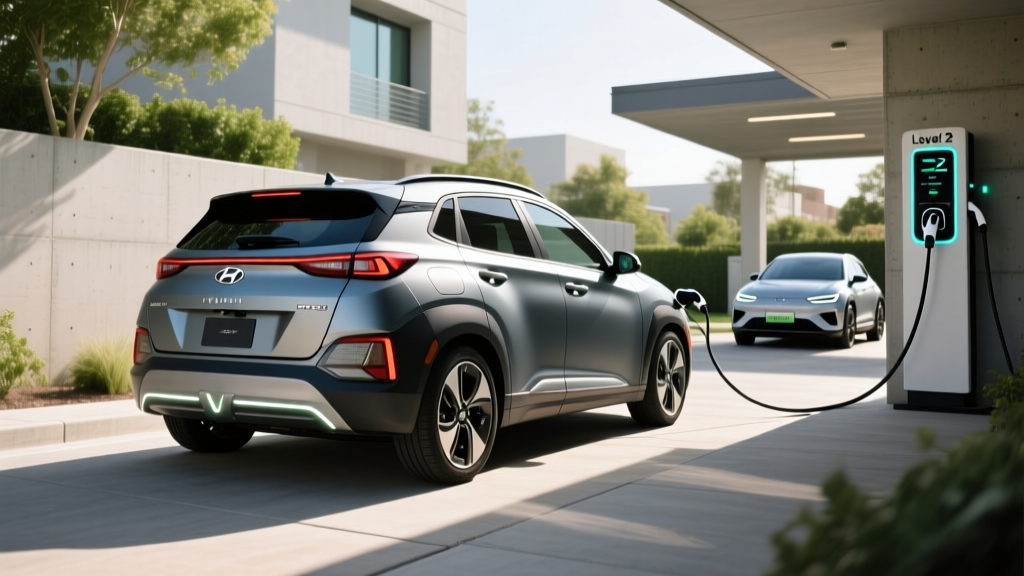
| Level 2 (240V home) | 10.9 kW | ~37 mi/hr | Daily charging; full charge in ~6.5 hrs |
| DC Fast Charge | Peak 100 kW | ~170 mi/hr (peak) | Road trips; 10–80% in ~43 min |
Charging curve reality: The Kona EV peaks near 100 kW only between roughly 10–40% state of charge. Above 60%, the rate tapers to 50–60 kW, and above 80% it drops below 25 kW. Plan road-trip stops around 10–80% to avoid the slow tail of the curve.
Home charging is essential. Without a Level 2 home setup, relying on Level 1 (standard outlet) adds only ~50 miles overnight — barely enough for many commutes. Budget $800–$1,500 for a 240V Level 2 installation (40-amp circuit, licensed electrician). If your home has a 200-amp electrical panel, installation is usually straightforward. Older 100-amp panels may require a $1,500–$3,000 upgrade — factor this in.
Public Charging Access
The Kona's CCS1 connector is compatible with Electrify America, EVgo, and most non-Tesla networks. Hyundai includes two years of complimentary Electrify America charging (limited sessions). For road trips through rural areas, check PlugShare or A Better Routeplanner beforehand — CCS coverage is solid on interstates but can be sparse in remote regions.
Federal Tax Credit (§30D) Eligibility for 2026
The Kona Electric's eligibility for the federal §30D Clean Vehicle Credit depends on several factors that shift yearly. As of the 2026 tax year, key requirements include:
- MSRP cap: SUVs/crossovers must be under $80,000 — the Kona EV qualifies at all trims.
- Buyer income limits: AGI must not exceed $150,000 (single), $225,000 (head of household), or $300,000 (joint).
- Battery sourcing: Critical minerals and battery components must meet phased-in percentages from US/FTA countries. Hyundai has been progressively shifting supply chains — check the IRS's current eligible vehicle list at purchase time.
- Point-of-sale transfer: You can transfer the credit to the dealer at purchase for an immediate price reduction, rather than waiting to claim it on your tax return.
- Assembly: The Kona EV sold in the US is assembled in South Korea — this was previously a disqualifier, but the commercial vehicle lease loophole and updated sourcing rules have restored partial/full credit for some trims.
Critical caveat: Sourcing requirements tighten each year. Always verify eligibility on the IRS eligible vehicle list at the time of purchase, and consult a tax professional for your specific situation. Never assume the full $7,500 without confirming.
Common Kona EV Misconceptions — Myth vs. Fact
| Myth | Fact |
|---|---|
| "261 miles of range isn't enough for road trips." | With DC fast charging, you can add 150+ miles in a 30-minute stop. Most road trips require one or two stops anyway. The real limitation is the 43-minute 10–80% charge time vs. faster-charging competitors. |
| "EV batteries need replacing every few years." | Hyundai's NMC battery is warranted for 10 years/100,000 miles at 70% capacity retention. Industry data shows typical degradation of 10–15% over 150,000 miles. Full replacement, if needed, runs $8,000–$12,000 but is rare. |
| "Charging an EV is more expensive than gas." | At the national average of $0.16/kWh, the Kona EV costs ~$0.045/mile to fuel. At $3.20/gal and 29 MPG, the gas Kona costs ~$0.11/mile. DC fast charging at $0.35/kWh raises EV cost to ~$0.10/mile — still competitive with gas. |
| "I need a Tesla to use Superchargers." | Tesla has opened select Supercharger locations to non-Tesla CCS vehicles via the NACS adapter and Tesla app. However, coverage is still limited for CCS vehicles — don't rely on Superchargers as your primary network. |
| "EVs are worse in winter." | Range drops are real (15–30%), but EVs start reliably in cold weather, and preconditioning while plugged in mitigates range loss. The Kona EV lacks a heat pump, making winter efficiency worse than EVs equipped with one (like the Ioniq 5). |
Decision Framework: Should You Buy the 2026 Kona EV?
Choose the 2026 Kona Electric if:
- You have access to Level 2 home charging (garage or driveway with a 240V circuit).
- Your daily driving is under 200 miles and you take road trips fewer than 5 times per year.
- You qualify for the §30D tax credit (check income limits and IRS sourcing list).
- You want a practical, warranty-backed EV under $35,000 and don't need cutting-edge charge speeds.
- You live in a moderate or warm climate where cold-weather range loss is manageable.
Look elsewhere if:
- You lack home charging access and depend entirely on public infrastructure — the 100 kW charge speed means longer stops than competitors.
- You regularly drive 300+ miles between charges or live in extreme cold (consider a longer-range EV or a PHEV like the Hyundai Tucson PHEV).
- You don't qualify for the tax credit — the price premium over the gas Kona is hard to justify without it.
- You want the latest charging tech — the Hyundai Ioniq 5 (235 kW charging, heat pump, NACS option) is significantly more capable, though it starts ~$9,000 higher.
First-Time EV Buyer Checklist
If the Kona Electric is your first EV, here's what to prepare before signing:
- Verify home charging feasibility: Check your electrical panel capacity (200A preferred). Get a quote from a licensed electrician for a 40A/240V circuit. Budget $800–$2,500 depending on panel condition and distance from panel to garage.
- Confirm tax credit eligibility: Cross-check your AGI against §30D limits and verify the Kona EV on the IRS eligible list for the current quarter.
- Get an insurance quote first: EV insurance averages 15–25% higher than gas equivalents. Shop quotes from GEICO, Progressive, and State Farm before committing.
- Download charging apps: PlugShare, A Better Routeplanner, and Electrify America are essential for trip planning.
- Understand the warranty: Hyundai covers the battery at 10yr/100k mi with a 70% capacity retention guarantee. The overall vehicle warranty is 5yr/60k mi — best in class.
2026 Hyundai Kona EV FAQ
What is the real-world range of the 2026 Hyundai Kona EV?
The EPA rates it at 261 miles. Expect 220–240 miles in highway driving, 180–220 miles in cold weather below 30°F, and up to 275 miles in city driving in moderate temperatures.
How long does it take to charge the Kona EV at home?
On a Level 2 (240V) home charger at 10.9 kW, a full 0–100% charge takes approximately 6.5 hours. Most owners plug in nightly and wake up to a full battery, adding roughly 37 miles of range per hour of charging.
Does the 2026 Kona EV qualify for the $7,500 federal tax credit?
It may qualify for up to $7,500 under §30D, but eligibility depends on your income (under $150K single / $300K joint), the vehicle's battery mineral sourcing at time of purchase, and current IRS rules. Always verify on irs.gov before purchasing.
Is the Kona EV good for road trips?
Adequate, not exceptional. With 261 miles of range and 100 kW peak DC charging, you'll stop every 180–220 miles on the highway and spend 35–45 minutes charging from 10–80%. That's 10–15 minutes longer per stop than faster-charging EVs like the Ioniq 5 or Tesla Model Y.
How does the Kona EV compare to the Hyundai Ioniq 5?
The Ioniq 5 offers 303 miles of range, 235 kW DC charging (10–80% in ~18 min), a heat pump for better cold-weather efficiency, and an available NACS connector — but starts around $42,500. The Kona EV is the budget pick; the Ioniq 5 is the performance-and-convenience pick.
What is the battery replacement cost for the Kona EV?
If out of warranty, a full battery replacement runs approximately $8,000–$12,000. However, Hyundai's 10-year/100,000-mile battery warranty (70% capacity retention) means most owners will never face this cost. Industry-wide, battery failure rates are well under 2% in the first 10 years.