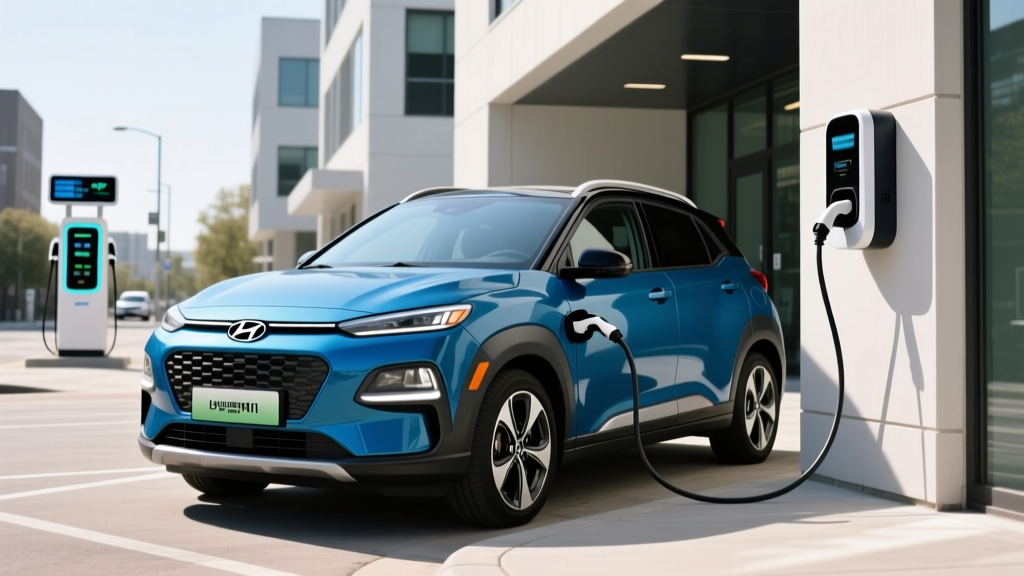
The 2026 Hyundai Kona Electric enters its third model year on the second-generation platform (introduced for 2024) as one of the most practical subcompact electric crossovers on the market. With an EPA-estimated 261 miles of range on the Limited trim, a usable 64.8 kWh battery, and a starting MSRP near $33,000, it occupies a critical price bracket for first-time EV buyers. But spec sheets don't tell the whole story. This review breaks down real-world range expectations, charging-curve behavior, and ownership economics to help you decide whether the Kona Electric earns a spot in your driveway.
2026 Hyundai Kona Electric Specifications at a Glance
| Attribute | SEL (Standard Range) | Limited (Extended Range) |
|---|---|---|
| EPA Range | ~200 mi | 261 mi |
| Battery (Usable) | 48.6 kWh (LFP) | 64.8 kWh (NMC) |
| Motor / Drivetrain | 133 hp / FWD | 201 hp / FWD |
| 0–60 mph | ~8.5 sec | ~7.2 sec |
| Max DC Fast Charge | ~100 kW | ~105 kW |
| 10–80% DC Charge | ~43 min | ~43 min |
| Level 2 Home Charge | 7.2 kW (~25 mi/hr) | 10.9 kW (~37 mi/hr) |
| MPGe (Combined) | ~125 MPGe | 129 MPGe |
| Cargo (rear seats up) | 25.5 cu ft | |
| Cargo (rear seats down) | 63.7 cu ft | |
| Rear Legroom | 38.3 in | |
| Battery Warranty | 8 yr / 100,000 mi | |
| Base MSRP (excl. dest.) | ~$32,975 | ~$38,975 |
Source: Hyundai Motor America and fueleconomy.gov. Final 2026 trim-level specs confirmed at launch.
Range, Efficiency, and the Real-World Reality Check
- City / mild-weather commuting: 265–280 mi (regen-heavy driving recovers energy)
- Highway (70–75 mph, 70°F): ~220–240 mi (aerodynamic drag dominates at speed)
- Highway (winter, 30°F): ~180–200 mi (cabin heating + battery resistance)
- Worst-case cold road trip (20°F, 80 mph, mountain terrain): ~160–175 mi
The Kona Electric's heat pump (standard on Limited) mitigates cold-weather losses better than resistive heating, but physics still applies. Budget ~15–25% below the EPA sticker for highway road trips and up to 30% in deep-winter conditions.
The Limited trim's 129 MPGe combined rating translates to roughly 26 kWh per 100 miles — efficient for the crossover segment, though the Hyundai Ioniq 5 and Tesla Model Y achieve slightly better efficiency per kWh due to lower drag coefficients and more advanced thermal management. For a daily commuter driving 30–40 miles round-trip, the 261-mile EPA figure means charging two to three times per week on a home Level 2, or once weekly if you're an aggressive regen driver in mild weather.
Charging Speed: DC Fast Charge and Home Level 2 Breakdown
Charging speed remains the Kona Electric's most debated attribute. At a maximum of ~105 kW on DC fast charging (CCS connector), it trails rivals like the Ioniq 5 (which peaks at 240 kW on 800V architecture) and the Kia EV6. But context matters: most public DC chargers in the U.S. deliver between 50 and 150 kW, so the Kona's peak rate is usable at a wide range of stations.
| Charging Level | Power / Voltage | Miles Added per Hour | Notes |
|---|---|---|---|
| Level 1 (120V household) | 1.4 kW | ~5 mi/hr | Emergency / overnight trickle only |
| Level 2 (240V, 32A) | 7.7 kW | ~26 mi/hr | Typical home wall-box; full charge ~8.5 hr |
| Level 2 (240V, 48A) | 10.9 kW | ~37 mi/hr | Requires 60A circuit; full charge ~6 hr |
| DC Fast (CCS, 50 kW station) | 50 kW | ~170 mi/hr | 10–80% in ~55 min |
| DC Fast (CCS, 150 kW+ station) | ~105 kW peak | ~350 mi/hr (peak) | 10–80% in ~43 min; tapers above 80% |
Charging-curve reality: The Kona Electric hits its ~105 kW peak only between roughly 10% and 40% State of Charge. From 40–60%, it steps down to ~80 kW; from 60–80%, it drops further to ~55 kW. Above 80%, charging slows dramatically to protect cell longevity — expect 80–100% to take an additional 25–30 minutes. This taper behavior is typical for 400V NMC architectures but means you should plan road-trip stops around the 10–80% window for maximum efficiency.
For home charging, a 48-amp Level 2 station (such as the ChargePoint Home Flex or Emporia Vue) on a dedicated 60-amp circuit delivers a full overnight charge in about 6 hours. Installation costs for a Level 2 home setup typically range from $500 to $2,000 depending on panel capacity and run length — budget for a possible $1,500–$3,000 panel upgrade if your home still has a 100-amp service.
Performance and Driving Impressions
The Limited trim's 201-horsepower front-mounted permanent-magnet synchronous motor delivers a 0–60 mph time of approximately 7.2 seconds — brisk for a subcompact crossover and more than adequate for highway merging. The single-speed reduction gear provides smooth, uninterrupted torque delivery, and the front-wheel-drive layout keeps weight and cost down.
Hyundai's shift-by-wire column shifter and adjustable regenerative braking (four levels, including a one-pedal "i-Pedal" mode via steering-wheel paddles) let you tailor deceleration to your preference. In i-Pedal mode, the Kona can come to a complete stop without touching the brake pedal, recovering up to ~0.25g of deceleration energy.
Ride quality is firm but compliant — Hyundai tuned the multi-link rear suspension to handle the ~3,700 lb curb weight (roughly 600 lbs more than the gas Kona). The low center of gravity from the floor-mounted battery pack keeps body roll well-controlled through corners. However, the FWD-only layout means no all-wheel-drive option; buyers in heavy snow regions may prefer the Ioniq 5 AWD or a competing dual-motor crossover.
Interior, Cargo, and Technology
The second-generation Kona Electric rides on a stretched wheelbase compared to its predecessor, and it shows in the cabin. Rear-seat legroom of 38.3 inches rivals midsize sedans, and the flat floor (no transmission tunnel) makes the middle seat genuinely usable for a fifth passenger on short trips.
Cargo capacity measures 25.5 cubic feet behind the rear seats and 63.7 cubic feet with the 60/40 split seats folded — enough for a week's worth of luggage for a family of four, or a full set of camping gear. There is no front trunk (frunk); the space under the hood houses the motor and power electronics.
Infotainment: Dual 12.3-inch displays (digital instrument cluster + touchscreen) run Hyundai's latest ccNC (Connected Car Navigation Cockpit) software with wireless Apple CarPlay and Android Auto. Over-the-air (OTA) updates keep the system current. The Limited trim adds a head-up display, digital key (NFC + UWB), and Hyundai's Bluelink connected services with remote preconditioning — a critical feature for optimizing battery temperature before DC fast charging in cold weather.
Driver Assistance: Hyundai SmartSense is standard across all trims and includes:
- Forward collision-avoidance assist with pedestrian/cyclist detection
- Lane keeping assist and lane following assist
- Blind-spot collision-avoidance assist
- Rear cross-traffic collision-avoidance assist
- Navigation-based smart cruise control with stop-and-go (Limited)
- Highway Driving Assist (HDA) with lane centering on Limited
Highway Driving Assist and Smart Cruise Control are SAE Level 2 driver-assistance systems. The driver must remain fully engaged, hands on the wheel, eyes on the road, at all times. These are not autonomous driving features.
Pricing, Trims, and Federal Tax Credit Eligibility
| Trim | MSRP (excl. $1,295 dest.) | Est. Out-the-Door | Federal §30D Credit | Effective Price After Credit |
|---|---|---|---|---|
| SE (Standard Range) | ~$32,975 | ~$34,270 | Up to $7,500* | ~$26,770* |
| SEL (Standard Range) | ~$34,475 | ~$35,770 | Up to $7,500* | ~$28,270* |
| Limited (Extended Range) | ~$38,975 | ~$40,270 | Up to $7,500* | ~$32,770* |
*Federal credit eligibility depends on multiple IRS requirements. See checklist below.
- MSRP cap: Vehicle MSRP must not exceed $55,000 for SUVs/crossovers (Kona Electric qualifies ✓)
- Buyer income cap: Modified AGI ≤ $150,000 (single) / $225,000 (head of household) / $300,000 (joint)
- Battery sourcing: Critical minerals and battery components must meet escalating U.S./FTA-sourced percentages — Hyundai has been shifting supply chains, but verify current-year compliance at irs.gov
- Point-of-sale transfer: Eligible buyers can transfer the credit to the dealer at purchase for an immediate price reduction (effective Jan 2024+)
- Assembly: Final assembly must be in North America — the Kona Electric is assembled in Ulsan, South Korea, which may disqualify it from the new-vehicle §30D credit
Critical caveat: Because the Kona Electric is built in South Korea, it likely does not meet the North American final assembly requirement for the new-vehicle §30D credit. However, leasing may still allow the lessor to claim the commercial clean vehicle credit (§45W) and pass savings to the lessee. Consult a tax professional and verify with the IRS before purchase. Some states (CA, CO, MA, NY, OR) offer additional rebates that stack regardless of assembly location.
How the Kona Electric Stacks Up Against Key Competitors
| Metric | Hyundai Kona Electric Limited | Kia Niro EV | Chevrolet Equinox EV 3RS | Tesla Model Y LR |
|---|---|---|---|---|
| EPA Range | 261 mi | 239 mi | ~319 mi | ~320 mi |
| Battery (kWh) | 64.8 (NMC) | 64.8 (NMC) | ~85 (NMC) | ~75 (NMC) |
| Peak DC Charge | ~105 kW | ~85 kW | ~150 kW | ~250 kW |
| 10–80% Time | ~43 min | ~55 min | ~35 min | ~25 min |
| 0–60 mph | 7.2 sec | 7.8 sec | ~7.5 sec | 4.8 sec |
| Base MSRP | ~$38,975 | ~$39,600 | ~$43,400 | ~$44,990 |
| Drivetrain | FWD | FWD | FWD / AWD opt. | AWD |
| Tax Credit (§30D) | Likely ✗ (Korea) | Likely ✗ (Korea) | ✓ Eligible | ✓ Eligible |
The Kona Electric's closest rival is the Kia Niro EV, which shares its platform and battery but offers slightly less range and slower DC charging. The Chevrolet Equinox EV offers more range and qualifies for the federal credit (assembled in Mexico under USMCA, with compliant battery sourcing) but costs roughly $4,500 more before incentives. The Tesla Model Y dominates on charging speed, performance, and Supercharger network access, but at a ~$6,000 premium over the Kona Limited.
Where the Kona wins: It is one of the most affordable ways to get 260+ miles of EPA range with a comprehensive feature set and Hyundai's industry-leading warranty. The 5-year/60,000-mile basic warranty and 8-year/100,000-mile battery warranty (covering degradation below 70% capacity) provide strong long-term peace of mind.
Pros and Cons: The Honest Verdict
- 261-mile EPA range at a sub-$40K price point
- Spacious cabin with 38.3" rear legroom
- Strong cargo capacity (63.7 cu ft max)
- Comprehensive Hyundai SmartSense safety suite
- Heat pump standard on Limited (cold-weather efficiency)
- 8-year/100,000-mile battery warranty
- OTA updates and wireless CarPlay/Android Auto
- One-pedal driving (i-Pedal) with adjustable regen
- DC fast charging limited to ~105 kW (43 min 10–80%)
- No AWD option
- Likely ineligible for federal §30D credit (Korea assembly)
- No frunk for additional cargo
- FWD torque steer under hard acceleration
- CCS connector (NACS adapter required for Tesla Superchargers)
- Rear visibility hampered by thick C-pillars
Who Should Buy the 2026 Hyundai Kona Electric?
- Daily commuters driving 30–60 miles round-trip who can charge at home overnight
- Urban and suburban buyers who want crossover ride height without the bulk of a midsize EV
- First-time EV owners who want a proven brand, strong warranty, and familiar crossover ergonomics
- Budget-conscious buyers who want 260+ miles of range without crossing $40K
- Frequent road-trippers who need sub-30-minute DC fast charging (look at Ioniq 5 or Model Y)
- Snow-belt drivers who need AWD traction
- Tax-credit-dependent buyers who need the full $7,500 federal credit at purchase (consider Equinox EV or Model Y)
Frequently Asked Questions
What is the real-world range of the 2026 Hyundai Kona Electric?
The EPA rates the Limited trim at 261 miles. In real-world highway driving at 70–75 mph in mild temperatures, expect roughly 220–240 miles. In winter conditions (below 30°F), plan for 180–200 miles of usable range. City driving with regenerative braking can match or slightly exceed the EPA estimate.
How fast does the Kona Electric charge at home and on the road?
On a 48-amp Level 2 home charger, the 64.8 kWh battery charges from empty to full in about 6 hours, adding roughly 37 miles of range per hour. On a DC fast charger, it peaks at ~105 kW and charges from 10–80% in approximately 43 minutes. Above 80%, charging slows significantly to protect battery health.
Does the 2026 Kona Electric qualify for the $7,500 federal EV tax credit?
Likely not for purchase. The IRS §30D credit requires North American final assembly, and the Kona Electric is built in Ulsan, South Korea. However, leasing the vehicle may allow the leasing company to claim the commercial clean vehicle credit and pass savings to you as a reduced monthly payment. Always verify current eligibility at irs.gov and consult a tax professional.
Is the Kona Electric worth buying over the Chevrolet Equinox EV or Tesla Model Y?
If your priority is the lowest upfront cost for 260+ miles of range and you charge primarily at home, the Kona Electric is compelling — especially if your state offers additional rebates. If fast DC charging, AWD, or federal tax credit eligibility are deal-breakers, the Equinox EV or Model Y are stronger (but more expensive) choices.
What is the battery warranty on the Kona Electric?
Hyundai covers the high-voltage battery for 8 years or 100,000 miles (whichever comes first), warranting it against capacity loss below 70% of original state of health. The basic vehicle warranty is 5 years/60,000 miles, and the powertrain warranty is 10 years/100,000 miles.
Can the Kona Electric use Tesla Superchargers?
The Kona Electric uses a CCS1 charge port. As of 2025, Hyundai offers a NACS (Tesla) adapter for DC fast charging at Tesla Superchargers. Verify adapter availability and compatibility with your model year at purchase, as Hyundai transitions some 2026+ models to native NACS ports.